
The Disappearance of Common Sense
Why Practical Wisdom Is Becoming One of Society's Rarest and Most Valuable Qualities
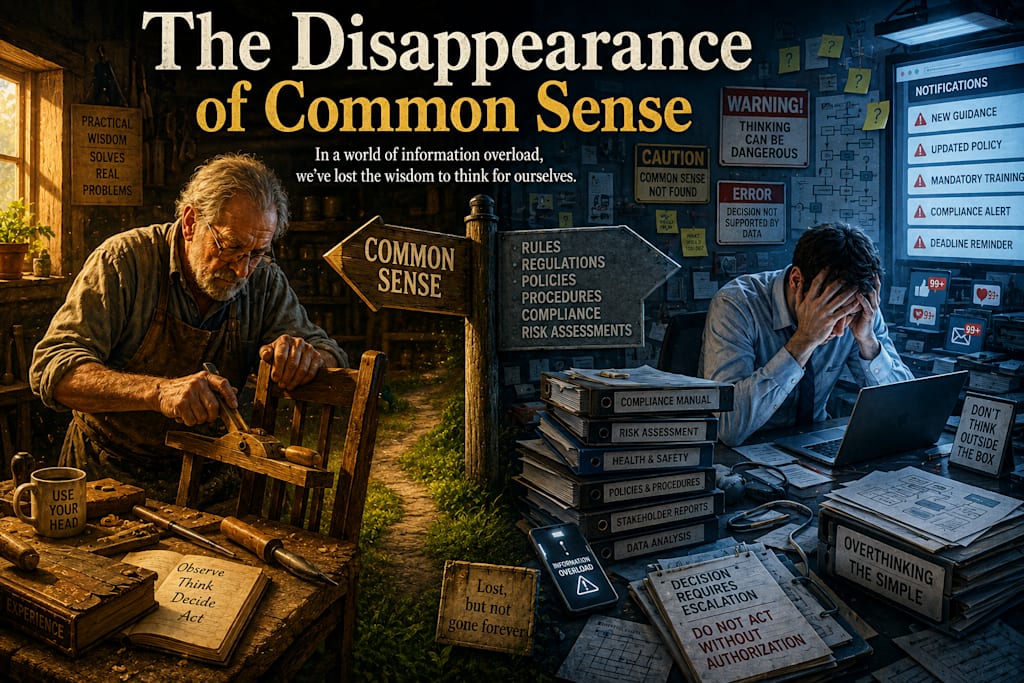
There was once a time when common sense was regarded as one of the most valuable qualities a person could possess. It did not require a university degree, years of specialist training or an impressive list of qualifications. It was the ability to look at a situation, weigh up the facts, draw on practical experience, and reach a sensible conclusion. Common sense was often learned through life itself, from parents, grandparents, neighbours and colleagues who had experienced enough successes and failures to recognise what usually worked and what did not. Today, many people believe that common sense is becoming an endangered species!
Modern society appears increasingly dependent on rules, procedures and expert opinion, even in situations where a straightforward practical solution would once have been obvious. We have become accustomed to consulting instruction manuals, government guidance, internet forums and artificial intelligence before making decisions that previous generations would have resolved in a matter of moments.
This is not to suggest that expertise is unimportant. Doctors, engineers, scientists and countless other professionals possess knowledge that ordinary people simply do not have. The problem arises when expertise begins to replace practical judgement rather than complement it. A person may possess impressive academic qualifications while lacking the ability to solve an everyday problem that requires nothing more than observation and experience.
One reason for this change is that many of life's practical skills are no longer passed from one generation to the next. Children who once learned how to repair bicycles, grow vegetables, mend clothing or build simple structures now spend much of their time interacting with digital devices. These technologies offer remarkable opportunities, but they also reduce the need to develop practical problem-solving skills and to think!
Another factor is the increasing fear of making mistakes. Organisations now operate within complex legal and regulatory frameworks where even minor decisions can carry significant consequences. As a result, employees are often encouraged to follow procedures rather than exercise judgment. While this may reduce certain risks, it can also discourage initiative and independent thinking.
Education has also changed. Schools have become increasingly focused on examinations, measurable outcomes and standardised testing. Students often become highly skilled at recalling information and passing assessments, yet they may receive fewer opportunities to develop practical reasoning through real-world experience. Knowledge and wisdom are not always the same thing.
Technology has brought enormous benefits, but it has also encouraged dependence. Satellite navigation systems tell us where to drive, calculators perform basic arithmetic, smartphones remember telephone numbers, and search engines answer questions that people might once have investigated for themselves. Convenience is undoubtedly valuable, yet every task delegated to technology is one less opportunity to exercise our own judgment.
Social media has further complicated matters. Opinions spread around the world within seconds, regardless of whether they are sensible or absurd. Popularity is often mistaken for accuracy. People may accept claims because thousands of others have shared them rather than because they have carefully examined the evidence. Common sense requires scepticism as well as curiosity, yet both qualities can be overwhelmed by the sheer volume of information now available.
The workplace provides many examples of the decline in practical thinking. Experienced employees sometimes find themselves ignored because their knowledge has not been formally documented. Decisions that once relied upon years of experience are increasingly driven by computer models, performance indicators and management reports. While data can be invaluable, it cannot always replace the intuition developed through decades of observation.
Healthcare offers another illustration. Medical science has achieved extraordinary advances, but many patients still value the doctor who listens carefully and applies sound judgment rather than relying solely on test results. Many patients feel that modern consultations rely increasingly on computerised decision support systems. Doctors often enter symptoms into a computer, which provides guidance on possible diagnoses, recommended investigations and treatment options. While these systems can improve consistency and patient safety, some people believe they have reduced the reliance on a doctor's own knowledge, experience and clinical judgement when reaching a diagnosis. Numbers and statistics provide essential information, but they do not always tell the whole story.
The disappearance of common sense is also evident in everyday life. Products carry warning labels advising against drinking bleach or placing pets inside microwave ovens. Such notices exist because someone, somewhere, did exactly that. Organisations understandably seek to reduce liability, but the growing number of obvious warnings suggests that society increasingly assumes people cannot be trusted to exercise basic judgement.
Politics is not immune to this trend. Policies are sometimes developed by committees far removed from the people affected by their decisions. Practical consequences may become secondary to ideological objectives, public relations or bureaucratic processes. Citizens often become frustrated when solutions that appear obvious from everyday experience are overlooked in favour of increasingly complicated systems.
Artificial intelligence presents perhaps the greatest challenge of all. AI can analyse enormous quantities of information in seconds and identify patterns beyond human capability. Yet it lacks lived experience, intuition, or genuine understanding. It can provide remarkably useful advice, but it cannot replace the practical wisdom that comes from living through success, failure, disappointment and achievement. Used wisely, artificial intelligence should enhance common sense rather than replace it.
Perhaps the greatest source of common sense has always been experience. A person who has repaired machinery, raised a family, run a business or overcome adversity develops insights that cannot easily be taught in a classroom. Experience teaches patience, proportion and the ability to distinguish between genuine problems and temporary inconveniences.
There is a danger that society increasingly values information while undervaluing wisdom. We celebrate knowledge because it can be measured, certified and displayed on a curriculum vitae. Common sense, by contrast, does not earn you a certificate. It is recognised only through sound decisions and practical results.
The encouraging news is that common sense has not disappeared entirely. It still exists in workshops, farms, factories, family businesses and countless homes where people continue to solve problems through observation, experience and straightforward reasoning. It survives wherever individuals are prepared to think independently rather than simply follow instructions.
Perhaps the real challenge is not recovering lost knowledge but rediscovering confidence in our own judgement. Common sense has always been less about knowing everything and more about applying what we already know with honesty, humility and practical wisdom. In a world overflowing with information, that may be the rarest skill of all.
About the Creator
Alan Spencer
Have been an author and writer for over 20 years. Have been a journalist, editor, proofreader, and a designer and presenter of training courses. Have written over 100 articles, two books, and around 20 training courses.
Enjoyed the story? Support the Creator.
Subscribe for free to receive all their stories in your feed. You could also become a paid subscriber, letting them know you appreciate their work.
Comments
There are no comments for this story
Be the first to respond and start the conversation.