Vocal
💰 “The Rich Man Who Envied the Poor” 🏚️
In a busy, shining city filled with tall buildings 🏙️ and luxury cars 🚗, there lived a very rich businessman named Mr. Adrian 💼💰. He owned big houses 🏡, expensive watches ⌚, and more money than he could ever spend in one lifetime.
By Daily Motivation10 months ago in Motivation
🕯️ “The Candle That Refused to Blow Out”
In a forgotten corner of a broken city 🌃, beyond the noisy streets and crowded buildings, there stood a small, abandoned house 🏚️. Its walls were cracked, its windows were broken, and its doors creaked with every whisper of the wind 🌬️. No one lived there — at least, not anymore.
By Daily Motivation10 months ago in Motivation
How Marathon Training Shapes a Stronger Mind
Marathon training changes runners in ways that extend far beyond physical conditioning. While the miles strengthen muscles and improve endurance, the more profound transformation occurs in the mind. Each day on the road, challenges focus, resilience, and emotional balance. As runners move through this demanding journey, they uncover a powerful mental toughness that develops through consistent, deliberate effort.
By Richard Ceffalio Jr.10 months ago in Motivation
🌳 “The Lazy Farmer and the Talking Tree” 🌾
In a quiet village surrounded by green fields 🌾 and soft hills ⛰️, there lived a farmer named Harris 👨🌾. But unlike other farmers, who woke up early with the sun 🌅 and worked hard till sunset 🌇, Harris was known for only one thing — his laziness 😴.
By Daily Motivation10 months ago in Motivation
✨ He Had Nothing… Yet He Gave Everything 🍞💛
In a world obsessed with wealth 💰, status 👑, and success 📈, people often forget the true meaning of richness. They chase money, power, and recognition, believing that having more makes them greater. But somewhere, in the quiet shadows of life, a silent lesson was waiting to be learned 🌒
By Daily Motivation10 months ago in Motivation
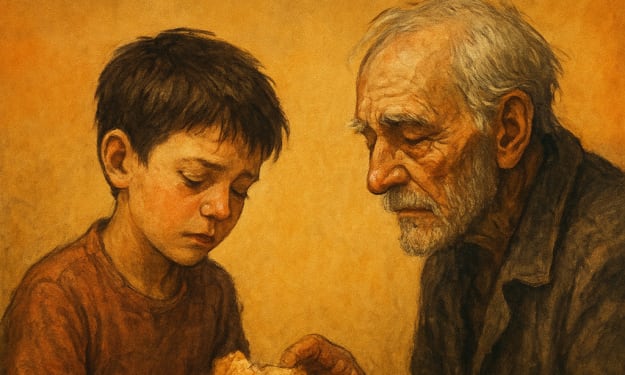
✨ “The Boy Who Shared His Last Piece of Bread” 🍞❤️
In a small and quiet village, surrounded by dry land and dusty paths 🌾🏜️, lived a little boy named Ethan 👦🏻. He was only twelve years old, but life had already been very hard for him 💔. His parents had passed away in a terrible accident, and he lived alone in a small broken house made of old wood and clay 🏚️.
By Daily Motivation10 months ago in Motivation
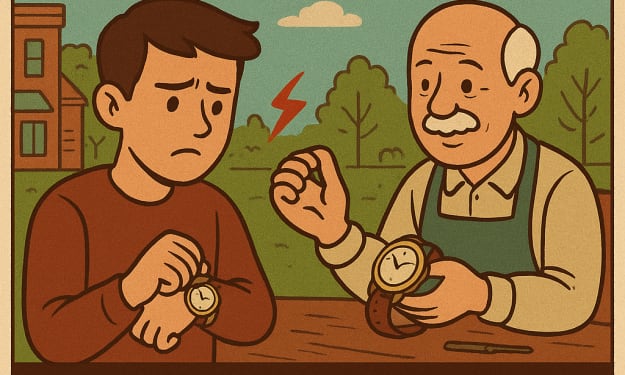
The Broken Watch That Fixed His Life ⌚💔➡️❤️
In a small, peaceful town surrounded by green fields 🌳🌾 and soft winds 🍃, there lived a young man named Aaron 👨🏻. Aaron was known for only one thing: he was always in a hurry 🏃♂️💨. His life moved as fast as a racing train 🚄. He believed that time was everything, and anyone who wasted time was a failure 📉😔.
By Daily Motivation10 months ago in Motivation
The Art of Making Money
Once upon a time, in a bustling village, there lived a young man named Ryan, who was 25 years old. Ryan spent his days working at a local grocery store. He had been at this job for five years, and over time, he had risen from a store clerk to a respectable position in the last three years. Ryan saved his earnings steadily, but he felt that his money was growing very slowly. Ryan began to wonder how he could put his money to work instead of waiting for it to grow slowly. He had no time to manage any other work, as his work at the store consumed most of his day. One day off, he decided to seek advice from a wealthy man from a nearby village, Mr. Dean. Mr. Dean was known for his extensive assets and businesses, which had made him rich without much effort. He was the perfect person for Ryan to learn from. Upon arriving at Mr. Dean’s house, Ryan found him relaxing under a large shady tree near his fields, enjoying a cup of coffee despite his wealth. Mr. Dean was not the busy type. His assets and money worked for him, exactly what Ryan wanted to learn after the exchange. Greetings. Ryan shared his goal with Mr. Deena so that he could learn how to make money for him. Mr. Deena smiled at Ryan’s determination. Good thinking. It’s never too late to start learning about passive income. He said that passive income is not limited to investing big bucks or buying gold. With the right mindset, even a small amount of money can work for you. If you can manage just Rs. 1 million, imagine what you could do with more money. Ryan was excited and listened intently as Mr. Deena went on. The first step in building passive income is simple: you need money. Save what you can from your profits, but avoid borrowing to invest. If you're just starting out, it's safer to work hard and save money, even if it's just a little bit. Do you understand? Ryan rushed over and nodded eagerly. "Yes, Mr. Dina, I understand. What should I do once I save some money?" Mr. Dina chuckled lightly at Ryan's excitement. "Take it easy, Ryan. The second step is to immediately stop the urge to buy expensive things. Don't rush into buying a luxury phone, car, or house unless you really need it. Expensive items like cars and phones depreciate in value quickly, and they can be expensive to maintain, especially when your income is modest. Instead, use this money for what Ryan always dreamed of having. Luxury things, but now he understood the importance of patience, "You're right, Mr. Dina. "If I spend all my money now, I won't have anything left," Mr. Dina replied. Look around you, explore your surroundings, and always check social media or the internet for ideas. There are many ways to generate passive income, even with a small investment." As they walked through the village, Mr. Dina gave examples. "Look at Rudy's house. He started a small Wii service with less than 500,000 rupees. Someone in the house next door started raising chickens with the same amount. The key is to find opportunities that suit your skills and interests." Ryan was amazed because he had never thought of such easy ways to start a passive income. "I never realized there were so many opportunities in front of me," he said, scratching his head in surprise. As they walked, Mr. Dina shared more examples of people using their small savings, whether it was farming or providing services.
By Abdur Rahman10 months ago in Motivation
The Boy Who Walked on His Hands: A Tale of Courage and Burden
The Courage of Raheela Mughal Yohan — and the Burden Our Children Carry BY: Ubaid Raheela Mughal Yohan is a ten-year-old boy from China, but his story carries a lesson for children across the world. He was only a year old when a sudden illness left the lower half of his body completely paralyzed. For many, such a life-altering disability might have closed the doors to childhood dreams and ambitions. But Yohan refused to let physical limitations turn into mental barriers. As he grew older and watched other children his age walking to school every morning, a fire awakened inside him — a desire to learn, to grow, and to stand tall in the only way he could. He decided that disability would not decide his future. And so, he made school a part of his life. Since he could not stand or walk like others, Yohan created his own way of moving forward. Balancing on his palms, lifting his entire body weight on his hands, he would slowly “walk” to school. Every morning, before the sun fully rose, he would begin his journey. It took him nearly one and a half hours to reach the school gate. His younger sister accompanied him, carrying his schoolbag on her shoulders. Together they crossed rough paths, uneven roads, and long distances. Whenever Yohan grew tired, the two siblings would stop to rest for a few minutes — and then continue again. There were no complaints, no excuses, and never a day when Yohan used his disability as a reason to avoid homework or school. His palms became his feet, his determination became his strength, and education became his dream. Yohan’s story is, at first glance, a tale of extraordinary courage. But it also forces us to look closely at our own societies — especially in countries like Pakistan — where countless young students carry a different kind of burden. Walk along any busy street at sunrise, and you will see them: small children with heavy backpacks strapped to their shoulders, their steps slow, their bodies bent, their faces sleepy yet determined. The metal rods on school vans are covered with dangling schoolbags, packed so tightly they look like they might drag the children backward. These are not students carrying the weight of dreams — these are children carrying the weight of books heavier than their bodies can bear. A sixth-grade child in Pakistan is usually around 11 to 12 years old and weighs roughly 30 to 32 kilograms. Yet the backpack he carries often weighs far more than the recommended limit. A fifth-grader, just 10 or 11 years old, weighs about 28 to 30 kilograms. Fourth-graders, 9 to 10 years old, weigh around 24 to 26 kilograms. And it continues downward: third-graders weighing 22 to 25 kilograms, second-graders 20 to 22, first-graders barely 16 to 18, and kindergarten children just 14 to 16 kilograms. Medical experts around the world agree on one simple rule: A schoolbag should never exceed 10–15% of a child’s body weight. But in reality, we see children whose bags feel closer to 30–40% of their tiny frames — a slow punishment disguised as education. Their shoulders remain tilted all day. Their spines strain. Their young bones carry stress they were never designed to handle. Their walk to school resembles not a journey of learning, but a silent struggle. Where Yohan overcame the weight of disability, our children struggle under the unnecessary weight of educational systems. Where Yohan found strength in hardship, many of our children lose health because of avoidable burdens. And that contrast is what makes his story so powerful. Yohan, a boy who cannot use his legs, accepted school as a blessing. He turned his pain into purpose. He found a way forward with nothing but the strength of his palms and the support of a loving sister. Meanwhile, in our cities and villages, thousands of children fully capable of walking are being held back by something much simpler — the weight of their schoolbags. They are not disabled, yet we unintentionally disable them with pressure, load, and neglect. Imagine the possibilities if our systems were as determined as Yohan. Imagine the strength of a generation whose physical and mental health were protected. Imagine children walking freely, not bent under unnecessary loads. Yohan’s journey teaches us more than courage. It teaches us gratitude, perspective, and responsibility. It reminds us that education is not supposed to break a child’s back — it is meant to build their future. As we admire the bravery of a boy who learned to walk with his hands, let us also think of the children in our own neighborhoods, walking with bent shoulders. Their struggle is different, but just as real. If a ten-year-old boy with paralyzed legs can reach school every day with determination and hope, then surely we can lighten the burden on our own children — literally and emotionally. Because the true purpose of education is not weight, but wisdom.
By Ubaid 10 months ago in Motivation
Why i like kpop music somuch
K-pop, also known as Korean pop, is a prominent music genre from South Korea that combines a variety of styles, including pop, hip-hop, and electronic dance music, with intricate choreography and eye-catching music videos. It is frequently performed by highly skilled performers, or "idols," who are either single performers or members of groups (such as boy or girl bands) and whose careers prioritize performance, style, and a well-curated public persona.
By Tinyiko Shitlhangu10 months ago in Motivation