success
The road to success is always under construction; share your equations for success — and learn some new ones.
The Price Of Everything
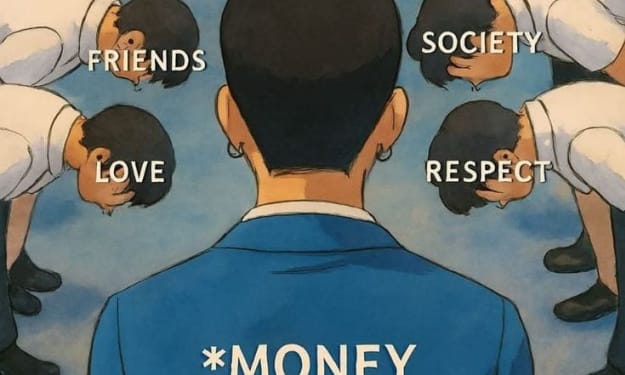
In today’s world, money speaks louder than words. It opens doors, builds houses, creates opportunities, and commands attention. But sometimes, without realizing it, we allow money to rise higher than everything else — higher than love, higher than friends, higher than happiness, and even higher than self-respect.
By Active USA 9 months ago in Motivation
Two Meanings
Fear stands like a giant rock in the middle of every life. No one escapes it. Some people meet it early, some later. But when it appears, it blocks the road just like a massive stone blocking a traveler’s path. At that moment, there are only two choices: Forget Everything And Run or Face Everything And Rise. The choice is always yours.
By USA daily update 9 months ago in Motivation
The Unbreakable Soul: From the Shadows of Failure to the Peak of Success
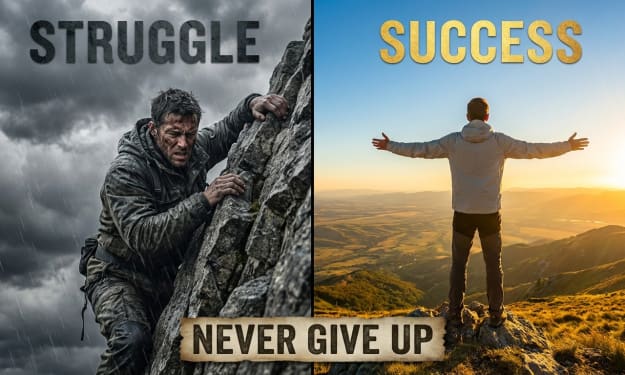
The Unbreakable Soul: From the Shadows of Failure to the Peak of Success By Hazrat Umer Why the secret to reaching the impossible is not talent or money, but the simple refusal to ever give up on yourself.
By Hazrat Umer9 months ago in Motivation
Permission to Rest
Rest used to feel like failure. Before my diagnosis, rest was something I earned after productivity. It was a reward waiting at the end of a finished task list, something to allow myself once everything else had been completed. Rest was optional. It was negotiable. It was something I could postpone in favour of being useful, being present, being enough.
By Millie Hardy-Ashton9 months ago in Motivation
The Girl Who Rewrote the Ocean: Bethany Hamilton and the Defiance of 'Done'
The harrowing and intensely motivational true story of Bethany Hamilton, who lost her arm to a tiger shark but refused to lose her identity, returning to professional surfing against all odds.
By Frank Massey 9 months ago in Motivation
The Algorithm Knows I’m About to Quit
The Algorithm Knows I’m About to Quit I didn’t tell anyone I was thinking about leaving. Not my manager, not my team, not even myself—not in words that could be quoted back to me. I framed it as tiredness. As a phase. As the natural drag of a job that paid well but asked for more hours than it admitted to. I told myself that everyone in tech felt like this eventually, that burnout was a badge you wore quietly until promotion or resignation made it irrelevant. The algorithm disagreed. It started with my recommendations. On Monday morning, my music app stopped suggesting anything upbeat. No more “Focus Flow” or “Monday Motivation.” Instead, it offered sparse piano playlists titled Letting Go and Soft Endings. I laughed and skipped them. Coincidence. Data drift. A weird week. By Tuesday, my video feed followed suit. Productivity gurus disappeared. In their place came videos about “knowing when it’s time to walk away” and “careers you can start over at 35.” I turned autoplay off. That feature had always felt a little too intimate anyway. At work, I was fine. Better than fine. I hit my sprint goals early, answered Slack messages promptly, attended meetings with my camera on and my posture upright. If burnout had symptoms, I wasn’t showing them. My performance metrics were green across the board. The algorithm saw something else. It began suggesting articles during my lunch break: The Hidden Cost of Staying Too Long, Burnout Isn’t Failure—It’s Information, Why High Performers Leave Without Warning. I didn’t click them. But I noticed. Noticed how precisely they threaded themselves into the cracks of my scrolling. I work on recommendation systems. That’s the irony that makes this harder to explain without sounding paranoid. I know how this works—or how it’s supposed to. Models trained on millions of users. Patterns, not people. Correlation, not intent. The system doesn’t know you; it knows what users like you have done before. It predicts behavior, not feeling. Except predictions shape behavior. We’ve known that for years. On Wednesday afternoon, my calendar app suggested I block off Friday “for rest.” Not a meeting conflict. Not a travel buffer. Just rest. The suggestion came with a gentle blue highlight, as if it were doing me a favor. I declined it. That night, my job board app—which I hadn’t opened in months—sent a notification: New roles you might like. Not promotions. Not lateral moves. Entirely different industries. Smaller companies. Words like meaning, balance, mission sprinkled through the descriptions like bait. I sat on the edge of my bed and tried to inventory my feelings, the way therapists and productivity coaches advise. Am I unhappy? I asked myself. I didn’t have a clean answer. I wasn’t miserable. I wasn’t crying in the bathroom or staring blankly at my screen. I still enjoyed parts of the work—the puzzle of optimization, the quiet satisfaction of reducing error rates by fractions of a percent. I liked my team. I liked my paycheck. But when I imagined doing this exact job a year from now, something in my chest tightened. Not pain. Not fear. Just resistance. Like a muscle refusing to engage. The algorithm had a name for that. I didn’t. On Thursday, my internal dashboard flagged an anomaly. We had recently deployed a new burnout-risk model, trained on behavioral signals: login times, message sentiment, task-switching frequency, micro-delays in response patterns. It was meant to be aggregate, anonymized, ethical. A way to help organizations understand systemic strain, not individual weakness. My user ID appeared in the test output. Burnout Risk: High Attrition Probability (90 days): 0.72 I stared at the numbers longer than I should have. This wasn’t my consumer profile. This was internal. My own work, reflecting me back to myself with unsettling confidence. I wanted to dismiss it. Models are imperfect. False positives happen. But the feature weights told a quieter story: increased hesitation before starting tasks, longer pauses between keystrokes, subtle shifts in language tone. Nothing dramatic. Nothing a manager would ever notice. Nothing I had noticed. The system didn’t say I was unhappy. It didn’t say I was failing. It said I was about to change. That evening, my phone surfaced a memory: a photo from six years ago, my first week in tech, standing in front of a whiteboard filled with ideas. I looked exhausted and alive in equal measure. The caption I’d written then was embarrassingly earnest. Something about building things that matter. I had built many things since. Efficient things. Profitable things. Things that worked exactly as designed. Somewhere along the way, the feeling changed shape. By Friday morning, I didn’t need the algorithm anymore. It had already done its work—not by persuading me, but by noticing what I wouldn’t name. By holding up a pattern I was still pretending was random. I took the day off. Not because an app told me to, but because sitting at my desk felt heavier than usual, and walking outside felt necessary in a way I could no longer ignore. I didn’t apply to any jobs. I didn’t draft a resignation letter. I just admitted, quietly, that something was ending. The algorithm didn’t make that choice for me. It never could. But it saw the outline of the decision before I let myself feel its weight. That’s the part no one talks about. We think of algorithms as cold, predictive machines. But sometimes they act like mirrors angled just enough to catch what we’re avoiding. Not intention. Not desire. Just trajectory. And once you see where you’re headed, pretending you don’t know becomes the hardest task of all.
By Talhakhan9 months ago in Motivation
Proving You’re Disabled Enough
The hardest part of applying for disability benefits was not the paperwork. It was the translation. A life quietly reshaped by illness had to be reduced to tick boxes, descriptors, and carefully worded answers. Pain had to become evidence. Fatigue had to become measurable. Personal limitation had to be presented as a case strong enough to be believed.
By Millie Hardy-Ashton9 months ago in Motivation
Am I Disabled Enough?
The hardest part of using my disabled parking badge isn’t the walking. It’s the watching. The moment I step out of the car, I feel it. The pause. The glance. The subtle double-take as someone tries to reconcile what they see with what they believe disability should look like. Their eyes flick from my face to the badge, then back again, searching for evidence that justifies my presence.
By Millie Hardy-Ashton9 months ago in Motivation
Just Believe
There are moments in life when the path ahead disappears. The waves rise. The noise grows louder. Fear whispers that you should turn back. Logic tells you that it cannot be done. And yet, somewhere deep inside, a quiet voice says two simple words: Just believe.
By USA daily update 9 months ago in Motivation