success
The road to success is always under construction; share your equations for success — and learn some new ones.
Looking Back On Life — Do You Hold On To The Love? Or To The Hate?
As a caregiver, I have learned a great deal from the elderly individuals I care for, which has helped me make informed decisions. Their lives became my manual for life and the decisions I make.
By Annelise Lords about a year ago in Motivation
Procrastination: it’s not always laziness - sometimes it’s emotional overload in disguise
We often blame ourselves harshly when we procrastinate, calling ourselves lazy, undisciplined, or unmotivated. But procrastination is rarely just a time management issue - it’s often an emotional one. Sometimes it’s fear. Sometimes it’s perfectionism. Sometimes it’s your body trying to protect you from something your mind hasn’t fully named. If you’re constantly wrestling yourself just to begin, the problem isn’t your ambition - it might be your overwhelm.
By Olena about a year ago in Motivation
The Stranger Who Changed My Life
It was an ordinary Tuesday — the kind of gray, unremarkable day you never expect to remember. I had missed my morning train, spilled coffee on my only clean white shirt, and forgotten to charge my phone. I was running on empty — emotionally, mentally, and even financially.
By Asad Khanabout a year ago in Motivation
If you have to constantly prove your value - it’s not love, it’s performance
Real love feels like a safe place, not a stage. But many people find themselves in relationships where they’re always hustling to be enough - enough to be noticed, enough to be valued, enough to be chosen. This constant striving isn’t love; it’s performance. And the difference is everything. Love embraces you for who you are; performance demands you constantly prove it.
By Olena about a year ago in Motivation
How to Build a Personal Brand in 2025 (Even If You're Starting from Zero)
Three years ago, I had no followers, no website, and no clue what a "personal brand" was. Today, my name appears in search results. I’ve worked with clients from around the world, and I earn a steady income from writing and consulting all because I built a personal brand from the ground up.
By Imdad Ullah Chemistabout a year ago in Motivation
The Psychology of Consistency: Why Showing Up Every Day Matters More Than You Think. AI-Generated.
"Success isn’t about doing great things occasionally—it’s about doing the right things consistently." We often think the key to success is talent, inspiration, or bursts of motivation. But if you’ve ever set a New Year’s resolution and failed by February, you know that fleeting energy isn’t enough. What actually creates long-term transformation is consistency—the quiet, unglamorous act of showing up even when you don’t feel like it.
By Ahmet Kıvanç Demirkıranabout a year ago in Motivation
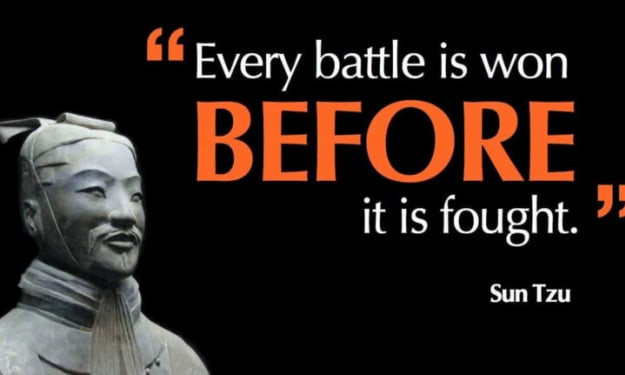
Summery The Art of War" by Sun Tzu
Summary of "The Art of War" by Sun Tzu (650 words) The Art of War is an ancient Chinese military treatise written by Sun Tzu, a legendary general, strategist, and philosopher. Composed over 2,500 years ago, the book remains one of the most influential works on strategy, leadership, and warfare. Though originally meant for military commanders, its lessons are widely applied in business, politics, sports, and daily life. 1. Foundations of Strategy Sun Tzu emphasizes that all warfare is based on deception. Victory depends on outsmarting the enemy, not necessarily overpowering them. He teaches that the best general wins without fighting — by breaking the enemy’s resistance through strategy, manipulation, and diplomacy. According to Sun Tzu, war should be the last option, pursued only when all peaceful means fail. 2. Planning and Preparation Preparation is vital. Sun Tzu outlines five key factors for success: The Way (moral alignment of people and ruler), Heaven (weather and timing), Earth (terrain and distance), The Commander (leadership qualities), and Method and Discipline (organization and logistics). A well-prepared leader considers all these before entering battle. He advises leaders to assess themselves and the enemy carefully. Knowing both will ensure victory; knowing only one can lead to defeat. Accurate calculations and a clear understanding of strengths and weaknesses are essential. 3. Waging War Wisely Sun Tzu warns that prolonged warfare drains resources and morale. Quick, decisive victories are best. He highlights the importance of managing supplies, avoiding unnecessary conflict, and using captured resources instead of depleting one’s own. 4. Positioning and Advantage The book teaches the importance of positioning in warfare. Victory comes not from brute force but from taking advantageous positions. This involves understanding the terrain, controlling key locations, and exploiting the enemy’s weaknesses while defending one's own. He explains the concept of shih — the energy or momentum of a situation — and how skilled leaders use it to gain dominance with minimal effort. 5. Flexibility and Adaptability A recurring theme is adaptability. There is no fixed method for victory. The general must be flexible like water — able to change direction and shape based on the battlefield. Just as water flows to the lowest point, a wise general avoids enemy strengths and attacks where they are weak. Sun Tzu criticizes rigid strategies and praises innovation. Being unpredictable confuses the enemy and creates opportunities. 6. Deception and Psychological Warfare Deception is central to Sun Tzu’s strategy. Misleading the enemy — about one’s strength, intentions, and location — creates confusion and opens paths to victory. “Appear weak when you are strong, and strong when you are weak,” he says. He also explores the power of fear, morale, and manipulation in warfare. A confident, united army defeats a divided, confused one. 7. Leadership and Command Sun Tzu describes the ideal leader as wise, courageous, disciplined, humane, and strict. A leader must inspire loyalty and obedience, make hard decisions, and act decisively. Overreaction, recklessness, or fear can lead to ruin. He emphasizes the importance of rewarding good conduct, punishing disobedience, and maintaining order in the ranks. Discipline ensures the army operates as one force. 8. Spies and Intelligence The final chapter focuses on espionage. Information is the lifeblood of warfare. Knowing the enemy’s plans, movements, and mindset allows a general to strike effectively. Sun Tzu outlines five types of spies and urges leaders to value intelligence above all else. Conclusion The Art of War is more than a military manual — it’s a timeless guide to strategic thinking. Its core principle is that war should be won with intelligence, not brute force. By mastering deception, preparation, adaptability, and leadership, one can secure victory while minimizing conflict and loss. Even today, Sun Tzu's ideas influence modern warfare, business strategy, leadership, and negotiations. His wisdom teaches that the greatest victories are those achieved with the least struggle.
By Khan Shahabout a year ago in Motivation
Emotional Discipline: How to Master Your Feelings Before They Master You. AI-Generated.
We often think of discipline as waking up early, hitting the gym, or turning down that second slice of cake. But there’s another, deeper form of discipline that receives far less attention: emotional discipline. It's the ability to regulate your feelings, stay composed in chaos, and respond rather than react. It’s what determines whether we say something we regret, give up on a goal too early, or spiral into self-sabotage.
By Ahmet Kıvanç Demirkıranabout a year ago in Motivation
The Rise of Ronaldo
He was too skinny, too poor, and too emotional to make it. That’s what they used to say about Cristiano Ronaldo dos Santos Aveiro—the boy from Madeira who cried every time he lost a match. But he didn’t cry because he was weak. He cried because he hated losing more than anything. That fire would become his greatest strength.
By Muhammad Riazabout a year ago in Motivation
The Power of Belief in a Child
I had just started my position as a teacher for Quran and Tawheed in a third-grade classroom. With only one month left before the academic year ended, I gathered my students to assess their learning levels, intending to design a better plan for their education.
By Abdulmusawerabout a year ago in Motivation