success
The road to success is always under construction; share your equations for success — and learn some new ones.
The Courage to Reinvent When No One Is Watching
There’s a moment in every life when the spotlight fades, the applause dies down, and the stage goes dark. And it’s in that silence—not on the stage—but in the stillness behind it, where the real reinvention begins.
By James Barbourabout a year ago in Motivation
The Weaver of Whispers
Elara lived in a world woven from two distinct fabrics. By day, her existence was a muted tapestry of routine: the hum of the office, the polite, predictable conversations, the endless stream of tasks that demanded precision but offered little soul. Her hands, though capable, often felt restless, yearning for a different kind of work. She wore masks of grey, a common thread in a society that valued conformity, while vibrant dreams, like iridescent butterflies, danced in the hidden chambers of her mind.
By Jack Nodabout a year ago in Motivation
What I Learned After Failing Multiple Times
There was a time in my life when I believed that failure was something to be ashamed of. Something to hide. Something that meant I wasn’t good enough. I carried that belief with me like a heavy backpack, and every time I stumbled, it felt like I was collecting more weight to carry. I still remember my first big failure. It wasn’t the end of the world, but it felt like it. I had prepared for weeks for a job interview I thought would change my life. I walked into that room confident, hopeful, and walked out crushed. I didn’t get the job. And the rejection email didn’t just say “no.” It said I lacked certain skills, that I wasn’t what they were looking for. I read that email at least ten times, each time feeling smaller than before. That failure stayed with me for weeks. I stopped applying to jobs. I questioned my ability. I compared myself to others. I thought, maybe I’m just not meant to succeed like other people. But that was just the beginning. That year, I failed at three other things. I lost a freelance project because I missed a deadline. I launched a blog and no one read it. I tried to start a fitness routine and gave up after two weeks. Every failure chipped away at my confidence, but somewhere deep down, something else started to form — a strange kind of awareness. A voice that whispered, “There’s something here you’re supposed to learn.” The truth is, failure forced me to stop and reflect in ways that success never could. It taught me patience. In my early 20s, I wanted everything quickly — success, money, recognition. I thought that if something didn’t happen fast, it meant it wasn’t meant to be. But failure showed me that real growth takes time. It takes effort, consistency, and the willingness to get back up even when no one is clapping for you. Failure also taught me humility. I used to think I had things figured out. That I was smarter than average. That things would just "work out" for me. But life doesn’t reward ego — it rewards learning. And you can’t truly learn unless you're willing to admit you don’t know everything. I remember sitting alone one evening after another failed attempt at launching an online store. I had spent money, time, energy — and it didn’t go anywhere. I was frustrated. But instead of spiraling into self-doubt, I opened my notebook and wrote a single question: “What did I do wrong?” That question led to ten honest answers. And those answers became the foundation for my next attempt — which, surprisingly, worked. You see, failure has a way of humbling you enough to listen. To observe. To understand that maybe your approach needs to change, not your dreams. It also taught me resilience. And I don’t mean the Instagram quote kind of resilience. I mean the real kind — the one that makes you show up even when you're tired, scared, or unsure. The kind that makes you start again with shaky hands but a steady heart. There’s a kind of courage that only comes after you've been knocked down a few times. A kind of strength you discover not because you wanted to, but because you had no choice. I look back now and I realize something powerful: if I hadn’t failed so many times, I wouldn’t be who I am today. I wouldn’t have developed the discipline to work without external rewards. I wouldn’t have learned how to separate my self-worth from my results. I wouldn’t have discovered what truly matters to me — and what doesn’t. Failure stripped away the noise. It made me ask deeper questions: What do I want to build? What am I afraid of? Who am I trying to impress? And most importantly — what am I willing to try again for? Now, when people ask me about success, I don’t talk about achievements or numbers. I talk about the nights I cried, the plans that didn’t work, the emails that never got replies, and the quiet mornings when I had to pick myself back up, again and again. Because that’s where the real growth happened. If you’re reading this and you’ve failed recently, let me tell you something I wish someone had told me back then: You’re not broken. You’re becoming. Failure is not the opposite of success — it’s the process of it. And sometimes, the lessons you learn while falling are the very ones that teach you how
By Misbah about a year ago in Motivation
Daily Habits That Helped Me Overcome Procrastination
There was a time in my life when I genuinely believed that procrastination was just a part of who I was. I used to say things like, “I work better under pressure” or “I’ll do it tomorrow.” But deep down, I knew I was lying to myself. I wasn’t working better. I was just avoiding the work — until I couldn’t avoid it anymore. Deadlines scared me. I’d wait until the very last minute, heart pounding, racing to get things done. And every time I submitted something late or just in time, it didn’t feel victorious. It felt like I barely survived. The guilt that came after was the worst part — knowing I could’ve done better, knowing I had the time but wasted it on scrolling, distractions, or simply sitting there feeling overwhelmed. The turning point came on a quiet afternoon. I was sitting on my bed, surrounded by notebooks, half-finished to-do lists, and the weight of yet another missed opportunity. I picked up a random self-help book and one line changed everything: “You don’t need motivation to start. You need momentum.” I read it again. And again. And I realized that all my life I had been waiting for this magical burst of motivation that never came. But maybe, just maybe, I didn’t need to feel ready. I just needed to begin. That night, I made a small decision. I told myself that from the next morning, I would test a new way of living — just for 30 days. I wouldn’t aim for perfection. I wouldn’t create a massive plan. I’d just try to introduce small daily habits. Nothing extreme, nothing revolutionary — just gentle, doable changes that could build momentum. One of the first habits I tried was the ten-minute rule. Every time I wanted to delay something, I told myself, “Just do it for ten minutes. If you want to stop after that, you can.” That little trick was magic. Starting is always the hardest part. But once I started, the resistance faded. Ten minutes turned into thirty. Tasks I had been putting off for days suddenly didn’t seem so difficult. The rule wasn’t about productivity. It was about tricking my brain into motion. Around the same time, I ditched digital to-do lists and bought a simple paper notebook. Each morning, I’d write down five tasks. Not twenty. Just five. Three big ones and two small ones. And as I crossed them off during the day, I felt a sense of achievement I hadn’t felt in years. There’s something powerful about physically checking something off a list. It’s like telling yourself, “Yes, you’re capable.” That small sense of progress became addictive. It didn’t matter if I finished everything — just knowing I was moving forward was enough to keep going. I also made another commitment: to win the morning. I used to wake up late, reach for my phone, and lose my first hour to the black hole of social media. Now, I started doing one productive thing before breakfast. It could be anything — writing a few lines, making my bed, replying to an email — but that small act gave me a head start. I realized that success isn't in doing big things once in a while. It’s in doing small things consistently. One of the hardest but most rewarding habits I adopted was staying off my phone for the first hour of the day. It was uncomfortable at first. I kept reaching for it out of habit. But within a week, I noticed a massive difference. My mornings became peaceful. My thoughts were clearer. I had fewer comparisons, fewer distractions, and more time to connect with myself. It’s surprising how much noise we let into our heads before we even brush our teeth. Another surprising shift happened in the way I spoke to myself. I stopped saying “I have to” and started saying “I choose to.” It might seem like a small change, but the effect was powerful. Saying “I choose to work on this project” felt empowering. It reminded me that I was in control — that my actions were a choice, not a burden. That new language gave me ownership over my time and my life. As the days turned into weeks, I realized that these habits weren’t just helping me get things done — they were changing the way I saw myself. I no longer felt lazy or broken. I wasn’t someone who “just couldn’t focus.” I was someone who was learning how to move. Someone who understood that progress starts small. That it’s okay to begin again — even if yesterday was a mess. I still procrastinate sometimes. I’m still human. But now, I don’t panic. I go back to the basics: set a timer for ten minutes, write a short list, get one small win, put my phone aside, and speak kindly to myself. These habits are no longer just tools — they’re lifelines. So if you’re like I was — stuck, overwhelmed, waiting for the perfect moment to begin — I want to tell you this: You don’t need to wait. You don’t need to feel ready. You just need to start. Pick one small thing. Do it for ten minutes. Write down three tasks. Make your bed. Anything. Just start. Because once you do, you’ll see the truth I finally discovered. It’s not about being perfect. It’s about building momentum. And momentum? That changes everything.
By Misbah about a year ago in Motivation
"Unlocking Confidence: 100 Powerful Reminders to Believe in Yourself"
INTRODUCTION In a world filled with doubt, pressure, and constant comparison, confidence often feels like a distant luxury — something others seem to have naturally. But the truth is, confidence isn't something you're born with. It's something you build — one step, one thought, one decision at a time.
By Stefano D'angelloabout a year ago in Motivation
From Failure to Success: Ten Causes and the Path to Liberation
Failure. Just hearing this word conjures clouds of disappointment, defeat, and despair in the mind. Every human tastes its bitterness at some point. But did you know failure is actually the hidden staircase leading to true success? The difference lies in what we learn from it, how we process it, and how we rise to move forward. Let’s deeply understand the ten root causes of failure and discover how to overcome them to march toward our goals.
By M.Bilalabout a year ago in Motivation
The Mountain Inside You: How to Unlock the Strength You Didn’t Know You Had. Content Warning. AI-Generated.
Introduction: The Myth of the Confident Climber We often admire those who seem to “have it all together”—the entrepreneurs who take bold risks, the athletes who defy odds, the artists who seem born with talent. But here’s a truth we rarely talk about:
By Chilam Wongabout a year ago in Motivation
How True Peak Performance Results In A Different Relationship With Time To Accomplish Significantly More
Time is such a Strange Thing. We Measure Time and Expect it to be Perfectly Even... Second to Second... Hour to Hour... Day to Day...
By H.E. Dr. Cody Dakota Wooten, COIE, DFM, DHMabout a year ago in Motivation
5 Passive Income Ideas That Actually Worked for Me.
When I first Googled “passive income,” I binge-watched Netflix and imagined money magically arriving while sipping iced coffee. Reality? It takes work up front — sometimes a lot — but once things start moving, the feeling of waking up to unexpected deposits is intoxicating.
By Echoes of Lifeabout a year ago in Motivation
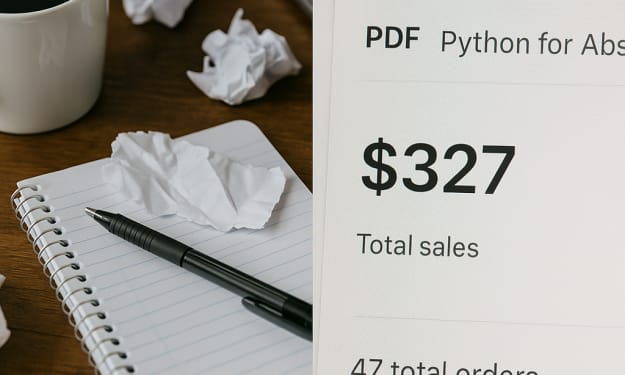
I Wasted 6 Months Trying to Get Rich Online — Here’s How I Finally Made My First $1,000 (The Ugly Truth)
1. The Lie That Cost Me $600 *"Make $10,000/month while you sleep!"* The YouTube ad glowed on my screen at 2 AM. I clicked. The guru—tan, grinning, leaning on a Lamborghini—promised his "secret system" would work for anyone.
By J khanabout a year ago in Motivation
"How I Accidentally Made $500 with Amazon Affiliate—Without Any Website or Tech Skills"
Disclaimer: This is a real-style story written for creative + motivational purposes. It reflects genuine methods and outcomes seen by beginners in affiliate marketing using Amazon and Pinterest. --- The Accidental Beginning Three months ago, if you’d asked me what "affiliate marketing" was, I probably would’ve said it sounded like something tech nerds do in Silicon Valley. I had zero tech skills, no website, no followers, and honestly, not much hope for making money online. I was just scrolling Pinterest for DIY home décor ideas when I stumbled upon a pin that said: > “Make $100 a week with Amazon Affiliate—no blog needed.” I didn’t believe it. But curiosity won. I clicked the link, and it led me to a blog post explaining how people were making money by simply sharing Amazon products with affiliate links—on Pinterest. I thought: "Wait... I use Pinterest all the time. Can I really do this?" --- Creating My Amazon Affiliate Account (USA) I live in Pakistan, but my goal was always to reach a USA audience, because that’s where buying power is. So, I signed up for the Amazon Associates US Program (affiliate program). Here’s how I did it: 1. Used a USA-focused Gmail. 2. Chose “Individual” account. 3. For website/traffic source, I used Pinterest. 4. For address, I added my real one—but that’s okay. You can still earn even if you’re outside the USA, as long as you're promoting Amazon.com products. Within 10 minutes, I had my affiliate dashboard ready with a unique tracking ID. --- Step 2: My First Pinterest Pin Here’s where things got interesting. I didn’t know graphic design. So I used Canva, selected a free Pinterest template, and created a pin like this: > 📌 “Top 5 Study Lamps Under $25 That Actually Work” With a clean background, bold text, and a mockup image of the lamps. I linked each product to its Amazon page using my affiliate link (generated from my Amazon dashboard). Then I wrote a 100-word Pinterest description full of USA keywords like: > “Looking for affordable study lamps in the US? These are trending on Amazon right now…” I posted it and forgot about it. --- The Surprise After 7 Days One week later, I checked my Amazon affiliate dashboard and saw: Clicks: 197 Ordered Items: 6 Commission: $8.57 I nearly dropped my chai. People were actually clicking my pins and buying from my link? Even better—Amazon was also paying me for other items they bought, not just the lamp I promoted. That’s when I realized the magic of Pinterest + Amazon. --- What I Did Differently After That I became obsessed (in a healthy way 😅). Here’s the exact system I built without any investment: 1. Niche Down: I chose “Study Desk Essentials for Students in the US” as my focus. 2. Create 3 Pins a Day: Each pin promoted a top-rated Amazon product under $30. 3. Use SEO Descriptions: I used tools like Google Trends and Pinterest Trends to find what students were searching. 4. Join Pinterest Group Boards: I joined 5 public boards where others were also posting affiliate content. 5. Shorten My Links: I used bit.ly to make links cleaner and trackable. --- One Pin Went Semi-Viral After 2 weeks, one of my pins — > “Best Noise-Canceling Headphones for College Students – 2024 Edition” got over 12,000 impressions and 850 link clicks in 5 days. That pin alone made me $137.22 in commission. Not bad for a design I made on my phone in 15 minutes. --- What Helped Me Go from $8 to $500 1. Focus on the USA Buyer Mindset: I used keywords like “Amazon Prime,” “back to school USA,” “students in the US.” 2. Timing is Everything: I posted seasonally: Back to school Valentine’s gift ideas Christmas stocking stuffers 3. Affiliate Disclosure: I added “#ad” in every pin’s description (Amazon requires this). 4. Re-pinning Strategy: Every 3 days, I would repin my top pins to multiple boards again. 5. Consistency: 3 pins a day. No matter what. --- Breaking $500 in 2 Months At the end of Month 2, I opened my Amazon dashboard and saw: > Total Earnings: $502.88 Clicks: 4,983 Ordered Items: 142 And this was just from Pinterest — no blog, no YouTube, no voiceovers. --- What I Learned (So You Don’t Repeat My Mistakes) Don’t spam pins with too many links. Focus on quality design and keyword-rich text. Don’t give up after a few days. Pinterest is a slow burn, but once it catches, it’s powerful. Use high-converting products (4+ star ratings, good images, under $50). --- Is This Still Working in 2025? Yes! Pinterest is still a huge traffic source for the USA market, and Amazon’s affiliate program still pays well. Even better — you can now promote Amazon Idea Lists, storefronts, and even influencer-style content directly from Pinterest or Facebook. And if you ever expand, you can add TikTok or YouTube Shorts to the mix. --- Final Thought I didn’t expect to make money online. I didn’t know what affiliate marketing was. But I took a chance, stayed consistent, and now this side hustle is slowly becoming a full-time thing. If I can do it with zero skills and a basic phone, so can you. --- ✅ Want to Try It? Start small. 1. Join Amazon Associates 2. Make a Pinterest business account 3. Start pinning daily 4. Focus on real value — not spam You might surprise yourself too. --- 🧷 Pin This Quote: > “You don’t need to be an expert. You just need to start.”
By Umar Farooqabout a year ago in Motivation
The Unseen Loom
The Unseen Loom Elara lived in a town that seemed perpetually under the influence of the fickle winds. Trends swept through Oakhaven like sudden squalls, leaving behind scattered debris of forgotten enthusiasms. One month, everyone was passionately baking sourdough; the next, it was intricate macrame. Businesses bloomed and withered with alarming speed, their innovative ideas often extinguished by the very novelty that had sparked them.
By Malik BILALabout a year ago in Motivation