Holiday
Nikita Kering: A Kenyan Musical Prodigy on the Rise
Nikita Chepchumba Kering, popularly known as Nikita Kering', is a name that resonates with raw talent, powerful vocals, and a profound artistry that transcends her young age. Born on February 26, 2002, in Nairobi, Kenya, Nikita has swiftly ascended to become one of East Africa's most compelling musical figures, captivating audiences with her unique blend of R&B, pop, and soulful Afrobeats. Her journey from a child prodigy to an internationally recognized artist is a testament to her dedication, innate ability, and unwavering passion for music.
By Kelly Munala Brookesabout a year ago in Motivation
Unleash Your Hidden Potential: Transform Your Life with Deep Self-Discovery
Introduction Are you trapped in a relentless cycle of just getting by, haunted by a persistent feeling that something vital is missing from your life? Endless notifications, looming deadlines, and quick-fix productivity hacks might keep you afloat, but they fail to address the deeper void - perhaps a lack of joy, intimacy, or a sense of purpose that lingers beneath the surface.
By Dishmi Mabout a year ago in Motivation
The Weight of a Single Brick
Ravi stood at the edge of the half-built apartment block, the air thick with dust and the hum of distant cranes. His calloused hands gripped a single brick, its edges rough against his skin. At 42, he’d laid thousands of them—schools, malls, homes—but this one felt different. This brick wasn’t just cement and clay; it was a decision.The site was a mess. Cranes loomed like skeletal giants, their arms frozen mid-motion. Workers shuffled with tired eyes, their chatter replaced by the occasional clink of tools. The project, a 20-story luxury tower in Mumbai’s outskirts, had stalled six months ago when the developer vanished with the funds. Half the crew had quit, leaving Ravi and a skeleton team to guard the skeleton structure. The local papers called it a “monument to greed,” but to Ravi, it was a wound—his wound.He’d grown up in a slum two kilometers away, where his father, a rickshaw puller, dreamed of a brick house. That dream never materialized; the monsoon took it, along with his father’s health. Ravi swore he’d build something lasting. At 18, he apprenticed under a mason, mastering the art of aligning bricks with precision, each one a step toward stability. This tower was supposed to be his masterpiece—a chance to lift his family from the tenement they still called home.But the developer’s betrayal changed everything. The unpaid wages left Ravi’s wife, Priya, juggling two jobs, and his son, Arjun, skipping college to help. The bank was breathing down their necks, threatening to seize their tiny plot. Yet, Ravi stayed. Not out of loyalty, but defiance. He’d finish this tower, even if it killed him.That morning, the site manager, a wiry man named Sanjay, handed Ravi a notice: demolish what’s built, clear the land, and move on.
By TrueVocalabout a year ago in Motivation
The Night Everything Fell Apart
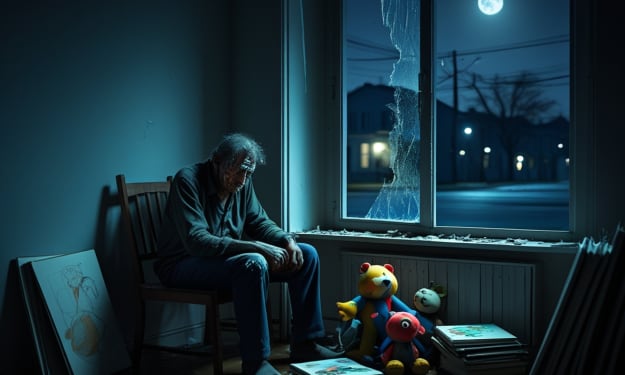
That night, James felt his world shatter in silence. The cold wind outside whispered through the cracked window panes, but inside the small apartment, a storm was raging far fiercer. His hands trembled uncontrollably as he stared at the empty chair across the room once occupied by Emily, his daughter, the light of his life. Now, the chair was hollow, just like his heart. Hours earlier, a simple misunderstanding had turned into painful silence, which then grew into a distance so vast, it felt impossible to cross. Emily had packed her bags quietly and left without a word. James tried calling her, texting her, but every attempt was met with silence. The last words they exchanged haunted him: “You never understand me.” As the night deepened, memories flooded James’s mind the first time he held Emily in his arms, her first steps, the countless laughter-filled evenings. Every memory reminded him of what he had lost in a moment of pride and stubbornness. Tears streamed down his face, unrestrained. For the first time in years, James felt completely helpless. But amidst the darkness, a fragile hope sparked. James realized that if he truly loved his daughter, he had to act, not just speak. Words had failed them both, but actions could bridge the gap. At dawn, James closed his small carpentry workshop, which he had poured his heart into for years. He gathered Emily’s favorite childhood toys, her worn-out sketchbooks filled with colorful drawings, and a small photo album of their happiest moments. Clutching the bundle tightly, he stepped out into the city streets, determination shining in his weary eyes. The city was bustling, indifferent to his pain. People brushed past him, caught up in their own lives. But James moved with purpose, navigating the maze of streets toward Emily’s apartment. Along the way, doubts gnawed at him Would she forgive him? Would she listen? But each question was met with a stronger resolve not to give up. Every step was heavy, yet hopeful. He recalled Emily’s favorite park bench, where they had spent countless afternoons. He decided that if she wasn’t home, he would wait there, hoping she might come back. Hours passed. The sun climbed high, casting long shadows on the pavement. Exhausted but unwavering, James finally reached her building. His heart pounded as he climbed the stairs, clutching the precious bundle. His hands shook violently as he reached her door. He knocked softly, fear and hope tangled together in his chest. The door opened a crack. Emily’s eyes, red-rimmed and wary, met his. For a moment, silence stretched between them a fragile bridge of emotions. Then, tears welled up in Emily’s eyes, and without a word, she stepped aside, allowing him in. That evening, in the quiet of her apartment, they talked. Not just about the fight, but about everything they had bottled inside the misunderstandings, the pain, the love. No accusations, no blame just honest, aching words. James apologized not just with words, but with a promise to listen, to understand, to never let pride come between them again. Emily, too, opened her heart, revealing her fears and loneliness. By the time night fell again, a new bond was forged one stronger than before, born out of pain, healing, and the unbreakable thread of love. Life Lesson: Life will sometimes break you down, testing your limits with pain and despair. But it is through that pain that we learn the true meaning of love patient, forgiving, and relentless. Small misunderstandings can create mountains between hearts, but with courage and humility, even the deepest divides can be crossed. Never let pride silence your heart’s voice. Reach out, listen, and hold tight to those you love, for relationships are fragile gifts that need nurturing every day.
By Ashraf about a year ago in Motivation
The River That Forgot to Flow
There once was a river nestled deep within an ancient valley, hidden from the eyes of most travelers. It had flowed for centuries graceful, wild, and free carving paths through stone, whispering to the trees, and nourishing every creature that touched its banks. It didn’t ask for thanks, didn’t expect recognition. It simply was untamed, constant, alive. But one day, something changed. The river stopped. Not frozen. Not dried. Just… still. As if it had forgotten what it meant to move. Birds circled overhead, confused by the silence. Leaves dropped from branches and lay upon its glassy surface, unmoved. The fish, once vibrant dancers in its current, now drifted in slow, bewildered spirals. The deer didn’t come to drink. The breeze didn’t hum across its surface. The world that had once revolved around its rhythm began to decay not with a crash, but with quiet. Many believed the river had died. But deep within the heart of the still water, the river was alive and listening. It had grown tired. For centuries, it had given and given. People came to wash away their pain, animals to quench their thirst, storms to dump their rage, and the sun to take what little moisture was left. And the river? It gave. Tirelessly. Endlessly. Without pause. Without question. It never once stopped to wonder: “What about me?” It had no voice, yet it had always spoken—in ripples, in rushes, in roars. But now, in its stillness, it began to hear something it hadn’t in a very long time: Silence. And in that silence, a single, trembling question rose like mist: “Who am I, if I do not flow?” The answer did not come from the mountains that once fed it, nor from the sky that once wept into it. It came from below from a small, round pebble nestled in its bed, a stone who had lived its entire life in the river’s presence. "You are not just movement," said the pebble, its voice like a memory. "You are not just a path for others to follow. You are reflection. You are memory. You are the mirror in which the sky sees itself." The river was stunned. All its life, it had believed its worth came from what it did not from what it was. Its motion had been its identity. Its giving, its validation. “But if I don’t flow,” the river whispered, “won’t they all leave me?” The pebble was quiet for a long moment. Then, gently, it replied, “They already have. And still, you remain.” That truth pierced the river like lightning. It had spent eternity trying to be useful, trying to be needed. It had sacrificed itself again and again, pouring out everything it had only to be left empty and alone. And so, it stayed still. Days passed. Then weeks. Then an entire season. Rain came and went. The sun burned and faded. The world turned, but the river did not move. Until one morning, a small child wandered to its edge. No bucket in hand. No intention to swim. She didn’t throw stones or scream into its silence. She simply sat… and looked. She saw it not as broken or failed but as beautiful. She marveled at the way the morning sky rested perfectly on its surface. She watched a dragonfly skim across the top, creating tiny rings of life in the quiet. She smiled not at its motion, but at its stillness. And in her silence, the river saw something it hadn’t known it needed: not expectation, but wonder. Something stirred. Not much. Just a whisper. A single ripple curled around the child’s reflection, as if the river had exhaled. It did not return to the river it once was. It did not roar or rush. It began to move slowly not to serve, not to satisfy but to express. Its movement was no longer an obligation. It was a language. A kind of art. A dance between presence and pause. And those who came back to it noticed something new in its waters not just refreshment or beauty, but truth. They saw a river not rushing to prove its worth, but existing in it. Moral: Sometimes in life, we forget that *being* is enough. We become rivers that only flow for others always giving, never resting. We define ourselves by our utility, our productivity, our ability to help, fix, do. And in doing so, we forget our own soul’s current. But it is not weakness to pause. It is wisdom. In stillness, we meet our reflection. In silence, we meet our truth. And in choosing to move because we feel it, not because we must, we return to ourselves.
By Ashraf about a year ago in Motivation
Why You Can't Focus Anymore - And the Ancient Trick That Rebuilds Your Brain Hour by Hour
Introduction Your brain is drowning in distractions - endless notifications, looming deadlines, and a to-do list that never shrinks. Every time you try to tackle something hard, your mind sabotages you, pulling you toward the comfort of scrolling or daydreaming.
By Dishmi Mabout a year ago in Motivation
Still Standing, Still True
The house wasn’t grand. No marble pillars, no shiny windows, no sprawling lawns. It sat quietly at the end of a gravel path, surrounded by tall oaks and years of memories. The roof sagged slightly under the weight of seasons. The paint was chipped in places, like time had run its fingers across it too many times to count. But the house had a soul. It had seen heartbreak, laughter, silence, and song. And through it all, it stood.
By Anees Kaleemabout a year ago in Motivation
The Graveyard of Clocks
People really remembered when Edgar stopped speaking. He simply decided one day that words had worn themselves out stretched too thin by apologies never meant, promises never kept, and smiles too sharp to trust. So, Edgar turned silent. But that wasn’t what made Edgar famous. What made Edgar unforgettable was what he did with time. It began on a rainy Wednesday when Mrs. Mallow spotted him in the cemetery with a shovel and a black bag. Naturally, she assumed he was mourning. But curiosity, a force stronger than respect, pulled her closer and what she saw unsettled her. Inside that black bag was not a keepsake or flowers. It was a clock. A large, round, ticking wall clock. She watched, frozen under her umbrella, as Edgar placed it gently in the earth and buried it. By the end of the month, Edgar had buried seventeen clocks wristwatches, kitchen timers, pocket watches, even cuckoos. Some ticking, some silent. Always with the same quiet ceremony: a hole, a pause, a covering of dirt. No headstone. No explanation. Some say he even whispered something each time before he covered them, though no one ever got close enough to hear. The town, naturally, began to talk. Some believed it was art. Others called it madness. The local pastor declared it sacrilege. Children followed him at a distance, whispering legends. “They say he’s burying time so he can live forever.” “No,” another child would argue, “He’s trapping it. So it can’t take anyone else.” But no one dared confront Edgar. His silence was too heavy, too haunted. That winter, time behaved strangely in Hartswell. Clocks stopped randomly. Phones glitched. Alarms failed. Days felt shorter, nights longer. People felt... displaced. As if time no longer flowed it throbbed. Even the weather didn’t seem to follow the rules. Snow came too early and stayed too long. Flowers bloomed in December. Dogs barked at empty space. And then came the letter. It was found taped to the church door one frozen morning, written in tight cursive:
By Ashraf about a year ago in Motivation
"The Quiet Bond"
The park was nearly empty, save for the scattered rustling of leaves and the occasional chirp of a bird daring to break the calm. It was late afternoon, golden light filtering through the trees, casting long, warm shadows across the old wooden bench where Thomas sat with his daughter, Ellie.
By Jawad Khanabout a year ago in Motivation
Elijah’s Silent Battle
He never looked behind him. Elijah was a man who walked like fire bright, bold, and with a certain silence that warned people not to get too close. He was the kind of person who could walk into a room and make the lights feel insecure. Yet, despite his presence, no one really knew him. Not even himself. For years, Elijah had lived under the weight of a shadow his own. But this was no ordinary shadow. It didn’t merely follow him in light. It whispered. It mocked. It remembered things he wished he hadn’t done. It dragged behind him the guilt of lost friendships, decisions he couldn't reverse, and words he never should've said. No matter where he went, the shadow came too long, looming, louder than ever in the stillness of night. One day, he heard about an old hermit who lived atop the Pale Ridge a man rumored to have once rid himself of his own shadow. Desperate, Elijah packed nothing but silence and questions, and set off. The climb was cruel. Each step higher seemed to stretch his shadow farther behind him, like it resisted his escape. But when he finally reached the summit, he found not a wise old man meditating in peace but a small, unremarkable hut with a single mirror leaning against a cracked stone wall. Inside stood an elderly man with no reflection. “You came to burn it,” the man said before Elijah could speak. “How did you know?” “I’ve heard your shadow screaming all the way from here,” he replied, eyes tired but oddly compassionate. “I want it gone,” Elijah said. “It’s... choking me.” The man nodded slowly, then reached for a candle. “Burning a shadow is easy. The hard part is what replaces it.” That night, they began the ritual. Elijah stood barefoot under the full moon, surrounded by salt and ash. The hermit lit the candle and held it behind Elijah’s back. The flame didn’t touch skin. It touched memory. Suddenly, Elijah saw everything at once his failures, the betrayals, the things he had buried under years of denial. He saw his father’s disappointed eyes. He saw a letter he never mailed. He saw the friend he left in a hospital waiting room without saying goodbye. His knees buckled, but the flame didn’t stop. It moved through him, not to destroy, but to reveal. When it was over, he lay in the ashes, trembling. The hermit handed him a mirror. “Look.” Elijah stared. No shadow. But his eyes his eyes were different. They held the storm now. The things he had avoided, the pain he had hidden they had not disappeared. They had moved inside him. “Where did it go?” he whispered. “You absorbed it,” the hermit said. “That is what it means to be free.” Elijah stayed on the mountain for three more days, learning to live without an external shadow. Learning to carry the weight inward where he could control it, face it, even forgive it. When he descended, he moved slower, but lighter. People noticed the change. Some said he looked brighter. Others said he looked haunted. But for the first time, Elijah didn’t care what they saw. Because he knew what he carried and he was no longer afraid of it. Author’s Note: We all have shadows echoes of things we wish we could forget. But what if the path to peace isn’t in escaping them, but owning them? What if true freedom begins not when the past disappears, but when it stops defining you?
By Ashraf about a year ago in Motivation
A Whisper That Echoes Loud
(A story that sings in silence) “When the heart broke, a sound escaped. But when trust shattered… even silence began to scream.” The qawwal sat cross-legged in front of his harmonium. The hall was packed, the crowd buzzing with anticipation. The mic crackled softly as he leaned forward. Fingers poised. Eyes closed. A breath held… and then nothing. Not a single note. No rhythm. No voice. Just… silence. At first, the audience was confused. Then, slightly amused. Whispered jokes began to ripple across the room. “Has he forgotten the lyrics?” “Maybe his voice gave out?” “Or maybe it’s part of the act?”
By AK Popalabout a year ago in Motivation
75+ Short Eid Captions for Instagram That Your Followers Will Love
Eid is a special time for Muslims all over the world. It’s a day to pray, eat delicious food, wear new clothes, and spend time with family and friends. It’s also the perfect time to share your joy on social media. If you’re planning to post a photo or video on Instagram this Eid, you might be looking for the right caption.
By Brian Henabout a year ago in Motivation