Holiday
"She Left Me a Note—and Then Disappeared"
I found the note on a Thursday morning. It was a day like any other, one of those sleepy, half-dressed moments where the kettle hums and the world hasn’t quite opened its eyes yet. I stumbled into the kitchen, expecting to find her by the window with that distant look she always wore in the mornings—half in this world, half in a memory I couldn’t reach. But she wasn’t there.
By Jawad Khanabout a year ago in Motivation
Success Isn’t a Straight Line
Success Isn’t a Straight Line When people hear the word "success," they often picture a straight road — one that moves cleanly from point A to point B. Study hard, get a degree, land a good job, and live happily ever after. I used to believe that too. Until life taught me that real success doesn’t work like that. It’s not a straight line. It’s a winding, messy, often painful journey — and in my case, it began with failure.
By Ali Asad Ullahabout a year ago in Motivation
A Letter to My First True Friend
Start writing... Dear Friend, I don’t know if you still remember me the way I remember you. Maybe life has carried you far from the days of paper airplanes, scraped knees, and shared secrets. But here I am, writing a letter to someone who helped shape the very beginning of who I became. We met long before either of us knew what the world really was. We didn’t understand taxes or heartbreak, deadlines or disappointment. But we did know the joy of a mud puddle, the mystery of a locked attic door, and the thrill of a dare shouted across a sun-drenched field. You weren’t just my friend. You were my world. My partner in crime. The other half of every imaginary game. While the adults were busy pretending their world was more important, we were building ours from chalk and cardboard. Remember our fort behind the garage? That old blanket smelled like mildew and dreams, and it was our castle. We ruled that kingdom until dinner called us home. You taught me how to laugh with my whole body. You showed me how to cry without shame. And when I was too scared to jump off the swing mid-air, you went first, just to prove it could be done. That’s the kind of courage you carried—not loud or showy, but steady and real. Somewhere between growing taller and growing up, we drifted. Not all at once. First it was different schools, then different circles, then different priorities. It happens. Everyone says so. But what they don’t tell you is how much it hurts to lose someone who knew you before the layers came on—before masks, before “I’m fine” became automatic. I often wonder who you are now. What music do you like? Did you ever learn to draw the perfect dragon like you always tried to? Do you still laugh with your whole body? I hope so. I saw a kid the other day running through a grocery store aisle with a toy sword. His mom was embarrassed, but all I saw was you and me battling monsters in the cereal section. That kid’s eyes held the same fire ours did—the belief that anything was possible. That heroes weren’t just on TV. They were us. Maybe that’s why I’m writing this letter. Not for closure, but for remembrance. Because some friends don’t fade, even when they vanish. Some friends live in echoes—in the smell of wet grass, in the sound of old cartoons, in the taste of a half-melted popsicle. You were my first real friend. Not the kind I had to impress. Not the kind who liked me for what I could give. Just… me. My weird, loud, messy, curious self. And you loved that version of me in a way that helped me believe I was worth loving. So thank you. Thank you for sitting with me in silence when my dog died. For sneaking extra cookies into your backpack for me. For swearing that your older brother didn’t scare you even though we both knew he did. For being there, without needing a reason. Life is busy now. It’s filled with obligations, unread emails, half-finished books, and people who smile but don’t see. And while I’ve made new friends—good ones, even—they don’t know the kid-version of me. The one who wore mismatched socks on purpose and believed in time travel. But you do. And in some quiet corner of the universe, I hope you’re remembering me, too. Wherever you are, I hope your life is kind. I hope you’re chasing dreams that still scare you a little. And I hope—once in a while—you close your eyes and feel the sun on your face, like we used to. Back when everything made sense, and the world was just big enough for two best friends and a whole lot of imagination. Forever grateful, Me
By Qaseem Ahmadzaiabout a year ago in Motivation
Daily Habits That Changed My Life
Daily Habits That Changed My Life We all dream of success, happiness, and a better life. But what if I told you that the key isn’t some overnight transformation — it’s hidden in the simple things you do every single day? That’s what I discovered. My life didn’t change because of a big opportunity or a stroke of luck. It changed because I changed my habits. Slowly. Consistently. Quietly.
By Ali Asad Ullahabout a year ago in Motivation
I Failed 100 Times Before I Got It Right
I Failed 100 Times Before I Got It Right Failure is something most people are afraid of. It feels bad, it makes us doubt ourselves, and sometimes, it makes us want to give up. But what if I told you that failing 100 times was the best thing that ever happened to me? This is the story of how I failed again and again—and how those failures helped me finally get it right.
By Ali Asad Ullahabout a year ago in Motivation
From Silent Shadows to Finding His Voice
Jay was never the loudest voice in the room. As a kid, he often wished he could just disappear. Growing up in a busy household with three siblings, he always felt overshadowed. His parents loved him, but Jay was the shy one — the kid who avoided eye contact, rarely spoke up, even when he wanted to. School was a struggle. Classrooms felt like pressure cookers. When the teacher’s eyes landed on him, his heart would race so fast it felt like it might burst. Words got stuck in his throat. Sometimes he stammered; other times, he stayed silent. He became a pro at hiding behind his notebooks or slipping into the back row. Social events weren’t any easier. Birthday parties, family gatherings, or hanging out with classmates — Jay just watched from the sidelines, too scared to join in. He was convinced whatever he said wouldn’t be interesting, or worse, people would laugh at him. But it wasn’t just fear of judgment. Inside his mind was a storm of racing thoughts and “what ifs” — a constant voice telling him he wasn’t good enough. At home, his silence was often misunderstood. His parents worried — was he sad or angry? His siblings called him “quiet Jay,” sometimes affectionately, sometimes frustrated. Jay didn’t know how to explain what he felt. So he retreated deeper into himself. One memory stuck with him — a fifth-grade presentation about his favorite book. When it was his turn, his palms sweated, voice caught in his throat, and his words barely reached a whisper. The class grew uncomfortable. The teacher gave a kind smile, but Jay felt crushed. That moment became a symbol of his silent struggle. He wanted to be heard. He wanted to be seen. But fear was stronger. For years, Jay carried this invisible weight — a prisoner of his own mind, longing to break free. Then came his sister’s wedding — a night meant for celebration. But for Jay, it was a test he wasn’t sure he could pass. Months earlier, his sister had asked him to give a toast. She wanted her big brother to share a few words from the heart. Jay hesitated, terrified of the spotlight, but he loved her deeply and didn’t want to disappoint. So he agreed, promising himself he’d prepare. He practiced in front of the mirror for days. His voice shook, but the words felt right. He hoped when the moment came, he could push through the fear. At the reception, with all eyes on him, Jay’s heart pounded like thunder. The room shrank. Faces blurred. He opened his mouth — Nothing. Panic took over. His throat tightened. The words he had memorized vanished. He froze. Sweat slicked his palms. The silence pressed down like a heavy weight. He wanted to disappear. His sister gave a small, encouraging smile, but it wasn’t enough to break the spell. Finally, Jay whispered a few barely audible words, mumbling through the toast. His cheeks burned with shame. The polite applause felt distant. Inside, Jay felt shattered. That night, replaying the moment over and over, the embarrassment gnawed at him. But beneath it was a quiet spark — a realization. He didn’t want to live like this anymore. He wanted to find his voice. The next morning, Jay woke up weighed down by the silence of the night before. But somewhere in the sadness, a flicker of hope burned. He decided to speak — even if it was just one word at a time. The next day, he forced himself to say “hello” to the barista at his local coffee shop. Heart pounding, palms sweaty, he whispered, “Good morning.” The barista smiled warmly, “Good morning! What can I get for you?” That small exchange cracked the wall Jay had built around himself. Emboldened, he sought other tiny chances to speak — saying thanks, asking questions, making small talk. His voice was shaky, barely audible sometimes, but he did it anyway. At night, he poured his thoughts into a journal — safe, private. He filled pages with frustrations, hopes, and dreams he never spoke aloud. Weeks later, Jay searched for “anxiety therapist near me.” The thought scared him. What if he was judged? What if he couldn’t explain how he felt? But staying silent was worse. He made the appointment. At his first session, Jay sat nervously, hands clenched, eyes darting. The therapist, Dr. Martin, listened patiently. “I feel trapped,” Jay said quietly. “Like my voice is stuck inside me, and no one hears it.” “You’re not alone,” Dr. Martin said gently. “Many struggle to find their voice. The good news — you can learn to speak. First to yourself, then to others.” Over weeks, Jay learned breathing exercises, grounding techniques, and how to challenge negative thoughts. Dr. Martin encouraged self-compassion — to be patient with himself when progress felt slow. There were setbacks. Days Jay retreated back into silence. But he reminded himself healing wasn’t linear. Every small step counted. Slowly, the walls crumbled. Jay joined a support group for people with anxiety. At first, he listened quietly. Then one day, he shared a few words. Later, a few more. His voice grew stronger. So did his confidence. One afternoon, Jay reflected on how far he’d come. The boy who once trembled at a simple “hello” was now speaking in front of strangers. It wasn’t perfect. It wasn’t easy. But it was progress. Jay realized breaking silence is about courage — not perfection. > “Courage doesn’t always roar. Sometimes courage is the quiet voice at the end of the day saying, ‘I will try again tomorrow.’” — Mary Anne Radmacher Months passed. Jay grew braver, speaking up whenever he could. But the biggest challenge awaited: a company event where he was invited to share his journey with anxiety. When his manager asked him to speak, Jay’s heart skipped. Hundreds of coworkers and clients would be there. The idea of the spotlight made his chest tighten. “Are you sure?” his best friend Mia asked over coffee. Jay nodded, swallowing fear. “If I don’t share my story, who will?” Weeks of preparation followed — drafting, practicing, battling self-doubt. Some mornings he felt excited. Other days, panic threatened to silence him. He kept going to therapy and leaned on Mia’s support. She listened without judgment, reminding him how far he’d come. On event day, backstage, Jay’s heart thundered. Hands trembled as he held his notes. “What if I freeze?” whispered a voice in his head. He breathed deep, recalling Dr. Martin’s words: “Your voice matters, Jay. Speak your truth.” Then he stepped to the podium. The spotlight blinded him briefly. Faces blurred. But Mia’s smile was in his mind. He started shaky, voice cracking, sharing his early struggles — the fear, the silence, the moments he wanted to disappear. He told them about the wedding toast that broke him, the small victories of saying “hello,” the courage it took to ask for help. He didn’t hide the hard parts — setbacks, tears, the lingering anxiety whispering doubts. But he shared hope. He spoke of growth, resilience, and the power of breaking silence. When he finished, the room was quiet — then erupted in applause. Tears welled in Jay’s eyes as he stepped down. For the first time, he felt seen. Heard. Free. Afterward, coworkers came up with hugs, thanks, and their own stories. Jay realized he wasn’t alone. His story sparked connection. That night, lying in bed, Jay felt a new peace. Fear would always be part of him, but it no longer controlled him. He had found his voice — and with it, reclaimed his life.
By Arshad khanabout a year ago in Motivation
The Whisper of Hooves
In a quiet village nestled between green hills and whispering woods, lived a boy named Arif. He was ten years old, quiet, and curious. His father worked in the fields, and his mother sewed clothes for the villagers. Though his days were simple, Arif often felt something was missing—until the day he met Raka, the old chestnut horse. Raka had once belonged to the village blacksmith, a kind old man named Baba Malik. When Baba Malik passed away, Raka was left alone in the stable behind the empty forge. No one seemed to want an old horse anymore. His once-glossy coat had dulled, and he rarely lifted his head. Most villagers believed Raka was too old to care for. But Arif saw something different. One quiet evening, while chasing his little wooden ball down the cobbled street, Arif found himself in front of the abandoned stable. Through the wooden slats, he saw Raka standing still, like a statue. Their eyes met—boy and horse, both a little lonely in their own way. Arif took a step closer. “Hello, old friend,” he whispered. Raka didn’t move. Arif reached into his pocket and pulled out a half-eaten apple. He stretched out his hand. Slowly, with a deep breath and cautious step, Raka came forward and took the apple gently from the boy’s hand. That was the beginning. From that day on, Arif came to see Raka every evening. He brought small treats—carrots, apples, sugar cubes—and a soft brush he borrowed from his father’s stable tools. He cleaned Raka’s hooves, combed his tangled mane, and spoke to him like a friend. He told Raka about school, how he loved stories, how he dreamed of riding far across the hills. Raka never replied, of course, but Arif swore the old horse listened. The sadness in Raka’s eyes began to fade. He would neigh softly when Arif approached, nuzzle his hand, and even trot around the stable. The villagers noticed. “That boy has breathed life back into that horse,” said the baker. “It’s like magic,” whispered the old schoolteacher. Then one morning, disaster struck. A heavy storm rolled over the hills, thundering through the village. Rain poured, winds howled, and the river that ran through the village began to rise. Arif’s house stood near the stream, and his parents rushed to gather their things and find higher ground. But Arif ran in the opposite direction. “Where are you going?” his mother cried. “Raka!” he shouted, already disappearing down the muddy path. When he reached the stable, the water was already at the gate. Raka neighed in fear, trapped behind a fallen beam. Arif didn’t hesitate. With shaking hands, he climbed through the half-open door, pushed the debris aside with all the strength his small arms could muster, and led Raka out. “Come on, boy! You can do this!” Raka slipped once but steadied himself. With Arif guiding him, they splashed through the rising waters and reached the dry hill where the villagers had gathered. Cheers erupted as the boy and horse emerged from the storm, soaked but safe. From that day on, Raka wasn’t just a forgotten horse—he was a hero. The village came together to build him a new stable. Arif’s bond with Raka deepened, and soon, under the guidance of the village elder, he began learning to ride. Each morning, just as the sun touched the hills, Arif and Raka would gallop across the fields, the boy’s laughter echoing, the horse’s mane flying in the wind. They were no longer just a boy and an old horse—they were a team, a story, a symbol of hope and friendship. And in every hoofbeat, Arif could still hear the whisper of that first day: a quiet hello that changed everything.
By Sofia Richie about a year ago in Motivation
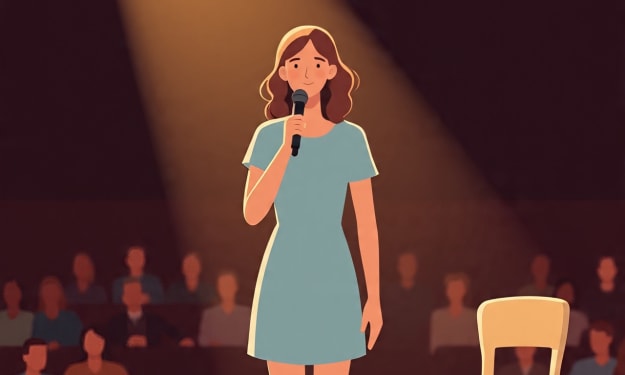
The Last Chair in the Room"
1. The Empty Auditorium The first time Maya stood on a stage, the auditorium was nearly empty. Just a janitor sweeping the back row and an old woman knitting in the second. She was 17, full of nerves, and every word in her speech trembled out of her like a bird afraid to fly. But she did it. She spoke for exactly 4 minutes and 32 seconds. And when she finished, no applause followed. The janitor kept sweeping. The woman kept knitting. She walked offstage, cheeks flushed, thinking: Maybe I’m not meant for this. But something stopped her from tearing up her note cards. A chair. A single, plastic chair in the middle of the room. Empty, upright, facing the stage. Waiting. Maya decided that day that no matter how many people filled or didn’t fill that room, she would always speak as if someone was sitting in that last chair. Listening. Needing. Hoping. Because once upon a time, she had been that person.
By Arshad khanabout a year ago in Motivation
The Last Chair in the Room
1- The Empty Auditorium The first time Maya stood on a stage, the auditorium was nearly empty. Just a janitor sweeping the back row and an old woman knitting in the second. She was 17, full of nerves, and every word in her speech trembled out of her like a bird afraid to fly. But she did it. She spoke for exactly 4 minutes and 32 seconds. And when she finished, no applause followed. The janitor kept sweeping. The woman kept knitting. She walked offstage, cheeks flushed, thinking: Maybe I’m not meant for this. But something stopped her from tearing up her note cards. A chair. A single, plastic chair in the middle of the room. Empty, upright, facing the stage. Waiting. Maya decided that day that no matter how many people filled or didn’t fill that room, she would always speak as if someone was sitting in that last chair. Listening. Needing. Hoping. Because once upon a time, she had been that person. --- 2. The Fear of Being Ordinary Maya was not born with a silver spoon or a perfect voice. Her father drove taxis in Detroit; her mother cleaned homes. They taught her to survive, not to dream. But Maya, as a child, would steal moments under her blanket with a flashlight, writing stories on old receipts, cereal boxes, and napkins. Her stories were about warriors with no swords, queens with broken crowns, and misfits who refused to fit in. But the older she grew, the louder the world became. “Be practical.” “Find a real job.” “Motivational speaking? That’s not a career, that’s a TED Talk fantasy.” She tried to obey. She enrolled in a business course at a local community college. She sold insurance for two years. She even worked at a shoe store where the slogan was: “Fit in or walk out.” Irony never paid well. Still, every time she passed a mirror, Maya felt the same gnawing truth: She was afraid of being ordinary. --- 3. The Risk Nobody Saw One stormy Thursday in April, Maya made a decision that terrified even herself. She quit her job, withdrew her college application, and took the remaining $372 from her savings. She spent $100 on a cheap microphone and the rest renting a hall for her first event. She printed fifty flyers that said: > “You’re Still Enough: A Free Motivational Talk” By Maya Reynolds – A Nobody with Something to Say. The night of her event, it rained so hard the power flickered in the hall. Only three people showed up. A boy with acne who said nothing. A woman with swollen eyes. And a man with a coffee stain on his tie who kept looking at his watch. Maya could’ve canceled. She could’ve apologized. Instead, she took a deep breath and imagined the last chair in the room. She imagined someone sitting there who was about to give up but chose to come anyway. So she spoke. She told them about her failures, her fears, the time she nearly dropped out of high school, and the voice inside her that kept whispering: “Try one more time.” When she finished, the room was silent. But the woman with the swollen eyes walked up and said, “I was going to take my life tonight. I came here instead.” Maya never charged for her events after that. Not for a long time. That night changed her, not because she was thanked—but because she realized something profound: Success isn’t measured by crowds. It’s measured by impact. --- 4. Going Viral Isn’t Everything In today’s world, everyone wants to go viral. Maya tried it once. She uploaded a dramatic, tear-filled video with sad piano music in the background. It got 1,200 views in two weeks. The comments? > “Cringe.” “Stop faking it.” “Another wannabe guru.” It crushed her. For three weeks, she didn’t get out of bed. But then, a handwritten letter arrived. It was from the boy with acne who had attended her first event. He wrote: > “I never said anything, but you changed my life. I’m studying psychology now because you made me feel heard. Thank you for seeing me.” That letter sat on her desk every day for the next five years. Because what Maya learned was this: Going viral is a moment. Changing someone is a mission. --- 5. The Day She Almost Quit At 28, Maya had been giving talks for over a decade. She was still living in a tiny apartment above a laundromat, driving a rusty Corolla with a broken window, and eating canned soup three nights a week. She was invited to speak at a conference in Chicago. Her dream event. But a week before, the organizer called and said: > “We’ve replaced you with a bigger name. Someone with a larger following.” Maya didn’t cry this time. She didn’t scream. She just looked in the mirror and said, “Maybe I’m not good enough.” But that night, she got an email. From a teenager in India. It read: > “I found one of your old YouTube videos. I was bullied for my weight and tried to starve myself. But your story made me stop. I want to be a speaker too, like you.” That one email lit a fire in Maya that a thousand rejections couldn’t kill. She replied with just four words: “You’re already speaking. Keep going.” --- 6. The Chair Was Never Empty By the time Maya turned 32, she had spoken in 46 cities across 9 countries. She still didn’t have a blue checkmark. Still hadn’t written a bestselling book. But when she spoke, the rooms were full. Not just with people—but with stories. Survivors. Fighters. Dreamers who had once almost given up. She gave her final speech of the year in a high school gymnasium in Cleveland. She had lost her voice that week, was recovering from the flu, and debated canceling. But she didn’t. And in the crowd sat a girl named Ellie. Sixteen, foster kid, shy, sitting in the last chair. After the talk, Ellie came up and whispered, “I didn’t know anyone else felt like me.” Maya smiled. “Me too,” she said. --- 7. The Legacy You Don’t See Maya never got famous. Not in the way Instagram defines it. She never married. Never owned a house. She kept her Corolla until it died on the highway at 241,000 miles. But her inbox was filled with letters from people in ten different languages. Letters that said: “You made me believe again.” “You helped me leave my abusive relationship.” “You made me feel seen.” And every time Maya stepped on a stage, she looked at the last chair. Even if the room had a thousand people, she focused on the invisible soul sitting quietly in the back, wondering if they mattered. Because they did. Because Maya once had. --- 8. The Final Talk Maya passed away at 44 after a sudden heart condition. Only 93 people came to her funeral. But what mattered is who came. The boy with acne—now a psychologist. The girl named Ellie—now a speaker herself. The woman with swollen eyes—now running a shelter for women like her. The janitor who heard her first speech—who had kept the flyer all those years. And sitting quietly in the back row of the chapel? A new face. A young man with trembling hands, holding a notebook. After the ceremony, he approached the podium and said, “I never met her. But her video saved me last year. I had planned my suicide. Then I heard her say: ‘The world needs your story.’” He paused. “So here I am. Telling it.” --- Epilogue: The Chair Remains Some stories don’t need to be shouted to be heard. Some legacies aren’t written in books, but in broken hearts mended, lives saved, and strangers who felt understood. Maya Reynolds was never a celebrity. But she was something rarer: A lighthouse in a storm. A voice in the dark. A hand reaching for the forgotten. And somewhere, in every room, a chair remains. Waiting for the next Maya. And the next soul who needs her.
By Arshad khanabout a year ago in Motivation