healing
How to heal fully and properly.
Desperate to help you
If you’ve spent any amount of time on the internet, you’ll have come across people either volunteering information or doing their best to help others in one way or the other even at a loss to themselves. You would discover something known as “open source” which basically means getting someone’s work for free, something they could charge for a fee is made available to the world completely free of charge, you could even just take it and commercialize it for yourself. The altruistic nature of humans is quite amazing and even people who don’t have a lot going for themselves still share this mindset, its amazing to say the least. Countless books written to educate people, countless philanthropes across the world donating all of their resources, countless persons sacrificing their lives to help others, countless selfless persons. I’ve also been in that position to a certain extent and today, I want to talk about my experience.
By real Jema2 years ago in Motivation
6 Benefits of Consuming Coconut Oil on an Empty Stomach
Coconut oil has been a staple in Indian households for centuries, commonly used for cooking, skincare, and even as a makeup remover. In recent years, its health benefits have gained widespread recognition. Rich in medium-chain triglycerides (MCTs), coconut oil is rapidly converted into energy, making it an excellent fuel for the brain and body.
By fitlifebyvidhan2 years ago in Motivation
Breaking the Silence:
Mental health has long been a taboo subject, whispered about in hushed tones, if discussed at all. Yet, the reality is that mental health issues affect millions of people worldwide. According to the World Health Organization (WHO), one in four people will experience a mental health disorder at some point in their lives. Despite these staggering numbers, stigma and misunderstanding continue to prevent open discussions about mental well-being. The Power of Open Conversations Talking about mental health can break the cycle of isolation and shame. When we speak openly about our struggles, we help others realize they are not alone. It also fosters a culture of empathy and understanding, where people feel safe seeking help without fear of judgment. Studies have shown that when people are open about their mental health, they are more likely to seek professional help and receive support from family and friends. This can lead to early intervention, which is crucial in managing mental health conditions effectively. A lack of conversation about mental health contributes to misinformation, leading to harmful stereotypes and discrimination. By engaging in open dialogue, we educate others and create a more informed and supportive society. When more people are aware of mental health issues, they can recognize symptoms in themselves or their loved ones and take appropriate action. Overcoming Stigma One of the biggest barriers to mental health discussions is stigma. Society often views mental health conditions as a sign of weakness, making people reluctant to acknowledge their struggles. However, mental health issues are medical conditions, just like diabetes or high blood pressure. Stigma can take many forms—social stigma, where individuals face discrimination and exclusion due to their mental health struggles; self-stigma, where a person internalizes negative beliefs about their condition; and institutional stigma, where policies and practices within workplaces, schools, and healthcare settings fail to accommodate or support mental health needs. Education is key in dismantling stigma. When people understand that mental illnesses are not character flaws but genuine health concerns, they become more supportive and less judgmental. Schools and workplaces can play a crucial role in normalizing mental health conversations by implementing awareness programs and encouraging open discussions. The Consequences of Silence Ignoring mental health issues has serious consequences. Individuals who feel they cannot speak about their struggles often suffer in silence, leading to worsening symptoms. Depression, anxiety, and other mental health conditions can escalate without proper support, increasing the risk of substance abuse, self-harm, or suicide. Beyond individual suffering, the broader community and society also bear the costs of untreated mental health issues. Workplaces experience lower productivity and higher absenteeism when employees struggle with unaddressed mental health problems. Relationships can become strained as people withdraw or struggle to communicate their emotions. How to Foster Meaningful Conversations Breaking the silence requires deliberate action. Here are some ways to encourage open discussions about mental health: 1. Create Safe Spaces – Encourage discussions where people feel comfortable expressing their emotions without fear of criticism. 2. Listen Without Judgment – Offer a listening ear rather than unsolicited advice. Sometimes, simply being there is enough. 3. Use Person-First Language – Say “a person with depression” instead of “a depressed person” to reinforce that the condition does not define them. 4. Share Personal Stories – When people see others being open about their experiences, they are more likely to do the same. 5. Encourage Professional Help – Seeking therapy or medication is not a sign of failure but a step toward recovery. 6. Educate Yourself and Others – Understanding different mental health conditions and treatment options can help reduce fear and misconceptions. 7. Challenge Harmful Language and Behaviors – When you hear someone making negative or dismissive comments about mental health, speak up and provide a more informed perspective. The Role of Media and Social Platforms The media and social platforms play a significant role in shaping perceptions of mental health. While they can be sources of misinformation, they also have the power to create positive change. Thoughtful portrayals of mental health in films, television, and literature can normalize struggles and show realistic recovery journeys. Social media can be a double-edged sword. While it allows for support networks and awareness campaigns, it can also contribute to unrealistic expectations and harmful comparisons. Users should be mindful of the content they consume and share, ensuring it promotes a healthy and informed view of mental health. The Importance of Policy and Advocacy Beyond personal conversations, systemic change is needed to support mental health on a larger scale. Governments, employers, and institutions must implement policies that prioritize mental well-being. This includes access to affordable mental health care, workplace accommodations, and mental health education in schools. Advocacy groups and mental health organizations play a crucial role in pushing for policy changes and providing resources for those in need. Supporting these initiatives—whether through donations, volunteering, or simply spreading awareness—can contribute to a more inclusive and understanding society. Taking the First Step Breaking the silence around mental health is not just beneficial; it’s necessary. When we engage in honest conversations, we create a world where mental well-being is prioritized and supported. If you or someone you know is struggling with mental health, start by reaching out to a trusted friend, family member, or professional. Small steps toward open dialogue can lead to significant changes in attitudes, policies, and overall mental wellness for individuals and society as a whole. Change starts with one conversation. Let’s make it happen.
By Stefan Rowles2 years ago in Motivation
How to Support a Loved One Who Struggles with Panic Attacks
If you’ve ever watched a loved one go through a panic attack, you probably felt like a helpless bystander in a chaotic movie scene. You want to help, but what do you do? Should you hug them? Should you give them space? Should you suggest deep breathing, or does that sound like you’re brushing off their experience? If you’ve found yourself scrambling to figure out how best to support someone during a panic attack, you’re not alone.
By Victoria Velkova2 years ago in Motivation
Two Entities in One Vessel: Part one
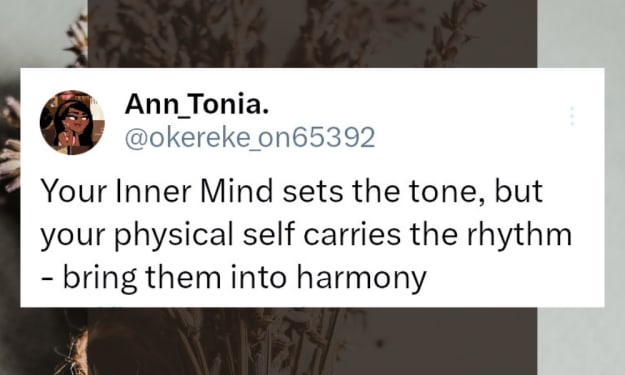
One of the biggest revelations in my self-love journey was realizing that I’m not just one single entity but two—merged into one vessel: the Physical Self and the Inner Mind. We might not have known these exact terms, but at some point in our lives, we could sense them. The physical self and the inner mind influence each other, and each has an essential role to play. Working against each other is self-sabotage, while working with each other is self-improvement.
By the.selfcare.advocate2 years ago in Motivation
7 Targeted Sacroiliac Joint Pain Exercises for Increased Mobility
Experiencing sharp lower back pain? Your sacroiliac (SI) joint, which connects your lower spine to your pelvis, might be inflamed. This can make everyday activities like walking or climbing stairs painful. While discomfort may discourage movement, targeted exercises can enhance mobility and provide relief.
By fitlifebyvidhan2 years ago in Motivation
Why You Should Ditch ‘Work-Life Balance’ and Embrace ‘My Vocation Is My Vacation’
The key to success is to make your vocation your vacation. Mark Twain I’m sure that as a professional, you’ve noticed how work-life balance has long been hailed as the gold standard of modern life and work.
By Gordon Manuain2 years ago in Motivation
Unbroken Spirit. AI-Generated.
I was born with a physical disability that made it difficult for me to walk, run or even stand for long periods of time. Growing up, I faced countless challenges and obstacles, from cruel taunts and teasing to physical barriers that made it hard for me to participate in activities that I loved. But despite the adversity, I never gave up. I never lost sight of my dreams and I never let my disability define me. Instead, I used my determination to drive me forward. I worked tirelessly to build my strength and endurance, pushing myself to do more and be more, even when it felt like my body was holding me back. And while I was assaulting, communicating and making friends I was able to get a medical remedy for my health issue then I took medication and I was healed I started to see results. I began to walk further, run faster and stand stronger. I started to participate in activities that I had previously been excluded from and I even started to compete in sports and events that I had never thought possible. But it wasn't just my physical abilities that improved. My determination also helped me to develop a stronger sense of self, a sense of purpose and direction that guided me through even the toughest of times. As I refresh on my past, I realized that my disability had actually been a blessing in disguise. It had taught me to be resilient, socialized, to be resourceful and to be determined. And it had given me a sense of perspective, a sense of gratitude for the things that I did have, rather than focusing on the things that I didn't. Today, I am a confident, capable and determined individual, known for my unwavering spirit and my unshakeable optimism. I am a role model and inspiration to others, proof that with hard work, determination and a refusal to give up, anything is possible. So if you're facing adversity, if you're feeling like the odds are stacked against you, I want you to know that you're not alone.I want you to know that someone has been there at some point or another. But I also want you to know that you have the power to choose how you respond. You have the power to choose whether you give up or keep going. So don't give up. Keep pushing forward, even when it feels like the universe is pushing back. Keep striving, keep struggling and most importantly, keep believing in yourself. Because if I, a person with a physical disability, can achieve my dreams and live a fulfilling life, then so can you. Remember, every great success story started with a struggle. Every person who has achieved greatness has faced obstacles and setbacks along the way. But the key to success is not in avoiding failure, but in learning from it. It's in using your mistakes as opportunities for growth and in refusing to give up, even when things seem impossible. So don't be afraid to take risks. Don't be afraid to fail. Because it's in those moments of uncertainty and doubt that you'll discover your greatest strengths. It's in those moments that you'll learn to tap into your inner power and to unleash your full potential. And when you do, you'll be unstoppable. You'll be a force to be reckoned with, a person who is capable of achieving greatness, no matter what obstacles come your way. So go out there and make it happen. Go out there and create the life you want. Because if I can do it, then so can you. In fact, I want to leave you with a challenge today. I want to challenge you to tap into your own inner strength, to discover your own determination and resilience. I want to challenge you to push past your limits, to test your boundaries and to see just how far you can go. Because I promise you, the results will be amazing. You'll be amazed at what you can achieve, at what you can overcome and at what you can become. So don't wait any longer. Don't let fear or doubt hold you back. Go out there and start achieving your dreams today.
By Henry Lucy2 years ago in Motivation
How Fertility and Relationship Counseling Can Strengthen Your Journey Through Infertility
Infertility is a deeply personal and often painful experience that affects millions of people. For those struggling to conceive, the emotional toll can be just as overwhelming as the physical challenges. Beyond the medical appointments and treatments, infertility can bring feelings of grief, isolation, and frustration that impact not only the individual but also their closest relationships.
By Inspired Mental Wellness2 years ago in Motivation