healing
How to heal fully and properly.
Believe it or Not-She Cured Herself From Lyme disease
One day Ellie was bitten by a tick and contracted Lyme disease, Doctors announced there is no cure for lyme disease, but Believe it or Not-She Cured Herself From Lyme disease. How she cured is a kind of miracle Read full story.
By Nav k Aidan2 years ago in Motivation
Birds Flying in the House
Birds Flying in the House: What Does It Really Mean? Birds flying in the house have long been associated with symbolic meanings across various cultures and religions. Whether it's seen as a spiritual sign, a religious omen, or a mere coincidence, people often wonder: what does it mean when a bird enters your home?
By Spiritual meaning Journey2 years ago in Motivation
people who grew up unhappy often feels depressed
Having grown up in an unhappy home may leave lasting impressions that manifest in a range of behaviors as adults. These behaviors typically stem from coping mechanisms fostered during childhood because of emotional neglect, criticism, or instability. Identifying these behaviors is critical in personal healing and development. Below are eight typical behaviors of adults who have grown up in unhappy homes:
By mehadi2 years ago in Motivation
I Was Homeless, Hungry, and Hopeless-Then a $30 Job on the Internet Changed My Life Forever.
If you had met me ten years ago, you would’ve seen a skinny teenager sleeping on park benches in Chicago with a torn backpack and no plan. Today, I’m a 29-year-old tech entrepreneur, running my own company and mentoring kids who are exactly where I once was. This is the story of how I turned poverty into power — not overnight, not with luck, but with relentless grit, stolen Wi-Fi, and a belief that I was worth more than my zip code. --- The Fall I grew up on the South Side of Chicago. My mom worked two jobs and still couldn’t afford rent some months. My dad left when I was nine. By sixteen, I was skipping school, getting into trouble, and sleeping in shelters or friends’ basements. I wasn’t lazy — I was just lost. No one around me talked about dreams. People talked about surviving. Then, one night in a public library, I watched a TED Talk on a computer someone left unlocked. It was about a man who taught himself to code while working as a janitor. I watched it three times. That night, I didn’t sleep. I Googled “how to code,” “how to get out of poverty,” “how to start from nothing.” That was the spark. --- Free Knowledge, Stolen Internet For the next year, I became obsessed. I would sneak into cafes or library corners and use free Wi-Fi to watch coding tutorials on YouTube. I learned HTML, CSS, and JavaScript. I practiced by building fake websites. I had no laptop, so I borrowed an old Chromebook from a church that ran a youth program. I told them I was trying to change my life — and to my surprise, they believed me. I slept rough, but every day I learned something new. I used free online platforms like FreeCodeCamp and Coursera. I found Reddit threads about freelance gigs. I emailed people. Most never replied. Some laughed. But one man in Germany — a total stranger — gave me a shot. He needed a simple landing page and paid me $30 via PayPal. That $30 changed everything. --- Building a New Identity That small job led to another. And another. Within a year, I was earning enough to rent a shared apartment with three other guys. I had my own bed, a desk, and working Wi-Fi. Luxury. I started a blog about my journey. I posted about freelancing while broke. People began reaching out. Some asked for advice. Some offered opportunities. By 24, I was making over $4,000/month. Not much in Silicon Valley terms, but for a kid who once stole muffins to eat — it was freedom. I registered an LLC. I built websites for nonprofits and local businesses. Eventually, I hired a few other freelancers. We became a team. We became a business. --- Returning the Favor Today, I run a small but growing digital agency. We serve clients globally — but more importantly, I teach. I mentor inner-city youth. I’ve spoken at schools and shelters. I tell kids, “You don’t need money to start. You need Wi-Fi, time, and insane belief.” We launched a free program that teaches web development to teens in low-income communities. We’ve helped over 300 students so far. Every time I see one of them get their first freelance job, it takes me back to that cold night in the library. --
By Rahim Baba2 years ago in Motivation
Healing Hearts, One Verse at a Time
Healing Hearts, One Verse at a Time By Faiz Ali A Student’s Calling The fluorescent lights of Dow University buzzed overhead as I, Faiz, a 24-year-old Generic Bachelor of Science in Nursing student, scribbled notes in my worn-out notebook. Between anatomy lectures and clinical rotations, my days were a blur of stethoscopes and textbooks. Yet, my heart carried another rhythm—one shaped by the Quran, memorized verse by verse as a Hafiz. Nursing was my calling, but faith was my anchor.
By Faiz Ali2 years ago in Motivation
6 Morning Habits That Changed My Life as a New Mom . AI-Generated.
Introduction As a new mom, a first-time mom, I went through one of the toughest times of my life. It was depressing. I didn’t feel cared for by the people around me. I wasn’t feeling well. I had no appetite. Yet I was doing exclusive breastfeeding.
By Tyjia Odaro2 years ago in Motivation
The Joy of Letting Go of Comparison
Have you ever looked at someone else’s life and felt like you’re not doing enough? Maybe you saw a friend get better grades, someone on Instagram looking perfect, or a classmate winning an award, and suddenly you felt like you weren’t good enough?
By Alex Farnando2 years ago in Motivation
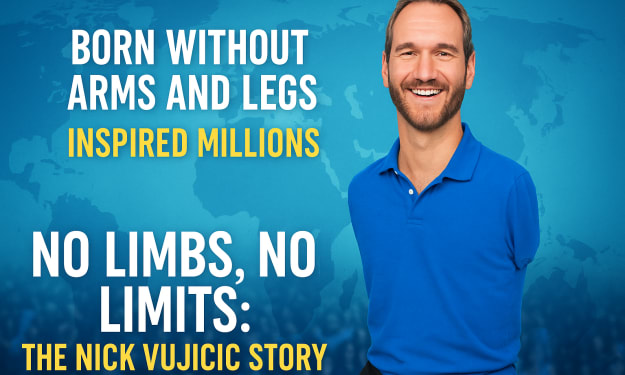
Nick Vujicic: Living Beyond Limits
Nick Vujicic was born in Melbourne, Australia, on December 4, 1982, with a rare condition called Tetra-amelia syndrome — a disorder that meant he was born without arms and legs. For many people, this would be considered the greatest misfortune, a life sentence of difficulty, struggle, and disappointment. And that’s exactly what his parents feared when they first learned of his condition.
By Syad Umar2 years ago in Motivation
The Broken Slippers of Hope
In the heart of a forgotten town, where the streets were filled with potholes and dreams often died before sunset, lived a boy named Iqbal. He wore broken slippers, torn at the heel, but he walked as if he wore gold beneath his feet. The town called him “the slipper boy” — not out of mockery, but because he never complained, never looked ashamed. Iqbal lived with his mother, Naseema, in a single-room clay house with no electricity and only one window. She stitched clothes for wealthy homes and cooked in other people’s kitchens. Her fingers were always sore, her eyes always tired, but her heart beat only for her son’s future. His father had passed away when Iqbal was only four, leaving Naseema with nothing but debts and sorrow. But sorrow never stayed long in their home. Naseema was a woman of faith, hope, and unshakable will. “We may be poor,” she’d say, “but we are not without purpose.” Iqbal never went to a formal school. He studied under the flickering light of a borrowed kerosene lamp, with second-hand books donated by a kind old teacher who visited the slum every weekend. That teacher, Mr. Rehman, saw in Iqbal something rare — hunger not for food, but for knowledge. Iqbal dreamed of becoming a teacher himself — not for money, but to give children what he never truly had: a guide, a chance, a voice. One winter, Naseema fell ill. Her lungs, worn from years of dust and smoke, gave in. But she hid her coughs behind a smile and kept stitching late into the night. Iqbal noticed, but she always said, “It’s just the cold. You focus on your studies.” That year, Iqbal was selected for a scholarship test in Lahore. The exam was in three days, but he didn’t have money for the bus, or decent clothes, or new slippers. Still, he studied harder than ever. The night before the test, Naseema quietly removed her only piece of gold — a tiny nose pin given by her mother — and sold it to a neighbor. She gave Iqbal the bus fare, a clean shirt, and warm parathas wrapped in cloth. “I sold a memory to build your future,” she whispered, placing her hand on his head. Iqbal cried silently that night, holding her hands, rough and cracked, like old parchment. The love in those hands carried more weight than a thousand comforts. The next day, he reached the city. Among hundreds of clean-cut, English-speaking boys, he looked like a shadow — dark, silent, unnoticed. But when the paper came, he saw nothing but light. The questions danced before him, and he answered each with the voice of his mother in his ears, urging him to move forward, to succeed. Two months passed. He never heard back. Naseema grew weaker, her cough deeper, but her faith remained strong. Every day she asked, “Did the letter come?” And every day Iqbal shook his head, though his heart sank a little deeper. Then, one morning, just after Fajr, the postman knocked on their door. A single envelope lay in his hands. Iqbal tore it open with shaking fingers. He had won. The school was a prestigious academy in Lahore, offering free education, a hostel, even a monthly stipend. Iqbal ran to his mother, who was lying under a thin quilt. She couldn’t speak, but her eyes filled with tears. That moment — that shining moment — was the brightest light in their life. Three weeks later, Naseema passed away in her sleep. She never saw him wear the new uniform. Never heard him recite his first English poem. But Iqbal kept going. He rose like the morning sun that had always missed their window. He studied day and night, knowing that every lesson was a tribute to the woman who gave everything she had — even her life — for his dreams. Years passed. Iqbal became a respected teacher, known for his gentleness and wisdom. He opened a school in the same slum where he grew up, naming it “The Naseema Foundation for Education.” Hundreds of children walked its halls, each wearing new shoes, each carrying a backpack full of hope. But in his office, on a high shelf, he kept a strange item in a glass case: his old, broken slippers. Beneath them, a small golden plaque read: “These carried me through darkness, on the shoulders of a mother’s prayer.” He would often stare at them when times got hard, or when he missed her. They reminded him that strength didn’t come from wealth or privilege — it came from love, sacrifice, and belief. Today, people see Iqbal as a symbol of inspiration. He speaks at universities, writes books, and mentors countless students. But he always tells them one thing: “Never forget where you started. Your roots are not your shame — they are your strength.” And he never replaced those slippers.
By Noman Afridi2 years ago in Motivation
From Rags to Respect: The Unseen Journey of a Poor Man's Rise
In a dusty corner of South Asia, nestled between scorched fields and forgotten roads, lived a man named Arman. Born into poverty, his life began in a crumbling mud house where hunger knocked more often than guests. His father, once a skilled woodworker, had died when Arman was just ten. His mother, thin as the shadows that danced across their walls, toiled endlessly to keep the family afloat. Arman sold boiled eggs on a roadside cart. His hands smelled of coal and his clothes bore the dust of despair. But his eyes? They were alive. Alive with dreams far larger than the narrow street he called his world. Every evening, after selling what little he could, Arman sat beneath a banyan tree with torn newspapers, reading stories of people who made it—who climbed out of poverty using only their ideas and grit. One article, in particular, caught his eye. It told the story of a boy who sold handmade toys online and built a small empire. Something stirred inside Arman that night. He couldn’t sleep. The next morning, with trembling hope, he visited his late father’s old shed. The tools were rusted, but still recognizable. He practiced for days, crafting crude wooden shapes. Using the last of his savings and a borrowed phone from a kind friend, Arman created an account on an online marketplace. He uploaded pictures of his toys, praying for a miracle. Nothing happened for a week. Then, suddenly, a message popped up: One item sold. That one sale changed everything. He rushed to a courier office, packed the item in reused cardboard, and shipped it with care. He couldn’t afford fancy wrapping, but he poured his soul into every detail. Days later, another order came. Then three. Then ten. Soon, his tiny room was filled with shavings of wood, half-made toys, and notes from customers praising the “honesty in his work.” He named his collection WoodSoul — a tribute to the spiritual connection he felt with his father’s craft. But growth wasn’t easy. Jealousy reared its head. An old neighbor accused him of copying his design. Rumors spread. Arman could’ve fought back. He didn’t. Instead, he worked harder, creating toys that told stories—an elephant that raised its trunk for good luck, a horse that galloped with dreams, a giraffe that stood tall like his ambitions. Months turned into years. An investor, touched by Arman’s journey shared in a viral blog, offered to fund a small workshop. Arman hired five young boys from his village. “No one should leave school like I did,” he told them. “Learn and earn.” Soon, WoodSoul Creations was a brand. His workshop expanded. He hired women, trained them in finishing and packaging. His toys reached cities he’d never heard of, then crossed borders. One winter, a journalist visited him. Her article, titled “The Boy Who Built Castles with Carved Dreams,” became a sensation. Orders flooded in. Interviews followed. Arman, the once barefoot egg-seller, now wore a tailored shirt and traveled by car. But he still visited the banyan tree every Friday. He didn’t build just a home for his mother. He built a school for children, a small hospital for the village, and a shelter for widows. When asked why, he simply said, “Because someone once trusted me when I had nothing.” His success story became a case study in universities. He was offered awards, titles, even political offers — which he politely declined. “I’m still Arman,” he’d smile. “Just with cleaner hands.” But perhaps his proudest moment came when he placed his father’s worn-out tools in a glass case in his office. Beneath them, a plaque read: “From these hands began the journey.”g GooD G
By Noman Afridi2 years ago in Motivation