healing
How to heal fully and properly.
The Weight of a Single Brick
Ravi stood at the edge of the half-built apartment block, the air thick with dust and the hum of distant cranes. His calloused hands gripped a single brick, its edges rough against his skin. At 42, he’d laid thousands of them—schools, malls, homes—but this one felt different. This brick wasn’t just cement and clay; it was a decision.The site was a mess. Cranes loomed like skeletal giants, their arms frozen mid-motion. Workers shuffled with tired eyes, their chatter replaced by the occasional clink of tools. The project, a 20-story luxury tower in Mumbai’s outskirts, had stalled six months ago when the developer vanished with the funds. Half the crew had quit, leaving Ravi and a skeleton team to guard the skeleton structure. The local papers called it a “monument to greed,” but to Ravi, it was a wound—his wound.He’d grown up in a slum two kilometers away, where his father, a rickshaw puller, dreamed of a brick house. That dream never materialized; the monsoon took it, along with his father’s health. Ravi swore he’d build something lasting. At 18, he apprenticed under a mason, mastering the art of aligning bricks with precision, each one a step toward stability. This tower was supposed to be his masterpiece—a chance to lift his family from the tenement they still called home.But the developer’s betrayal changed everything. The unpaid wages left Ravi’s wife, Priya, juggling two jobs, and his son, Arjun, skipping college to help. The bank was breathing down their necks, threatening to seize their tiny plot. Yet, Ravi stayed. Not out of loyalty, but defiance. He’d finish this tower, even if it killed him.That morning, the site manager, a wiry man named Sanjay, handed Ravi a notice: demolish what’s built, clear the land, and move on.
By TrueVocalabout a year ago in Motivation
The Clock That Wept
Everyone thinks time moves forward. That each tick of the clock pushes us ahead toward growth, toward age, toward death. But what if I told you... time doesn’t move at all? It waits. And sometimes… it watches you break. My name is Elias. I was born in a town where the air smelled of old wood, and the silence of the streets was interrupted only by one thing: the Clock Tower. Every hour, it cried out—a deep, echoing sound that reminded us we were alive… and running out. I was seven when I first asked my grandfather, “Why does the clock cry?” He looked at me with tired eyes. “Because it knows,” he said. “It knows what you don’t.” I didn’t understand then. But the older I grew, the more I felt it: the burden of time. Birthdays stopped feeling like celebrations. New Years became reminders of what I didn’t achieve. And every tick of the second hand started to sound more like a warning than a rhythm. By the time I turned thirty, I had stopped living. I was a shell working, eating, sleeping—but never being. Until one day… the clock tower stopped. No chime. No ticking. Nothing. The entire town felt it. People gathered outside, staring up at the silent tower as if it had died. For them, it was eerie. For me… it was an invitation. That night, I returned alone. I broke the lock and climbed the spiral staircase, step by step, breath by breath. Dust hung in the air like ghosts of forgotten moments. And at the top, in the heart of the clock, I found something that should not have existed: A boy. He looked exactly like me. Same eyes. Same birthmark. Same scar on the eyebrow. But he was seven. Sitting cross-legged, watching the gears, smiling. “You came,” he said. My throat dried. “Who... what are you?” “I’m you. The part that never moved on.” I staggered back. “You left me here,” he continued, “when you started counting minutes instead of making memories. When you began measuring life by deadlines instead of daydreams.” I wanted to speak but guilt choked me. He stood up and walked toward a small gear at the edge of the clock’s mechanism. “This is where time stopped,” he whispered. “Not for the world just for you.” And he pointed to the center of the gears, where a memory played like a film reel. It was me at twenty-four kneeling by a grave. My mother’s.
By AK Popalabout a year ago in Motivation
The Night Everything Fell Apart
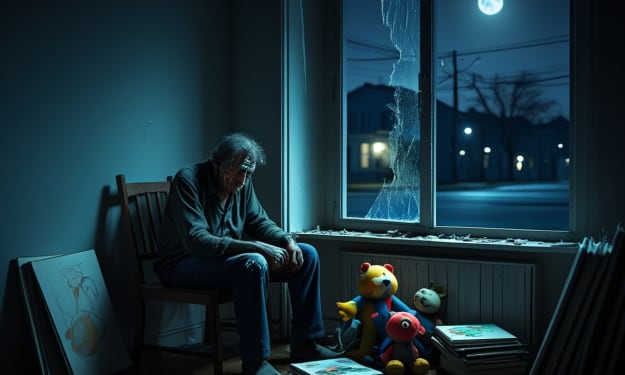
That night, James felt his world shatter in silence. The cold wind outside whispered through the cracked window panes, but inside the small apartment, a storm was raging far fiercer. His hands trembled uncontrollably as he stared at the empty chair across the room once occupied by Emily, his daughter, the light of his life. Now, the chair was hollow, just like his heart. Hours earlier, a simple misunderstanding had turned into painful silence, which then grew into a distance so vast, it felt impossible to cross. Emily had packed her bags quietly and left without a word. James tried calling her, texting her, but every attempt was met with silence. The last words they exchanged haunted him: “You never understand me.” As the night deepened, memories flooded James’s mind the first time he held Emily in his arms, her first steps, the countless laughter-filled evenings. Every memory reminded him of what he had lost in a moment of pride and stubbornness. Tears streamed down his face, unrestrained. For the first time in years, James felt completely helpless. But amidst the darkness, a fragile hope sparked. James realized that if he truly loved his daughter, he had to act, not just speak. Words had failed them both, but actions could bridge the gap. At dawn, James closed his small carpentry workshop, which he had poured his heart into for years. He gathered Emily’s favorite childhood toys, her worn-out sketchbooks filled with colorful drawings, and a small photo album of their happiest moments. Clutching the bundle tightly, he stepped out into the city streets, determination shining in his weary eyes. The city was bustling, indifferent to his pain. People brushed past him, caught up in their own lives. But James moved with purpose, navigating the maze of streets toward Emily’s apartment. Along the way, doubts gnawed at him Would she forgive him? Would she listen? But each question was met with a stronger resolve not to give up. Every step was heavy, yet hopeful. He recalled Emily’s favorite park bench, where they had spent countless afternoons. He decided that if she wasn’t home, he would wait there, hoping she might come back. Hours passed. The sun climbed high, casting long shadows on the pavement. Exhausted but unwavering, James finally reached her building. His heart pounded as he climbed the stairs, clutching the precious bundle. His hands shook violently as he reached her door. He knocked softly, fear and hope tangled together in his chest. The door opened a crack. Emily’s eyes, red-rimmed and wary, met his. For a moment, silence stretched between them a fragile bridge of emotions. Then, tears welled up in Emily’s eyes, and without a word, she stepped aside, allowing him in. That evening, in the quiet of her apartment, they talked. Not just about the fight, but about everything they had bottled inside the misunderstandings, the pain, the love. No accusations, no blame just honest, aching words. James apologized not just with words, but with a promise to listen, to understand, to never let pride come between them again. Emily, too, opened her heart, revealing her fears and loneliness. By the time night fell again, a new bond was forged one stronger than before, born out of pain, healing, and the unbreakable thread of love. Life Lesson: Life will sometimes break you down, testing your limits with pain and despair. But it is through that pain that we learn the true meaning of love patient, forgiving, and relentless. Small misunderstandings can create mountains between hearts, but with courage and humility, even the deepest divides can be crossed. Never let pride silence your heart’s voice. Reach out, listen, and hold tight to those you love, for relationships are fragile gifts that need nurturing every day.
By Ashraf about a year ago in Motivation
I Forgot How to Receive Support
I don’t remember the last time someone asked how I was doing not in the polite, passing kind of way. I mean really asked. Eyes holding mine, voice steady with care. I’ve always been the one on the other end the safe landing, the anchor, the one people call when their world collapses. I didn’t mind it at first. It gave me purpose. It made me feel… worthy. But somewhere along the way, I forgot how to receive support. I forgot how to say “I’m not okay.” Because strength, for me, became silence.
By Zanele Nyembeabout a year ago in Motivation
From Small Buns to Billion Dreams
In the dusty sun of 1940s California, nestled along Route 66 in the small town of San Bernardino, stood a modest drive-in burger stand. There were no neon lights, no golden arches, no corporate buzzwords. Just two hardworking brothers, their tiny kitchen, and a simple mission: serve delicious food fast, fresh, and cheap.
By MIGrowthabout a year ago in Motivation
The Millionaire’s Mirror: Lessons from the Man Who Thought Differently
People in the small coastal town of Grayrock whispered about Elias. Some called him lucky. Others said he was just a brilliant investor. But most simply wondered how a man who once sold used radios at flea markets had become one of the town’s wealthiest figures... and why he still wore worn-out shoes and ate at the same diner every morning.
By MIGrowthabout a year ago in Motivation
They Called Me Brave. I Called It Survival
They called me brave. They said it like a compliment like I was a warrior, like I had conquered something, like I should be proud. And maybe I should’ve been. But what no one saw was the shaking hands I hid behind closed doors. The quiet sobs into my pillow at 2 a.m. The way I’d rehearse my “I’m okay” like a script before stepping into a room full of people. Because being strong didn’t feel like a victory. It felt like survival. Like carrying a world that no one else could see.
By Zanele Nyembeabout a year ago in Motivation
The River That Forgot to Flow
There once was a river nestled deep within an ancient valley, hidden from the eyes of most travelers. It had flowed for centuries graceful, wild, and free carving paths through stone, whispering to the trees, and nourishing every creature that touched its banks. It didn’t ask for thanks, didn’t expect recognition. It simply was untamed, constant, alive. But one day, something changed. The river stopped. Not frozen. Not dried. Just… still. As if it had forgotten what it meant to move. Birds circled overhead, confused by the silence. Leaves dropped from branches and lay upon its glassy surface, unmoved. The fish, once vibrant dancers in its current, now drifted in slow, bewildered spirals. The deer didn’t come to drink. The breeze didn’t hum across its surface. The world that had once revolved around its rhythm began to decay not with a crash, but with quiet. Many believed the river had died. But deep within the heart of the still water, the river was alive and listening. It had grown tired. For centuries, it had given and given. People came to wash away their pain, animals to quench their thirst, storms to dump their rage, and the sun to take what little moisture was left. And the river? It gave. Tirelessly. Endlessly. Without pause. Without question. It never once stopped to wonder: “What about me?” It had no voice, yet it had always spoken—in ripples, in rushes, in roars. But now, in its stillness, it began to hear something it hadn’t in a very long time: Silence. And in that silence, a single, trembling question rose like mist: “Who am I, if I do not flow?” The answer did not come from the mountains that once fed it, nor from the sky that once wept into it. It came from below from a small, round pebble nestled in its bed, a stone who had lived its entire life in the river’s presence. "You are not just movement," said the pebble, its voice like a memory. "You are not just a path for others to follow. You are reflection. You are memory. You are the mirror in which the sky sees itself." The river was stunned. All its life, it had believed its worth came from what it did not from what it was. Its motion had been its identity. Its giving, its validation. “But if I don’t flow,” the river whispered, “won’t they all leave me?” The pebble was quiet for a long moment. Then, gently, it replied, “They already have. And still, you remain.” That truth pierced the river like lightning. It had spent eternity trying to be useful, trying to be needed. It had sacrificed itself again and again, pouring out everything it had only to be left empty and alone. And so, it stayed still. Days passed. Then weeks. Then an entire season. Rain came and went. The sun burned and faded. The world turned, but the river did not move. Until one morning, a small child wandered to its edge. No bucket in hand. No intention to swim. She didn’t throw stones or scream into its silence. She simply sat… and looked. She saw it not as broken or failed but as beautiful. She marveled at the way the morning sky rested perfectly on its surface. She watched a dragonfly skim across the top, creating tiny rings of life in the quiet. She smiled not at its motion, but at its stillness. And in her silence, the river saw something it hadn’t known it needed: not expectation, but wonder. Something stirred. Not much. Just a whisper. A single ripple curled around the child’s reflection, as if the river had exhaled. It did not return to the river it once was. It did not roar or rush. It began to move slowly not to serve, not to satisfy but to express. Its movement was no longer an obligation. It was a language. A kind of art. A dance between presence and pause. And those who came back to it noticed something new in its waters not just refreshment or beauty, but truth. They saw a river not rushing to prove its worth, but existing in it. Moral: Sometimes in life, we forget that *being* is enough. We become rivers that only flow for others always giving, never resting. We define ourselves by our utility, our productivity, our ability to help, fix, do. And in doing so, we forget our own soul’s current. But it is not weakness to pause. It is wisdom. In stillness, we meet our reflection. In silence, we meet our truth. And in choosing to move because we feel it, not because we must, we return to ourselves.
By Ashraf about a year ago in Motivation