happiness
Happiness, defined; things that help you find happiness, keep it, and share it with others.
Not Everything ‘Bad’ Is Actually Bad, You’ve Just Been Programmed That Way
Let’s get this straight. We’re living in a world that worships appearances more than substance. If something doesn’t fit the socially filtered Instagram aesthetic or some unwritten rulebook of how to "properly exist as a human being," it’s automatically labeled as bad. But guess what? Some of those “bad” things? They’re actually quite decent even healthy, necessary, or liberating.
By Nova Aji Nugroho2 years ago in Motivation
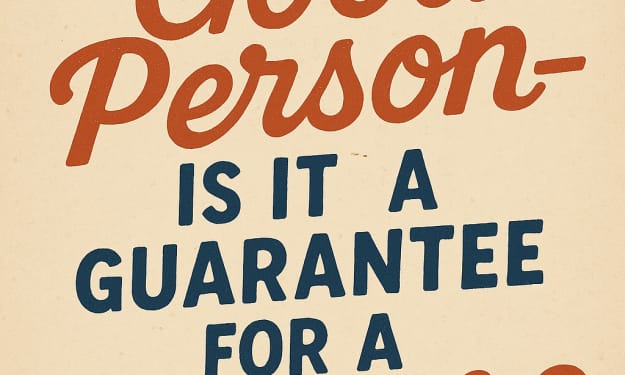
Being a Good Person, Is It a Guarantee for a Good Life?
Let’s start with a brutal sentence that might make you choke on your morning coffee: being a good person doesn’t guarantee you a good life. If that makes you feel disappointed, angry, or nod slowly while whispering “I’ve known that for a long time, bro,” then congratulations you’re officially a member of the club of people who’ve been slapped around by reality.
By Nova Aji Nugroho2 years ago in Motivation
Scientifically Proven Best Morning Routine for Peak Productivity and Wellbeing
Having a scientifically proven morning practice is not just a nice-to-have—it's a must in a world that wants our attention as soon as we wake up. Setting up a meaningful, structured way to start the day can greatly improve your mental clarity, physical energy, and emotional strength. This comprehensive guide will assist us in achieving our utmost potential through the optimal morning routine. It draws from psychological studies, neuroscience, and proven lifestyle habits.
By Bloom Boldly2 years ago in Motivation
I Lost All My Friends, But Found Myself Instead
Let me get this straight: no, I didn’t murder anyone. I didn’t cheat, lie, or join a cult (though if one had free snacks, I might’ve considered). I just... slowly stopped showing up. Group chats became silent museums. Invites dried up. My phone turned from a buzzing social hub into a lonely rock. And somehow, weirdly, it felt like relief.
By Nova Aji Nugroho2 years ago in Motivation
The Paper Boat
In a small village near a wide river, floods were a regular part of life. Every year, the heavy rains would come and the water would rise. The streets would fill with muddy water, and people would climb onto rooftops or seek shelter in nearby schools and temples.
By Nihal Khan2 years ago in Motivation
The Rainy Stall
In a small town, on a crowded street full of noise and people, there was a tiny tea stall. It didn’t look like much—just a wooden table, a big kettle, a few cups, and an old umbrella for shade. But what made the stall special was the woman who ran it.
By Nihal Khan2 years ago in Motivation
The Rabbit, the Turtle, and the Second Race
Once upon a time, in a lush green forest filled with chirping birds and whispering trees, there lived a turtle named Taro and a rabbit named Remy. Most animals knew them from the famous race they had long ago—where the fast and boastful Remy had lost to the slow but steady Taro.
By Nihal Khan2 years ago in Motivation
12 Proven Strategies to Save Money on a Tight Budget
Managing finances on a limited income can often feel overwhelming, especially when expenses seem to rise faster than earnings. However, with the right mindset and practical strategies, even the tightest budgets can be managed effectively. The key lies in building financial habits that support long-term savings without compromising essential needs.
By Nasratulllah Barakzai2 years ago in Motivation
Genius: a journey into the minds of the greats
In 1921, Albert Einstein found himself in a corner of his room in Princeton, United States, immersed in an intense moment of reflection. It was a crucial period in his career, and his mind was focused on a problem that would change our understanding of the universe: the theory of general relativity. While the world outside continued to rush, he sat there, surrounded by scattered papers and incomplete notes. But what made him different from an average person wasn’t just the complexity of his research, but the way his mind worked.
By Halina Piekarska (UltraBeauty Blog)2 years ago in Motivation
The Silent Ache: Living with a Heart That's Broken
The Silent Ache: Living with a Heart That's Broken. Heartbreak. We all know it, but we try to avoid using it. It is more than just an emotional sting; it is also a weight, a quiet ache that sinks deeply into the soul and cannot be ignored. When your heart is broken, the world doesn't stop spinning, but everything feels off-axis. It's like walking through fog and simultaneously experiencing everything and nothing. We often think of heartbreak as romantic love, but it can come from many different things: the death of a friend, a betrayal, a dream that didn't come true, or the long silence after an argument with someone you never thought you would lose. Heartache is universal, regardless of the cause. It's just human nature. Time is said to heal all wounds, but heartbreak does not follow a routine. Some days you're fine. On other days, a song, a smell, or a place can completely break you. It sneaks up , uninvited, and pulls you back into that hollow space where love once lived. .
By Tamim Ahamed2 years ago in Motivation
How Our Mind Creates the Enemies We Fear Most
A Chilling Psychological Experiment In the United States, inside ADX Florence—the most secure prison in the country—a disturbing psychological experiment was conducted on a death row inmate. Scientists were granted permission to study the power of the human mind. Instead of executing the prisoner by hanging, they showed him a highly venomous snake and told him, "In 40 days, this snake will bite you, and you will die from its venom." For the next 40 days, the prisoner was kept in complete isolation, with nothing but his fear consuming him. As time passed, the psychological toll became evident—his heart rate became erratic, he lost his appetite, and he suffered from severe insomnia. He woke up night after night drenched in sweat, trembling at the thought of the snake’s fangs sinking into his skin. His body began reacting as if he had already been poisoned—his hands shook, his breathing weakened, and his immune system started shutting down—despite being physically unharmed. When the 40 days ended, the scientists blindfolded him. Instead of using a real snake, they pricked his skin with a needle, mimicking a snakebite. The moment the prisoner felt the "bite," his body went into shock. His breathing became shallow, his muscles stiffened, and his heartbeat slowed. Within minutes, he was dead. The autopsy revealed something shocking—his body displayed the exact same effects as a fatal snakebite, yet no venom was present. His own brain had produced the poison that killed him. This is not fiction. It is a terrifying demonstration of how fear alone can be lethal. Our greatest enemy isn’t always external—sometimes, it’s our own mind. The Brain: A Double-Edged Sword The human brain is a biological marvel, a complex network of billions of neurons orchestrating everything from our breath to our deepest emotions. It allows us to love, create, and navigate the world. Yet, like any powerful tool, its effects depend on how it’s used—or, more accurately, how it uses us. The prisoner’s death was not caused by a physical snake but by the idea of one—a fear so deeply ingrained that it manifested physically. This phenomenon, known as the nocebo effect, is the dark counterpart to the placebo effect. It proves that negative expectations can produce real, harmful outcomes. How Fear Shapes Reality Think about your own life. How often has fear held you back? Fear of failure, judgment, or the unknown? These fears aren’t tangible threats like a predator in the wild—they are mental constructs, projections of the brain based on past experiences or imagined futures. Yet, they trigger real physiological responses: a racing heart, shallow breathing, muscle tension, and mental fog. Chronic fear floods the body with stress hormones, weakening the immune system, disrupting digestion, and contributing to long-term health issues. The brain, trying to protect you, ends up sabotaging your well-being. The Brain’s Deceptive Narratives Our thoughts and beliefs shape our reality, yet they are often based on distortions. The brain filters information through past conditioning, creating patterns and narratives that may not reflect truth. Consider your inner voice—the constant stream of thoughts commenting, judging, and worrying. Is this voice truly you, or is it an automatic program running outdated scripts? Phrases like "I can’t do this," "I always fail," or "I’m not good enough" aren’t facts—they are reinforced beliefs that solidify into identity. The brain constructs a story about who you are and then filters reality to confirm it. This is the essence of self-imposed limitation. The Illusion of Reality The brain doesn’t just influence emotions—it constructs our entire perception of reality. What we see, hear, and feel is not an objective truth but an interpretation. Our senses capture only a fraction of the world, and the brain fills in the gaps, creating a coherent (but often flawed) picture. Ancient wisdom traditions have long recognized this. Hinduism speaks of Maya, the illusion that veils true reality. Buddhism describes Samsara, the cycle of suffering fueled by attachment to mental constructs. These teachings suggest that ordinary consciousness is like a dream—and awakening means seeing through the mind’s illusions. Breaking Free from Mental Prisons The solution isn’t to fight the brain but to become aware of its mechanisms. Mindfulness and meditation help us observe thoughts without identifying with them. Instead of being swept away by fear or negativity, we learn to step back and recognize these patterns as passing phenomena. Neuroplasticity shows that we can rewire our brains through conscious practice. By cultivating awareness, we weaken fear-based pathways and strengthen those linked to clarity and peace. The Path to Liberation The prisoner died because he believed his mind’s story without question. But we don’t have to. The key lies in recognizing that: Thoughts are not facts. They are mental events, not absolute truths. Fear is a survival mechanism, not a prophecy. It can be acknowledged without being obeyed. Awareness is freedom. By observing the mind instead of being controlled by it, we reclaim our power.Start writing...
By BeyondTheVeil2 years ago in Motivation