happiness
Happiness, defined; things that help you find happiness, keep it, and share it with others.
The Greedy Fox
The Greedy Fox Once upon a time, in a lush green forest, there lived a clever but greedy fox named Felix. Felix was known for his sly tricks and his endless hunger. No matter how much food he found, he always wanted more. The other animals often warned him about his greed, but Felix never listened.
By Shahzad Khan2 years ago in Motivation
How Elon Musk become the world richest man
In 1984, while most kids were busy playing video games, a 12-year-old boy was busy making his own game. He was different from everyone else—smart, curious, and full of big ideas. But being different wasn’t easy. He had no friends and was bullied badly. Still, he didn’t give up. That boy was Elon Musk, who is now the richest man on Earth—building rockets, electric cars, and AI tools. Early Life Elon was born in 1971 in Pretoria, South Africa. His dad was a mechanical engineer, and his mom was a model and dietitian. As a child, Elon would often go into a “trance,” where he looked lost. Everyone thought he had hearing issues, but it turned out his brain worked like a supercomputer—he was just deeply focused on ideas. He loved reading science fiction and encyclopedias. Once, when a cousin said she was scared of the dark, Elon said, “Darkness is just the absence of light.” He always spoke in facts, which made other kids avoid him. He was bullied often—once he was beaten so badly he had to be hospitalized. Till the age of 8, Elon’s life was normal. Then his parents got divorced. Elon chose to live with his dad. At age 10, he saw a computer in a mall and asked his dad to buy it. The computer had only 5 KB of memory and came with a workbook to learn BASIC coding. While most people took six months to complete the book, Elon did it in three days without sleep. At age 12, he made a space shooting game called Blaster and sold it for $500. That was his first business. As he grew older, Elon felt he was meant for bigger things—and for that, he needed to move to America. Journey to America To get to the U.S., he first went to Canada because he had relatives there. At 17, he moved, did odd jobs, and later studied at Queen’s University. After two years, he transferred to the University of Pennsylvania in the U.S. In 1995, after college, Elon and his brother Kimbal had an idea. Back then, people still used paper maps and phone books to find local businesses. So, they created a website that listed local businesses with maps—something like Google Maps today. They called it Zip2. Elon coded the site, while Kimbal went door-to-door getting businesses to join. It started small, but soon got big. The company raised millions in funding. In 1999, Compaq bought Zip2 for $307 million. Elon got $22 million. He could have retired rich. But he was just getting started. Building PayPal Elon saw that banks were old-fashioned. He wanted to put all banking—payments, loans, and savings—online. So he started a company called X.com in 1999 and gave $20 to each new user to get sign-ups. Around the same time, Peter Thiel started PayPal, a similar company. Instead of competing, the two companies merged. Elon became CEO. But many people didn’t like the name X.com, while customers preferred PayPal. Elon was also known for being too strict. While he was on his honeymoon, the board replaced him with Peter Thiel as CEO. Still, Elon was the biggest shareholder. In 2002, eBay bought PayPal for $1.5 billion. Elon got $180 million from the deal. Personal Loss and New Dreams Right after PayPal's success, tragedy struck. Elon lost his baby son at just 10 weeks old. To deal with the pain, he buried himself in work. As a child, Elon loved rockets. In 2001, he wondered why no one had gone to Mars yet. He learned that NASA had no clear plans. So he decided to start his own space company. He even tried to buy rockets from Russia but failed. That’s when he said, “Let’s build our own rockets.” And just like that, SpaceX was born in 2002. Starting SpaceX Elon wanted to make rockets cheaper and faster. He hired top scientists and built a team. They worked differently—design and build teams worked side-by-side to save time and reduce mistakes. They also made rocket parts in-house to cut costs. Their first rocket, Falcon 1, was ready in 2006. But it failed three times in a row. Elon had already spent $100 million. They had money left for just one last launch. At the same time, Elon had joined another mission—Tesla. Starting Tesla Gas cars were harming the environment, and Elon believed electric cars were the future. He found a startup named Tesla Motors that was working on an electric sports car called Roadster. Elon joined in 2004 as a lead investor. Making the car was tough. They used laptop batteries (lithium-ion) instead of old lead-acid ones. But costs kept rising. By 2007, the car cost $100,000 to build, way more than expected. In 2008, the global financial crisis hit. Investors backed out. Elon sold his luxury cars and homes to keep Tesla alive. Back at SpaceX, the fourth Falcon 1 rocket launched in September 2008—and finally, it worked. It reached orbit. A few weeks later, NASA gave SpaceX a $1.6 billion contract. SpaceX was saved. Saving Tesla Tesla still needed money. Elon personally reached out to investors. On Christmas Eve, they received $40 million in emergency funding. Tesla was saved at the last minute. The Roadster proved that electric cars could be fast, stylish, and long-range. In 2012, Tesla launched Model S, a luxury electric sedan with a 500 km range and top tech features. It wasn’t just a car—it was like a computer on wheels. Model S won many awards. Tesla went public, and by 2013, it became profitable. Now and the Future Tesla later launched Model X, Model 3, and Model Y. By 2017, it became the world’s most valuable car company. Tesla is now working on self-driving cars. SpaceX is working on missions to Mars. From being bullied as a child to becoming a tech icon, Elon Musk’s story shows how powerful big dreams and hard work can be. He faced failure, loss, and rejection—but kept going. And that made all the difference.
By SophiaSoso2 years ago in Motivation
A Thousand Miles to Myself
Ravi stood at the edge of the mountain trail, his backpack feeling heavier than it should have. The sun had just begun to rise, casting long golden fingers across the path that disappeared into the forest. This was it—the moment he’d been dreaming about for years. And yet, his feet wouldn’t move.
By Mansoor Ahmad2 years ago in Motivation
Ambition Under Survival. AI-Generated.
In times of comfort, ambition feels limitless. We envision our best selves conquering vast, uncharted territories—in careers, relationships, passions. The hunger for "more" is painted with the bright colors of dreams: a better job, a bigger house, a lasting legacy. But what happens when life tightens its grip, and "more" is no longer about flourishing but simply surviving? What becomes of ambition when survival is all that matters?
By Ahmet Kıvanç Demirkıran2 years ago in Motivation
The Power They Feared
In a quiet village nestled between rolling hills and emerald forests, there lived a boy named Ishan. He was not the strongest, nor the fastest, nor the most talented among his peers, but there was something in him that others couldn't quite put into words. His eyes carried a quiet determination—like a candle that refused to flicker out, even in the wind.
By Mansoor Ahmad2 years ago in Motivation
12 Powerful Messages to Inspire Your Journey. AI-Generated.
01 - "You don’t need to be ready, you just need to start." Most people wait for the “perfect moment,” but it almost never comes. When you take action with what you have, even without feeling prepared, you make the most important move. The beginning is the hardest part, but it’s also where the real change begins.
By Fabio Leite2 years ago in Motivation
How She Turn herself from a Pro Athlete to award-winning screenwriter
This Woman is a professional Athlete , she was broke her shoulder in a bike crash just a day before competing in a triathlon in Costa Rica in 2016. This was a big chance Despite the injury, she forced herself to participate in the triathlon, the reason why she participated in triathlon despite of injuries is mind blowing reason.
By Nav k Aidan2 years ago in Motivation
The Day I Unplugged: How 24 Hours Without Internet Changed My Life
Last Friday, an unexpected event flipped my world upside down — my Wi-Fi suddenly stopped working. At first, I didn’t panic. I assumed it was just a small issue. Like every modern human, I went through the standard rituals: restart the router, unplug, replug, check the network settings. But nothing worked.
By MD Saiem Akanddo2 years ago in Motivation
The Cat’s Eye and the Rat’s Fight
In every alleyway of the world, there exists a silent battle—one that’s older than memory, older than names. A single moment in time when the cat's eye catches the flicker of something beneath the trash bin—a whisper of movement, a brush of tail. And just like that, the game begins.
By Md. Ashraful Azad2 years ago in Motivation
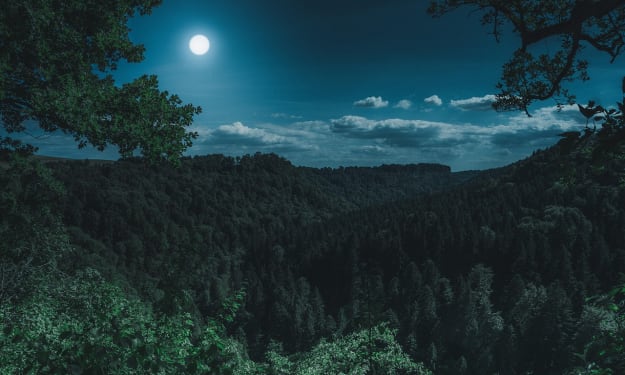
MOON. AI-Generated.
Humanity has always been fascinated by the Moon, Earth's only natural satellite. Glowing in the night sky with a calm and mysterious light, the Moon has inspired countless myths, poems, scientific studies, and dreams of exploration. Its soft glow has been a guiding light for ancient travelers, a timekeeper for early calendars, and a muse for storytellers across cultures. People have always looked up and been curious about that far-off, glowing orb—how it got there, what it is made of, and whether or not anything lives on its surface. With its gentle cycles—from new moon to full moon and back again—it has been a symbol of change, time, and even emotion. The Moon influences Earth in more ways than most people realize. It controls the tides through its gravitational pull, affecting the oceans in a daily dance of rising and falling water. The Earth's rotation is also subtly slowed by this pull, which gradually alters the length of our days. Beyond science, it plays a major role in cultures, religions, and spiritual beliefs, often associated with femininity, mystery, and magic. Scientifically, the Moon is about 1/6 the size of Earth, and it's roughly 384,400 kilometers (238,855 miles) away. Its surface is covered in dust, craters, and ancient lava plains called “maria.” Because it lacks a significant atmosphere, there’s no wind or water to wear things down, so even footprints from astronauts still remain, untouched for decades. One of the greatest human achievements was landing on the Moon in 1969. When Neil Armstrong took that historic first step and said, “That’s one small step for a man, one giant leap for mankind,” it wasn’t just a moment of American pride—it was a moment for all humanity. We gained a better understanding of the Moon's composition and origin thanks to the Apollo missions. The majority of scientists now believe that the Moon was formed billions of years ago when an object the size of Mars came into contact with the young Earth. The impact sent debris into space, which eventually gathered to form the Moon. Despite being barren and lifeless, the Moon still holds potential for the future. Scientists are looking into the possibility of establishing bases on the Moon and using it as a launch pad for further space missions. It has resources like water ice in the polar regions on its surface that could be turned into rocket fuel or used as drinking water. Because of its lower gravity and lack of atmosphere, it’s an ideal candidate for future spaceports or observatories. The Moon also affects us psychologically and emotionally. For some, it brings feelings of calm and wonder. For others, particularly during the full moon, it sparks stories of werewolves, madness, or unusual behavior. These stories have been passed down for centuries, even if science doesn’t always support them. The Moon also plays a key role in art and literature. The Moon is frequently used as a symbol of love, loneliness, mystery, or hope in both ancient writings and contemporary music and movies. Artists and writers often use it as a symbol of longing or reflection. Even in modern times, we continue to turn to the Moon for inspiration. It is a constant in our sky and a quiet observer of all human activity, from the rise and fall of empires to moments when people just look up in awe at it. It’s there for everyone, no matter where you are on Earth. The Moon connects us—past, present, and future. In many cultures, lunar calendars are still in use, and festivals such as the Mid-Autumn Festival in China or Ramadan in Islam are based on the Moon’s cycles. These traditions show how deeply the Moon is embedded in our daily lives and history. Despite all our technological advances, the Moon remains a frontier. People are once again dreaming of going back—not just to visit, but to stay. New missions by NASA, private companies, and other space agencies aim to build bases, conduct research, and prepare for journeys beyond, like Mars. The Moon, silent and still, may one day be the site of humanity’s next great leap. In a way, the Moon is a mirror—not just reflecting sunlight, but reflecting humanity’s curiosity, ambition, and capacity for wonder. It reminds us that even though we are small in the vast universe, we are capable of reaching far beyond our grasp. The Moon is not just a rock in the sky; it is a part of Earth’s story, and of ours.
By Chayon Shikder2 years ago in Motivation
The Tortoise and the Eagle – An Unlikely Friendship
In a lush green forest, where trees touched the sky and rivers sang through the land, there lived a tortoise named Timo. Timo was very slow, but he was wise and had a determined heart. In the same forest lived an eagle named Elara, known for her swift flight and love for the skies. Elara often soared high above, looking down at the forest below. She would see Timo crawling slowly across the forest floor and couldn’t help but laugh. “Timo! You’re always crawling. Don’t you ever wish to fly like me, to touch the sky?” she teased. Timo would smile and reply, “My path is different, Elara. I may move slowly, but I always reach my destination.” Elara laughed loudly. “At this pace, it’ll take you a century to achieve anything!” Days passed. Elara stayed busy exploring the skies, while Timo continued his quiet journey on the ground. He stayed close to the earth, met different animals, rested under trees, and slowly discovered the secrets of the land. One day, Elara spotted a towering mountain. On its peak bloomed a rare golden flower, said to release its scent only to those with a pure heart. Elara decided to reach the peak. She flew swiftly toward the mountain, but as she got closer, the weather changed. Dark clouds rolled in, thunder rumbled, and strong winds howled. Caught in the storm, Elara lost control. A powerful gust slammed her into a tree. She crashed down, injuring one of her wings. She couldn’t fly anymore. Lying on the ground in pain, fear crept in. Night fell, and the jungle grew cold and dangerous. Just when she thought all hope was lost, a familiar voice called out: “Elara… are you okay?” To her surprise, it was Timo! “I saw you fall,” he said gently. “I’ve been searching for you ever since.” Tears welled up in Elara’s eyes. “You came for me… even after how I treated you?” Timo smiled and replied, “True friendship isn’t measured by speed. It’s measured by heart. I may be slow, but I always do what’s right.” Carefully, Timo lifted Elara onto his back and step by step carried her to a nearby cave for shelter. All night, he kept her warm, gathered leaves, found water, and stayed by her side. By morning, something had changed in Elara. For the first time, she saw the world from the ground—from Timo’s perspective. She realized that true beauty wasn’t only in flying high, but also in staying grounded, humble, and kind. For many days, Timo took care of Elara until her wing healed. In that time, a deep friendship grew between them. One day, Elara looked up at the sky and said, “I can fly again, but you’ve shown me that there’s more to life than speed and height—like patience, kindness, and truth.” She flew once more toward the mountain, but this time, her heart was full of gratitude instead of pride. When she reached the golden flower, its scent surrounded her—a sign that her heart had truly changed. Elara didn’t pick the flower. Instead, she left it there, like a silent message: some things are more beautiful when left untouched, just like the lessons we learn from the ground. --- Moral: In the race of life, it’s not always the fastest who win. True success belongs to those who walk with patience, kindness, and determination. A slow journey, taken with purpose, can still lead to the greatest heights.
By Mr How2 years ago in Motivation