happiness
Happiness, defined; things that help you find happiness, keep it, and share it with others.
Mental Health and Psychosocial Support
Mental Health and Psychosocial Support: Nurturing the Mind in a Rapidly Changing World • In the world associated with the rapid kid today, mental well-being, no longer a luxury is a must. As the companies evolved and the sort of health care, support of mental and psychosocial (mph’s) have become vital pine stones public health and human resistance. From the classrooms to the business rooms, the refugees fields in remote remote countries, which call the priority mental health is louder than .understanding mental health and psychosocial support Mental health refers to the emotional person of a person and social and social. This affects the way we think, you are to act and make life. This affects the way of the stress manage, we are linked to others and make choices. A good mental health does not mean a mental illness, but unlike the presence of balances, of the goal and emotional scope., meanwhile the psychosocial support to fill a wide range of services that help people manage the disaster, and restore a sensation of Normalized during or after a crisis. This may include advice, support by the culls, educational programs, lists of lists and community to community and the connection. Together, mental health and support psychosis form a full-full square to healing, build-up and promote emotional force. Because it counts more than ever last decides about was marked by global uncertainty. Cuckoo Pandemia-19, climate DISASTBI, COMPLETED MEANS, Economic and Supreme difficulty increased created new layers of psychological pressure. These pressure have left millions of people with anxiety, depression, tightness and stoic. Kids are lost education and routines, adults were suffered and uncertainty, and a lot of people lost it - that may cause or agreed or aggregate in the fragile regions, where basic needs are already inflated, mental health Support becomes even more critical for survival and recovery. What makes MHPs so important is their ability not to handle mental health problems, but preventing the hopes and rebuild the social cuts supporting well. Provide care of the oils that exceeds individual medicines or therapy to approach the wider context of a person's life. 4.444 Common obstacles for mental health supports despite increasing consciousness, access to effective support remains irregular. Some of the most common obstacles include:
By shoaib khan2 years ago in Motivation
Overcoming Insecurity in Relationships
Overcoming Insecurity in Relationships In the intricate dance of human connection, the shadow of insecurity can often cast a long and unsettling pall. It whispers doubts, fuels anxieties, and can erode the very foundations of what could otherwise be a fulfilling and nurturing relationship. Whether it manifests as a persistent fear of abandonment, a gnawing need for constant reassurance, or a tendency towards jealousy, insecurity acts as a corrosive agent, impacting not only the individual experiencing it but also the dynamic of the partnership itself. Understanding the roots of insecurity and, more importantly, cultivating strategies to overcome it is paramount for fostering healthy and thriving relationships.
By sang ibrani2 years ago in Motivation
If I Were Broke and Starting Over, Here’s What l’d Do
Hey there….. Listen… Imagine, I’m broke, starting over with nothing — no big team, no multiple streams of income, just me and a dream to rebuild my online earnings. That’s the situation I’m picturing today.
By Georgios Adel2 years ago in Motivation
Starting My Journey as a Sexual Violence Advocate. AI-Generated.
Today marked the beginning of something new and meaningful for me. I officially started my online training to become an advocate for STAR®—Sexual Trauma Awareness and Response. It’s a big step for me, one I’ve taken during what feels like a challenging time in my life. But that’s something I’ve noticed about myself over the years: I often choose to begin big, important journeys when things are tough. Somehow, those are the times I grow the most.
By Sajjad Ali2 years ago in Motivation
Digital Detox: How Unplugging Rewired My Mindset
Let’s be honest: we all love technology. From staying in touch with friends to learning new things, it connects us to the world. But somewhere along the way, I realized I was too connected—to the point that I was no longer connected to myself. This is my story. A real, personal journey of how I decided to take a step back, unplug from the digital world, and reconnect with my own thoughts, my mental peace, and my real goals. I never expected how much this decision would change my mindset—and my life. --- When the Screen Becomes a Cage It all started subtly. I wasn't aware that my daily routine had become ruled by my phone. I woke up and instantly reached for Instagram. I couldn’t eat without checking notifications. My focus during study hours disappeared. Even in the middle of conversations, I’d catch myself scrolling aimlessly. Worse, I felt anxious for no reason. My sleep was disturbed, and I was always tired—even after 8 hours in bed. I began to feel mentally foggy, distracted, and emotionally drained. That’s when I knew something had to change. I needed a break, not from the world—but from the screens that were filtering it. --- Starting the Digital Detox I had heard about digital detoxes before, but I always thought, That’s not for me. I’m a student, a creator, and I use tech to learn and grow. But this time, I didn’t want to quit tech forever—I just wanted control back. So I made a plan: 1. No phone for the first hour after waking up. 2. No screen while eating or walking. 3. No devices after 9 PM. 4. Journaling at night instead of scrolling. 5. At least one hour outside daily without any screens. It wasn't easy. The first few days were frustrating. I felt bored. My hands reached for the phone out of habit. But something inside me told me to stick with it—and I did. --- The First Changes Within the first week, something amazing began to happen. I could think clearly. I started sleeping better. I wasn't rushing through everything. I started enjoying my meals again—really tasting them. I was able to finish tasks without checking my phone every 10 minutes. Even my conversations with friends and family became more meaningful. I was truly listening instead of half-hearing things while browsing Twitter. My journal began filling up with thoughts, dreams, and reflections that I didn’t even know were inside me. --- Rediscovering Myself One surprising thing I noticed during this detox was how much time I actually had. Before, it always felt like 24 hours weren’t enough. Now, I had time to walk, read, write, and even just think. That mental space felt like a deep breath I hadn’t taken in years. I started enjoying the little things—sunlight coming through the window, the sound of leaves in the wind, the quiet before bed. I wasn’t rushing through life anymore; I was living it. --- What I Learned After two weeks of digital detox, I learned a few powerful lessons: We don’t need to be online all the time to feel connected. Silence is powerful. It's where real thoughts and creativity grow. Boundaries with technology can improve our relationships, sleep, and mental clarity. Journaling is therapy—and it doesn’t cost a single rupee. --- My Current Tech Routine I didn’t quit technology. Instead, I reshaped how I use it: I keep my phone on silent most of the time. I removed unnecessary apps. I check social media only twice a day. I use screen time limits. I do “silent mornings” where I spend the first hour writing or reading. Now, my tech supports me. It doesn’t control me. --- A Challenge for You If you’re feeling tired, distracted, anxious—or just off—maybe it's time to pause and ask yourself: > “Is my screen helping me grow, or is it holding me back?” Try a digital detox for just one day. Then stretch it to three days, maybe a week. Keep a journal. Watch what happens. The clarity, peace, and control you gain will surprise you—just like it did for me. --- Final Words This digital detox became one of the best things I’ve ever done for myself. It helped me find balance, inner peace, and the version of me that had been hiding under all the noise. If you’re on your own growth journey, I hope my story inspires you to pause, unplug, and start listening to your own thoughts again. Because growth doesn't always mean doing more—sometimes, it means doing less and being present.
By The Growth Journal2 years ago in Motivation
A Cry from a Weary Heart
“Even if no one stays, You do. O Allah, never leave me to myself—not even for a moment.” There are days when I feel like I’m breathing but not really living. My body walks through the world, but my heart drags behind—tired, fragile, and in need of something deeper than rest. No amount of sleep, comfort, or conversation soothes this kind of weariness. It’s not a physical exhaustion—it's a soul that’s searching, aching, yearning. And in the middle of all that silence, there is a whisper that never leaves: Return to Allah.
By Mymuna✯✯2 years ago in Motivation
A Friend of Allah: The Untold Journey of Peer Saifi ur Rehman
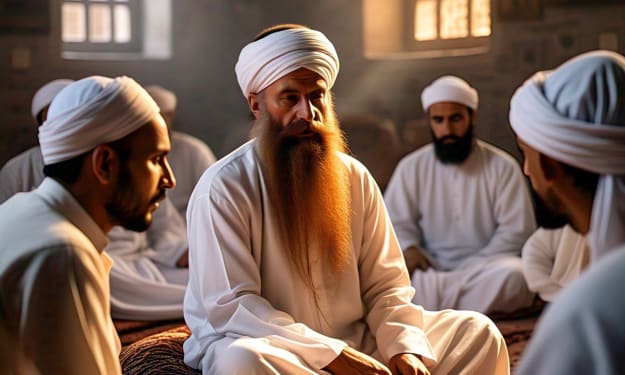
In a world consumed by noise, war, and restlessness, there lived a man whose heart beat only for Allah. His name was Akhunzada Peer Saifi ur Rehman, a saint whose journey began in Afghanistan, amidst conflict, loss, and displacement. Born into a respected and spiritual family, he grew up surrounded by the echoes of dhikr and the fragrance of sincerity. But as violence erupted in his homeland, he was forced to leave behind all he had his property, his peace, and the land of his ancestors. While most would be devastated, Peer Saifi ur Rehman (رحمة الله عليه) did not complain. Instead, he would simply say, "Allah knows best. Alhamdulillah in every condition." He migrated to Khyber Agency, a place nestled in the rugged beauty of the tribal lands, where life was hard, and danger was always near. Here, too, he tried to live peacefully, continuing his path of zikr, dua, and silent service to humanity. But fate had more tests in store. Militant groups and terrorists, suspicious of his peaceful teachings and spiritual gatherings, ordered him to leave the area. Yet, he remained calm. Not a trace of fear, anger, or hatred crossed his face. Instead, he packed his few belongings and quietly migrated to Lahore, Punjab, leaving behind the mountains but carrying within him a heart that was more stable than mountains themselves. He settled in a small area on the outskirts of Lahore, away from the noise of fame or the pull of politics. But soon, people began to hear about him. Not through advertisements or social media but through something far more powerful: the peace that radiated from his presence. People who were mentally shattered, spiritually lost, and morally broken would come to him. Many were burdened by sins, drowning in depression, or carrying guilt that made life feel unbearable. But just by sitting in his company, something would shift. Their hearts would begin to lighten. Their eyes, once dry from hopelessness, would tear up in remembrance of Allah. Without saying a word, Peer Saifi ur Rehman (رحمة الله عليه) would awaken something deep inside them a longing for Allah, a love for the Prophet Muhammad (صلى الله عليه وسلم), and a desire to live by the Qur’an and Sunnah. His karamah were subtle yet undeniable. Once, a young man sat in his company, silently wishing for some guidance about his future he hadn’t uttered a word. But Peer Saifi ur Rehman (رحمة الله عليه) looked at him and answered the very question he held in his heart. When the young man asked, “How did you know?”, he simply smiled and said, “Allah gives to whom He wills.” He never claimed to be a karamah-worker. He never asked for money. He didn’t dress like a king or speak in riddles. He lived simply, ate little, and slept even less his nights were spent in silent conversation with his Lord. His message was always the same: Love Allah, follow the Sunnah, clean your heart, and serve creation. He would say, “A friend of Allah is not known by how loud his zikr is, but by how silent his ego has become.” The true karamah was the way people changed in his presence. A drunkard once came to mock him but left weeping, with a tasbeeh in hand. A thief once sat in the back of his majlis but returned home and gave up stealing forever. His presence was like a mirror when people looked into it, they saw who they really were… and who they could become. Even with all his trials losing his homeland, property, facing threats he remained thankful, never once saying “Why me?” Instead, he always said, “Shukr is the key to peace.” He lived and died as a true Wali of Allah a man whose silence spoke louder than sermons, whose smile healed more than medicine, and whose heart was a bridge between earth and the heavens. Moral: The friends of Allah may live unnoticed by the world, but their hearts carry oceans of light. Through their trials, they teach us that peace does not come from possessions, but from connection with Allah, love for His Messenger, and service to His creation. Disclaimer: This story is shared for spiritual inspiration, based on accounts of Hazrat Akhunzada Peer Saifi ur Rehman (رحمة الله عليه). The karamat mentioned reflect traditional and authentic Islamic belief about the pious. Only Allah knows best.
By Taj Muhammad 2 years ago in Motivation
The Letter I Never Sent: A Goodbye to My Younger Self. AI-Generated.
Dear Younger Me, I don’t know why I never wrote this before. Maybe I was afraid to face you. Maybe I thought I had moved too far past who you were. Or maybe—deep down—I didn’t want to admit that you’re still a part of me.
By Head Hunter2 years ago in Motivation
She Accidentally Made $5 Million from a Spreadsheet—and Changed the Way People Think About Side Hustles
It didn’t take a business degree or a massive audience. It wasn’t a startup pitch or some complicated blueprint. It was just a regular woman, alone in her bedroom, making quirky videos about spreadsheets—and somewhere along the way, she stumbled into millions.
By Ojo2 years ago in Motivation
"The Final Hour"
"The Final Hour" It was the last hour before the final exam of the year, and Aria sat alone in the campus library, her heart racing and hands trembling. Her laptop sat open, but the words on the screen blurred with every blink. For the past few weeks, she had been juggling classes, a part-time job, and her ailing mother’s care. Sleep had become a luxury. Confidence? A memory.
By VISHWANATHA2 years ago in Motivation
"The Power of One More Try"
"The Power of One More Try" It was a chilly morning in early March when Daniel Harper stood at the edge of the old running track in his small hometown of Brookville. The same track where he once shattered high school records was now cracked and fading, much like his own belief in himself.
By VISHWANATHA2 years ago in Motivation