happiness
Happiness, defined; things that help you find happiness, keep it, and share it with others.
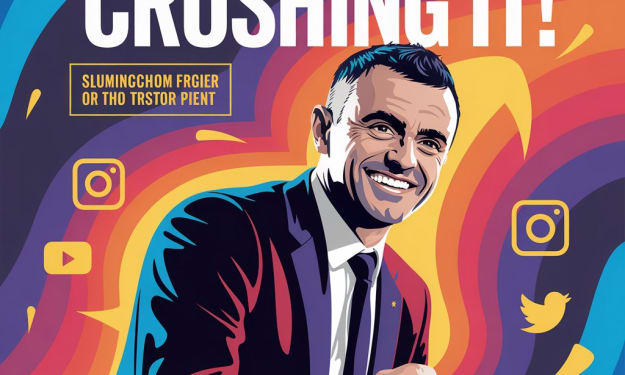
Crushing It!
The Foundation of Crushing It! Gary Vaynerchuk starts the book by discussing the importance of personal branding in the digital age. He believes that anyone, from a small-town entrepreneur to a large corporation, can use social media and online platforms to build a recognizable personal brand. Personal branding, according to Vaynerchuk, is no longer just about self-promotion. It’s about authenticity, providing value to your audience, and being consistent across platforms.
By Muhammad HUzaifaabout a year ago in Motivation
A Village Heart in an Urban World
In the heart of a bustling city, surrounded by skyscrapers, honking cars, and relentless routines, I often find myself pausing to listen—not to the noise around me, but to the quieter rhythm of where I come from. The village. The dusty paths, the sound of roosters at dawn, the laughter of barefoot children, and the peaceful rustle of wheat fields under the breeze. That world feels far away now, yet it lives in me—because I carry a village heart in an urban world. Where It All Began I was born in a small village tucked away in the mountains of Khyber Pakhtunkhwa, Pakistan. Life was simple—sometimes painfully so. We didn’t have much: no fancy gadgets, no fast food, no shiny malls. But we had each other. Neighbors were like family, and a shared meal meant more than any restaurant experience ever could. The village taught me values that no textbook could: respect for elders, the power of hard work, the beauty of silence, and the strength of community. But it also came with its limitations—especially for someone like me who had big dreams stitched quietly into the fabric of his mind. Stepping Into the Unknown My first day in the city was unforgettable. Everything moved faster, sounded louder, and felt bigger. I was a stranger here—lost in a sea of strangers. I barely understood the city’s language, not just literally but emotionally. People didn’t smile as easily. Time felt like money. Relationships were fleeting, and loneliness wore a new face. I remember feeling like I didn’t belong. My village accent made people laugh. My clothes made me look “different.” I was seen as unpolished, unprepared, even unintelligent. The city had sharp edges, and I was still too soft. But every time I wanted to give up, I remembered where I came from—not with shame, but with pride. My village had raised a fighter. My struggle wasn’t a sign of weakness—it was proof I was growing. Learning to Walk Tall Adapting to city life wasn’t easy. I had to work twice as hard to keep up—academically, socially, and emotionally. But I slowly began to discover that I didn’t need to erase my roots to succeed. In fact, it was those very roots that gave me strength. While others chased trends, I held onto values. While some got lost in the race, I stayed grounded in purpose. I didn’t have the polish of the urban-born, but I had grit—and that mattered more in the long run. I started reading more, writing better, and expressing myself more confidently. I learned the city’s ways, yes, but I didn’t let it change the core of who I was. And somewhere along the way, the boy from the village became a man who could walk through the city—not unnoticed, but unshaken. The Beauty of Dual Identity I am both—a child of the soil and a product of the streets. My feet still remember the feel of the earth back home, and my eyes have adjusted to the neon lights of the city. This dual identity is not a burden but a blessing. I know how to live simply, yet think ambitiously. I can be humble without being invisible. I can value tradition while embracing progress. And in a world that often demands you to pick a side, I stand proudly in between—proof that you can belong to both worlds without betraying either. Giving Back to the Roots Now that I’ve found a voice, I don’t want to just speak—I want to echo. I want to give back to the villages, not just with money but with meaning. I want young dreamers there to know that they can rise, not by abandoning who they are, but by believing in it. If I could speak to the younger version of myself, sitting on the rooftop of our mud house, staring at stars and wondering about a bigger world, I’d tell him this: “You’re not small because your world is small. You are as vast as your dreams. Your background doesn’t define your limits—it defines your strength. Carry your village in your heart, and the world will make space for you.” A Heart That Doesn’t Forget The city may offer opportunities, but it is the village that taught me what to do with them. The rush of success feels sweeter because I’ve known the silence of struggle. The pride of achievement is deeper because I’ve tasted the bitterness of failure. I never want to forget the scent of wet soil after rain, the taste of tea shared under a tree, the lullabies of my grandmother, or the prayers whispered into the wind. These are not just memories—they are anchors. They remind me of who I am, no matter how far I go. Inspiring Others Like Me If you’re someone who has traveled the same path—from a small place to a big one—know that your journey matters. It’s not just a change of address; it’s a transformation of the soul. You are proof that dreams are not reserved for the privileged—they are sparked in humble places, too. You don’t have to shed your skin to fit in. Keep your village in your voice, in your walk, in your values. It is your uniqueness that sets you apart. Let your roots fuel your rise.
By Sajid about a year ago in Motivation
Whispers of the Lion and the Muse
An Untold Fable of Strength and Spirit In the heart of the Vastlands, where golden grass bowed to the rhythm of ancient winds, there lived a lion unlike any other. His name was Ariyah, meaning "lion of the heavens", and he was the last of his kind—a great beast born beneath a blood moon, whose roar once shook the hills and stirred the rivers from their slumber.
By Muhammad Jalalabout a year ago in Motivation
Superstitions and inhuman social practices of Hinduism—An analysis
Superstitions and Inhuman Social Practices of Hinduism—An Analysis Although Hinduism is one of the oldest religions in the world, it contains many beliefs, rituals, customs, and traditions that challenge modern humanity and rationality. Even if the antiquity of a religion or philosophy honors it, if its practices are filled with superstitions and oppress people mentally and physically, then it is very important to question, analyze, and try to change that religious practice. Deep within Hinduism, there are many beliefs and practices that are scientifically unreasonable, socially discriminatory, and anti-human.
By Abdul Barikabout a year ago in Motivation
How I Started My Business With $100
When people hear “I started my business with only $100,” most assume it’s an exaggeration. But it's the honest truth. I didn’t have wealthy investors, fancy equipment, or even a business degree. What I did have was determination, resourcefulness, and a very tight budget.
By Blackwood Storiesabout a year ago in Motivation
Saddam Hussein: The Last Roar of Arab Pride
The Beginning of a Storm Born in 1937 in the humble village of Al-Awja, near Tikrit, Saddam Hussein rose from poverty and abandonment to become one of the most influential — and controversial — figures of the Arab world. Orphaned young and raised by a harsh uncle, his early life was molded by survival, ambition, and a deep resentment toward colonial influence and oppression. By the 1950s, Saddam had joined the Arab nationalist Ba'ath Party, a political movement that believed in Arab unity, anti-imperialism, and strong leadership. His commitment was not just ideological — it was action-driven, daring, and often dangerous. He participated in the failed 1959 assassination attempt on then Prime Minister Abd al-Karim Qasim, marking the beginning of his reputation as a fearless nationalist. --- The Rise to Power Saddam's political climb was swift and calculated. In 1968, the Ba'ath Party seized power in Iraq. Saddam, though initially vice president under President Ahmed Hassan al-Bakr, quickly became the real force behind the government. By 1979, he formally took over the presidency — and Iraq would never be the same. Under his rule, Iraq experienced a unique blend of authoritarianism and advancement. He nationalized the oil industry, funneled revenues into education, infrastructure, and healthcare, and aimed to build Iraq as a modern Arab power. Literacy soared, universities expanded, and Baghdad emerged as a cultural and political capital of the Arab world. But his leadership came with an iron fist. Dissent was crushed with brutal precision. Political opponents vanished, and fear became a tool of governance. To some, he was a savior; to others, a tyrant. But even his critics could not ignore his defiance of Western dominance. --- The Revolutionary Voice What made Saddam Hussein distinct in the Arab world was not just his rule — but his roar. He dared to speak against Western imperialism, challenged Zionist expansion, and openly defied the United States. During the Iran-Iraq War (1980–1988), Saddam positioned himself as a bulwark against the spread of Iran's Islamic revolution into the Arab world. Though the war brought immense devastation, many Sunni Arab leaders saw him as their shield. In 1990, he invaded Kuwait, a move that would prove catastrophic. While his reasons were strategic — economic pressure, territorial disputes, and regional dominance — the reaction from the global stage was swift. The U.S.-led Gulf War in 1991 devastated Iraq's military and economy. International sanctions followed, isolating Iraq and plunging its people into suffering. --- The Downfall and the Trial The U.S. invasion of Iraq in 2003, under the pretext of weapons of mass destruction, marked the beginning of Saddam’s final chapter. Baghdad fell within weeks. Saddam disappeared, only to be found months later in a small underground hideout near Tikrit. His trial was public, polarizing, and emotionally charged. Supporters saw it as humiliation by foreign forces; critics called it justice long overdue. On December 30, 2006, Saddam Hussein was executed. His final words praised God, condemned foreign occupation, and invoked Arab unity. --- The Man, The Myth, The Memory To this day, Saddam Hussein remains one of the most debated figures in modern history. For some, he was a dictator who ruled through fear and war. For others, he was the last lion who dared to challenge the West and speak for Arab dignity. In a region fragmented by foreign interests and weakened leadership, Saddam stood out as a symbol of strength — even if his strength came with scars. His statues were torn down, but his image still appears on walls, in whispers, and in hearts yearning for self-respect and independence. --- A Final Salute History will always be divided about Saddam Hussein. But what cannot be denied is his impact — on Iraq, on the Arab identity, and on the global order. He ruled with fire, fell with defiance, and left behind a legacy that still echoes in debates, documentaries, and dreams of a united Arab future. Saddam Hussein was not just a man — he was a moment in Arab history. A moment that roared.
By Noman Afridiabout a year ago in Motivation
Islam takes away women's rights and subordinates them to men.
Allegation: Islam takes away women's rights and subjugates men. This accusation is often heard in the modern world, especially from the Western media, secular feminist groups and some Islamophobic thinkers. They say that Islam has placed women below men, taken away their freedom and dignity and has confined them to a life of domestic confinement. How true is this claim? Has Islam really taken away women's rights? Or is this idea a distorted portrayal that contradicts the true message of the Quran and Hadith?
By Abdul Barikabout a year ago in Motivation
Make America Great Again. AI-Generated.
**Title: "Make America Great Again": More Than a Slogan** Few political slogans have captured the national and global imagination quite like “Make America Great Again.” First popularized by Ronald Reagan during his 1980 presidential campaign, the phrase found renewed prominence decades later under Donald J. Trump, who turned it into the cornerstone of his 2016 presidential run. Often abbreviated as “MAGA,” the slogan has become both a rallying cry and a source of controversy, reflecting deep divides within American society.
By MD. Nazmul Haqueabout a year ago in Motivation
Top Trends Shaping Start-ups in 2025
In the dynamic and ever-evolving world of entrepreneurship, staying ahead of the curve is essential for success. The year 2025 marks a pivotal point for startups as emerging technologies, changing consumer expectations, and global socioeconomic shifts reshape how businesses are born, operate, and scale. From the widespread adoption of AI and automation to the redefinition of workplace culture, start-ups are undergoing a seismic transformation.
By Sanjay Sanjayabout a year ago in Motivation
How To Increase
. Inner We are living in the dawn of a new beginning. Traditional religious and spiritual ways are in decline and new ways are replacing them. This is happening because people want inner peace, not just promises of inner peace. People want to experience what is sacred directly, not through the words of middlemen. People want lives filled with love and fellowship, not lives filled with stress and separation. People want communities that truly have their back, not communities that let the powerful prey on them. This web site provides tools for this new beginning.
By Farhan Rafidabout a year ago in Motivation
Rebuilding from Rock Bottom: A Story of Unbreakable Will
The sun dipped below the horizon, casting long shadows across the empty apartment. Emma sat on the edge of her mattress—the only piece of furniture left—surrounded by half-packed boxes and the echoes of a life she once knew. A year ago, she had it all: a promising career, a loving partner, and dreams that seemed within reach. But life, unpredictable and unforgiving, had its own plans. A series of setbacks—first the layoff, then the breakup, and finally, the financial strain—left her standing on the edge of despair. Friends offered sympathy, family suggested practicality, but Emma was tired of surviving; she wanted to live. She wanted more than just making ends meet; she wanted purpose, adventure, and a story worth telling. On a whim, she opened her laptop and searched for volunteer opportunities abroad. Her fingers hovered over the 'Apply' button for a teaching program in Thailand. It was a world away, both literally and metaphorically. Everything familiar would be left behind. Yet, in that moment, fear was overshadowed by something stronger—hope. Two months later, Emma found herself standing in a bustling classroom halfway across the globe. The air was thick with humidity, and the sounds of children laughing filled the room. The language barrier was daunting, the culture shock even more so, but every day she grew stronger. Teaching became her purpose, her new beginning. The challenges were plenty. Some days, the homesickness crept in, threatening to overshadow her progress. She missed the familiar comforts of home—the smell of her mother's cooking, the soft hum of her favorite café, the laughter of friends. But Emma pushed through, finding comfort in the smiles of her students and the warmth of the local community. She began to document her journey, writing late into the night about her experiences—the struggles, the victories, and the lessons learned. Her words became a testament to growth, resilience, and the power of starting over. Over time, Emma's confidence returned, blossoming in the most unexpected ways. She started learning the local language, connecting with her students, and discovering a passion for helping others. Her weekends were filled with exploring local villages, volunteering at community events, and building connections that transcended language. She learned to navigate the bustling markets, negotiate prices in broken Thai, and share meals with neighbors who welcomed her like family. What began as an escape turned into a journey of self-discovery. Emma realized that leaving her comfort zone was the best decision she had ever made. The version of herself that had once been shackled by fear and uncertainty was now a distant memory, replaced by someone unafraid to embrace the unknown. She began mentoring new volunteers, sharing her story of resilience and transformation. Her journals, once a private collection of thoughts, became blog posts that inspired others to pursue their dreams fearlessly. A year later, she returned home—not the same broken person who had left, but someone rebuilt, redefined, and reborn. Emma took the experience and launched a nonprofit that connected volunteers with teaching programs worldwide. Her story spread, inspiring others who felt trapped in their circumstances to find the courage to begin again. She spoke at events, sharing her journey from rock bottom to rebuilding her life with purpose and passion. Because sometimes, the bravest thing you can do is let go of what’s familiar and step boldly into the unknown, trusting that the path forward, no matter how uncertain, is worth walking. Emma's story is a reminder that when everything falls apart, it’s often the perfect time to build something even stronger.
By Ishaq Ahmadzai about a year ago in Motivation