happiness
Happiness, defined; things that help you find happiness, keep it, and share it with others.
From Fear to Freedom: My Journey of Self-Discovery
Life has a way of catching us off guard. For years, I lived in a bubble of fear and hesitation. Every decision, big or small, seemed to weigh heavily on my mind. I was scared of failure, rejection, and, most of all, the unknown. People around me were chasing success, traveling, and living boldly, while I remained stuck, constantly telling myself, “I’ll start tomorrow.”
By Izhar Ullah10 months ago in Motivation
First Photos Of 2026: Global New Year’s Celebrations Finish With A Bang. AI-Generated.
As the clock struck midnight for the final time across the globe, the first photos of 2026 began flooding social media and news platforms, capturing a world united by celebration. From dazzling fireworks over iconic skylines to intimate cultural rituals passed down through generations, New Year’s Eve 2025–2026 ended with a spectacular global send-off. These images did more than mark the arrival of a new calendar year—they told powerful stories of hope, resilience, and shared humanity. A World Welcomes 2026, One Time Zone at a Time The earliest celebrations of 2026 began in the Pacific, where island nations like Kiribati, Samoa, and Tonga welcomed the New Year hours before most of the world. Photos from these regions showed communities gathered along coastlines, traditional dances illuminated by torchlight, and vibrant fireworks reflecting off calm ocean waters. These moments set the tone for what would become a 24-hour relay of joy. As midnight rolled westward, major cities followed with their own signature celebrations. Sydney once again stole the spotlight with its world-famous harbor fireworks. The first photos of 2026 from Australia showcased the Sydney Opera House and Harbour Bridge bathed in cascades of color, with synchronized pyrotechnics and drone displays spelling messages of unity and renewal. Millions watched live, but the still images captured the raw emotion—crowds cheering, couples embracing, and the sky ablaze with light. Asia’s Blend of Tradition and Modern Spectacle Across Asia, the New Year was welcomed with a captivating mix of ancient customs and cutting-edge technology. In Tokyo, photos revealed orderly crowds gathered near temples and city squares, as countdowns blended with traditional bell-ringing ceremonies known as joya no kane. Each bell toll symbolized the release of human burdens, a poignant reminder that 2026 represents a fresh start. In cities like Shanghai, Seoul, and Bangkok, images highlighted massive LED displays, riverfront fireworks, and drone shows forming intricate patterns in the sky. Meanwhile, quieter but equally powerful photos emerged from rural areas, where families lit lanterns, shared meals, and prayed together. These contrasting scenes illustrated how the New Year is both a public spectacle and a deeply personal moment. Europe Lights Up the Night As Europe welcomed 2026, iconic landmarks became the backdrop for unforgettable visuals. The Eiffel Tower shimmered under a midnight light show, while London’s Thames hosted a dramatic fireworks display synchronized with music. First photos from these cities showed rivers glowing with reflections, historic buildings framed by bursts of color, and crowds wrapped in winter coats, braving the cold to witness the moment together. In smaller European towns, the imagery took on a different tone. Photos from villages in Italy, Spain, and Eastern Europe captured bonfires, church bells, and community gatherings in town squares. These images reminded viewers that while global cities dazzle with scale, the heart of New Year’s lies in togetherness and tradition. The Middle East, Africa, and the Americas Join In The Middle East welcomed 2026 with a blend of luxury and culture. Dubai’s skyline once again dominated global headlines, and the first photos of 2026 from the region featured record-breaking fireworks and laser shows around the Burj Khalifa. Elsewhere, more understated celebrations highlighted family dinners and prayers, emphasizing reflection as much as festivity. In Africa, images showcased vibrant street celebrations, music, and dance. From Cape Town’s waterfront fireworks to Lagos’ energetic concerts, the photos radiated joy and resilience. Many communities used the New Year as a moment to express gratitude and hope for progress in the year ahead. Finally, as midnight reached the Americas, cities like New York, Rio de Janeiro, and Los Angeles closed out the global celebration. Times Square’s iconic ball drop produced instantly recognizable images—confetti-filled air, beaming faces, and a sea of lights. In Brazil, photos from Copacabana Beach showed millions dressed in white, honoring traditions meant to invite peace and good fortune into 2026. More Than Fireworks: What the First Photos of 2026 Represent While fireworks dominated many of the first photos of 2026, the most compelling images were often the quietest. A child watching the sky in wonder, healthcare workers celebrating a rare moment off-duty, families separated by borders connecting through video calls—these snapshots told deeper stories. After years of global challenges, the tone of this New Year felt especially meaningful. The photos reflected cautious optimism, a collective desire to move forward stronger and wiser. They showed that despite differences in language, culture, and geography, the act of welcoming a new year remains a universal human experience. A Visual Time Capsule for the Year Ahead The first photos of 2026 will live on as a visual time capsule, marking not just the start of a year but the mood of the world at that moment. They remind us that every New Year begins the same way: with light in the darkness, voices raised in countdown, and the shared belief that tomorrow can be better. As celebrations faded and fireworks smoke cleared, one thing became clear—2026 didn’t arrive quietly. It finished its global entrance with a bang, leaving behind images that inspire hope, connection, and a renewed sense of possibility for the year ahead.
By Asad Ali10 months ago in Motivation
The Last Message Before Midnight. AI-Generated.
At 11:59 p.m., Aarav sat alone on the edge of his bed, the blue light of his phone cutting through the darkness of the room. Outside, the city was preparing to celebrate. Inside, he was fighting a war with memory.
By shakir hamid10 months ago in Motivation
Life ,Hope ,And Small Happiness
Life is not always about big dreams, high success, or perfect moments. Most of the time, life is made of small steps, quiet struggles, and simple joys. Many people spend their lives chasing happiness, without realizing that happiness is already around them, hidden in small and simple things.
By shaoor afridi10 months ago in Motivation
The Salt-Kissed Call
Leo worked the line, same as his old man, same as his old man's old man. The smell of hot metal and industrial cleaner was the scent of his life, stuck in his throat like a swallowed lie. Six days a week, the thrum of the machines vibrated up through his worn boots, rattling his teeth, shaking loose something deep inside him. It wasn't just boredom. It was an ache, sharp and persistent, for somewhere else. A specific somewhere, even though he couldn't name it, hadn't a clue where it might be. He just knew it. Knew it like a scar on his own hand.
By HAADI10 months ago in Motivation
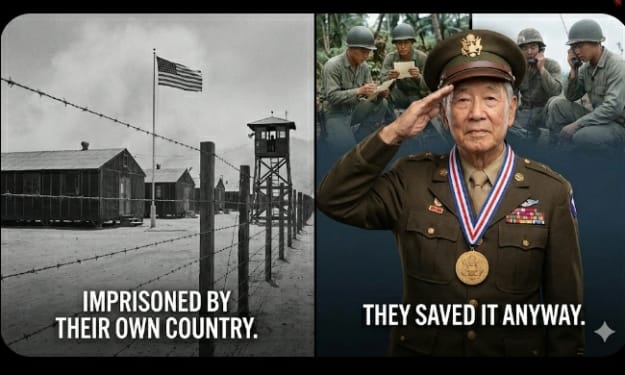
The Patriots Behind Barbed Wire: How the Men America Imprisoned Saved America From Defeat
The untold true story of the Nisei linguists of the Military Intelligence Service (MIS) during WWII. How Japanese Americans recruited from internment camps translated enemy codes, shortened the war, and proved their loyalty to a country that had betrayed them.
By Frank Massey 10 months ago in Motivation
Why We Stay in Relationships That Break Us
The coffee had gone cold in my hands, but I didn't notice. I was too busy staring at my phone, waiting for it to light up with his name. It was our fifth anniversary, and he'd forgotten. Again. But this time, I told myself, would be different. This time, I wouldn't cry. This time, I wouldn't make excuses for him.I cried anyway. And made excuses. Again.That night, as I lay in bed alone—despite sharing it with someone—I asked myself the question I'd been avoiding for years: Why do I stay?The answer was more complicated than I wanted it to be.The Architecture of StayingWe don't wake up one day and decide to accept less than we deserve. It happens gradually, like water wearing away stone. One compromise leads to another. One overlooked hurt becomes a pattern. Before we know it, we're living in a relationship that looks nothing like the one we dreamed of, yet we can't seem to find the door.I stayed because leaving felt impossible. Not because I couldn't physically walk away, but because I'd built my entire identity around being his partner. Who would I be without him? The question terrified me more than the reality of staying in something that was slowly crushing my spirit.My friends would ask, "Why don't you just leave?" As if it were that simple. As if love and pain didn't become so tangled together that you couldn't tell where one ended and the other began.The Sunk Cost of the HeartThere's an economic principle called the sunk cost fallacy—the idea that we continue investing in something because of how much we've already invested, even when it's clear we're losing. We do this with money, with careers, and especially with relationships.I'd given him six years. Six years of my twenties, the years everyone said were supposed to be the best of my life. How could I walk away from that? Wouldn't leaving mean all that time, all that effort, all that love was wasted?I see now what I couldn't see then: staying doesn't honor the time you've invested. It just ensures you'll lose more.Every day I stayed, I was betting against myself. I was choosing the familiar ache over the unknown possibility of something better. And I was teaching my heart that its needs came second.The Illusion of PotentialI didn't fall in love with who he was. I fell in love with who he could be. I saw his potential like a sculptor sees a masterpiece in a block of marble. I just had to chip away at the rough edges, be patient, love him harder, and eventually, he'd become the man I knew he could be.But people aren't projects. And love isn't a renovation.I spent years waiting for him to change, not realizing I was the one being transformed. I was becoming smaller, quieter, more accommodating. I was learning to read his moods like a weather forecast, adjusting my entire existence to avoid the storm.The person I was trying to create didn't exist. And the person I was becoming? I didn't recognize her anymore.Fear Dressed as LoveThe truth I didn't want to face was this: I wasn't staying because of love. I was staying because of fear.Fear that I'd never find anyone else. Fear that I was too damaged, too difficult, too much and not enough all at once. Fear that being alone would be worse than being with someone who made me feel lonely.Society had taught me well. It whispered that a bad relationship was better than no relationship. That I should be grateful someone wanted me at all. That if I just tried harder, loved better, gave more, things would improve.So I stayed. And stayed. And stayed.
By Ameer Moavia10 months ago in Motivation
The Night I Finally Chose Myself Over Love
I remember the exact moment I realized I was disappearing.It was 2 a.m. on a Tuesday, and I was sitting on the bathroom floor with my phone in my hand, reading through our text messages for the hundredth time that week. I was trying to decode his words, searching for hidden meanings, wondering what I'd done wrong this time. My hands were shaking. My chest felt tight. And somewhere in the back of my mind, a small voice whispered: This isn't love. This is survival.But I stayed anyway.For three more months, I stayed.
By Ameer Moavia10 months ago in Motivation
The Woman Who Left First
Sophie broke up with Michael on their six-month anniversary.He'd planned a dinner. Bought flowers. Was clearly about to say something significant—maybe "I love you," maybe something about their future. She could see it in his eyes, the way he kept nervously touching the small box in his jacket pocket.And Sophie felt pure panic.Not because she didn't care about Michael. But because she cared too much. Because six months was exactly when people left. When they got close enough to see the real her and decided she wasn't worth staying for. When the fantasy dissolved and reality—messy, needy, imperfect Sophie—became too much.So she left first."I don't think this is working," she said before he could open the box. "I think we want different things."Michael looked shattered. "What? Where is this coming from? I thought we were—""We're not. I'm sorry. I have to go."She walked out of the restaurant, leaving Michael sitting alone with unopened flowers and whatever was in that box. She made it to her car before the tears came.This was the fourth relationship Sophie had ended exactly this way. Right when things got serious. Right before the other person could leave her. Right at the moment when staying would require trusting that someone might actually choose her permanently.Sophie's friends called her a "commitment-phobe" or "emotionally unavailable." Her therapist used words like "avoidant attachment" and "self-sabotage."But Sophie knew what she really was: terrified. Absolutely, bone-deep terrified of being abandoned. So terrified that she'd rather destroy good relationships herself than wait for the inevitable moment when the other person realized she wasn't enough and left.She was thirty-one years old, and she'd been running from abandonment her entire life. The problem was, in running from it, she'd made it happen over and over again.She'd become the abandoner to avoid being the abandoned. And it was destroying her.The Architecture of Abandonment FearHere's what Sophie's friends didn't understand: her fear of abandonment wasn't irrational anxiety. It was a deeply wired survival mechanism that had been forged in childhood and reinforced every year since.Dr. John Bowlby, who developed attachment theory, discovered that fear of abandonment originates in early childhood experiences where caregivers are inconsistent, unavailable, or actually abandon the child. The developing brain learns: People leave. Connection is dangerous. I'm not safe.Sophie was four when her father left. No explanation that made sense to a four-year-old. Just there one day, gone the next. Her mother, overwhelmed with grief and suddenly single parenting, became emotionally unavailable. Present physically, but absent in every way that mattered.Young Sophie learned: People you love disappear. Even when they stay physically, they can leave emotionally. I am not important enough to make them stay.By age seven, Sophie had developed a strategy: don't get attached. Don't need anyone. Don't let people get close enough to hurt you when they inevitably leave.But humans need connection to survive. So Sophie's strategy became more nuanced: get close, but not too close. Let people in, but keep one foot out the door. Care, but be ready to run the moment leaving looks possible.Neuroscience research by Dr. Ruth Feldman shows that children who experience early abandonment develop hyperactive amygdalas—their threat-detection systems are constantly scanning for signs of impending rejection. Their nervous systems exist in a perpetual state of vigilance, waiting for the other shoe to drop.By the time Sophie was an adult, her abandonment fear wasn't conscious thought—it was autonomic response. When relationships got close, her nervous system interpreted closeness as danger. Her amygdala screamed: This person will leave. Get out now before it hurts more.And Sophie, not understanding this was old programming rather than accurate prediction, would listen. She'd find reasons the relationship wasn't right. She'd create distance. She'd leave.She thought she was protecting herself. But she was actually creating the exact outcome she feared most: being alone.The Pattern She Couldn't SeeSophie's best friend Emma had watched this happen four times now. After Sophie left Michael, Emma finally confronted her."Why do you keep doing this? Michael was good to you. He was patient with your boundaries, he respected your pace, he clearly cared about you. And you just... ran.""It wasn't working," Sophie said defensively."It was working fine. You were happy. I saw you happy. Then the moment he got serious, you panicked and destroyed it.""I didn't destroy anything. We just wanted different things.""No, Sophie. You wanted the same things. You're just too terrified to admit it."Sophie felt tears threaten. "You don't understand. Everyone leaves eventually. My dad left. My mom checked out. Every relationship I've had has ended. It's just... inevitable. I'm just speeding up the inevitable so it hurts less.""Except you're the one leaving, Sophie. You're not being abandoned. You're doing the abandoning."The words hit like a slap. Because Emma was right. Sophie had spent thirty-one years so afraid of being left that she'd become the person who leaves. She'd turned her biggest fear into her defining behavior.Dr. Gabor Maté's work on trauma patterns reveals this phenomenon: people often unconsciously recreate their core wounds in an attempt to gain control over them. If you were abandoned as a child and felt powerless, you might become the abandoner as an adult to reclaim that power.But it doesn't heal the wound. It just reinforces it. Every time Sophie left, she confirmed her belief that relationships end, that people don't stay, that she's alone. She was proving her own abandonment fear correct through her own actions."I don't know how to stop," Sophie admitted quietly. "I don't know how to stay when every cell in my body is screaming at me to run.""Then you need to figure it out," Emma said gently. "Because you're going to wake up at fifty, alone, and realize you spent your whole life running from the one thing you actually wanted."
By Ameer Moavia10 months ago in Motivation