goals
Understanding your goals to help you achieve them.
India and Pakistan agree to an immediate ceasefire, Trump announces
In a surprising turn of events, U.S. President Donald Trump announced today that India and Pakistan have agreed to an immediate ceasefire, bringing a sudden and much-needed pause to escalating tensions along the Line of Control (LoC). The announcement, made from the White House press room, signals a potential breakthrough in one of the world’s most volatile regional conflicts.
By Muhammad about a year ago in Motivation
The 15 Rules of Money
Eli had always believed that working hard would eventually lead him to wealth. But despite clocking long hours and being dedicated to his job, he found himself constantly treading water... living paycheck to paycheck, with no real savings or investments. He wasn’t irresponsible. He just didn’t know the rules of money.
By MIGrowthabout a year ago in Motivation
The Spark That Ignited Change.
Once upon a time, in a small town nestled between rolling hills, there lived a young woman named Clara. She had always dreamed of achieving great things, but for years, she struggled with self-doubt and fear of failure. Every time an opportunity came her way, she would freeze, unsure of whether she was good enough to pursue it. Her heart would race, and her mind would be filled with a million "what ifs"—what if she wasn't smart enough, strong enough, or talented enough to succeed? These thoughts held her back, trapping her in a cycle of hesitation.
By Rida Nitajabout a year ago in Motivation
Everyone Said It Wouldn’t Work—How I Built a Career with AI
Everyone Said It Wouldn’t Work—How I Built a Career with AI Growing up in a small town, I always heard the same words repeated around me—“It’s not possible,” “That’s not for people like us,” or worse, “Don’t dream too big.” For most of my life, I believed those voices. I thought success in technology or freelancing was something meant only for the privileged — people with expensive degrees, fluent English, and big-city connections.
By Syed Mokter Hossainabout a year ago in Motivation
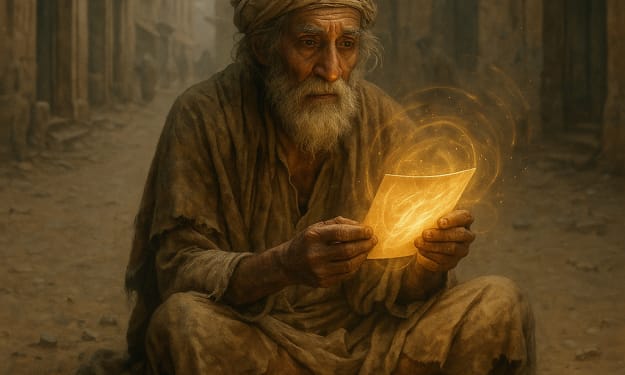
The Beggar Who Traveled Through Time
It was a hot, dry afternoon in Lahore. The traffic hummed past on the main road, indifferent to the man who sat under the broken shade of a neem tree. He was a beggar, or at least he looked like one. His clothes were patched and faded, his beard unkempt, and his eyes half-closed. He sat there every day, mumbling verses no one cared to understand. Children laughed and ran past him, some throwing coins, others insults. Shopkeepers ignored him, and passersby pretended not to notice. But no one knew that this man, who called himself Baba Zamaan, was once a scientist, and not just any scientist—he was the mind behind a secret government experiment that had failed twenty years ago. Back in 2005, Baba Zamaan, then known as Professor Zaman Ali, had been working on a project called “ChronoKey”—a device that could unlock fragments of time. Funded in secrecy, tested in silence, it was meant to open a controlled ripple through time. But the experiment had gone horribly wrong. During the final test, the device exploded, and Zaman vanished. He was presumed dead. But he didn’t die. He had jumped. Not forward. Not backward. Sideways—in a sliver of time that ran parallel to ours. There, he had no food, no water, no sound, only darkness and echoes of forgotten moments. He wandered in that realm for what felt like years. Time was meaningless there. Until one day, he found a way back. When he reappeared in the middle of a street in Lahore, no one recognized the aged, disoriented man. He had no memory of who he was. The trauma of timeless isolation had shattered his mind. All he remembered was the device, and a whisper: “Time is a beggar’s game.” Years passed. Zaman, now Baba Zamaan, became a fixture on the roadside. His mind flickered between brilliance and madness. He wrote symbols on the dirt with a stick, muttering equations that even advanced physicists would struggle to understand. One rainy afternoon, a university student named Faraz noticed the old man. Faraz was curious by nature and intrigued by the strange symbols the beggar scribbled. He began visiting him daily, sitting beside him, asking questions. At first, Baba Zamaan ignored him. But slowly, the fog in his mind began to lift. He spoke in riddles, asking Faraz, “If time is a river, do you drink from it, or do you drown?” Faraz laughed, but listened. One day, Baba Zamaan handed him a crumpled notebook. “This,” he said, “is the map of the hours lost.” Inside were sketches of a device, pieces of equations, and a final note: "The ChronoKey still breathes. Under the earth, beneath the light." Driven by curiosity, Faraz took the notebook to his physics professor, Dr. Ishrat. The professor’s face turned pale as he read. “Where did you get this?” When Faraz told him about the beggar, Dr. Ishrat’s hands trembled. “This… This is Professor Zaman Ali’s work. He disappeared two decades ago. We all thought he died.” Excited and shocked, Faraz and Dr. Ishrat returned to the spot the next morning, but Baba Zamaan was gone. Only a symbol remained, etched in the mud: the symbol of the ChronoKey. Weeks passed. Faraz couldn’t sleep. He kept studying the notebook until one night, something clicked. He built a prototype, crude but functional. When activated, it emitted a soft hum and projected a hologram of Baba Zamaan. In the hologram, Baba spoke clearly: “If you’ve found this, then time has chosen you. I am no longer of this world, but of many. Don’t look for me. Look ahead. One day, you too will stand at the edge of time. Choose wisely.” Faraz never saw Baba again. But he knew he hadn’t imagined him. That hologram, the equations, the memory—they were all real. He buried the ChronoKey prototype in a box and hid it in his closet. Years later, Faraz became a renowned physicist. He never told anyone the full story. But whenever he passed that old neem tree, now long gone, he whispered, “Thank you, Baba Zamaan.” And somewhere in the sliver of time, an old beggar smiled, whispering, “The river flows on.”
By Noman Afridiabout a year ago in Motivation
The Turning Point: From Debt to Financial Freedom
Michael sat at his desk, his hands tangled in his hair, eyes fixed on the mountain of bills scattered before him. Credit card statements, utility bills, and loan reminders formed a chaotic sea of red ink. It wasn’t always like this—just two years ago, he was living comfortably, spending freely without a second thought. But one financial misstep after another had brought him here, to this moment of reckoning.
By Ishaq Ahmadzai about a year ago in Motivation
The Majesty of the Falcon: A Symbol of Power and Grace
The falcon, often revered for its strength, grace, and precision, is more than just a bird of prey. It represents power, freedom, and the spirit of unyielding determination. Known for its unmatched hunting skills and exceptional flying abilities, the falcon has captivated the human imagination for centuries. But there’s something deeper, something symbolic, that sets this magnificent bird apart. This story aims to delve into the majestic world of the falcon, unraveling its profound impact on nature, culture, and the human heart. --- A Hunter Like No Other The falcon’s reputation as a formidable hunter isn’t just folklore. It is a bird of exceptional skill and precision. With its aerodynamic body built for speed and agility, the falcon can reach astonishing speeds of over 240 miles per hour when diving. This makes it the fastest bird in the world and the fastest animal on the planet. Its sharp talons and keen eyesight allow it to swoop down upon its prey with deadly accuracy. In the wild, falcons are known to hunt small to medium-sized birds and mammals. But beyond their role as predators, they are symbols of perseverance, as they never give up on their pursuit, relentlessly chasing their target until they achieve success. --- A Symbol of Freedom For many cultures, the falcon is not just a bird; it’s a symbol of freedom and courage. In ancient civilizations, falcons were seen as messengers between the heavens and earth, representing the connection between the mortal world and the divine. Egyptians, for example, associated the falcon with Horus, the god of the sky, representing strength and protection. In the modern world, the falcon continues to inspire people, particularly those who value independence and self-reliance. It reminds us that, just like the falcon in the sky, we too can rise above obstacles and soar to greater heights. Its presence in literature, art, and mythology continues to evoke feelings of awe and reverence, urging humanity to seek freedom and greatness. --- The Bond Between Human and Falcon Perhaps one of the most fascinating aspects of the falcon is its relationship with humans. Falcons have been used in falconry for over 3,000 years, making it one of the oldest forms of hunting. The bond between a falconer and their bird is a unique one, built on trust and respect. In ancient times, falconry was a sport of royalty, symbolizing status, wealth, and a deep connection with nature. Even today, falconers around the world maintain this ancient tradition, training falcons to hunt with them. The bond between the falconer and the falcon is one of mutual understanding. The falcon, wild at heart, learns to trust the falconer, while the falconer learns to respect the falcon's natural instincts. This partnership is a testament to the deep respect humans have for these majestic creatures and their place in the world. --- Falcons in Modern Culture The influence of the falcon extends far beyond hunting and symbolism. Today, it appears in sports team logos, military insignias, and even on the flags of several nations. It’s a symbol of precision, power, and focus—qualities that are highly valued in modern society. The falcon's sharp focus on its target, its ability to move swiftly, and its instinctive drive to succeed resonate with people in various walks of life. In the world of aviation, the falcon has even inspired aircraft designs, with engineers studying the bird’s flight mechanics to create faster, more efficient airplanes. The falcon’s sleek and aerodynamic body continues to inspire innovations in technology, design, and engineering, showing how nature often serves as the ultimate blueprint for human progress. --- The Spiritual Significance of the Falcon Beyond its physical attributes, the falcon holds significant spiritual meaning. Many spiritual leaders and philosophers have drawn parallels between the falcon's unyielding determination and the pursuit of higher knowledge. Just as the falcon rises above the clouds, humans are urged to rise above their limitations and chase after enlightenment and truth. In some traditions, falcons are seen as spirit guides, representing vision, clarity, and the ability to see things from a higher perspective. They are symbols of a spiritual journey—reminding us to seek clarity in our own lives, to rise above the noise and distractions, and to find our true path. --- Conclusion: The Timeless Legacy of the Falcon The falcon is much more than a bird of prey. It’s a creature that represents the best of what humanity strives to be: powerful, free, precise, and wise. Through its speed and elegance, the falcon has carved its place in the hearts and minds of people across the world. Whether as a symbol of strength in ancient cultures or as a modern-day inspiration, the falcon continues to soar high, leaving a legacy that will endure for generations to come. The falcon is not just a bird; it is a reminder of our potential to rise above, to hunt our goals with determination, and to soar to new heights, no matter what challenges lie ahead.
By Noman Afridiabout a year ago in Motivation
The Price of Doing Nothing: Why Inaction Is Costing You More Than You Think
You wait. You hesitate. You convince yourself that now isn’t the right time. You say things like: “I’ll do it when I’m ready.” “I need to think about it more.” “What if it doesn’t work out?” And while you’re thinking, waiting, preparing — life keeps moving. Opportunities come and go. Energy fades. And slowly, you begin paying a price no one talks about: **The cost of doing nothing.** --- ### The Illusion of Safety Doing nothing feels safe. It’s low risk, low exposure, low drama. But that safety? It’s an illusion. A trap. When you choose comfort over action, you don’t just avoid failure — you avoid progress, clarity, growth, and confidence. You stay in the same job you hate. You hold onto toxic habits. You keep talking about the idea… but never act on it. It feels safe, but it’s quietly suffocating you. **Real safety isn’t about standing still.** It’s about building skills, learning, adapting, and becoming so capable that you can handle what life throws at you. Standing still? That just weakens your ability to move when it counts. --- ### Missed Opportunities Are Expensive You don’t see it at first. That gig you didn’t apply for. The message you didn’t send. The side hustle you never started. You think: “No big deal. I’ll try later.” But here’s the thing: Opportunities are rarely static. They move, evolve, disappear. And often, they don’t come back. Meanwhile, someone else with less talent — but more action — jumps in, learns, fails fast, improves, and gets ahead. **The cost of inaction isn’t just staying the same.** It’s watching others live the life you wanted while you keep waiting for the “right moment.” --- ### Comfort Zones Kill Growth Your brain loves routine. It wants to keep you safe — not successful. So it resists change, even if that change leads to something better. You stay in the same patterns, do the same things, hang with the same people, and then wonder why nothing changes. Growth isn’t comfortable. It’s awkward. It’s scary. It’s messy. But that’s the point. That’s the price of leveling up. If everything you’re doing feels safe and easy, you’re not growing. You’re repeating. --- ### Fear Disguised as Logic Let’s be honest: Most of the time, we don’t take action because of fear — not logic. But we dress fear up with clever excuses: “I need more research.” “I’m not experienced enough.” “I’ll wait for a better time.” And those sound smart… but they’re not real reasons. They’re fear in a professional costume. Fear of failing. Fear of being seen trying. Fear of judgment. But here’s the kicker — no one successful avoided fear. They just acted in spite of it. --- ### Action Is the Real Superpower Action builds momentum. Action builds confidence. Action builds your future. You don’t need a perfect plan. You need movement. Because clarity doesn’t come from overthinking. It comes from doing. That blog you want to start? Write one post. That skill you want to learn? Watch one tutorial. That message you’ve been avoiding? Send it. Every action, no matter how small, shifts your trajectory. And once you’re moving, magic starts happening. --- ### Final Thoughts: Regret Is the Real Cost People rarely regret what they tried. They regret what they *never* tried. What they delayed. What they ignored. What they talked themselves out of. The cost of doing nothing is invisible at first. But later, it hits hard: - Lost confidence - Missed chances - What-could-have-beens - A version of yourself that never came to life Years from now, you won’t remember the reasons you waited. You’ll remember that you didn’t move. So ask yourself right now: What’s one thing I’ve been putting off? Now ask again: Can I afford the price of *never* doing it? Because inaction doesn’t protect you. It slowly erases you. And the most expensive decision isn’t trying and failing — it’s doing nothing at all.
By SHADOW-WRITESabout a year ago in Motivation
"Level Up Your Life With Njoki"
46.How I Simplified My Life and Got Happier Instantly In today's fast-paced world, we are constantly bombarded by distractions, responsibilities, and pressures that often leave us feeling overwhelmed and unfulfilled. For many years, I struggled with the notion that happiness was something to be achieved by accumulating more — more things, more experiences, more success. However, the breakthrough moment came when I realized that the key to happiness wasn't about adding more to my life but about removing the unnecessary. Here's how I simplified my life and found an instant boost in my happiness.
By Peris Njokiabout a year ago in Motivation