goals
Understanding your goals to help you achieve them.
The Sketch That Changed Everything
Once upon a time in a quiet town nestled between green hills and winding rivers, there lived a young man named Arjun. He was like many others in his village... humble, kind-hearted, and filled with dreams that seemed too big for the modest world he lived in.
By MIGrowthabout a year ago in Motivation
The Myth of Overnight Success
We love the legend of the overnight success. The startup that went from idea to IPO in twelve months. The artist discovered on social media who woke up famous. The story of someone who posted a single video and never had to work a 'normal' job again.
By Eddie Akpaabout a year ago in Motivation
The Goldilocks Rule: How to Stay Motivated in Life and Business
This article is an excerpt from Atomic Habits, my New York Times bestselling book. In 1955, Disneyland had just opened in Anaheim, California, when a ten-year-old boy walked in and asked for a job. Labor laws were loose back then and the boy managed to land a position selling guidebooks for $0.50 apiece.
By Farhan Rafidabout a year ago in Motivation
Rafale: The Sky’s Dominator
Above the battlefield, where clouds meet conflict, one aircraft glides with elegance and strikes with deadly precision. This is the Rafale fighter jet — a symbol of technological excellence, aerial supremacy, and strategic power. Designed and built by the French aerospace company Dassault Aviation, the Rafale is a 4.5-generation multirole combat aircraft, trusted by some of the world’s most advanced air forces. It’s more than just a machine; it’s a flying weapon system that combines agility, intelligence, and lethality in one platform. The Birth of a Beast The development of Rafale began in the 1980s when France decided to build an aircraft that could perform air dominance, ground attack, reconnaissance, and nuclear strike — all in one plane. Unlike most other jets built for specific roles, the Rafale was designed from the start as an “omnirole” fighter — meaning it could do it all. The first flight of Rafale took place in 1986, and after years of refinement, it entered operational service in the French Air Force and Navy in the early 2000s. Since then, it has proven its worth in combat missions in Afghanistan, Libya, Mali, Iraq, and Syria. Design: Sleek, Smart, and Stealthy Rafale’s sleek design is not just for show — it’s a blend of aerodynamics and stealth. Its delta wings and canard foreplanes give it superior maneuverability, allowing it to perform tight turns and rapid climbs. It has a reduced radar cross-section, making it harder for enemy radars to detect. While it’s not a full stealth aircraft like the F-35, Rafale uses passive stealth techniques — such as special materials and shape — to minimize its visibility. Power and Performance Powered by two Snecma M88 engines, the Rafale can fly at a speed of Mach 1.8 (around 2,222 km/h). It has a combat range of about 1,850 kilometers and can refuel mid-air, making it capable of deep-strike missions. The jet is capable of taking off from both land bases and aircraft carriers, making it extremely versatile. Its powerful engines and fly-by-wire controls allow it to remain stable at all speeds and altitudes — from dogfights to high-altitude bombing runs. Technology and Avionics One of the Rafale’s strongest points is its cutting-edge avionics — the electronic systems that help it fly, fight, and survive. RBE2 AESA radar: Detects multiple targets from long range with pinpoint accuracy. SPECTRA electronic warfare system: Detects and jams enemy radar, launches countermeasures, and provides 360-degree threat awareness. OSF (Optronique Secteur Frontal): Infrared and optical sensors that allow Rafale to track and target without using radar. The cockpit is designed for the pilot’s ease and survival, with a wide-angle HUD (Head-Up Display), voice command system, and hands-on throttle-and-stick controls. The pilot can focus entirely on the mission without getting overwhelmed. Weapons: A Flying Arsenal The Rafale can carry a wide variety of air-to-air, air-to-ground, and air-to-sea weapons. It has 14 hardpoints (attachment stations for weapons) and can carry over 9.5 tons of external load. Key weapons include: Meteor: A beyond-visual-range air-to-air missile that can destroy enemies before they even see the Rafale. MICA: Dual-purpose missile for both short and medium-range aerial combat. SCALP: Long-range cruise missile for deep strikes. Hammer: Smart bombs with GPS and laser guidance. Exocet: Anti-ship missile. Nuclear capability: The Rafale is also capable of delivering nuclear warheads as part of France’s deterrence strategy. Rafale Around the World While initially a French exclusive, the Rafale has gained international popularity. Countries like India, Egypt, Qatar, Greece, and the UAE have bought Rafale jets, often praising their combat readiness, ease of maintenance, and operational flexibility. India’s acquisition of Rafale jets in 2016 was a landmark deal. In a region where aerial dominance is key, the Rafale gave India a strategic edge. Indian pilots have lauded the aircraft’s capabilities during training and operational missions. Battle-Tested Excellence Rafale is not just about numbers and specs — it’s a battle-proven aircraft. It has seen real combat in some of the world’s toughest environments. Whether bombing terrorist hideouts in the desert or intercepting enemy aircraft at high altitude, Rafale has always performed with reliability and precision. The Future of Rafale Dassault continues to upgrade the Rafale with next-generation sensors, improved engines, and network-centric warfare capabilities. It is expected to stay relevant well into the 2040s, and may even play a role in future European stealth fighter programs. --- Conclusion The Rafale is not just an aircraft — it’s a statement of power, technology, and modern warfare. It embodies the future of air combat while delivering results today. With its unmatched versatility, advanced systems, and graceful dominance in the skies, the Rafale stands as a legend in the world of fighter jets. Every time it takes off, the sky makes way — for the Rafale is not just flying, it is commanding the air.
By Noman Afridiabout a year ago in Motivation
The Day I Almost Gave Up
I still remember the day like it was carved into my memory. It was a Monday. Cold. Gray. The kind of morning where everything feels a little heavier than usual. The sky was dull, my shoes were soaked from a puddle I didn’t see, and my backpack felt like it was carrying the weight of my future — probably because, in a way, it was.
By Nafees Ahmadabout a year ago in Motivation
How To Never Get Angry or Bothered By People. AI-Generated.
In a thought-provoking conversation between Angella Nazarian and Sadhguru, the core themes of vision, willingness, and volunteerism take center stage. Hosted at a gathering organized by Visionary Women—a volunteer-run organization—this dialogue unpacks how true transformation begins not with external action, but with inner readiness and a shift in perspective.
By Abdul Rehman about a year ago in Motivation
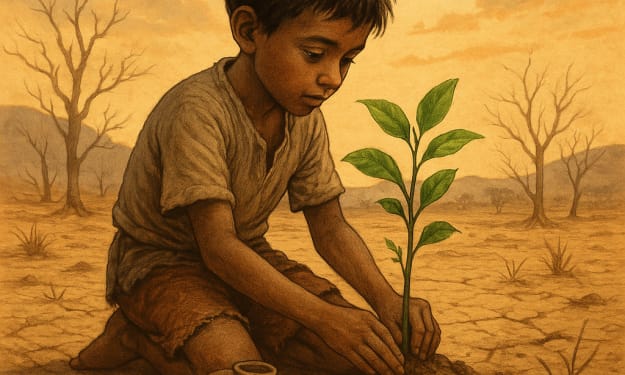
Who Planted Hope"
In a small, forgotten village on the edge of a vast desert, where dust covered every rooftop and the wind sang songs of sorrow, lived a boy named Ayan. He was no different from other children his age—barefoot, thin, and sunburned—but he carried a seed of something powerful inside him. Not a seed of grain or fruit, but a seed of hope.
By Rahimullah Mohmandabout a year ago in Motivation
Reward and Punishment of Life:
In the heart of an old city filled with cobbled streets and whispering winds, lived a man named Arman. He was a quiet shopkeeper who ran a small bookstore on the corner of Market Street. His store wasn’t large, and his profits were never impressive, but he loved the smell of old pages, the rustle of stories, and the peace of a life lived slowly.
By syed waqar ahmedabout a year ago in Motivation
A Village Heart in an Urban World
In the heart of a bustling city, surrounded by skyscrapers, honking cars, and relentless routines, I often find myself pausing to listen—not to the noise around me, but to the quieter rhythm of where I come from. The village. The dusty paths, the sound of roosters at dawn, the laughter of barefoot children, and the peaceful rustle of wheat fields under the breeze. That world feels far away now, yet it lives in me—because I carry a village heart in an urban world. Where It All Began I was born in a small village tucked away in the mountains of Khyber Pakhtunkhwa, Pakistan. Life was simple—sometimes painfully so. We didn’t have much: no fancy gadgets, no fast food, no shiny malls. But we had each other. Neighbors were like family, and a shared meal meant more than any restaurant experience ever could. The village taught me values that no textbook could: respect for elders, the power of hard work, the beauty of silence, and the strength of community. But it also came with its limitations—especially for someone like me who had big dreams stitched quietly into the fabric of his mind. Stepping Into the Unknown My first day in the city was unforgettable. Everything moved faster, sounded louder, and felt bigger. I was a stranger here—lost in a sea of strangers. I barely understood the city’s language, not just literally but emotionally. People didn’t smile as easily. Time felt like money. Relationships were fleeting, and loneliness wore a new face. I remember feeling like I didn’t belong. My village accent made people laugh. My clothes made me look “different.” I was seen as unpolished, unprepared, even unintelligent. The city had sharp edges, and I was still too soft. But every time I wanted to give up, I remembered where I came from—not with shame, but with pride. My village had raised a fighter. My struggle wasn’t a sign of weakness—it was proof I was growing. Learning to Walk Tall Adapting to city life wasn’t easy. I had to work twice as hard to keep up—academically, socially, and emotionally. But I slowly began to discover that I didn’t need to erase my roots to succeed. In fact, it was those very roots that gave me strength. While others chased trends, I held onto values. While some got lost in the race, I stayed grounded in purpose. I didn’t have the polish of the urban-born, but I had grit—and that mattered more in the long run. I started reading more, writing better, and expressing myself more confidently. I learned the city’s ways, yes, but I didn’t let it change the core of who I was. And somewhere along the way, the boy from the village became a man who could walk through the city—not unnoticed, but unshaken. The Beauty of Dual Identity I am both—a child of the soil and a product of the streets. My feet still remember the feel of the earth back home, and my eyes have adjusted to the neon lights of the city. This dual identity is not a burden but a blessing. I know how to live simply, yet think ambitiously. I can be humble without being invisible. I can value tradition while embracing progress. And in a world that often demands you to pick a side, I stand proudly in between—proof that you can belong to both worlds without betraying either. Giving Back to the Roots Now that I’ve found a voice, I don’t want to just speak—I want to echo. I want to give back to the villages, not just with money but with meaning. I want young dreamers there to know that they can rise, not by abandoning who they are, but by believing in it. If I could speak to the younger version of myself, sitting on the rooftop of our mud house, staring at stars and wondering about a bigger world, I’d tell him this: “You’re not small because your world is small. You are as vast as your dreams. Your background doesn’t define your limits—it defines your strength. Carry your village in your heart, and the world will make space for you.” A Heart That Doesn’t Forget The city may offer opportunities, but it is the village that taught me what to do with them. The rush of success feels sweeter because I’ve known the silence of struggle. The pride of achievement is deeper because I’ve tasted the bitterness of failure. I never want to forget the scent of wet soil after rain, the taste of tea shared under a tree, the lullabies of my grandmother, or the prayers whispered into the wind. These are not just memories—they are anchors. They remind me of who I am, no matter how far I go. Inspiring Others Like Me If you’re someone who has traveled the same path—from a small place to a big one—know that your journey matters. It’s not just a change of address; it’s a transformation of the soul. You are proof that dreams are not reserved for the privileged—they are sparked in humble places, too. You don’t have to shed your skin to fit in. Keep your village in your voice, in your walk, in your values. It is your uniqueness that sets you apart. Let your roots fuel your rise.
By Sajid about a year ago in Motivation