goals
Understanding your goals to help you achieve them.
From Shadows to Stardom
Born into a humble village where opportunities were as scarce as the food on the table, Alex’s early life was a daily fight against poverty. His parents worked tirelessly from dawn till dusk, but the family barely managed to get by. Alex was the eldest child, and from a young age, he saw the weight of responsibility on his shoulders. The clothes he wore were worn out, and his schoolbooks were second-hand, often missing pages. Despite all this, Alex nurtured a dream—to break free from the chains of poverty and build a life filled with hope and success.
By The 1%about a year ago in Motivation
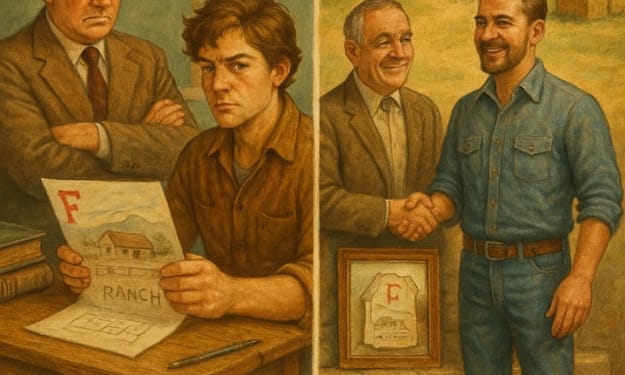
Keep Your Dreams Alive: The Unshaken Vision of Monty Roberts
### **The Power of an Unwavering Dream** Monty Roberts’ story is more than just an anecdote about perseverance—it’s a testament to the power of holding onto a vision, no matter how impossible it may seem to others. His journey from a dismissed high school assignment to owning a sprawling horse ranch in San Isidro is a reminder that dreams are worth fighting for, even when the world says otherwise. ### **A Teacher’s Doubt, A Boy’s Resolve** When young Monty poured his heart into that seven-page paper, he wasn’t just describing a fantasy. He was mapping out his future. His detailed diagrams of the ranch, the stables, and even the 4,000-square-foot home weren’t just doodles—they were blueprints of determination. Yet, his teacher saw only impossibility. The scarlet "F" scrawled across his work wasn’t just a grade—it was a challenge. Many would have crumbled under that rejection. Some might have rewritten the paper to please authority. But Monty’s response—*"You keep the F, and I’ll keep my dream"*—was the first defiant step toward making that dream real. His father’s advice—*"You have to make up your own mind"*—gave him the quiet strength to stand firm. ### **The Ranch That Defied Logic** Years later, Monty’s ranch stands as proof that dreams don’t have to bow to logic. The same teacher who once called his vision "unrealistic" eventually brought students to camp on that very land. The irony wasn’t lost on Monty—nor was the lesson. *"I was something of a dream stealer,"* the teacher admitted. *"Fortunately, you had enough gumption not to give up on yours."* That moment wasn’t about victory over a doubter; it was about redemption—for both of them. The teacher acknowledged his past limitations, and Monty proved that some dreams are too stubborn to die. ### **Why Dreams Need Defenders** Monty’s story isn’t unique in its beginning—many people have had their dreams dismissed—but it’s rare in its ending. How many potential artists, inventors, or entrepreneurs gave up because someone told them, *"You’ll never make it"*? How many world-changing ideas were abandoned because they seemed "unrealistic"? The difference between Monty and those who surrender isn’t just talent or luck—it’s grit. Grit isn’t just working hard; it’s working hard *in spite of* the voices (internal or external) that say it’s pointless. ### **The Ripple Effect of a Dream Achieved** Monty didn’t just build a ranch; he built a legacy. By opening his home for fundraisers supporting at-risk youth, he turned his success into a lifeline for others. His story does more than inspire—it actively changes lives. The kids who visit his ranch aren’t just learning about horses; they’re learning that dreams *can* come true, even for those the world counts out. ### **The Lesson for All of Us** 1. **Doubt is Inevitable, But Not Definitive** People will question your dreams. That doesn’t mean they’re wrong—it just means you’ll have to prove them wrong. 2. **Persistence is the Price of Extraordinary** If Monty had settled for a "realistic" goal, he might have lived a comfortable, forgettable life. But he chose the harder path—and it led to something extraordinary. 3. **Dreams Aren’t Selfish—They’re Gifts** When you fulfill a dream, you don’t just help yourself. You show others what’s possible. Monty’s ranch isn’t just his—it’s a beacon for anyone who dares to dream big. ### **Final Thought: What’s Your Unsurrendered Dream?** Monty’s story ends with a challenge: *What dream are you holding onto—or have you let go?* Maybe it’s starting a business, writing a book, or turning a hobby into a career. Whatever it is, someone, somewhere, has probably said it’s impossible. But remember: The teacher who gave Monty an "F" later stood on his ranch, surrounded by the proof that dreams *do* come true. So keep yours. No matter what.
By Kaleem Ullah about a year ago in Motivation
8 Life-Changing Habits You’re Not Doing Yet (But Should Be). AI-Generated.
In the fast-paced world we live in, adopting life-changing habits isn't just a luxury—it's a necessity. These often-overlooked practices have the power to revolutionize your productivity, mindset, and well-being. If you're ready to unlock your full potential, it's time to integrate these powerful routines into your daily life. Below is a list of 8 life-changing habits you’re not doing yet.
By Diana Merescabout a year ago in Motivation
The Flame That Won’t Burn Out
In the rugged lands of Balochistan, where the mountains are high and the roads are dusty and forgotten, a young woman decided to stand up against fear. Her name is Dr. Mahrang Baloch. She is not a politician, nor does she lead a large group. She is simply a doctor — and a daughter whose father never came back home. When Mahrang was still a child, her father, a kind man who stood up for people’s rights, was taken away by unknown forces. That day changed everything. Her family cried and waited, but no one returned. The world moved on, but Mahrang did not. In her heart, she made a promise that she would never stop looking for justice, not only for her father but for every missing person in Balochistan. Years passed, and Mahrang became a doctor. She worked hard, studied late into the night, and treated sick people with love. But even while healing patients, her mind stayed busy with memories of her father. Why was he taken? Why did no one answer her mother’s tears? Why do so many families in Balochistan carry the same pain? One day, she stood quietly outside a government building, holding a photo of her father. Around her, other families held photos too. Their faces were tired, but their eyes were strong. They had no weapons, no loud slogans — only silence and sorrow. But in that silence, Mahrang’s message was loud: “Where are our loved ones?” The police came. Some people were pushed. Some were shouted at. But Mahrang did not move. Her silence was stronger than the noise. That was the beginning of her journey. People began to notice her. Some praised her courage, others tried to break it. She was called names. She was followed by unknown men. She received threats. But she kept going. When fear tried to stop her, her father’s face gave her strength. Mahrang chose peace, even when anger would have been easier. She held sit-ins, spoke to students, gave interviews, and told the world about the missing people of Balochistan. She said they are not numbers — they are fathers, brothers, daughters, mothers. They had names, they had birthdays, they had dreams. And someone took them away. Many women in Balochistan looked at Mahrang and found new strength. They saw that their pain could become power. Young students from Quetta, Karachi, and other cities joined her. Some cried. Some marched. Some simply stood beside her. But all of them believed in her voice. Of course, the government was not happy. They tried to stop her. They called her a threat. They said she was working against the country. But Mahrang did not stop. She smiled, stood taller, and kept asking: “Where are the missing people?” Even when the cameras left, even when it rained, even when no one clapped for her — she stayed. Because this was not about fame. It was about her people. It was about justice. It was about love. In the darkest nights of Balochistan, when mothers cry silently and children ask too many questions, there is still a little hope. That hope walks in the streets, speaks on the mic, and carries a photo close to her heart. That hope is Dr. Mahrang Baloch. She does not shout. She does not beg. She just stands — and the world listens. Her fight is not over. There are still many names, many photos, many tears. But as long as she walks forward, the flame of courage keeps burning. And sometimes, one woman’s quiet steps can shake the silence of a whole country.
By Kaleem Ullah about a year ago in Motivation
Echoes of Silence
In the cacophony of modern-day political turmoil, some movements speak not with volume but with resonance. They do not erupt like firestorms, but rather seep through the cracks of oppression like steady rain—imperceptible at first, yet ultimately transformative. Such is the story of Manzoor Ahmed Pashteen, the emblematic leader of the Pashtun Tahafuz Movement (PTM), a civil rights movement that rose from the ashes of war, prejudice, and state-sanctioned violence. Born in the war-ravaged lands of South Waziristan, Pashteen is not the archetypal revolutionary. He did not wield a weapon nor command a militia; instead, he emerged with an ironclad will and a disarming smile. His iconic red cap became a metaphorical banner, a symbol of dissent and cultural pride, embodying the dignity of a people often marginalized, vilified, and rendered invisible. The Pashtun belt—long a geopolitical conflagration—has suffered decades of militarization, insurgency, and dispossession. Pashtuns have been inundated by war, their villages obliterated, their youth disappeared under the guise of counter-terror operations. And through all this, their narratives were carefully expunged from national discourse. Pashteen changed that. But not with spectacle—with silence. His earliest protests were unostentatious, almost imperceptible, as he and a small cohort of students questioned extrajudicial killings and landmine injuries. Yet each quiet demand held the gravitas of accumulated decades of pain. Their slogans were not incendiary; they were incisive. “What is our crime?” they asked. “Why are we treated as aliens in our own land?” The 2018 extrajudicial killing of Naqeebullah Mehsud was the catalyst. The tragedy ignited the first major PTM sit-in in Islamabad. Thousands joined—youth, women, elders—chanting not with vengeance but with clarity, cohesion, and courage. The state, unable to counter their moral certitude, responded with suppression—media blackouts, arrests, smear campaigns. But the more silent the coverage, the louder their resonance grew. Manzoor Pashteen's leadership is antithetical to populist demagogues. He does not traffic in hyperbole or jingoism. His speeches are deliberate, rational, and steeped in historical context. He invokes the Constitution, not slogans. He cites data, not conspiracies. In doing so, he reclaims the political space not just for Pashtuns, but for all disenfranchised communities across Pakistan. Internationally, PTM is seen as a litmus test for Pakistan’s commitment to pluralism, civil liberties, and rule of law. Within Pakistan, however, the establishment brands them seditious, a threat to national unity. But to the thousands who walk beside Pashteen, he is not a separatist—he is a unifier. His rhetoric never calls for division, only accountability. There’s power in his restraint. In a world addicted to spectacle, Pashteen’s humility is revolutionary. His weapon is truth, his armor is resilience, his strategy is consistency. He embodies stoicism, and in his equanimity, there is defiance. To those in power, silence is often comforting—it signals compliance. But when silence becomes organized, articulate, and unrelenting, it transforms into a reverberating challenge. The PTM's rallies—despite bans and threats—continue to swell. Each gathering is an act of civil disobedience, a testament to the indomitable human spirit. Manzoor Pashteen's journey is not without peril. He has faced incarceration, vilification, and threats. Yet, he remains unflinching, anchored in a vision that refuses to be subdued. His story is not merely of protest, but of philosophical resistance—a belief that truth, even when ignored, will eventually resound. Indeed, the dialectic of power and resistance is centuries old. But in the case of PTM, the power lies in nonviolence, civic consciousness, and collective dignity. Pashteen has woven these threads into a tapestry of defiance that continues to challenge entrenched orthodoxies. This is what makes his movement extraordinary: it is loud without shouting, powerful without violence, unrelenting without chaos. It is a whisper that unsettles an empire. It is silence that screams. As history often teaches us, it is not always the gun that wins revolutions. Sometimes, it is the word. And sometimes, even a word is not needed—just the presence of those who refuse to bow. “Silent movements,” as Pashteen has proven, “create the loudest sounds.”
By Kaleem Ullah about a year ago in Motivation
5 Simple Habits That Can Change Your Life in 30 Days
Introduction : We often think that changing our lives requires big moves—quitting a job, moving cities, starting a business. But in reality, it’s the small, consistent habits that make the biggest difference over time. When practiced daily, these habits can rewire your brain, reset your focus, and improve your emotional and physical health. If you’re ready to take control of your life, feel more grounded, and start achieving your goals, then give the next 30 days a purpose. Start with these five simple habits that are easy to follow, yet powerful enough to shift your mindset and your future. --- 1. Wake Up 30 Minutes Earlier Mornings set the tone for the rest of the day. By waking up just 30 minutes earlier than usual, you create valuable time that belongs only to you. You can use this time to meditate, read, stretch, review your goals, or simply enjoy a quiet cup of tea without distraction. It’s not about doing more — it’s about starting with clarity. Early mornings are proven to improve productivity and reduce stress. You feel more prepared, more grounded, and in control. Start small: If you usually wake up at 8:00 AM, aim for 7:45 AM for a few days. Once comfortable, go for 7:30. Over time, those 30 minutes will become the most peaceful and powerful part of your day. --- 2. Write Down Your Daily Goals Your mind is a powerful tool—but only if it’s focused. Writing down your top three goals each morning helps organize your thoughts, set your priorities, and create momentum. These don’t have to be life-changing goals. Simple intentions like “drink more water,” “complete my project,” or “call my mom” are just as meaningful. It’s about creating alignment between your actions and your intentions. Try this: Every morning, before checking your phone or email, write three tasks you want to accomplish. At the end of the day, check them off. That feeling of progress, no matter how small, keeps you motivated and builds discipline over time. --- 3. Limit Screen Time (Especially Social
By khalidabout a year ago in Motivation
Inspirational Quotes for Teens Every Parent Must Share
Teenage years can be stressful, emotional, and demanding. Encouragement, advice, and wisdom are especially important at this stage in forming a teenager's mentality. As parents, one of the most powerful tools we have for inspiring our teenagers is words, especially words of hope, courage, and strength. Below are inspirational quotations for teenagers that every parent should share. Each statement is followed by an explanation of why it is important and how it might help your kid navigate life with clarity and confidence.
By Teenage Parentingabout a year ago in Motivation
Why Young People Today Are Choosing Careers Over Relationships
A Cultural Shift: Prioritizing Ambition Over Attachment In previous generations, the expected life path was straightforward: graduate, marry, have kids. But today’s youth are rewriting that script. Instead of settling early, they’re focusing on: Professional growth Financial freedom Personal fulfillment These values are not born out of rebellion—they stem from clarity. Young adults want to build their lives on purpose, not pressure. For them, it’s about living a life aligned with their values—not simply checking off boxes handed down by older generations. Freedom, Not Fear, Is Driving the Change Many assume that this shift is driven by a fear of commitment—but that couldn’t be further from the truth. What’s actually happening is a pursuit of freedom. With rising inflation, competition, and evolving industries, young people see career success as the foundation for long-term security and happiness. Stability, not dependency, is the new goal. By prioritizing career first, many believe they are equipping themselves with the resources, mindset, and independence necessary to later approach relationships with a clearer, more grounded perspective. The Rise of the Career-First Lifestyle > According to a 2025 report by The Times of India, nearly 39% of Indian women and 28% of men aged 25–30 prefer to remain single while building their careers. This growing trend isn't about avoiding relationships—it’s about choosing the right timing. Career-first doesn’t mean love-last. It means love will come when the foundation is strong. Across both rural and urban India, as well as global cities, young adults are realizing that a strong personal brand or professional reputation opens more doors than ever before—and gives them a stronger platform to build any kind of future they want. Technology: The Ultimate Enabler of Independence Technology has become the backbone of this new mindset. Platforms like: LinkedIn – for networking and job discovery YouTube & Instagram – for personal branding Upwork & Fiverr – for freelance income ...have made it possible to build a fulfilling career from anywhere. Careers are no longer confined to 9-to-5 cubicles—they now represent freedom, flexibility, and self-expression. Young professionals are no longer waiting for “the right job” to come to them. They’re creating opportunities on their own terms—and shaping new industries in the process. Mental Health, Boundaries, and Self-Awareness With more emphasis on mental health, today's generation values emotional stability and clear boundaries. They understand that rushing into relationships without self-understanding can cause more harm than good. Self-love is the first step to healthy love. Career success gives them the tools and confidence to show up better in future partnerships. More importantly, they're building self-awareness that many older generations had to develop after marriage—today’s youth are developing it first. Changing the Definition of Love and Success Modern relationships are being redefined. They’re now based on: Mutual support Emotional readiness Shared goals There’s no longer a “one size fits all” model. Success is personal, and for many, career satisfaction comes first—with love becoming an addition, not a requirement. Young people want partners who add value to their already fulfilling lives—not complete a life that feels unfinished. Purpose-Driven Living Is the New Standard Today’s youth are driven by purpose. Whether they pursue careers in: Technology Social impact Entrepreneurship Creative arts ...they want their work to mean something. It’s not about ego—it’s about making a positive difference in the world. Legacy matters. The idea of leaving behind meaningful contributions is more motivating than ever before—and it’s a key driver behind the career-first mindset.
By Suba_Writes about a year ago in Motivation
Do We Have to Share Everything?
In today’s world, social media often feels like an open stage where everyone is expected to perform. We share our celebrations, heartbreaks, daily meals, new outfits, opinions, and even our deepest sorrows. There’s a growing belief that if it’s not posted, it didn’t really happen. But must every personal moment be shared with the world?
By Mymuna✯✯about a year ago in Motivation