goals
Understanding your goals to help you achieve them.
Jim Vani: Redefining Success Through Grit and Vision
Turning Setbacks into Stepping Stones In every industry, there are individuals whose journeys inspire others not just because of their accomplishments, but because of the obstacles they overcame to get there. One such story is that of Jim Vani, a real estate investor and construction professional whose life highlights the power of grit, reinvention, and vision. His work demonstrates that true success is built not only on financial returns but on resilience, self-awareness, and the courage to start again.
By Jim Vaniabout a year ago in Motivation
Building Success Through Resilience: The Journey of Jim Vani
Life rarely unfolds in a straight line. For many entrepreneurs, the path to success is filled with sharp turns, setbacks, and the kind of obstacles that test determination. Few stories embody this reality as clearly as the journey of Jim Vani, a real estate investor and construction leader who has built a career on resilience, reinvention, and vision. His professional and personal experiences illustrate how adversity can be transformed into an engine for growth.
By Jim Vaniabout a year ago in Motivation
Frames of Fortune
When Liam was 19, he worked at a small coffee shop, earning just enough to cover rent and a secondhand car. He felt invisible... one more anonymous young man drifting through a big city, clocking in and clocking out, waiting for something to happen. But deep down, he sensed that if he could just see his life differently, he could live it differently.
By MIGrowthabout a year ago in Motivation
3 Low Cost Side Hustle You Can Start Today That Are Making $2000/Month. AI-Generated.
Do you dream of extra money each month? What if you could add an easy $2000 to your bank account, just from a side project? The good news is, finding financial freedom or just a little breathing room is closer than you think. Many low-cost side hustles exist that offer serious income potential without breaking the bank to get started.
By Akmal54about a year ago in Motivation
Understanding How Little We Think Of Ourselves And Our Potential As Humans
If you've followed my work, then you know that I consider myself a Runner. I have been Running at least One Mile, Every Single Day, for Over 450 Days Straight.
By H.E. Dr. Cody Dakota Wooten, COIE, DFM, DHMabout a year ago in Motivation
The Road Within: A Journey of Self-Discovery
Life is often described as a journey, yet most of us imagine roads, flights, or destinations on a map. But there is another kind of journey—one that has nothing to do with distance and everything to do with the soul.
By Muhammad Kaleemullahabout a year ago in Motivation
When Did You Accept Your Own Mediocrity? The Hidden Freedom in Being Ordinary. Content Warning. AI-Generated.
In a world obsessed with success, fame, and extraordinary achievements, most of us quietly face a sobering truth: we are ordinary. Yet accepting this so-called mediocrity may not be a failure, but a form of liberation. This article explores the moment we realize our limits, and how embracing ordinariness can bring us peace, freedom, and genuine happiness.
By Chilam Wongabout a year ago in Motivation
The Flame Within: How Perseverance, Hope, and Courage Create Extraordinary Lives. Content Warning. AI-Generated.
Introduction Every human life is a story filled with triumphs and tragedies, victories and defeats, light and darkness. At the heart of this story lies a question: What makes us keep moving forward when everything seems lost?
By Chilam Wongabout a year ago in Motivation
The Power of Relentless Growth: How to Reinvent Yourself at Any Age
Introduction: The Myth of “Too Late” Have you ever felt that a dream has passed you by? Maybe you think you’re too old to start a business, too far behind to change careers, or too tired to begin again.
By Ahmed Mohamedabout a year ago in Motivation
Naziya: Trapped Between Love and Dark Magic
Naziya: Trapped Between Love and Dark Magic BY: Khan Nazish Akhtar, known by her pseudonym Naziya, lived a seemingly perfect life with her husband, Riyan—a handsome, loving young man who showered her with affection. They were happy, laughing, playing, and enjoying life together. But their bliss was short-lived. One day, Riyan had a serious car accident. He had been careless and wasn’t wearing a seatbelt, which led to severe injuries. Miraculously, he survived, but his condition left him dependent and fragile. As Riyan recovered, his once cheerful demeanor began to fade. One day, while speaking to an elderly woman over the phone, he remarked, “It feels like our Naziya has been caught in some dark magic. She was like a blooming flower, laughing, playing… but now she seems so lifeless, as if the life has drained out of her.” Concerned, the woman suggested they consult a renowned spiritual healer, Baba Chitte Shah, whose mystical abilities were widely praised. Reluctantly, they sought Baba Chitte Shah’s help. Naziya, sitting beside me, was in tears. “Auntie, my relatives and their friends have ruined me. Baba says that someone has cast a powerful spell. Darkness surrounds me. He says a mighty jinn is involved and to destroy it, a ritual—Chilla—must be performed. I may even be asked to be present during it. Day or night, whenever called, I must go. They claim if the ritual is stopped midway, it could even endanger Riyan’s life.” I asked gently, “Is Baba very old, Naziya?” She looked at me, tears streaming. “He is grotesque in appearance. His hands are full of silver rings with different gemstones. He wears long, thick necklaces, and his hair is long and unkempt. When he looks at you, it feels… dangerous. I can’t explain it.” I held her hand and spoke softly, “Child, real pious elders have a pure appearance. Their gaze reflects God’s light. They do not scare or manipulate people. What you are experiencing is emotional manipulation. He wants to make you believe that your husband’s life is in danger so you’ll comply with him.” I continued, “You can approach places like Jamia Ashrafia, where learned scholars guide lost souls and help them find the right path. Understand this—no one except Allah can truly remove your hardships. Those who love Allah and His Messenger never beg before others for help in such matters.” Curious, I asked, “Naziya, has any relative ever desired to marry Riyan to someone else, or was there a proposal you didn’t accept?” “Yes, Auntie,” she replied. “Several suitors approached me, but my uncle’s troublesome daughter wanted Riyan for her niece. My elder cousin in America also advised her. They were furious when I became Riyan’s bride. I recall my aunt saying, ‘If you hadn’t interfered, my Mona would have ruled this house.’ At the time, I didn’t think much of it, but now it makes sense.” I nodded. “This could explain a lot. Those who meddle in relationships often seek destructive means. They may hire manipulators to break marriages. But remember, the power of Allah and His Word is sufficient to protect and heal. Quranic guidance can shield you, but it must be paired with sincere faith and the right actions.” I continued gently, “Naziya, the first step is to strengthen your belief. Understand that everything happening to you is by Allah’s will. Trust Him completely. Simply reciting phrases like ‘Iyyaka na’budu wa iyyaka nasta’in’ is not enough; they must be internalized and acted upon. Many innocent women, like you, fall prey to manipulative individuals—sometimes even their own husbands or relatives unknowingly become agents of this deception, seeking talismans or charms for children, turning the woman into a mere tool.” “People driven by envy or malice can cast spells. Disrupting marriages and creating discord between spouses is their favorite tactic. But you must leave the weak-minded belief in such acts and rely solely on Allah. This is the key to a peaceful life.” I explained further, “Satan’s work is always destructive. The Prophet Muhammad (peace be upon him) instructed severe punishment for those practicing magic, yet he forgave those who attempted harm against him. His protection from magic, after reciting the Mu’awwidhatain (chapters of refuge from the Quran), serves as a guiding light for us.” I prayed aloud, “May Allah protect Naziya and other innocent women from such trials. May those who misguide and exploit others be stopped from committing sins. May He grant us all the wisdom to follow the straight path and live with peace and safety.” Naziya, listening, seemed to take a deep breath, a faint smile returning. Her story is a reminder that evil thrives through manipulation and fear, but faith, knowledge, and trust in Allah can overcome even the darkest challenges.
By Khan about a year ago in Motivation
The Friend They Once Called Miser
The Friend They Once Called Miser BY:Ubaid Saquib Fareed, Tasawur, Sajid, and Nasir—these were names often heard together in the corridors of the college in Jhang. Out of them, Nasir was the most recent addition to the group. He had joined the college only two months earlier but had already won the trust and affection of both Sajid and Tasawur. Nasir came from a modest household. His politeness and respectful demeanor set him apart in class, and not a single student had ever complained about him. Teachers liked him, classmates found him easy to talk to, and he rarely raised his voice at anyone. Yet, despite his good qualities, there was one thing that kept Tasawur and Sajid from fully accepting him. They believed Nasir was stingy. Both Sajid and Tasawur had a habit of spending their pocket money recklessly. After classes, they would rush to street vendors selling samosas, chickpea chaat, and other fried delicacies. Their laughter echoed in the bazaar as they ate together, sometimes competing over who could eat the most. But Nasir never joined them. He would politely decline their repeated invitations, making excuses and leaving early. To them, it looked like he was too miserly to part with even a few rupees for snacks. They teased him often. “You’re too stingy, Nasir,” Sajid would say. “Yes,” Tasawur would add, “you must be saving money to build a treasure chest someday!” Nasir would only smile faintly, neither offended nor defensive. One day, while sitting in the classroom, their teacher, Sir Khalid, overheard the boys mocking Nasir. He called them close and gently explained: “Children, never mock someone without knowing the full story. Maybe Nasir has a reason for not spending his money on snacks. Everyone has their own circumstances. And remember, fried foods are not good for health anyway.” Though the words silenced Sajid and Tasawur for the moment, their curiosity grew even stronger. If Nasir wasn’t spending his pocket money on food, then where was it going? The two friends hatched a plan. “Let’s follow him after college,” Tasawur whispered. “Then we’ll know for sure.” The very next afternoon, when the final bell rang, they quietly got on their motorbikes and trailed behind Nasir. Keeping a safe distance, they followed him through the narrow streets until he stopped outside a worn-down, crumbling house. Its walls were cracked, and the paint had long faded. Nasir parked his motorbike, walked inside, and disappeared. Cautious yet eager, Sajid and Tasawur parked a little further away and crept toward the house. They peered through the half-open doorway. What they saw inside left them speechless. On a wooden cot lay a young man with bandages around his legs, his face pale with pain. Beside him sat an elderly woman, her wrinkled hands resting on his shoulders. Across from them, on another cot, sat Nasir. His posture was calm, his expression kind. Before they could retreat, Nasir noticed the movement at the door. He stood up, surprised, and invited them inside. The elderly woman welcomed them warmly, as though she had known them for years. She began to speak, her voice heavy with emotion: “A few weeks ago, my son met with a terrible accident. Since then, he has not been able to work. It is Nasir who helps us. Every month he brings us some money for household expenses. Without his support, I do not know how we would survive.” Her words hit Sajid and Tasawur like a wave of shame. The boy they had laughed at, calling him miserly, was actually sacrificing his own comforts to help a struggling family. The samosas and chaat they had mocked him for refusing were nothing compared to the dignity and compassion he had shown in silence. They both lowered their heads. “We are sorry, Nasir,” Sajid whispered. “We didn’t know.” Nasir smiled again, the same faint smile, but this time they understood the depth behind it. From that day forward, their perception changed entirely. Instead of teasing Nasir, they began to admire him. They made a promise to themselves: they, too, would save money and use it to support those in need. When Sir Khalid heard the story, his eyes shone with pride. He praised all three boys, especially Nasir, but also reminded him: “Compassion is noble, my son. But friendship is also important. Once in a while, share a meal with your friends. Joy multiplies when it is shared.” Nasir nodded. He understood. From then on, their friendship grew stronger than ever. Sometimes they still went out for snacks together, but the purpose of their pocket money had changed. They spent less on unnecessary treats and more on helping families like the one they had visited. Sajid and Tasawur no longer called Nasir a miser. Instead, they called him their great friend. And indeed, he was. For greatness does not lie in wealth, nor in appearances. It lies in the quiet sacrifices we make for others, in the kindness that expects no reward. Nasir taught them a lesson they would carry for the rest of their lives: Those who have compassion in their hearts are always the truly great ones.
By Ubaid about a year ago in Motivation
The Boy Who Changed Lives: A Lesson in Humanity
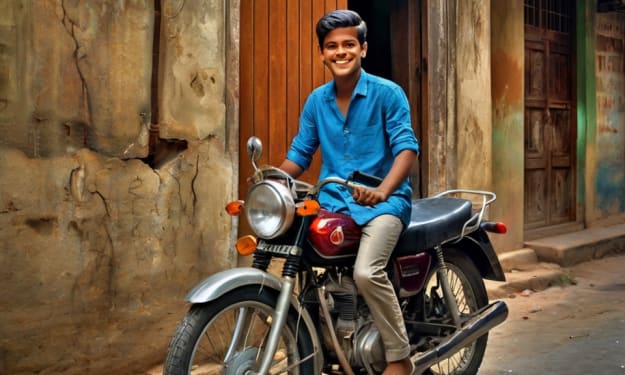
The Unseen Teacher: How One Boy Changed Lives BY:Ubaid My name is Muhammad Hammad, and I grew up in Karachi. Near my home, there was a small auto repair workshop. A young boy worked there, and everyone called him Chhoto. He must have been around nine or ten years old. As a schoolboy, I often passed by the workshop with my friends. I used to look at Chhoto working in his dirty clothes, handling greasy tires and engines, and I would tell my friends, “Thank God I don’t have to do this work. Otherwise, my clothes would be ruined, and I’d have to touch those filthy tires too.” Time went by. I finished school and reached matriculation. Chhoto grew older too. He now worked with more confidence, but his clothes were still the same old grease-stained ones. Occasionally, I would warn him, “You are wasting your life. I wish you could study like us, stay clean, and become a respected member of society.” Chhoto would always smile and reply, “Whether a person is educated or not, the most important thing is humanity and empathy toward others.” Years passed. I graduated from university with high marks and secured a prestigious job. My parents arranged my marriage, and I was blessed with two daughters. I often considered myself fortunate, attributing my success to education. I would proudly say that knowledge had brought me this far and allowed me to provide a good upbringing for my children. One day, while driving somewhere, my car got a puncture. Luckily, there was an auto workshop nearby, and I pushed my car there. To my surprise, it was the same workshop where Chhoto had once worked. A mechanic started fixing the tire. I noticed a man in the workshop who looked like the owner, but he was wearing dirty, worn clothes. Then I realized it was Chhoto himself! Even more surprising were the young mechanics around him—they were well-educated, polite, and courteous. I approached Chhoto and greeted him. He immediately recognized me. We chatted for a while as the puncture was fixed. When I was about to leave, I turned to the young mechanics and said, “The owner of this workshop, Chhoto, is an old acquaintance of mine.” One of the young men replied, “Sir, we don’t like calling him ‘Chhoto.’ What you see in front of you today is all because of him. He pays for our tuition, uniforms, and books. Not just us, but many other students’ expenses as well. He isn’t just a workshop owner; he’s like an angel to us.” I was stunned. I had spent my life believing that my education made me successful. But here was a boy I had once thought was wasting his life—working in a dusty workshop—who had quietly changed the lives of dozens of young people. That day, I realized that success isn’t always about formal education or prestigious jobs. Chhoto’s life, dedicated to helping others, had created opportunities that no university degree could replicate. His generosity and humanity had shaped countless futures. I walked away from that workshop humbled, reflecting on the irony of life. I had spent years studying to secure my future, while Chhoto, through hard work and compassion, had uplifted so many others without a word of recognition. The boy I once pitied had quietly become a giant in the lives of others. The lesson was clear: true greatness lies not in degrees or titles, but in the impact you have on other lives. Chhoto taught me more about humanity than all my textbooks combined. His example reminded me that one person’s small sacrifices can ripple outward, changing countless destinies. From that day forward, I carried a renewed respect for people like Chhoto—the ones society overlooks but who make the world a better place every day. And I understood, finally, that my achievements were my own, but the lives Chhoto had touched were far greater proof of what it means to truly make a difference. In a world obsessed with status and recognition, I learned the most valuable lesson of all: kindness, empathy, and generosity are the real measures of success.
By Ubaid about a year ago in Motivation