goals
Understanding your goals to help you achieve them.
The Boy Who Wanted His Mother’s Story Written
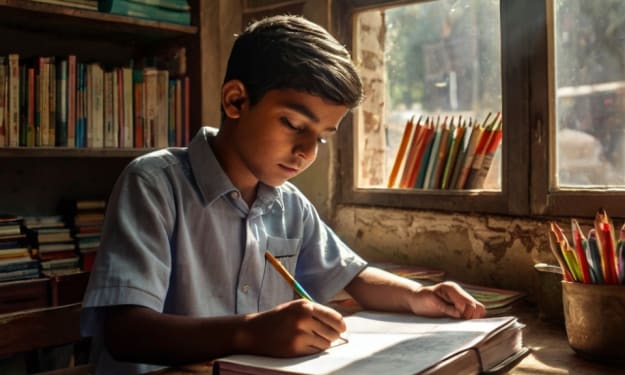
The Story That Changed Arshad’s Life BY:Khan Arshad and Amjad were two brothers who lived in a small village with their parents. Life was simple and poor, yet peaceful. Their mother was a loving and caring woman who tried her best to make their lives comfortable despite the hardships. She made sure her sons wore clean clothes, ate proper food, and learned good manners. Poverty surrounded them, but love kept their home warm. Then one day, life changed forever. Their mother fell ill. For months she struggled between life and death, and despite all efforts, she passed away. Her death was like a mountain falling on the two young boys. The house that once echoed with her gentle voice now felt silent and empty. Their father and uncle tried to take care of them, but nothing could fill the void their mother left behind. Days turned into weeks, and the brothers found it hard to live in the same village where every corner reminded them of their mother. Their father’s small income barely covered food. There was no school nearby, and even if there was, they couldn’t afford to attend. Hunger and hopelessness started to grow. Finally, their father decided to leave the village and move to the city in search of a better life. After a long and tiring journey, they reached a noisy, crowded city filled with tall buildings and busy streets—so different from the calm fields of their village. Their father started working as a laborer, taking on long hours under the sun. Still, the money wasn’t enough, so both Arshad and Amjad had to find small jobs to help. Arshad got a job at a stationery store. Every day, he arranged notebooks, pencils, and colors for customers. The store sold all kinds of school supplies—things that reminded him of what he didn’t have: education. One afternoon, while he was busy at the counter, a kind-looking woman walked in. She asked for children’s storybooks. Arshad handed her a few. As they talked, he found out she was a children’s writer. She wrote stories about love, kindness, and lessons from life. Arshad’s eyes lit up. “Can you write my story too?” he asked shyly. The woman smiled. “Your story? What kind of story would you like me to write?” “Write my mother’s story,” Arshad said softly. “She passed away some time ago.” The woman looked at him with warmth. “That’s a beautiful idea,” she said. “But will you promise me something?” “Yes,” Arshad replied immediately. “If you love your mother so much that you want her story written,” she continued, “then honor her by doing what every mother dreams of — learn. Study, even if you can’t go to school. Read in your free time. Ask for help. Once you learn to read, you’ll discover a world full of wisdom. You’ll know what’s right and wrong, and you’ll become the person your mother wanted you to be.” Her words struck him deeply. Arshad stood there in silence, feeling something awaken in his heart. That night, as he lay on his small bed, he couldn’t stop thinking about what she had said. He realized that while he couldn’t bring his mother back, he could still make her proud. The owners of the store were kind people. When they learned about his wish to study, they offered to help. They allowed him to read and learn after work hours. They gave him old books, notebooks, and a little corner in the shop where he could sit and practice. It wasn’t easy. After long hours of work, his hands were tired, and his eyes burned with fatigue. But he didn’t give up. Every evening, he opened his books and tried to understand new words. Slowly, the letters that once looked strange began to make sense. He learned to read stories, then to write, and then to dream. Months turned into years. Arshad’s hard work and determination started to shine. He completed his basic education through night classes. Later, he went on to finish college. Eventually, he earned a Master’s degree in Commerce (M.Com). Today, Arshad works as a manager in a factory. His office is neat and filled with books and files. When he looks out of his office window, he often remembers that dusty little stationery shop where his journey began—and the kind woman who had changed the course of his life with a few simple words. He never got to meet her again, but her advice became his guiding light. He often tells young workers in his factory, “Don’t let poverty stop you. Education doesn’t belong only to those who can afford it — it belongs to anyone willing to work for it. Age doesn’t matter. If you have the will to learn, the world will open its doors.” Whenever he visits his mother’s grave, he smiles and says quietly, “Ammi, I did it. I studied… and I made you proud.” The story of Arshad is not just about one boy—it’s a reminder for all of us. Life can be unfair, and loss can break us, but hope and education can rebuild everything. Sometimes, all it takes is one kind word, one small opportunity, or one stranger’s advice to change a life forever. --- Moral: Education has no age or boundary. No matter where you come from or what you’ve lost, knowledge can always be your way forward.
By Khan 11 months ago in Motivation
Ceferina Murrell: Championing Equity and Innovation in Boston
Ceferina Murrell is a name that resonates in Boston for her unwavering commitment to public service, equity advocacy, and innovative leadership in the private sector. Born and raised in Dorchester’s Uphams Corner, Murrell has become a powerful voice for underrepresented communities, leveraging her expertise to create meaningful change across government and business.
By Ceferina Murrell11 months ago in Motivation
Beyond the Horizon: How Young Visionaries Turn Struggles into Strength. Content Warning. AI-Generated.
Introduction In the stillness before dawn, the horizon holds a secret promise. It whispers to the restless soul: Keep going. Your moment is coming. But most of us never hear that whisper. We settle for safe paths, quiet compromises, or dreams half-buried.
By Chilam Wong11 months ago in Motivation
How to Stay Positive During Tough Times
Life is full of ups and downs. Everyone faces moments of stress, disappointment, or uncertainty. Tough times can feel overwhelming, but staying positive is possible if you focus on the right habits and mindset. Positivity does not mean ignoring challenges; it means facing them with strength, hope, and a constructive approach. Here’s how you can stay positive even during the hardest times.
By Kashif Wazir11 months ago in Motivation
How I Learned to Let Go Without Losing Myself
For a long time, I thought letting go meant giving up. When people said, “You need to move on,” I heard, “You’ve failed.” So, I held on — to people, to memories, to versions of myself that no longer fit. I held on until my hands hurt. I grew up believing that loyalty meant endurance. My mother used to say, “If something matters, you fight for it.” And I did. I fought for friendships that had lost their warmth, for love that no longer loved me back, for jobs that drained me more than they fulfilled me. I told myself this was strength. But strength, I later learned, can turn into stubbornness. It happened during one winter in Edinburgh. The days were short and cold, and I had just come out of a long relationship. I told myself I was fine, that I just needed time. But time didn’t heal much when I kept replaying everything that had gone wrong. My flat felt too quiet, the bed too big. I filled my evenings with noise — music, television, long walks through the city — anything to avoid silence. Because silence reminded me of what I’d lost. One night, while walking near the old bridge, I stopped to watch the water below. It moved steadily, carrying fallen leaves downstream. I wondered how the river could keep flowing when it had to let go of everything it touched. That thought stayed with me. Letting go, I realised, wasn’t about forgetting or pretending something never mattered. It was about learning to hold it differently — gently, without breaking yourself in the process. So, I began to practice. I started with small things. I deleted old messages I had been too afraid to erase. I returned gifts that had lost their meaning. I stopped checking social media to see how he was doing. Every act of letting go felt like pulling out a thorn I had been carrying quietly. Then came the harder part — letting go of the version of me that needed to be needed. I had built my worth around being someone else’s anchor. When that anchor wasn’t required anymore, I felt lost. Who was I if I wasn’t fixing, helping, or saving? One morning, I sat in a small café near the Royal Mile. It was raining outside, and a woman at the next table was reading a book titled The Art of Stillness. The title caught me. I wrote it down in my notebook. That night, I tried to sit in stillness. No phone, no distractions. Just me and my thoughts. It was uncomfortable — almost unbearable at first. But then something strange happened. I started to hear myself again. Beneath all the noise, there was a quiet voice that said, “You don’t have to hold everything.” Over time, I realised that letting go isn’t a single act. It’s a long, gentle conversation with yourself. It’s forgiving the past without needing closure. It’s allowing things to end without turning them into enemies. It’s remembering what happened without letting it define you. Months passed. The winter turned into spring. I walked through Princes Street Gardens one morning and noticed the cherry blossoms beginning to bloom. For the first time in a while, I smiled without forcing it. I met new people, slowly, naturally. I laughed again — not to prove I was fine, but because I actually was. I learned that healing doesn’t mean forgetting what broke you. It means finding beauty in the cracks. One day, while cleaning my flat, I found an old photograph of me and my ex at the seaside. I looked at it for a long moment. Instead of pain, I felt gratitude. That version of me — the one who loved, who tried, who stayed — had done her best. She deserved kindness too. So, I placed the photo in a box and whispered, “Thank you.” Then I put it away. Letting go didn’t erase my past. It just made space for my future. Now, when I think about that time in my life, I no longer feel the weight of what I lost. I feel the strength of what I learned. I learned that I don’t have to grip so tightly to prove something mattered. I can let go with love, and still remain whole. The truth is, letting go isn’t about losing anything. It’s about returning — to yourself, to peace, to the quiet certainty that you are enough even when nothing else stays. I still take walks by the bridge where the river moves steadily beneath the stone. I watch the water carry the leaves away, and I understand now. The river doesn’t hold on, and yet it never loses itself. It just keeps flowing, beautifully and endlessly forward. And so do I.
By LUNA EDITH11 months ago in Motivation
Lights, Camera, Courage
When 15-year-old Mira uploaded her first video, she didn’t even show her face. Her hands shook as she hit “publish.” It was a quiet clip of her sketching a simple sunrise in her notebook, recorded with an old phone taped to a cup. No fancy editing, no music... just a pencil scratching on paper.
By MIGrowth11 months ago in Motivation
How Gen Z Turns Self-Expression Into a Lifestyle
In the modern era of individuality, Gen Z has redefined self-expression, transforming it from a personal choice into a cultural lifestyle. Unlike previous generations, who often separated personal identity from public life, Gen Z lives and breathes authenticity in every space—online and offline. This group expresses itself in many ways, from digital art to social activism. They do this to fit in, connect, and change the world.
By Relationship Guide11 months ago in Motivation
One More Try
Oliver Bennett had always been the kind of man who gave up quietly. Not because he was lazy, but because he feared failure more than he wanted success. If something didn’t work out on the first few tries, he convinced himself that it wasn’t meant to be. It was easier to walk away than to face the sting of disappointment. He had dreams once — small ones, but they mattered. As a teenager in Manchester, he wanted to be a musician. He played the guitar in dimly lit cafés, his voice trembling but full of heart. People clapped politely, but no one remembered his name. After a few failed auditions and harsh words from producers, he packed away his guitar and told himself he wasn’t talented enough. Years passed, and life became predictable. He worked at an office, lived alone, and spent evenings scrolling through what he called “other people’s victories.” His old guitar collected dust in the corner, silent and forgotten. One rainy afternoon, as he walked home, he saw a young street performer outside a bookstore. The boy couldn’t have been older than sixteen. His voice cracked, his hands shook, but he kept singing. People walked past without stopping. A few even laughed. Oliver wanted to tell him to stop — to spare himself the embarrassment — but something held him back. The boy finished his song, smiled nervously, and began another. For reasons he couldn’t explain, Oliver stayed. When the performance ended, he dropped a few coins into the open guitar case. “You’ve got courage,” he said softly. The boy grinned. “I just keep trying. I mess up a lot, but every time I tell myself — one more try.” Those words struck Oliver like a lightning bolt. That night, he couldn’t sleep. He kept thinking about that boy, about how he sang through the rain without caring who listened. He thought about how he used to be like that — before the fear, before the giving up. The next morning, Oliver took the guitar from its case. The strings were old, the wood slightly warped, but when he strummed a chord, something familiar came alive inside him. His fingers stumbled at first. The sound was rough, imperfect. But he didn’t stop. One more try, he whispered. He played for hours. His fingertips burned, his back ached, but for the first time in years, he felt awake. Every missed note was a lesson, not a failure. Every wrong chord meant progress. He began recording short pieces, posting them online under a simple name — Just One More Try. At first, no one watched. Then a few people did. Then a few more. Comments started to appear — small words of encouragement from strangers who understood what it meant to start over. Weeks turned into months. Oliver’s playing improved, but more importantly, so did his spirit. He began to realize that effort itself was a kind of success. That persistence was more valuable than perfection. One evening, he received a message from a young woman in Lisbon. She wrote, “I was going to quit art school today. Then I found your videos. Thank you for reminding me that trying again matters.” Oliver sat still for a long time after reading that. He realized that his small decision to try again had reached someone else’s heart. He began performing again — not for fame, but for connection. He played in cafés, libraries, and street corners, the same places where he once lost hope. This time, people stayed. They listened. Not because he was perfect, but because he was honest. One night after a small concert, an old man approached him. “You’ve got something special,” he said. “Not the sound — the courage.” Oliver smiled. “It only took me twenty years to find it.” The old man chuckled. “It only takes one more try.” That sentence stayed with him. He began to see how it applied to everything — relationships, dreams, even ordinary days. People give up not because they can’t succeed, but because they forget that progress is built one attempt at a time. Months later, Oliver stood on a small stage at a local festival. The crowd wasn’t huge, but they listened intently. He played a song he had written himself — about second chances, about the courage to fail and begin again. When the final note faded, the audience clapped, not because it was flawless, but because it was real. Oliver looked out over the faces and smiled. He finally understood what that young boy had meant. The difference between failure and success often lies in a single moment — the choice to try one more time. As he walked home that night, he passed the same bookstore where it had all begun. The same streetlight, the same rain, the same hum of passing cars. Only this time, he felt no regret. He whispered to himself, “One more try.” And somewhere in that quiet Manchester night, life began again.
By LUNA EDITH11 months ago in Motivation
The Power of One Small Step
There’s a moment in everyone’s life when the road ahead feels too long, too uncertain, and too heavy to even begin. For me, that moment came on an ordinary morning — the kind where everything felt the same, but deep inside, I knew something had to change.I had dreams, big ones. I wanted to live a meaningful life, to make something of myself. But for months, I felt stuck. Every time I thought of starting, a small voice inside whispered, “It’s too hard. You’re not ready yet.”So, I waited.
By hamad khan11 months ago in Motivation