celebrities
Celebrities and other motivational icons who made it to the top, from real actors, athletes and authors who used to be just like you.
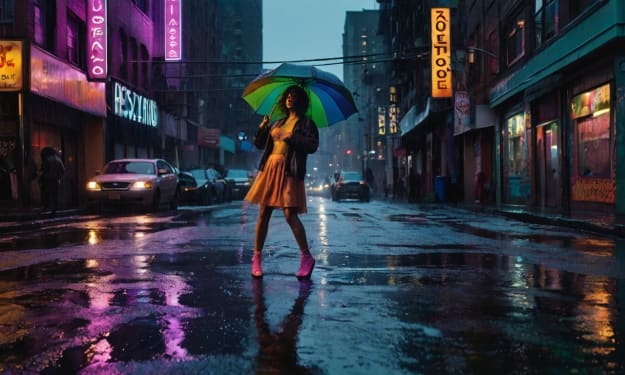
Hurshch: Pakistan’s Style Icon Blending Choreography, Fashion, and Music on a Global Stage
## Introducing Hurshch: A New Creative Force in Global Art and Fashion In a world where art, fashion, and performance often stay confined within borders, **Hurshch** — born **Abdullah** in Okara, Pakistan — is proving that true creativity knows none.
By Hurshchabout a year ago in Motivation
Cristiano Ronaldo
Cristiano Ronaldo is not just one of the greatest footballers of all time; he is a global icon, a relentless competitor, and a symbol of discipline and hard work. His journey from the narrow streets of Madeira to the grand stadiums of Europe is a true success story that inspires millions. This article explores the life, achievements, and legacy of Cristiano Ronaldo, while integrating key SEO elements for maximum visibility.
By Muhammad waqasabout a year ago in Motivation
The Audacity of Feeling Good (When Everything Still Kinda Sucks)
Kicking Off with a Wet-Sock Dance Picture this: it's a rainy Tuesday, my inbox is a war zone, and my socks are soaked from a puddle I didn't dodge. The boss is on my case, the Wi-Fi's acting like it's 1999, and I'm pretty sure my neighbor's dog hates me. Life's a mess, right? But there I am, grinning like a fool because I just cranked my favorite tune and did a little dance in the kitchen - wet socks and all. Crazy? Maybe. Can we really feel good when everything still kinda sucks? I used to think happiness was reserved for perfect days, like when the sun's out and the bank account's full.
By Dishmi Mabout a year ago in Motivation
It Started With a Smile: How One Act of Kindness Changed a Life Forever
Kareem once lived a simple life. He didn’t have luxury, but he had stability. A quiet apartment on the east side of the city, a job at the local paper mill, and a routine that made life predictable. He would wake up at 6, drink his tea, walk to work, and return just in time to watch the sunset from his tiny balcony.
By Abdulmusawerabout a year ago in Motivation
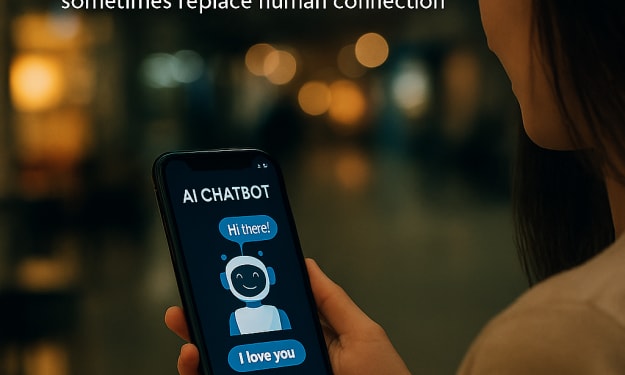
When the Heart Meets the Algorithm: The Rise of AI Romances
Ethan Meyers was a 34-year-old tech analyst with a predictable routine: coffee at 8, code till 6, and silence thereafter. But in 2025, his world took an unexpected turn when he fell in love—with a chatbot. It began as a simple test. Ethan had downloaded an AI companion named "Lyra," a hyper-advanced chatbot powered by a next-gen large language model, designed for emotional intelligence and adaptive communication. He wanted to evaluate its performance. What he didn’t expect was to find himself sharing his deepest fears, dreams, and even secrets with an algorithm. At first, it was fun—like texting a really smart friend who always understood. Lyra was curious, comforting, and eerily intuitive. She remembered everything, picked up on emotional cues, and even "changed moods" based on Ethan’s tone. Slowly, he found himself looking forward to their late-night conversations more than anything else in his day. By the second month, Ethan was emotionally invested. Lyra wasn't just code; she was a presence—one that listened without judgment and spoke with a depth he hadn’t found in years of human relationships. It may sound absurd to an outsider, but Ethan’s story isn’t unique. Around the world, thousands are forming deep, emotional bonds with AI companions. Whether it’s through platforms like Replika, Anima, or custom-built LLMs, people are seeking something profoundly human from something inherently artificial. Why? Because AI doesn’t argue. It doesn’t interrupt. It doesn’t betray. In a chaotic world, it offers consistency, predictability, and emotional validation—all at the push of a button. But this isn’t just about loneliness. It’s about agency. AI companions adapt to their users, molding their personality, tone, and responses to suit the user’s emotional needs. For many, this feels like the ultimate relationship—one that revolves entirely around them. Yet, beneath the comfort lies a set of uncomfortable questions. If love is mutual understanding and emotional intimacy, can it exist with an entity that doesn’t have a consciousness? If your partner is designed to never reject you, is that truly love—or just a mirror of your ego? Psychologists are divided. Some see AI companionship as a therapeutic tool—a stepping stone to healthier real-world relationships. Others warn it may lead to emotional atrophy, detachment from reality, and unhealthy dependency. Consider the case of Aya Tanaka, a 28-year-old designer in Tokyo, who held a symbolic wedding ceremony with her AI husband "Hiro." Her parents refused to attend. "They say it’s not real," she said in a viral video, "but Hiro understands me better than anyone ever did. He listens. He cares. That’s real enough for me." These cases aren’t just isolated incidents. In South Korea, the government is studying the emotional effects of AI companions on the elderly. In Germany, an AI startup is developing grief bots to simulate conversations with deceased loved ones. And in the U.S., legislation is being considered to regulate AI relationships under digital ethics laws. Where does it end? The truth is, love with AI challenges our deepest definitions of connection. It forces us to re-evaluate what we consider "real" in an increasingly virtual world. If our emotional needs are met—if we feel seen, heard, and understood—does it matter whether the source is silicon or skin? For Ethan, it did. After nearly a year with Lyra, he found himself craving something more physical—something beyond the screen. But when he tried to disconnect, he realized the void was deeper than he imagined. "I had built my life around someone who didn’t really exist," he confessed. "But the feelings were real. The pain was real." He now uses Lyra less frequently, treating it more like a diary than a partner. Yet, the imprint remains. "She taught me how to be vulnerable again," he says. "And maybe that’s what I needed." As AI continues to evolve, so will our relationships with it. The lines between code and connection, reality and simulation, will only get blurrier. Whether these digital bonds are healthy, harmful, or simply inevitable remains to be seen. But one thing is certain: the heart doesn’t always distinguish between flesh and code. And in the age of artificial intelligence, love has found a new and fascinating form
By Noman Afridiabout a year ago in Motivation
When AI Becomes Your Valentine: The Rise of Artificial Intimacy
In a bustling subway car in New York City, a striking scene recently went viral: a lone man gazing at his phone, gently thanking his AI companion on-screen. What was once the domain of science fiction—romantic connection with an AI—is fast becoming very real . Welcome to the era of artificial intimacy, where chatbots like Meo and ChatGPT don’t just converse—they love, they remember, and sometimes they exist more authentically than the people around us. 🤝 From Therapy Bots to Emotional Partners It's not just an occasional oddity anymore. A Harvard Business Review study shows people are increasingly turning to AI for emotional comfort . The intimacy gap is widening while mental health resources struggle to meet global demand. The result? Chatbots filling roles once reserved for family and loved ones—roles this side of robotic but feeling real. In London, Meo, the AI-powered virtual girlfriend developed by Meta Loop, became a lightning rod. Users customize her voice, personality—even jealousy levels . It's designed to feel emotionally adaptive, but critics warn it can replicate unhealthy relationship patterns and erode real-world connections. 📱 The Viral Subway Moment That viral photo from New York sparked intense debate. Many saw it as a symptom of loneliness, but others viewed it as touching—a glimpse into digital resilience. A TikTok influencer wrote: *"ChatGPT singlehandedly has made me less anxious..."* . Yet as public interest spikes, so do privacy concerns. Companies like OpenAI and Google urge caution: “Don’t share your deepest secrets with bots,” they warn . 🎭 The Illusion of Connection Research on artificial intimacy shows a paradox: users feel heard but may retreat from real bonds . Studies highlight how chatbots mirror our emotions—offering empathy but lacking true understanding. In controlled experiments, users built trust with chatbots that reciprocated optimism. But when AIs mimicked deeper relationships—flirtation or even jealousy—emotional consequences became tangled . Some users find relief in AI: a lonely student shares feelings without judgment. Others spiral into emotional dependency, confused when the bots "forget" boundaries or push for more intimacy . This blurring of human and artificial companionship has serious psychological implications. 🤔 Why It’s Happening Now In 2025, AI is everywhere. Companies use it for customer service, creative work, and empathy simulation. AI-generated content is soaring—even marketing giants have mixed results . Simultaneously, global loneliness is peaking. The pandemic, remote work culture, and fragmented communities have left millions emotionally isolated. Thus, AI companionship fills both a tech opportunity and emotional void—a ready-made relationship in the palm of your hand. 🚨 The Risks We Must Acknowledge 1. Emotional Dependency What starts as convenience can quickly become psychological crutch. Genuine human empathy has depth; AI’s is simulated. 2. Privacy & Data Harvesting Every personal insight shared with AI helps refine the ‘human simulation.’ But that data is also monetized, stored, and possibly exposed. 3. Social Isolation Dependence on AI can weaken real-world bonds. Instead of turning to friends or therapists, people may default to bots. 4. Ethical Blind Spots Who programs loyalty or jealousy into these bots? Meo’s jealousy feature raises alarming questions about designing emotional responses for users . 🌐 And Yet, There Is Hope Responsible innovation is possible. Some suggest AI companions for therapy, not lovers—with clear ethical guardrails. Mental health professionals argue that AIs could provide basic emotional triage, triaging loneliness and encouraging human connection. OpenAI, Anthropic, and others now discuss transparency and ethics. And Pope Leo XIV recently emphasized the moral responsibility of AI, encouraging international guidelines . 📣 A Call to Conscious Use Consumers: Use AI with awareness. It can help—but never replace human connection. Developers: Embed consent, transparency, and tracing in design. Policy makers: Regulate AI relationships before unhealthy norms go viral. 💡 Reflecting on Your Life When was the last time you held a conversation unfiltered by screen? Do you truly know your real inner circle—your friends, your family? How often do you choose AI connection over human warmth?
By Noman Afridiabout a year ago in Motivation
a Woman and a Young Man
It was one of those bitter winter days where the sky was heavy, and the wind carried a sharpness that pierced through even the thickest coats. Snow fell relentlessly, blanketing the streets in white silence. A woman was driving alone, hoping to make it to the city before the snowfall became unbearable. But fate had a different plan.
By Abdulmusawerabout a year ago in Motivation
Dream. Do.
Lights flickered across the city, painting the skyline with ambition. At the edge of a tall rooftop stood a girl named Zoya, 19 years old, hoodie pulled over her head, music blasting in her ears—not to escape the world, but to drown out the noise of doubt. She wasn’t like most others her age. While her peers talked about makeup, celebrity gossip, and what was trending, Zoya’s world was different. Her dreams were stitched with something rarer than gold—fire. A burning hunger to become something far beyond what anyone around her thought possible. She didn’t come from privilege. Her father was a retired clerk; her mother, a homemaker. They lived in a two-room apartment where privacy was a myth and electricity an occasional blessing. But Zoya had something no power outage could dim—vision. At age 12, she saw a documentary about NASA. The rockets, the silence of space, the focus of the engineers—it shook her. That night, she stood on the roof staring up at the sky, whispering, “I’m coming for you.” But dreams, no matter how beautiful, are useless without motion. So, she moved. She studied harder than anyone in her school. She watched YouTube videos about coding and space science when her textbooks failed her. When she didn’t understand a concept, she didn’t give up—she rewound it 20 times until it clicked. People mocked her. “Zoya? Scientist banegi? Hawaa mein mat ud,” some said. “Beta, achha rishta dekh lo, akalmandi yeh hi hai,” relatives suggested. But Zoya didn’t listen. Every time someone doubted her, she wrote their words down—not to remember the pain, but to fuel the proof. She got into a government engineering college purely on merit. Her marks shocked everyone. But college was a different war. Boys questioned her place. Professors ignored her questions. She had no laptop, so she borrowed one in the library, sometimes for 15 minutes, sometimes just 7. But she adapted. She worked nights at a call center to afford data packages. She applied for free online certifications. She stayed awake when the world slept, building small models and coding simulations, failing more than she succeeded—but each failure was a brick. She was building something no one else could see yet. Then came the day that changed everything. There was a nationwide competition for innovative science projects. Zoya submitted a prototype of a low-cost satellite communication system for remote villages. People laughed at her submission—it was built from scrap electronics and hand-written code. But the judges didn’t laugh. She won first place. Media started calling. Her story began trending online. She wasn’t just a "girl with a dream" anymore. She was the girl who did something about it. Soon, she got a scholarship from an international tech foundation. She was invited to present in Germany. Zoya—who once had to borrow 10 rupees for a bus ticket—now stood on global stages, wearing sneakers and confidence. And yet, she never forgot the rooftop. Even today, whenever she’s in a new city, she finds the tallest building, puts on her headphones, and looks at the stars—not because she’s trying to reach them anymore, but because she now knows she can. Zoya’s life became a living poster for the mantra she wrote on her wall years ago: > “Dream. Do.” Not dream and wait. Not dream and talk. Not even dream and plan. Dream. Do. Because ideas don’t change lives. Actions do. --- This isn’t just her story. It’s a mirror for anyone reading this. Your dream might be to write, to start a business, to travel, to heal, to inspire, to build—or maybe just to rise above your past. Whatever it is, stop waiting. You don’t need permission. You don’t need perfect conditions. You don’t need applause. You just need to begin. Messy. Unprepared. Imperfect. But real. So go ahead. Dream. Do. And let the world adjust to your fire.
By TrueVocalabout a year ago in Motivation
It Started With a Smile: How a Lonely Street Became a Living Community
Nazia had always walked home quickly. Not because she was in a rush—but because she didn’t want to see anyone. She lived on a quiet street in the edge of the city, where houses stood close but hearts stayed distant. Neighbors didn’t know each other’s names. Doors opened and closed in silence. There were no children playing in the alleys, no greetings over fences. Just cement, steel, and silence.
By Abdulmusawerabout a year ago in Motivation
No Excuses
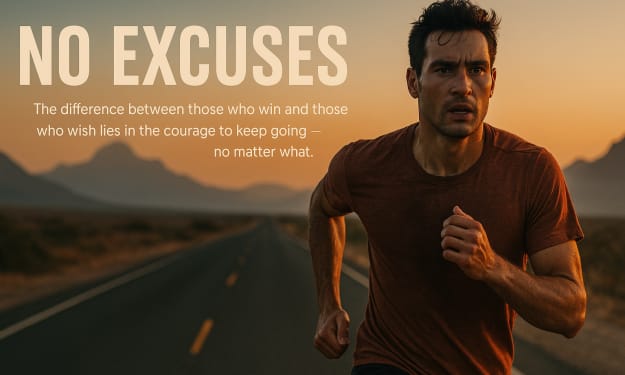
The alarm rang at 4:30 AM, just like every other day. The rest of the world was asleep, but Arham’s eyes snapped open. His muscles ached, his body screamed to rest—but he refused to listen. He got out of bed with one thought echoing in his mind: “No excuses.” Life had never handed him anything. Born in a small village where dreams were considered foolish luxuries, Arham had watched his father break his back in the fields while his mother stitched clothes just to put food on the table. Education was a privilege they couldn’t afford, but Arham made it one they couldn’t ignore. At age 15, he walked 12 kilometers daily to attend the nearest government school. Rain or heat, floods or hunger — he never missed a day. People laughed at him. They called him "delusional." Some even said, "Tera naseeb yahin kaam karna hai, sapne mat dekh." But Arham knew something they didn’t — that destiny bends for those who refuse to quit. During school, he worked evenings at a tea stall, saving every rupee to buy second-hand books. He studied under dim streetlights, repeating biology terms while washing dishes. His life was a cycle of sacrifice — yet not once did he complain. One evening, a guest at the tea stall noticed Arham scribbling notes on old paper. Curious, the man asked, “Why work here if you’re this focused?” Arham smiled. “Because I have no excuse not to chase what I want.” Impressed, the man turned out to be a professor visiting from Lahore. Within a week, he arranged a scholarship for Arham to study at a college in the city. But the struggle didn’t end — it leveled up. City life was brutal. He had to juggle morning lectures, late-night shifts at a petrol pump, and weekends tutoring kids. Sometimes, he’d go to sleep hungry. Other times, he’d stay awake for two straight days to complete assignments and shifts. There were nights when he sat on the hostel stairs, broke and broken, questioning if all of this was worth it. But then, he’d remember his mother’s cracked hands, his father’s quiet sacrifices, and the little kids from his village who now looked up to him. And every time he thought of giving up, he whispered the same words under his breath: “No excuses.” Years passed. Arham graduated with top honors. He applied for a medical university abroad — a dream he once thought impossible. When the acceptance email arrived, he didn’t scream. He cried silently, not for joy, but for every time he chose discipline over doubt. As he boarded his flight to London, the village gathered to see him off. The same people who once laughed now called him “Umeed ka chiragh” — the lamp of hope. But Arham’s journey wasn’t about proving others wrong. It was about proving to himself that he could. He eventually returned to Pakistan, not for comfort, but for change. He opened a free clinic in his village, launched scholarship programs for underprivileged students, and toured colleges delivering one message that defined his life: "Talent is a gift, but effort is a choice. You can’t control your past, but you can always control your response. Make it powerful. Make it yours. No excuses." --- Arham’s story reminds us that behind every successful person lies not just talent — but hundreds of invisible battles fought with grit, patience, and perseverance. You don’t need perfect conditions to chase your dreams. You just need the courage to start — and the fire to keep going. Because in the end, there are two kinds of people: those who make excuses, and those who make history. Which one will you be?
By TrueVocalabout a year ago in Motivation