book review
Book reviews for the self-help enthusiast to help you conquer obstacles and achieve goals.
The Universe Is Rooting for You.
“The Universe Is Rooting for You: Embracing the Gifts of Life” Have you ever wondered if the Universe is silently working in your favor, even when life feels like it’s falling apart? Sometimes, it’s not about the things you wish for but about seeing what’s already being offered. The Universe is not indifferent—it’s patient, waiting for you to recognize that its gifts are already within reach.
By Melanie2 years ago in Motivation
Charlie and the Great Glass Elevator
Introduction Charlie and the Great Glass Elevator is the sequel to Charlie and the Chocolate Factory, where young Charlie Bucket inherits Willy Wonka’s marvelous chocolate factory. This time, the story takes Charlie and his family on an extraordinary journey into space, introducing new perils, discoveries, and magical surprises. Roald Dahl crafts a whimsical, adventurous story as Charlie and his companions navigate space stations, dangerous creatures, and fantastical situations that test their bravery and quick thinking.
By Ermelita T. Engracio2 years ago in Motivation
The Day My Dreams Took Flight
The sun was simply starting to look into the great beyond, projecting its brilliant beams into my little, jumbled room. I lay conscious with considerations representing things to come going through my mind. I have consistently longed for an existence of extravagance, a day-to-day existence where money was no object. I needed to have the option to purchase anything I needed, venture to the far corners of the planet, and help those less lucky.
By Iftikhar Akram2 years ago in Motivation
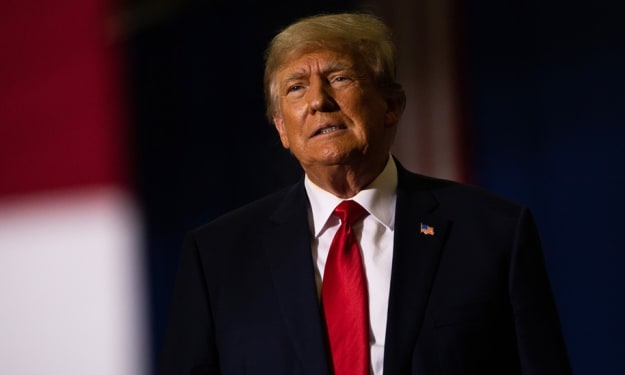
A Bogus New Rationale for Trump’s Economic Agenda
His allies now claim that he wouldn’t really impose massive global tariffs if elected. But the uncertainty created by threats is bad enough. By Scott Lincicome Perhaps the most levelheaded defense of Donald Trump’s misguided plan for steep global tariffs is that they’ll never be imposed. Trump surrogates have lately been assuring the business world that the former president will, if elected, use merely the threat of across-the-board import taxes of 10 to 20 percent to pressure other countries to lower their own barriers to American goods. The result: freer trade among participating nations, and more revenue for American companies, without ever firing anything more than a warning shot.Howard Lutnick, a billionaire co-chair of the Trump transition, recently made a version of this argument on CNBC, using the auto industry as an example. “If we said, ‘We’re going to tariff you the way you tariff us,’ do you think they’re going to allow Mercedes and all these Japanese companies and Porsches and BMWs to all of a sudden have 100 percent tariffs in America?” he said. “Of course not. They’re going to come and negotiate, and their tariffs are going to come down, and finally Ford and General Motors are going to be able to sell in these places.” The idea that the White House can use import restrictions to affect foreign governments’ policies is not entirely without precedent. Research shows that from the 1970s through the early 1990s, various administrations sometimes succeeded in prying open foreign markets by threatening tariffs or other protectionist measures. A reasonable case can even be made that Trump’s 2019 promise to slap 10 percent tariffs on Mexican imports helped push our southern neighbor to cooperate more fully on restricting illegal immigration. Trump’s new global tariff threat, however, would likely be far less successful, and would impose significant costs even if the tariffs were never applied. The “just a threat” strategy sounds nice in the abstract but in reality suffers from fatal flaws: It ignores not only America’s checkered history of such gambits but also the economic damage that threats alone can inflict on the American and global economies. The occasional tariff-threat success stories are exceptions to a broader negative trend. In a comprehensive analysis of every U.S. unfair-trade investigation from 1975 to 1993—91 cases targeting foreign discrimination against U.S. goods, services, and intellectual property—Kimberly Ann Elliott and Thomas O. Bayard found that American efforts to pressure foreign countries to open up their markets were successful less than half of the time. The authors’ definition of “success” was generous to U.S. officials: It could include just the partial achievement of U.S. objectives and result in no actual trade liberalization. Even then, the wins occurred mostly when a single country was dependent on the U.S. market—a situation that applies to only a few countries today—and during a short period in the mid-1980s, when the U.S. had far more economic heft in global markets than it has now. (China in 1991, for example, shipped almost one-third of its exports to the United States; today, the number is about 15 percent.) When the U.S. government actually applied trade restrictions, moreover, the strategy worked only twice in 12 tries. In the other 10 cases, foreign governments did not acquiesce to American demands; despite new U.S. protectionism, they kept in place the policies and practices to which Washington objected.Trump-era trade actions have encountered similar difficulties. No nation lowered its tariffs on U.S. goods in response to tariffs imposed, or merely threatened, during the Trump administration, and most of those U.S. tariffs remain in force today. Even worse, several foreign governments—in China, the European Union, India, Turkey, Canada, Mexico, and Russia—retaliated against U.S. exports, which in some cases remain depressed. Since then, Trump’s “Phase One” deal with Beijing, signed in early 2020 and hailed as proof that the tariffs were working, because China had agreed to buy American farm goods and open certain domestic markets, has fizzled out; China has largely failed to follow through. And, as the current U.S. Trade Representative Katherine Tai just confirmed, the China tariffs have not changed Chinese government policies or behavior. Overall, a recent analysis of the Trump-era retaliation shows that “a one percentage point increase in foreign tariffs was associated with a 3.9 percent reduction in U.S. exports.” So Trump’s previous strategic tariff experiment resulted in less trade, not more, and America is still paying for it.Just the threat of a tariff also can inflict considerable economic costs, because it increases uncertainty for business, which has been found to reduce U.S. investment, output, and hiring. An unpredictable policy environment gives private companies an incentive to stay out of the U.S. market until policy is clarified, resulting in a lower level of current economic activity overall. Numerous studies have confirmed these effects, but they’re really just common sense: Who would want to wager millions of dollars on a new U.S. facility that might soon face higher production costs, or be unable to sell products abroad, thanks to possible tariffs? Various measures of what economists refer to as “trade policy uncertainty,” or TPU, spiked during Trump’s time in office as he routinely announced or teased radical changes to U.S. tariff policy on Twitter. According to one index, average TPU during the Trump administration was the highest recorded under any president since 1960, when the series began. A study in the Journal of Monetary Economics estimated that the increase in Trump-era uncertainty reduced aggregate U.S. investment by $23 to $47 billion in 2018 alone.American trade law compounds this uncertainty by giving the president broad and ambiguous power to quickly impose new tariffs without congressional input or approval. As my Cato Institute colleague Clark Packard and I detail in a new paper, following the Smoot-Hawley tariff debacle of the 1930s—in which Congress dramatically increased U.S. protectionism and thereby set off a global trade war that deepened the Great Depression—the legislative branch delegated much of its constitutional trade authority to the executive. Congress assumed that the president, with national constituency and foreign-affairs responsibilities under Article II, was less likely to repeat Smoot-Hawley. This approach to U.S. trade policy making worked reasonably well for 80-plus years, but Trump (and, to a lesser degree, Joe Biden) exposed a key flaw: The laws at issue are so broad and ambiguous as to allow a president to unilaterally impose or maintain damaging tariffs on dubious grounds.Over the past seven years, moreover, U.S. courts have rejected every challenge to the Trump-era tariffs on steel, aluminum, and Chinese imports, and to the laws under which the tariffs were imposed. Judges have proved to be particularly deferential to the executive branch in cases alleged to involve “national security,” a term so broad and undefined that one Trump-administration lawyer famously refused to concede that it couldn’t apply to imported peanut butter. Given this precedent, the next president will effectively have a green light to impose new tariffs—and dictate U.S. trade policy—with little concern that the other branches of government will stand in the way. Any such tariffs, as well as their size and scope, will thus come down to the whims of one person in the Oval Office, who might be Trump. Future courts might find global, across-the-board tariffs to be fundamentally different from past actions and thus beyond the bounds of whatever law was used to justify them, but that outcome is far from guaranteed. Until Congress changes the law, trade policy will be vulnerable to abuse and will therefore continue to thicken the fog surrounding trillions of dollars in annual U.S. trade.That fog is, unfortunately, again building up as trade-policy uncertainty has climbed back to levels not seen since Trump’s time in office. His victory next week would likely boost uncertainty even more, with inevitable collateral damage to the U.S. investment climate and economy. Indeed, with reports of corporate angst and delayed investment already proliferating, the damage appears to have already begun.
By Abd Ullah2 years ago in Motivation
Leadership Isn’t a Spectator Sport: The Dangerous Allure of Deliberate Indifference
Leadership. It’s a word that gets tossed around like confetti in corporate America. We talk about it endlessly—seminars, books, webinars—yet we rarely address the elephant in the room: the leaders who are physically present but emotionally AWOL.
By WorkShyft2 years ago in Motivation
Bible Study 101: Understanding Old Testament vs. New Testament Teachings. AI-Generated.
Studying the Bible can be a deeply rewarding spiritual experience, but it often brings up questions about the differences between Old Testament and New Testament teachings. Understanding how these two sections of the Bible complement each other is essential for grasping the broader message of Scripture. Let’s explore key aspects of both the Old Testament and New Testament teachings, highlighting their distinct purposes and how they relate.
By Betty Sue Michael2 years ago in Motivation
Why Is the Sun So Hot?
“Why Why World: Why Is the Sun So Hot?” As the holiday season approaches and temperatures rise, parents and guardians everywhere are searching for meaningful and entertaining gifts that spark the imagination and foster learning. Enter Why Why World: Why Is the Sun So Hot?, a captivating children’s book that answers the curious questions of young minds aged 3 to 8. This holiday season, give the gift of discovery with this delightful story that will be available at a special Kindle Countdown price just in time for Christmas.
By Estalontech2 years ago in Motivation
Rising Above
Embracing the Storm High above the valleys, beyond the reach of most creatures, an eagle takes flight. This isn’t just a flight through clear skies—this is a journey of struggle, survival, and self-discovery. The eagle faces harsh winds that threaten to pull it down, fierce storms that block its view, and rain that seems unending. But rather than fighting against these forces, the eagle learns to move with them, letting the storm’s power help it climb higher, embracing each challenge as a part of its ascent.
By Melanie2 years ago in Motivation
Finding My Voice on Vocal. Content Warning. AI-Generated.
Nia had always loved to write. Her journals, filled with fragments of stories, thoughts, and occasional poems, had become a part of her, a place to release her ideas and express emotions she rarely shared. But, like many aspiring writers, she wondered if anyone would find value in her words. Her work remained locked within those pages, waiting for a moment she never thought would come.
By Nomkhitha Nhlangulela2 years ago in Motivation
Book Review: The 4-Hour Workweek
Introduction The 4-Hour Workweek: Escape 9-5, Live Anywhere, and Join the New Rich, authored by Timothy Ferriss, explores how people can break free from traditional work models and achieve a life filled with freedom, adventure, and personal fulfillment. Ferriss, who successfully implemented this lifestyle himself, offers readers an unconventional roadmap for redefining success in work and life. Through a blend of personal anecdotes, case studies, and actionable strategies, Ferriss introduces readers to the idea of the "New Rich"—those who prioritize time and experiences over money alone.
By William Dodge2 years ago in Motivation
Where to Build Your Climate Tech Startup: Goldman's $74Trillion Green Tech Roadmap
In the fast-evolving climate tech landscape, knowing where to focus your entrepreneurial energy can be the difference between building the next breakthrough solution and getting lost in the noise. A new Goldman Sachs Research report has just mapped out a $74 trillion investment opportunity through 2070 - and for green entrepreneurs, it's essentially a treasure map of where capital will flow over the coming decades.
By Andrea Zanon2 years ago in Motivation
Raspberry pi 5 vs mini pc
## Raspberry Pi 5 vs. Mini PC: A Comparative Analysis **Choosing the Right Device for Your Needs** When considering a compact computing device, the Raspberry Pi 5 and mini PCs are two popular options. While both offer powerful capabilities, they cater to different needs and preferences. **Raspberry Pi 5: A Versatile Single-Board Computer** The Raspberry Pi 5 is a versatile single-board computer (SBC) that excels in a variety of applications, including: * **Home automation:** Controlling smart devices, creating home security systems, and automating tasks. * **Retro gaming:** Emulating classic video game consoles. * **Media server:** Streaming media content to various devices. * **Web server:** Hosting personal websites and web applications. * **Educational projects:** Learning programming, electronics, and robotics. **Key advantages of the Raspberry Pi 5:** * **Affordable:** It's a cost-effective option for many projects. * **Community-driven:** A large and active community provides extensive support and resources. * **Versatile:** Can be used for a wide range of applications. * **Energy-efficient:** Low power consumption, making it suitable for long-term projects. **Mini PC: A Powerful Desktop Alternative** Mini PCs are compact desktop computers that offer more powerful performance than Raspberry Pi. They are ideal for tasks that require significant processing power, such as: * **Office work:** Running productivity software like Microsoft Office. * **Gaming:** Playing less demanding games. * **Video editing:** Editing videos and photos. * **Web development:** Running web servers and development tools. **Key advantages of Mini PCs:** * **Powerful performance:** Offers significantly better performance than Raspberry Pi. * **Upgradability:** Some models allow for upgrades like RAM and storage. * **Windows compatibility:** Most mini PCs support Windows, making them suitable for a wider range of software. **Choosing the Right Device** To make the right choice, consider the following factors: * **Performance:** If you need high performance for tasks like gaming or video editing, a mini PC is a better option. For less demanding tasks, a Raspberry Pi 5 may be sufficient. * **Versatility:** Raspberry Pi is more versatile and can be used for a wider range of projects, while mini PCs are more suitable for specific tasks. * **Budget:**
By Bsty2 years ago in Motivation