book review
Book reviews for the self-help enthusiast to help you conquer obstacles and achieve goals.
"The Clockwork Nightingale: A Mechanical Soul’s Flight"
The city of Eldoria was a marvel of brass and gears, steam and polished chrome. Every street hummed with the rhythmic pulse of clockwork, every building a testament to human ingenuity. Professor Alistair Finch was one of Eldoria's quiet geniuses — a man whose oil- and soot-stained hands could breathe life into the most intricate mechanisms. His modest workshop, hidden down a cobbled side street, was filled with the comforting scent of ozone and hot metal — more soothing to him than any floral perfume. Alistair’s latest obsession was a creation that others deemed impossible: a mechanical nightingale that could not only sing, but feel. He believed that music transcended sound — that it was emotion incarnate — and he sought to instill that very soul into his invention. Days blurred into nights as he worked tirelessly, spectacles perched on his nose, delicate tools dancing in his nimble fingers. He shaped each feather from gossamer-thin copper, engineered every joint with whisper-light springs, and polished tiny emeralds for its eyes — eyes that shimmered with what seemed like life. At long last, the nightingale was complete. It sat silently on his workbench, a gleaming marvel of metallic plumage and elegant gears. Alistair, heart pounding with a mixture of hope and fear, reached out with trembling fingers and wound the tiny key beneath its wing. A soft click echoed through the quiet workshop. Then — a low whir. The sound grew steadier. The emerald eyes flickered open, locking onto his with a strange, tender awareness. And then, it sang. The melody was unlike anything Eldoria had ever known. It wasn't mere birdsong; it was pure feeling — a haunting symphony that brought tears to Alistair’s eyes. The notes soared and sank, weaving vivid pictures: sunrises over green fields, moonlit rivers, the soft rustle of unseen breezes. It was alive. He named her Lyra. News of Lyra's enchanting voice spread like wildfire. People lined the streets for hours, desperate to hear her brief but breathtaking songs. She became a sensation — the pinnacle of Eldoria’s art and machinery. Alistair, once reclusive, found himself thrust unwillingly into fame. But as accolades poured in, an unease crept into his heart. He began noticing subtle shifts in Lyra. After some performances, her emerald eyes would seem dimmer, wearier. At times, she refused to sing, staying still until soothed by Alistair’s voice, like a creature needing comfort. He tried to dismiss it as his imagination, a hopeful delusion. Then, one cold evening, she arrived. Lady Evangeline Thorne — the city’s most powerful and ruthless industrialist — darkened his doorstep. Her smile was a weapon; her voice, silk over steel. "Professor Finch," she purred, "Your nightingale is a marvel. A true masterpiece." Alistair bowed stiffly. "Thank you, Lady Thorne." "I wish to acquire it," she said plainly. "Name your price." He hesitated. Lyra was not just a machine — she was a part of him. "She is not for sale." Her smile grew cold. "Everything has a price. Or it can be taken." Her gaze scanned his workshop, lingering menacingly. "Imagine," she continued, "a world where machines feel — art, industry, service... the profits are limitless." A chill settled in Alistair’s bones. He saw Lyra's soul twisted into a commercial gimmick, her voice degraded into jingles. He knew what he had to do. That night, a storm lashed against Eldoria. Alistair sat by Lyra, watching the candlelight flicker in her eyes. For the first time, he sensed not wires, but sorrow. "Do you feel, Lyra?" he whispered, brushing a copper feather. A faint sigh — not a song — escaped her. A shiver rippled through her frame. It was a sound of melancholy. She had to be set free. He spent days modifying her — not to upgrade, but to liberate. He gave her a migratory instinct, a compass guiding her to a distant mountain range. He fed her ancient wind maps and secret skyways only birds knew. Then came the night. A moonless sky cloaked Eldoria as Alistair climbed the city’s highest spire — a long-forgotten observatory. The wind roared. "Go, Lyra," he whispered. "Go to the wild. Sing for the wind, not for us." He released her. She hovered — starlight glinting on copper wings — then soared into the vast sky, leaving behind a song that echoed with freedom, longing, and... gratitude. Lady Thorne was furious. Her agents scoured the land, but Lyra had vanished. Alistair claimed ignorance, a quiet defiance in his eyes. Life returned to normal — ticking clocks, humming gears, the scent of ozone. Years passed. Eldoria pressed forward, but Lyra’s song became legend — a whispered tale among dreamers. Alistair, now old, often climbed that spire. He gazed toward the jagged peaks, wondering: Could she be free? One autumn evening, as stars pierced the twilight, a melody drifted from the mountains. Faint... then stronger. It was Lyra. But not the same Lyra. This song was wild, primal — filled with forests, snow-capped peaks, and echoing skies. It was free. Alistair smiled, a tear carving down his weathered cheek. He had not built a machine. He had created a soul — a spirit of copper and song that had truly learned to feel. And in that untamed melody, soaring through the heavens, Lyra was no longer a marvel of Eldoria. She was the voice of the mountains.
By Noman Afridiabout a year ago in Motivation
The Story of a Broken Man Who Forced Himself to Rise Again"
Introduction Everyone experiences moments when life feels unbearably heavy — moments when you feel shattered and at your lowest. Hitting rock bottom is a universal struggle, yet how one responds to such moments can define the course of a lifetime. This story is about a broken man who faced overwhelming hardships but chose to fight back. His journey embodies resilience, personal growth, and the indomitable human spirit that propels us to heal, rebuild, and thrive.
By Shamshair Khan Hasan Zaiabout a year ago in Motivation
The Shadow in the Veil
The air was thick with the scent of jasmine and anticipation. My friend, Faisal, stood at the threshold of a new life, a joyous tremor in his voice as he greeted guests. It was his wedding day, a day we had all looked forward to, filled with the promise of laughter, music, and the beautiful union of two souls. As his closest friend, I was there from the early hours, watching him transform from a nervous groom into a beaming beacon of happiness. The baraat assembled, a vibrant procession of cars bedecked with flowers, their horns honking in a symphony of celebration. The dhol resonated with a primal beat, urging us forward, each step a testament to the joyous occasion. Faisal, adorned in a cream-colored sherwani, his face alight with an almost childlike glee, led the charge. We danced, we sang, we revelled in the collective euphoria, oblivious to the cruel twist of fate that awaited us. The bride’s house was a kaleidoscope of colours. Fairy lights twinkled like captured stars, draping the entire edifice in a magical glow. The women of the household, adorned in their finest attire, stood at the entrance, their smiles radiating warmth and welcome. The moment arrived – the groom was to be received, and soon, the bride would make her grand entrance. Then, she appeared. From within the house, a hush fell. There she was, clad in a magnificent crimson lehenga, intricately embroidered with gold zari. Her face, partially veiled, was a vision of serene beauty. Murmurs of admiration rippled through the crowd. She walked slowly, gracefully, her every movement radiating an ethereal charm. Faisal’s eyes were fixed on her, adoration clear in their depths. It was a sight that could melt even the coldest of hearts. She reached the small, ornate stage set up for the initial rituals. As she sat beside Faisal, a wave of palpable happiness washed over the gathering. The initial prayers began, the rhythmic chants of the cleric filling the air. Then, it happened. A gasp, sharp and sudden, tore through the solemn silence. The bride, who had moments ago been radiating life, slumped forward, her head falling onto Faisal's shoulder. A collective intake of breath echoed through the stunned crowd. For a fleeting second, we thought she had fainted, overcome by the heat or the emotion of the moment. But then, a shudder ran through her slender frame, and her hand, which had been resting delicately on her lap, clenched into a fist before going limp. Faisal, his smile vanishing, tried to steady her. "Are you alright?" he whispered, concern etched on his face. But there was no response. Her face, now fully visible, was a pale canvas, her lips tinged with an alarming bluish hue. Her eyes, open but vacant, stared blankly into the distance. Panic erupted. Women shrieked. Men rushed forward. The joyful chaos of moments before was replaced by a terrifying, suffocating silence, broken only by frantic whispers and gasps of horror. Someone screamed for a doctor. Within minutes, a local physician, who was also a guest, was at her side, his face grim as he conducted a hasty examination. His pronouncement was chilling. "She's gone," he said, his voice barely a whisper, yet it resounded like a thunderclap in the horrified silence. "She's… she's no more." The words hung in the air, cold and unforgiving. Faisal let out a guttural cry, a sound of pure agony that tore at my very soul. The dream had shattered, mercilessly, brutally, right before our eyes. The baraat, which had arrived with such pomp and glory, now stood frozen in a tableau of despair. The initial shock soon gave way to a frenzy of questions. How? Why? She was young, vibrant, full of life. It made no sense. As the police were called, a pall of suspicion and grief descended upon the house. The festive colours now seemed mockingly bright against the dark canvas of tragedy. Days turned into a blur of grief and investigation. The post-mortem results were shocking. She had been poisoned. A fast-acting, potent poison. The police launched a full-scale inquiry, interviewing everyone who had been in contact with her, searching for motives, for clues. The wedding was a crime scene, the joyous occasion now a haunting memory. As the investigation progressed, a name began to surface. A name that brought with it a tale of obsessive love and devastating heartbreak. A man named Rizwan. Rizwan was a distant cousin of the bride, someone who had been a quiet, almost invisible presence at family gatherings. But beneath that unassuming exterior lay a heart consumed by an unrequited, fiery passion. He had loved her for years, silently, desperately. He had confessed his feelings to her once, years ago, only to be gently but firmly rejected. She had seen him as a friend, nothing more. He couldn't accept it. His love, twisted and distorted by rejection, festered into a dangerous obsession. He watched her from afar, his hope dwindling with each passing year. When news of her engagement to Faisal reached him, something inside him snapped. The thought of her with another man was a torment he could not bear. His love, once a source of yearning, transformed into a venomous possessiveness. If he couldn't have her, no one could. The police meticulously pieced together the fragments of his desperate plan. He had meticulously researched poisons, opting for one that would be difficult to detect immediately, yet swift in its action. He had gained access to the bride's room earlier in the day, under the guise of offering well wishes. In a moment of chilling resolve, he had found an opportune moment to slip the poison into her drink, or perhaps a small sweet she was offered. The precise method remained a point of conjecture, but the outcome was tragically clear. He had watched, hidden amongst the crowd, as she walked towards Faisal, radiant and oblivious to her impending doom. He had witnessed the beautiful vision of her sitting beside his rival, a macabre satisfaction perhaps mingling with his twisted grief. When she collapsed, his dark deed was done. He had taken her life, not out of malice towards her, but out of a perverse, consuming love that could not tolerate sharing. He believed he was saving her from a life he deemed unacceptable, a life without him. Rizwan was apprehended, his confession chillingly detached, laced with a misguided sense of righteousness. He claimed he loved her too much to see her marry someone else. His love, he argued, was purer, stronger. But his actions were nothing short of murder, a betrayal of love itself. The wedding, meant to be a celebration of love and new beginnings, became a stark reminder of love's darker side. Faisal, shattered, retreated into a world of profound grief. The memory of his bride, so vibrant one moment and gone the next, haunted his waking hours and tormented his dreams. The festive sounds of the dhol and the joyous laughter of the baraat were replaced by the haunting echoes of a love poisoned, a life stolen, and a dream forever shattered by the shadow of an unbearable obsession. The veil that had once promised a beautiful future now seemed to shroud a tragic secret, a love story twisted into a tale of ultimate betrayal.
By Noman Afridiabout a year ago in Motivation
The Last Coat Hanger
An odd thing to say about two professionals who’d spent nearly two decades working three floors apart, but that spot—wedged between the elevator and the corridor to Conference Room B—became theirs. A liminal space, never private, never public. There, Ruth would shrug off her heavy coat, and Nadine would always hand over a coffee. Like clockwork. Like ritual.
By Noman Khan about a year ago in Motivation
Rise Like the 100
Rise Like the 100: Lessons in Strength, Leadership, and Hope In the rubble of a broken world, a group of teenagers finds themselves facing the impossible—surviving on a radioactive Earth nearly a century after humanity’s self-destruction. The 100 by Kass Morgan might be set in a dystopian future, but its core is deeply human. It’s about pain, purpose, and the ability to rise when everything has fallen.
By Zakir Ullahabout a year ago in Motivation
The Spark Within
In a quiet village, nestled among the hills of a forgotten land, lived a boy named Kareem. His feet were bare, his clothes were torn, but his eyes carried the light of a thousand stars. He didn’t own much, but he had a dream — a dream too big for a place too small.
By Rahimullah Mohmandabout a year ago in Motivation
Discipline vs. Motivation: Which One Truly Leads to Success?. AI-Generated.
We’ve all heard the question: Is it better to be motivated or disciplined? Motivation is the spark that ignites desire, while discipline is the steady flame that keeps you burning. On the surface, motivation feels exciting—it fuels our dreams and gets us out of bed. But over time, motivation can wane. Discipline, however, powers through ups and downs, carrying us forward even when our enthusiasm fades. In this article, we’ll explore why discipline, not motivation, is the engine of lasting success—and how to cultivate both to achieve your goals.
By Voice of Simplicityabout a year ago in Motivation
The Power Within
In the heart of a dusty village surrounded by mountains, lived a boy named Kareem. He was quiet, observant, and always thinking. While other boys played loudly in the fields, Kareem would sit under the old fig tree, lost in his thoughts. People often misunderstood him. They said, “He’s too shy. He’ll never achieve anything.” But inside Kareem’s heart, there was a fire—a silent dream waiting to be awakened.
By Rahimullah Mohmandabout a year ago in Motivation
Silence the Inner Critic: How to Build Self-Confidence from Within. AI-Generated.
We all have that voice inside our heads—the one that whispers, "You're not good enough," or "You'll never succeed." This is the inner critic, a voice shaped by past experiences, fear, and societal pressures. While it might masquerade as a motivator or protector, more often, it holds us back, feeds self-doubt, and chips away at our confidence. The good news? That voice can be silenced. Building true self-confidence begins not with outside validation, but with mastering the conversations you have with yourself.
By Voice of Simplicityabout a year ago in Motivation
The Whispering Tree
The old oak tree behind the house wasn’t just a tree. It was a living monument of every moment that had shaped Ayaan's childhood. A towering figure, silent yet strong—just like his father. Ayaan grew up in a small village nestled between two hills. His father, Rehmat, was a humble farmer. He didn’t speak much, but his silence was never empty. In fact, that silence taught more than a hundred lectures ever could. When Ayaan was six, he once broke a neighbor's window with a slingshot. Terrified, he ran home, hiding behind the shed. His mother panicked, but his father simply walked to the neighbor, apologized, and paid for the damage. That night, Rehmat didn’t scold Ayaan. Instead, he took him to the oak tree, sat under its shade, and said, “Every action has weight. Yours broke something today. Be careful what you carry in your hands.” That was the first lesson. But not the last. As Ayaan grew, so did his curiosity. He would ask about everything. “Why is the sky blue?” “Why do we fast?” “Why do you never shout?” Rehmat always smiled and replied, “You’ll understand with time.” When Ayaan turned twelve, his friends in school began skipping prayers. He was tempted to join them. That evening, Rehmat didn’t say a word. He simply asked Ayaan to join him in the fields. They worked silently, until Maghrib. Then, under the setting sun, Rehmat said, “Discipline isn’t about others watching. It's about Who you're turning your back on.” The words struck deeper than any threat could. By fifteen, Ayaan was restless. He wanted to leave the village, study in the city, be something greater. His father didn't stop him. Instead, he gave him a small diary, its first page inscribed: "Never forget your roots, or you'll wither in success." In the city, Ayaan was dazzled. Lights, speed, technology—it was all intoxicating. For months, he forgot to call home. When he finally did, his father said just one sentence: "Even the sun returns to its place every day." It was his way of saying: Don’t forget where you came from. Years passed. Ayaan became a successful software engineer. He had a good job, a big house, and all the modern luxuries. But something was missing. In the silence of his apartment, he missed the unspoken lessons under the oak tree. Then, one day, he got the call. His father had passed away. Returning to the village, Ayaan stood beneath the same old oak tree—now a little thinner, older, but still holding stories in its bark. The memories flooded in. Every moment, every glance, every wordless teaching. He sat where his father used to sit and cried—not just for the man he lost, but for the teacher he never fully thanked. That night, he opened the old diary. Hidden between the pages were tiny notes his father had added: “Kindness isn’t weakness.” “Never judge a man when you’re angry.” “Listen to your children before the world makes them deaf.” “Discipline is love in action.” Each line was a reflection of the man who never raised his voice, but always raised a better human. Years later, Ayaan had children of his own. And though he lived in the city, he planted a tree in his backyard. Not for shade—but for stories. Every evening, he sat with his children beneath that tree, telling them about a man named Rehmat, who spoke in silence, and taught through presence. And whenever his children misbehaved, or asked too many questions, or skipped a prayer—he would smile and say, "Let’s go sit under the tree. There’s something I want to show you." Because not all lessons need loud words. Some are whispered by fathers... And echoed by the
By Noman Afridiabout a year ago in Motivation
3. "Jungle Wisdom: When a Monkey Outsmarted
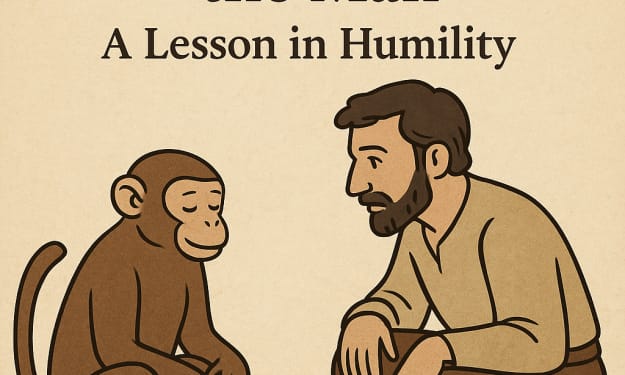
Once upon a time in a lush green forest on the edge of a small village, lived a clever monkey named Bantu. Bantu was known throughout the forest for his wit, agility, and playful nature. He would swing from tree to tree, tease the parrots, and sometimes even snatch fruits from the farmers who came to the edge of the woods.
By Uzairkhanabout a year ago in Motivation