advice
Advice that will put you on the path to success; tips, tricks and nuggets of wisdom from trusted experts and motivational mentors.
Staying True To Your Values
Staying True to Your Values: A Guide to Living Authentically In the hustle and bustle of modern life, it’s easy to lose sight of what truly matters. With countless opinions, societal expectations, and the pressure to conform, staying true to your values can feel like a daunting challenge. Yet, it is precisely this commitment to your core principles that builds a foundation of integrity, happiness, and lasting fulfillment.
By Oluwatosin Adesobaabout a year ago in Motivation
How Do You Grieve?
I accompanied an older female to the clinic for her regular checkup. After getting her number and waiting for her to call to be registered, we sat in a line of blue chairs inside. A female came and sat in front of us. After telling us good morning, she sat down and began to do the puzzle in the Daily Star.
By Annelise Lords about a year ago in Motivation
How One Broken Pot Taught a Life-Changing Lesson
The Dreaming Priest These motivational stories will encourage you to follow your dreams, treat others kindly, and never give up on yourself. A long time ago there lived a priest who was extremely lazy and poor at the same time. He did not want to do any hard work but used to dream of being rich one day. He got his food by begging for alms. One morning he got a pot of milk as part of the alms. He was extremely delighted and went home with the pot of milk. He boiled the milk, drank some of it, and put the remaining milk in a pot. He added slight curds in the pot to convert the milk to curd. He then lay down to sleep. Soon he started imagining the pot of curd while he lay asleep. He dreamed that if he could become rich somehow all his miseries would be gone. His thoughts turned to the pot of milk he had set to form curd. He dreamed; "By morning the pot of milk would set, it would be converted to curd. I would churn the curd and make butter from it. I would heat the butter and make ghee out of it. I will then go to that market and sell that ghee, and make some money. With that money, I will buy a hen. The hen will lay many eggs which will hatch and there will be many chickens. These chickens will in turn lay hundreds of eggs and I will soon have a poultry farm of my own." He kept on imagining. "I will sell all the hens of my poultry and buy some cows, and open a milk dairy. All the townspeople will buy milk from me. I will be very rich and soon I shall buy jewels. The king will buy all the jewels from me. I will be so rich that I will be able to marry an exceptionally beautiful girl from a rich family. Soon I will have a handsome son. If he does any mischief I will be very angry and to teach him a lesson, I will hit him with a big stick."During this dream, he involuntarily picked up the stick next to his bed and thinking that he was beating his son, raised the stick and hit the pot. The pot of milk broke and he awoke from his daydream. The priest sat there for a long while, staring at the broken pot. His heart was heavy, not just because the milk was lost, but because he had built a whole world in his mind that vanished in seconds. He realized that while dreaming is natural, one should never forget the ground they’re standing on. Life does not change through thoughts alone—it changes through action, effort, and perseverance. Many of us, at different points in life, build dreams without putting in the effort required to realize them. We wait for miracles, for luck, for someone to hand us success. But the truth remains unchanged: success is earned, not gifted. The story of the dreaming priest reminds us to focus on what we have now and work steadily toward what we want. If we spend all our time thinking about the future without respecting the present, we might lose even what we already possess—just like the priest lost his milk. It's wise to dream, but wiser to act. Moral: Success demands hard work. If you love the rain, you must learn to embrace the mud too. So in the end I would like to say, work hard and make the world yours.
By Yaseen Writesabout a year ago in Motivation
Speak Fearlessly: How to Conquer Public Speaking Anxiety and Master New Languages
Imagine standing at the edge of a busy stage, your heart pounding like a drum. The crowd waits, silent, as your mind goes blank. The microphone feels like a heavy weight in your hand. This isn’t a nightmare—it’s the fear of public speaking, a dragon that lurks in the hearts of millions. Now, picture another scenario: you’re abroad, trying to order coffee in a language you’ve studied for months. Your tongue trips over unfamiliar sounds, and embarrassment creeps in. What do these two fears have in common? Both stem from the fear of judgment. But don’t worry—this dragon can be tamed. Here’s how to slay it.
By Maaz Ahmadabout a year ago in Motivation
The Day I Walked Away: How Leaving My Job with Just $200 Transformed My Life
I stood at the gate of my office for the last time, my resignation letter crumpled in one sweaty hand, my phone in the other. I had $200 in my bank account, no backup plan, and a dream I barely dared to believe in. Everyone told me I was crazy. Maybe I was.
By Inamullah Afridiabout a year ago in Motivation
Nature’s Shield: The Importance of Greenery in Our Lives
In an era of rising urbanization, climate instability, and growing health concerns, one of the simplest yet most powerful protectors of life remains often overlooked: greenery. From dense forests and community parks to rooftop gardens and roadside trees, green spaces offer a natural shield that supports physical well-being, balances ecosystems, and fosters social harmony. The importance of greenery in our lives goes far beyond aesthetics—it is, quite literally, nature’s shield, safeguarding our present and fortifying our future.
By Ayan Aliabout a year ago in Motivation
Is Laziness a Myth? Why Motivation and Mental Health Matter More
The Origin of the “Lazy” Label The concept of laziness has long been used to shame people into action. In schools, workplaces, and even families, being called lazy often results in guilt or embarrassment. But labeling someone as lazy ignores the underlying reasons why they might be struggling to act.
By Muhammad about a year ago in Motivation
A Doctor Without Shoes
"A Doctor Without Shoes" A journey from barefoot poverty to healing the world—with nothing but hope and a mother’s prayer. Raheel never owned a pair of shoes until he was twelve. He grew up in a forgotten village in interior Sindh, where the summers were dry, the winters cruel, and dreams rarely made it past the village boundary. His father was a tenant farmer—working from dawn till dusk on someone else’s land, harvesting crops he could never claim as his own. His mother washed clothes for neighbors, often kneeling by the river, her hands cracked and bruised from the cold water and harsh soaps. They didn’t have a fan. They didn’t have a gas stove. There was no fridge or phone. But they had one thing: each other—and a fierce, unwavering hope. Raheel was the youngest of five siblings. His older brothers left school early to work in the fields. His sister was married off when she was sixteen. But Raheel? He was different. Every morning, he would walk three kilometers barefoot—across gravel roads and muddy fields—to reach the only government school in the area. The classroom had no proper desks, just mats on a crumbling cement floor. Sometimes the teacher showed up, and sometimes he didn’t. Still, Raheel sat quietly in the front row, with a pencil worn down to half its size and a second-hand notebook that barely held together. He asked questions. He listened carefully. And at night, he’d lie on the rooftop, staring at the stars, wondering how someone like him could ever reach the sky. One day, a free medical camp came to the village. It was the first time Raheel had ever seen a real doctor—young, clean-shaven, wearing a white coat and speaking gently to the villagers. The doctor gave his mother free medicine and even took her blood pressure. That night, Raheel turned to her and asked, “Ammi, who was he?” She replied, “He’s a doctor. A man who heals people.” Raheel was quiet for a moment. Then he whispered, “I want to become him.” His mother smiled faintly and said, “Then become him. No one’s stopping you but hunger and fear—and we’ve survived both.” But wanting is one thing. Becoming is another. Books were expensive. Shoes were a luxury. Even school uniforms had to be stitched at home from leftover cloth. When Raheel passed his matric exams with distinction, his father was proud but worried. They barely had enough to eat—how could they afford college? Still, his mother sold her wedding shawl—embroidered by her own mother on the day of her nikkah. With trembling hands, she gave the money to Raheel and said, “This is our investment. The return will be your white coat.” Raheel walked to college too, often skipping lunch so he could save what little money they gave him. He would borrow textbooks, copy diagrams by hand, and study by candlelight when there was no electricity—which was often. He passed his F.Sc. with flying colors. When the MDCAT exam came, he didn’t have enough for a bus fare to the city. So, he woke up before sunrise, walked halfway, and then rode on the back of a sugarcane tractor to reach the test center. He gave the exam barefoot. A month later, the results were announced. Raheel had ranked in the top 200 students of the province. He had done it. He had gotten into Liaquat University of Medical and Health Sciences. When the admission letter arrived, the village gathered around his home to celebrate. But Raheel’s family knew the real struggle was just beginning. The fees, the books, the hostel—all out of reach. The villagers pooled together what they could. An old schoolteacher handed him a used laptop, saying, “You’ll need this more than I ever did.” Another neighbor gave him a suitcase. Someone from a nearby city sent him a brand-new pair of shoes. His first. He cried that night—not out of joy, but out of the weight of it all. The expectations. The love. The burden of dreams too heavy for one boy’s shoulders. Medical college in the city was a different universe. English lectures, anatomy labs, models, ward rounds, night duties—it was overwhelming. His classmates came from cities, spoke fluent English, wore branded clothes, and had expensive phones. Raheel would sit in the back, quietly observing, copying notes late into the night. He couldn’t afford extra classes or paid notes. But he made it through—one lecture, one prayer, one breath at a time. In his third year, he received a call. His father had collapsed in the fields during a heatwave and passed away before Raheel could return. It was the hardest moment of his life. He wanted to drop out, to go home and support his mother. But she stopped him. Over a crackling phone line, she said, “Your abbu always wanted to see you in that white coat. Don’t let his dream die.” So Raheel stayed. He passed his final professional exam with honors. At the graduation ceremony, he looked around and saw no family in the audience. His mother couldn’t afford the travel, and his siblings were working. But in his heart, he felt them all. Today, Dr. Raheel runs a free clinic near his village. He treats the poor, the forgotten, the ignored. Patients come on donkey carts, motorbikes, even on foot—just to be seen by “the barefoot doctor who made it.” He doesn’t take money from the poor. He remembers too well what it felt like to be helpless. Every Friday, after closing the clinic, he walks to his father’s grave and sits silently for a while. Then he returns home, takes off his shoes, and walks barefoot in the courtyard. It reminds him of where he came from—and of the mother who gave up everything so he could walk with pride. Because some doctors are born in hospitals. Others are made in huts, raised by prayers, and shaped by pain.
By Doctor marwan Dorani about a year ago in Motivation
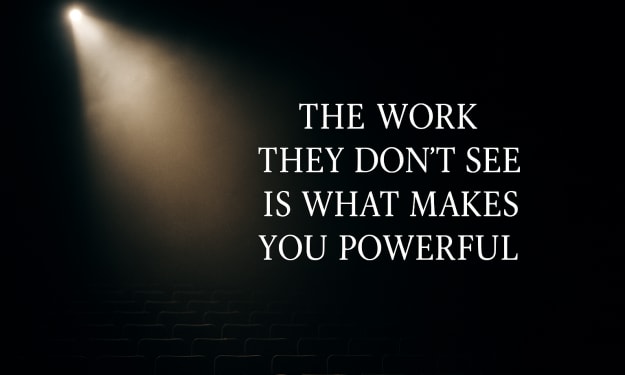
The Work They Don’t See Is What Makes You Powerful
There’s a myth we’ve been sold — especially in today’s world of social media and overnight sensations. It’s the idea that success is a lightning strike. A viral moment. A standing ovation that happens because someone finally noticed you.
By James Barbourabout a year ago in Motivation