advice
Advice that will put you on the path to success; tips, tricks and nuggets of wisdom from trusted experts and motivational mentors.
Hard Work Got Me Everything—Until It Got Me Nowhere
I always thought networking was a buzzword made up by people who didn’t want to work hard. You know the type—shiny LinkedIn posts, coffee chats with no substance, endless meet-and-greets where people pretend to care for five minutes and then vanish. That wasn’t me.
By Deepika D.about a year ago in Motivation
When love is real, it doesn’t make you question your worth - it reminds you of it.
Real love is not supposed to make you feel small, uncertain, or replaceable. Yet too often, we confuse emotional chaos with passion, inconsistency with mystery, and silence with strength. In the process, we lose ourselves trying to prove we’re lovable enough to stay. But here’s the truth: when love is genuine, it doesn’t come with games or emotional guesswork. It sees your worth - and never tries to make you forget it.
By Olena about a year ago in Motivation
If you always feel alone when you’re together - that’s not love. That’s loneliness in disguise.
Being physically close to someone yet emotionally distant is one of the most painful forms of loneliness. You sit next to them, share meals, exchange daily updates - but deep down, you feel invisible. When love turns into a quiet ache, when you’re constantly wondering if you’re asking for too much just by wanting to feel seen, it’s time to pause and reflect. The hardest truths are the ones we often try to avoid: maybe what we’re calling love isn’t actually love at all. And maybe, just maybe, you deserve a relationship that doesn’t make you question your own worth every time you’re in the same room.
By Olena about a year ago in Motivation
Two Green Golds That Could Change Your Life in Africa. AI-Generated.
By Marc Reflects I once thought that wealth was only for the chosen few — the lucky, the highly educated, or those born in cities. But one day, an agronomist friend shook that belief to its core. “Why do you always complain about being broke,” he asked me gently, “when you're standing on land that could make you wealthy?”
By Marc Reflects about a year ago in Motivation
The Illusion of Being Good: When Morality Becomes a Performance. AI-Generated.
In a world obsessed with appearances, morality has become just another costume. We curate our personalities as carefully as we curate our Instagram feeds, carefully editing our thoughts and behaviors for public approval. Being good used to be a matter of character. Now, it's often a matter of optics.
By Ahmet Kıvanç Demirkıranabout a year ago in Motivation
My toyota rav4 think it's a sports car, and it's kind of right.
I never thought I’d bond with a machine. But that changed the day I bought a used 2017 Toyota RAV4. You see, I needed something practical—room for groceries, occasional road trips, and a car that wouldn’t cry every time gas prices went up. The dealer sold me on the RAV4 by calling it “the reliable middle child of Toyota.” That should’ve been a red flag. Middle children always crave attention. And mine? Oh boy.
By USA daily update about a year ago in Motivation
The Autopilot Life: Are We Really Living, or Just Performing?. AI-Generated.
We wake up, scroll through our phones, rush through breakfast, and slip into the rhythm of the day like a well-worn shoe. Meetings, tasks, commutes, interactions — all of it choreographed to a familiar beat. But in the stillness between actions, a question lingers:
By Ahmet Kıvanç Demirkıranabout a year ago in Motivation
The Unseen Teacher: How Failure Became My Greatest Lesson
The Unseen Teacher: How Failure Became My Greatest Lesson When people talk about life lessons, they often mention advice from elders, personal victories, or moments of inspiration. Rarely do we hear failure celebrated as a great teacher. And yet, when I reflect on the moments that shaped who I am — not just what I’ve done, but how I think, act, and value the world — they all have one thing in common: failure. Not the cinematic, heroic kind, but the quiet, humiliating, deeply personal kind that leaves a mark long after the moment passes. It was in one of those dark corners of life that I found a lesson more powerful than any success could have taught me.
By Anwar Jamilabout a year ago in Motivation
From Silent Shadows to Finding His Voice
Jay was never the loudest voice in the room. As a kid, he often wished he could just disappear. Growing up in a busy household with three siblings, he always felt overshadowed. His parents loved him, but Jay was the shy one — the kid who avoided eye contact, rarely spoke up, even when he wanted to. School was a struggle. Classrooms felt like pressure cookers. When the teacher’s eyes landed on him, his heart would race so fast it felt like it might burst. Words got stuck in his throat. Sometimes he stammered; other times, he stayed silent. He became a pro at hiding behind his notebooks or slipping into the back row. Social events weren’t any easier. Birthday parties, family gatherings, or hanging out with classmates — Jay just watched from the sidelines, too scared to join in. He was convinced whatever he said wouldn’t be interesting, or worse, people would laugh at him. But it wasn’t just fear of judgment. Inside his mind was a storm of racing thoughts and “what ifs” — a constant voice telling him he wasn’t good enough. At home, his silence was often misunderstood. His parents worried — was he sad or angry? His siblings called him “quiet Jay,” sometimes affectionately, sometimes frustrated. Jay didn’t know how to explain what he felt. So he retreated deeper into himself. One memory stuck with him — a fifth-grade presentation about his favorite book. When it was his turn, his palms sweated, voice caught in his throat, and his words barely reached a whisper. The class grew uncomfortable. The teacher gave a kind smile, but Jay felt crushed. That moment became a symbol of his silent struggle. He wanted to be heard. He wanted to be seen. But fear was stronger. For years, Jay carried this invisible weight — a prisoner of his own mind, longing to break free. Then came his sister’s wedding — a night meant for celebration. But for Jay, it was a test he wasn’t sure he could pass. Months earlier, his sister had asked him to give a toast. She wanted her big brother to share a few words from the heart. Jay hesitated, terrified of the spotlight, but he loved her deeply and didn’t want to disappoint. So he agreed, promising himself he’d prepare. He practiced in front of the mirror for days. His voice shook, but the words felt right. He hoped when the moment came, he could push through the fear. At the reception, with all eyes on him, Jay’s heart pounded like thunder. The room shrank. Faces blurred. He opened his mouth — Nothing. Panic took over. His throat tightened. The words he had memorized vanished. He froze. Sweat slicked his palms. The silence pressed down like a heavy weight. He wanted to disappear. His sister gave a small, encouraging smile, but it wasn’t enough to break the spell. Finally, Jay whispered a few barely audible words, mumbling through the toast. His cheeks burned with shame. The polite applause felt distant. Inside, Jay felt shattered. That night, replaying the moment over and over, the embarrassment gnawed at him. But beneath it was a quiet spark — a realization. He didn’t want to live like this anymore. He wanted to find his voice. The next morning, Jay woke up weighed down by the silence of the night before. But somewhere in the sadness, a flicker of hope burned. He decided to speak — even if it was just one word at a time. The next day, he forced himself to say “hello” to the barista at his local coffee shop. Heart pounding, palms sweaty, he whispered, “Good morning.” The barista smiled warmly, “Good morning! What can I get for you?” That small exchange cracked the wall Jay had built around himself. Emboldened, he sought other tiny chances to speak — saying thanks, asking questions, making small talk. His voice was shaky, barely audible sometimes, but he did it anyway. At night, he poured his thoughts into a journal — safe, private. He filled pages with frustrations, hopes, and dreams he never spoke aloud. Weeks later, Jay searched for “anxiety therapist near me.” The thought scared him. What if he was judged? What if he couldn’t explain how he felt? But staying silent was worse. He made the appointment. At his first session, Jay sat nervously, hands clenched, eyes darting. The therapist, Dr. Martin, listened patiently. “I feel trapped,” Jay said quietly. “Like my voice is stuck inside me, and no one hears it.” “You’re not alone,” Dr. Martin said gently. “Many struggle to find their voice. The good news — you can learn to speak. First to yourself, then to others.” Over weeks, Jay learned breathing exercises, grounding techniques, and how to challenge negative thoughts. Dr. Martin encouraged self-compassion — to be patient with himself when progress felt slow. There were setbacks. Days Jay retreated back into silence. But he reminded himself healing wasn’t linear. Every small step counted. Slowly, the walls crumbled. Jay joined a support group for people with anxiety. At first, he listened quietly. Then one day, he shared a few words. Later, a few more. His voice grew stronger. So did his confidence. One afternoon, Jay reflected on how far he’d come. The boy who once trembled at a simple “hello” was now speaking in front of strangers. It wasn’t perfect. It wasn’t easy. But it was progress. Jay realized breaking silence is about courage — not perfection. > “Courage doesn’t always roar. Sometimes courage is the quiet voice at the end of the day saying, ‘I will try again tomorrow.’” — Mary Anne Radmacher Months passed. Jay grew braver, speaking up whenever he could. But the biggest challenge awaited: a company event where he was invited to share his journey with anxiety. When his manager asked him to speak, Jay’s heart skipped. Hundreds of coworkers and clients would be there. The idea of the spotlight made his chest tighten. “Are you sure?” his best friend Mia asked over coffee. Jay nodded, swallowing fear. “If I don’t share my story, who will?” Weeks of preparation followed — drafting, practicing, battling self-doubt. Some mornings he felt excited. Other days, panic threatened to silence him. He kept going to therapy and leaned on Mia’s support. She listened without judgment, reminding him how far he’d come. On event day, backstage, Jay’s heart thundered. Hands trembled as he held his notes. “What if I freeze?” whispered a voice in his head. He breathed deep, recalling Dr. Martin’s words: “Your voice matters, Jay. Speak your truth.” Then he stepped to the podium. The spotlight blinded him briefly. Faces blurred. But Mia’s smile was in his mind. He started shaky, voice cracking, sharing his early struggles — the fear, the silence, the moments he wanted to disappear. He told them about the wedding toast that broke him, the small victories of saying “hello,” the courage it took to ask for help. He didn’t hide the hard parts — setbacks, tears, the lingering anxiety whispering doubts. But he shared hope. He spoke of growth, resilience, and the power of breaking silence. When he finished, the room was quiet — then erupted in applause. Tears welled in Jay’s eyes as he stepped down. For the first time, he felt seen. Heard. Free. Afterward, coworkers came up with hugs, thanks, and their own stories. Jay realized he wasn’t alone. His story sparked connection. That night, lying in bed, Jay felt a new peace. Fear would always be part of him, but it no longer controlled him. He had found his voice — and with it, reclaimed his life.
By Arshad khanabout a year ago in Motivation
The Last Bench: A Lesson in Silence and Strength
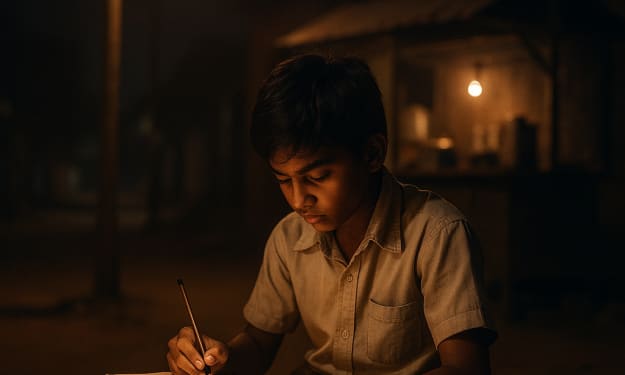
In a dusty corner of a small Indian town stood a public school where rules were rigid, uniforms were faded, and dreams were often small. Among the sea of students sat Arjun — always on the last bench. Not by choice, but by quiet force of habit. The front benches were reserved for the “smart ones,” the favorites, the ones who spoke loud and fast. Arjun was different. He was the quiet one, the forgotten one. He never raised his hand. Never volunteered. His shoes were worn out. His shirt was always a size too big. His lunchbox was often empty. And most notably, he never spoke unless spoken to. Teachers rarely noticed him, except when marking attendance. His classmates whispered that he was “weird,” and some cruelly nicknamed him “Zero.” But no one knew the truth. Each day after school, Arjun walked three kilometers to a roadside tea stall. From 4 PM to 10 PM, he served tea, cleaned tables, and washed cups. His father had died in a factory accident two years ago, and his mother worked as a maid. Arjun's earnings paid for his sister’s school books and medicine for his mother's back pain. He never complained. He never showed anger. But every night, after finishing work, he would sit under the same streetlight near the stall with a tattered notebook. He would write. He didn’t write essays or homework. He wrote stories — stories filled with colors, hope, monsters, dreams, and kindness. He wrote about people who fought battles no one saw. About children who became heroes in silence. His pen was his voice, his notebook his stage. Then came “Annual Talent Week” at school. For the first time, the school announced a short story competition. The topic: "The Day That Changed My Life." Arjun was hesitant. Who would read his story? But that night, he took out a fresh page and began. He wrote about his father's death. About the first day he held a tea tray with trembling hands. About the shame. The struggle. The silent tears. And then about how he discovered writing — his escape, his power, his healing. He didn’t write his name on it. Just submitted it anonymously. The judges — three English teachers and the principal — were stunned. Among dozens of entries about cricket wins, birthday parties, and movie dreams, this story stood out. It was raw, powerful, and deeply human. At the school assembly, the principal read the winning story aloud. As the last word was spoken, the entire hall was silent. No one moved. Even the class bullies had nothing to say. The principal looked around and asked, “Who wrote this?” Silence. Then, a hand slowly rose from the back. Arjun stood up. Some students gasped. A few giggled nervously. The teachers looked surprised. The boy they never noticed had written something they would never forget. From that day forward, things changed. His classmates began to talk to him — not out of pity, but respect. One teacher offered him extra notebooks. Another started helping him prepare for writing competitions outside school. Someone even gave him a second-hand typewriter. Years passed. Arjun went on to win district and state-level story contests. He got a scholarship to college. Later, he became a published author. His books were not just stories — they were lifelines for kids like him who felt invisible in their own classrooms. But Arjun never forgot that last bench. He never forgot the notebook, the streetlight, or the tea stall. In every author bio, in every speech, he mentioned one thing: > “Everyone saw my silence. No one saw my story. Until I wrote it.” --- 🧠 Moral of the Story: Never underestimate anyone based on silence or appearance. Behind every quiet face, there may be a powerful story waiting to be heard. Respect each person, not for what they show, but for what they carry silently. #InspirationalStory #RealLifeLessons #HiddenTalents #StudentStruggles #NeverGiveUp #EmotionalJourney #WritingToHeal #OvercomingAdversity #LastBenchLegend #SuccessThroughSilence
By Afzal khan dotani (story uplode time 10:00 PM)about a year ago in Motivation