advice
Advice that will put you on the path to success; tips, tricks and nuggets of wisdom from trusted experts and motivational mentors.
Procrastination: it’s not always laziness - sometimes it’s emotional overload in disguise
We often blame ourselves harshly when we procrastinate, calling ourselves lazy, undisciplined, or unmotivated. But procrastination is rarely just a time management issue - it’s often an emotional one. Sometimes it’s fear. Sometimes it’s perfectionism. Sometimes it’s your body trying to protect you from something your mind hasn’t fully named. If you’re constantly wrestling yourself just to begin, the problem isn’t your ambition - it might be your overwhelm.
By Olena about a year ago in Motivation
The Stranger Who Changed My Life
It was an ordinary Tuesday — the kind of gray, unremarkable day you never expect to remember. I had missed my morning train, spilled coffee on my only clean white shirt, and forgotten to charge my phone. I was running on empty — emotionally, mentally, and even financially.
By Asad Khanabout a year ago in Motivation
If you have to constantly prove your value - it’s not love, it’s performance
Real love feels like a safe place, not a stage. But many people find themselves in relationships where they’re always hustling to be enough - enough to be noticed, enough to be valued, enough to be chosen. This constant striving isn’t love; it’s performance. And the difference is everything. Love embraces you for who you are; performance demands you constantly prove it.
By Olena about a year ago in Motivation
10 Brutal Life Facts Everyone Learns Too Late
Life is not always fair, kind, or predictable. As we grow older, we start to realize that the world works in ways far different from what we were taught as children. The truth is, most of us are walking around pretending everything is fine, while silently carrying the weight of these hard realities. These truths are not meant to hurt you, but to awaken you. Because once you accept them, you stop living in denial and start living in freedom.
By Mian Suhaib Aminabout a year ago in Motivation
How to Build a Personal Brand in 2025 (Even If You're Starting from Zero)
Three years ago, I had no followers, no website, and no clue what a "personal brand" was. Today, my name appears in search results. I’ve worked with clients from around the world, and I earn a steady income from writing and consulting all because I built a personal brand from the ground up.
By Imdad Ullah Chemistabout a year ago in Motivation
The Psychology of Consistency: Why Showing Up Every Day Matters More Than You Think. AI-Generated.
"Success isn’t about doing great things occasionally—it’s about doing the right things consistently." We often think the key to success is talent, inspiration, or bursts of motivation. But if you’ve ever set a New Year’s resolution and failed by February, you know that fleeting energy isn’t enough. What actually creates long-term transformation is consistency—the quiet, unglamorous act of showing up even when you don’t feel like it.
By Ahmet Kıvanç Demirkıranabout a year ago in Motivation
The Blind Mother's Embrace
The little girl, Elara, knew her mother by touch, by scent, by the gentle lull of her whispered lullabies. Every night, without fail, her mother would visit her in her dreams. Not a vivid, bustling dream, but a soft, warm cocoon where she would be cradled in her mother’s lap, her tiny head resting against a familiar, comforting chest. Her mother’s hands, impossibly soft, would stroke her hair, trace patterns on her back. And even though Elara never saw her face in these dreams – it was always shrouded in a gentle, hazy darkness – she knew, with an innocent certainty, that these were her mother's hands, her mother's scent of lavender and old books, her mother's soothing voice. > “My sweet girl,” her mother would murmur in the dream, her voice a melody of pure love. “Always my brave little star.” Elara would wake up feeling cherished, a warmth spreading through her little body that lingered long after the dream faded. She would skip down the stairs, eager to see her mother in the waking world, to share stories of the dream world. But every morning, she would find only her father, Marcus, in the kitchen, meticulously preparing her breakfast. > “Good morning, Daddy!” she’d chirp, climbing onto her chair. “Mommy visited me again last night!” Marcus would freeze, his hand hovering over the cereal box. A shadow would fall over his kind eyes, a deep, unnameable sadness. He’d force a smile, a little too tight, a little too quick. > “Did she, sweetie? That’s nice.” He never engaged further, always steering the conversation to her school, her toys, anything but her mother. Elara, being only six, didn’t quite understand the shift in his demeanor, but she sensed the discomfort. So, she stopped talking about her dream mother at the breakfast table. But the dreams continued, growing richer, more detailed. In her dreams, her mother was always gentle, but there was a quiet solemnity about her, a stillness that was not quite normal. Elara noticed her mother never seemed to look directly at her, or at anything else for that matter. Her gaze, if one could call it that through the haze, was always inward, or distant. It was as if her eyes, though present, saw nothing. One morning, after a particularly vivid dream where her mother had held her close, humming a tune Elara had never heard before but felt deep in her soul, she decided she had to know more. She walked into the kitchen, her little brow furrowed with serious questions. > “Daddy,” she began, her voice small but determined, “what does Mommy look like? What color are her eyes?” Marcus dropped the spatula. It clattered loudly against the tiled floor. He knelt down, taking her small hands in his. His face was pale, drawn. > “Elara,” he said, his voice thick with emotion, “we’ve talked about this. Your mother… she’s not with us anymore.” Elara frowned. > “But she is! She visits me every night. She holds me. She sings to me.” His eyes, full of unshed tears, searched hers. > “Honey, your mommy… she died when you were just a baby. She never got to hold you, not really. Not like that.” Elara shook her head, tears welling in her own eyes. > “No! That’s not true! She holds me tight. Her hands are so soft.” She lifted her hands, demonstrating. “And she smells like lavender. And her eyes are… well, I can’t see them, but they feel like they’re closed. Like she’s sleeping, but talking.” Marcus's face crumpled. He pulled her into a tight embrace, burying his face in her hair. Elara could feel his body shaking. > “Oh, my brave little star,” he choked out, the same words her dream mother used. “Your mommy… she was blind, Elara. She never saw you. Not with her eyes.” The words hit Elara like a physical blow. Blind. Her mother was blind. That explained why she never saw her, why her eyes in the dream felt distant and unseeing. A shiver, not of cold, but of something far more unsettling, ran down her spine. If her mother was blind, and she died when Elara was a baby, and never truly held her… then who was holding her in her dreams? Who was whispering those tender words? That night, Elara dreaded going to sleep. The thought of the dream mother, her unseen face, her impossibly soft, blind touch, filled her with a new, creeping dread. She pulled her blanket up to her chin, her eyes wide open in the dark. She fought sleep for hours, but eventually, exhaustion claimed her. She slipped into the familiar dreamscape. The gentle darkness. The comforting scent of lavender. The soft hands reaching for her. She felt herself being lifted, placed in the familiar lap. The warmth spread, just as it always did. But this time, it felt different. Heavier. More cloying. > “My sweet girl,” the voice murmured, close to her ear. It was the same loving voice, yet now, it held an edge of something… possessive. Something hungry. Elara tensed. She remembered her father’s words: “She never got to hold you, not really.” > “Who are you?” Elara whispered in the dream, her voice trembling. The hands stroking her hair paused. The gentle humming stopped. A cold silence descended. Then, the voice, now clearer, colder, and impossibly close, responded. Not with the tender words of a mother, but with a chilling, raw desperation. > "Your mother, little star. The one who never held you." The hands on her back began to press harder, almost painfully, pulling her closer, enveloping her. The scent of lavender was still there, but now it was mixed with a faint, cloying sweetness, like decaying flowers. Elara felt the familiar warmth turn into a burning chill. She tried to pull away, to escape the embrace, but the hands held her fast, impossibly strong for such softness. She tried to see her mother’s face, to pierce the hazy darkness that always veiled it. And as she strained, the darkness seemed to thin, to swirl, revealing not a face, but something else. Two empty sockets, where eyes should have been, stared out from the hazy void. Not closed. Not distant. Just… empty. And from those empty spaces, a deep, silent yearning seemed to emanate, a profound, aching hunger for the touch it had been denied in life. Elara gasped in the dream, a silent scream of terror. The embrace tightened, squeezing the breath from her lungs. The blind mother, denied the warmth of her child in life, was now claiming it in death, consuming it, absorbing it. Elara felt herself being drawn deeper, swallowed by the cold, possessive love. She woke with a sudden, violent jolt, gasping for air. Her room was dark, silent, and blessedly empty. She sat bolt upright in bed, her body trembling, her heart pounding. The scent of lavender, faint but unmistakable, lingered in the air around her. She scrambled out of bed, ran to her father's room, and pounded on the door. When he opened it, sleepy-eyed and concerned, she flung herself into his arms, sobbing hysterically. > “She’s not Mommy, Daddy!” she cried, clutching his shirt. “She’s not Mommy! She… she’s blind, and she wants to keep me!” Marcus held her close, stroking her hair, the same way her dream mother had. But this time, Elara didn't feel safe. She felt the lingering chill of a love that was not love, of an embrace that wanted to consume. And she knew, with a certainty that chilled her to her core, that the blind mother would be back tonight, reaching for the child she had never truly held, seeking to make up for a lifetime of lost touch. > And next time, she might not let go.
By Noman Afridiabout a year ago in Motivation
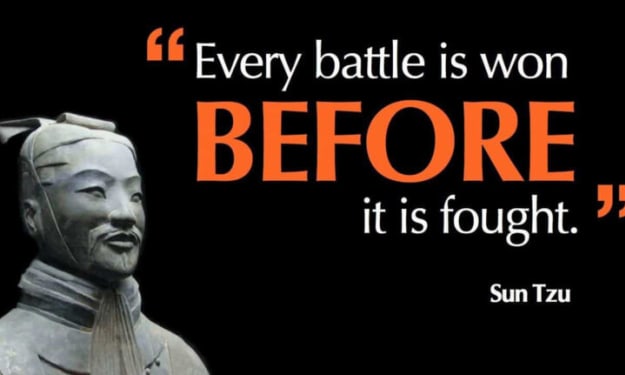
Summery The Art of War" by Sun Tzu
Summary of "The Art of War" by Sun Tzu (650 words) The Art of War is an ancient Chinese military treatise written by Sun Tzu, a legendary general, strategist, and philosopher. Composed over 2,500 years ago, the book remains one of the most influential works on strategy, leadership, and warfare. Though originally meant for military commanders, its lessons are widely applied in business, politics, sports, and daily life. 1. Foundations of Strategy Sun Tzu emphasizes that all warfare is based on deception. Victory depends on outsmarting the enemy, not necessarily overpowering them. He teaches that the best general wins without fighting — by breaking the enemy’s resistance through strategy, manipulation, and diplomacy. According to Sun Tzu, war should be the last option, pursued only when all peaceful means fail. 2. Planning and Preparation Preparation is vital. Sun Tzu outlines five key factors for success: The Way (moral alignment of people and ruler), Heaven (weather and timing), Earth (terrain and distance), The Commander (leadership qualities), and Method and Discipline (organization and logistics). A well-prepared leader considers all these before entering battle. He advises leaders to assess themselves and the enemy carefully. Knowing both will ensure victory; knowing only one can lead to defeat. Accurate calculations and a clear understanding of strengths and weaknesses are essential. 3. Waging War Wisely Sun Tzu warns that prolonged warfare drains resources and morale. Quick, decisive victories are best. He highlights the importance of managing supplies, avoiding unnecessary conflict, and using captured resources instead of depleting one’s own. 4. Positioning and Advantage The book teaches the importance of positioning in warfare. Victory comes not from brute force but from taking advantageous positions. This involves understanding the terrain, controlling key locations, and exploiting the enemy’s weaknesses while defending one's own. He explains the concept of shih — the energy or momentum of a situation — and how skilled leaders use it to gain dominance with minimal effort. 5. Flexibility and Adaptability A recurring theme is adaptability. There is no fixed method for victory. The general must be flexible like water — able to change direction and shape based on the battlefield. Just as water flows to the lowest point, a wise general avoids enemy strengths and attacks where they are weak. Sun Tzu criticizes rigid strategies and praises innovation. Being unpredictable confuses the enemy and creates opportunities. 6. Deception and Psychological Warfare Deception is central to Sun Tzu’s strategy. Misleading the enemy — about one’s strength, intentions, and location — creates confusion and opens paths to victory. “Appear weak when you are strong, and strong when you are weak,” he says. He also explores the power of fear, morale, and manipulation in warfare. A confident, united army defeats a divided, confused one. 7. Leadership and Command Sun Tzu describes the ideal leader as wise, courageous, disciplined, humane, and strict. A leader must inspire loyalty and obedience, make hard decisions, and act decisively. Overreaction, recklessness, or fear can lead to ruin. He emphasizes the importance of rewarding good conduct, punishing disobedience, and maintaining order in the ranks. Discipline ensures the army operates as one force. 8. Spies and Intelligence The final chapter focuses on espionage. Information is the lifeblood of warfare. Knowing the enemy’s plans, movements, and mindset allows a general to strike effectively. Sun Tzu outlines five types of spies and urges leaders to value intelligence above all else. Conclusion The Art of War is more than a military manual — it’s a timeless guide to strategic thinking. Its core principle is that war should be won with intelligence, not brute force. By mastering deception, preparation, adaptability, and leadership, one can secure victory while minimizing conflict and loss. Even today, Sun Tzu's ideas influence modern warfare, business strategy, leadership, and negotiations. His wisdom teaches that the greatest victories are those achieved with the least struggle.
By Khan Shahabout a year ago in Motivation