advice
Advice that will put you on the path to success; tips, tricks and nuggets of wisdom from trusted experts and motivational mentors.
The Power of Positive Thinking
Positive thinking is a powerful tool that can transform your life in profound ways. By cultivating a positive mindset, you can overcome obstacles, achieve your goals, and live a happier, more fulfilling life. In this article, we'll explore the power of positive thinking and provide practical tips for incorporating it into your daily life.
By Motivate4universeabout a year ago in Motivation
The Wisdom of Modesty
On a typical Monday morning in Riverton, the city buzzed with commuters and the smell of fresh coffee. Inside TechNova, a mid-sized software company, employees settled into their routines. Alex, a 35-year-old software engineer, arrived promptly at 8:30 a.m. Wearing a simple shirt and khakis, he carried a thermos of homemade coffee—a small habit that saved him money. His desk was neat: just a laptop, a family photo, and a small plant. He greeted a few coworkers quietly and focused on his work. Across the room, Mark, a 28-year-old sales rep, entered with a sharp suit and a flashy watch. “Morning, team!” he called out, eager to share stories from his weekend. His energy filled the room as he chatted with colleagues. Alex glanced up briefly. “Saw the highlights,” he said politely, then returned to his coding. He lived by a principle his grandfather taught him: save money quietly, show less than you have, and speak less than you know. It wasn’t flashy, but it had served him well. Lunchroom Moments At lunch, Mark showed off a new watch, proud of his latest purchase. “Cost a fortune,” he said, smiling. “You only live once, right?” Sarah, a project manager, admired it. “I wish I could afford that.” Mark grinned. “It’s about working smart. I’m into cryptocurrency now—it’s going up fast. You should try it!” Alex ate a simple turkey sandwich he’d brought from home, listening quietly. He preferred steady investments over risky trends. Sarah asked Alex, “What do you think about crypto?” “I’m cautious,” Alex replied. “I stick to what I understand.” Mark rolled his eyes. “Risk means reward!” “Maybe,” Alex said calmly. “I just like to be careful.” Later, Sarah asked Alex for advice. “Should I try crypto?” Alex said, “Only invest what you can afford to lose, and research it yourself.” She smiled. “Thanks, Alex. You always seem so calm.” Quiet Strength Weeks passed, and rumors of budget cuts spread. Alex overheard managers discussing layoffs but kept the information to himself. He focused on his work and kept saving. He lived simply—no fancy car or nights out, just a modest apartment and growing savings. Mark continued his flashy lifestyle, buying gadgets and taking expensive coffee. His desk was cluttered with the latest tech and business cards. One evening, Alex stayed late to help Lisa, a junior engineer struggling with a problem. He patiently guided her through the issue without making a fuss. “Thanks, Alex,” she said. “I didn’t want to look dumb.” “We all start somewhere,” he replied. Hard Lessons Then the crypto market crashed. Mark lost thousands overnight. He came to work stressed and frustrated, his mood affecting everyone. Layoffs soon followed. TechNova offered buyout packages. Mark, burdened by debts, was stuck. “I should have saved more,” he admitted to Sarah. Alex, however, had a cushion. He’d been saving for years and had a business idea ready. The buyout could fund his startup. His manager, impressed by his steady work, offered support. “You’ve handled this well,” his manager said. “What’s next?” “I’m starting my own company,” Alex said. “This feels like the right time.” “Good luck,” the manager said. Before leaving, Alex found Mark. “Tough break with crypto,” he said. “If you want, I can share some budgeting tips.” Mark looked surprised but grateful. “Thanks, Alex. I need help.” A New Beginning Six months later, Alex’s startup opened a small office. The space was simple but welcoming. His software was gaining clients. Mark visited, quieter and less flashy. “This is impressive, Alex,” he said. “You kept it low-key.” Alex smiled. “Slow and steady.” “I’m trying to change,” Mark said. “After my mistakes, I’m saving and being careful.” “Good,” Alex said. “It’s a long game.” As the evening ended, Alex felt steady and content. His quiet approach—saving, modesty, and listening—had brought real success. Mark was learning the same lesson: sometimes, less is more.
By Nauman Hassan Khanabout a year ago in Motivation
From Fat to Fit
There comes a moment in life when the mirror no longer lies. It no longer reflects just an image it tells a story. A story of neglect, stress, emotional eating, and silent battles. For many people, weight gain doesn’t happen overnight. It slowly creeps in, hidden beneath work pressure, family responsibilities, emotional struggles, and a lifestyle that barely makes room for health. This is the story of transformation not just of a body, but of mindset, habits, and life itself. It started with a simple breathlessness while climbing stairs. That moment of gasping for air became the wake-up call. The realization wasn’t about looking bad; it was about not feeling alive. The body felt heavy, but more than that, the mind carried a burden. That burden of knowing you’re capable of more but stuck in a cycle of bad food choices, long sitting hours, zero exercise, and constant excuses. Like many others, the journey began with doubt. Can I really do this? I’ve tried before and failed. What if I give up again? But this time, something clicked. It wasn’t about short-term goals like a wedding or a vacation. It was about living fully, playing with kids, climbing mountains, walking without pain, and waking up feeling strong. The motivation was no longer external it came from a deep desire to change from within. The first step wasn’t the gym or a diet plan. It was honesty. Sitting alone and accepting the truth: I let myself go, and now I will bring myself back. The next step was setting real, achievable goals — not “lose 30 kg in 2 months” — but “walk 20 minutes daily,” “cut soda,” “sleep on time,” and “cook one healthy meal a day.” Walking became the first friend on this journey. A simple walk in the park, headphones in, music playing, and the world left behind. Each step felt like a victory. The scale didn’t change immediately, but the mood did. The energy started rising, and sleep improved. Sugar cravings slowly reduced as water and real food took their place. Instead of punishing the body with crash diets, the focus shifted to fueling it with kindness — fruits, vegetables, proteins, and balanced meals. Gym was scary at first, all those fit people, machines, mirrors — it felt like another planet. But soon it became a place of power. Not because of six-pack abs or heavy weights, but because it represented consistency. A place where effort mattered more than perfection. Trainers helped, but it was the internal drive that became the strongest support system. Along the way, there were setbacks. Birthdays, holidays, emotional days — they all brought challenges. Some days ended with pizza and guilt, but the next morning brought a chance to return. That was the key — never quitting completely. The all-or-nothing mindset was replaced with “something is always better than nothing.” One healthy meal, a 15-minute walk, drinking water all these small acts kept adding up. As weeks turned into months, the body started changing. Clothes became loose, energy became natural, and people noticed. Compliments came, but they weren’t the real reward. The true reward was the ability to run without pain, to wake up without tiredness, to smile in the mirror with pride. This transformation wasn't a magic pill or a 30-day challenge. It was built on patience, understanding the body, and creating habits that were realistic. It involved learning how to cook healthy meals, reading nutrition labels, listening to hunger cues, and resting when needed. It wasn’t perfect and it didn’t need to be. Mental health also played a big role. Meditation, journaling, and positive affirmations helped heal the emotional relationship with food and the body. Instead of punishing the body for being fat, the new approach was to thank it for surviving and to nurture it toward better health. Support from family and friends helped, but self-support mattered most. There were days when no one understood the struggle, when the scale got stuck, when progress felt slow — but showing up every day made the difference. And one day, that same person who once hid from photos, who used to avoid mirrors, now stood confidently proud, strong, and truly alive. This story is not unique. It can be yours too. Whether you’re at the beginning or in the middle of your journey, know this change is possible. Not overnight, not without effort, but absolutely within your reach. You don’t need to be perfect. You need to be consistent, kind to yourself, and honest about your habits. The journey from fat to fit is not about shame or pressure. It’s about reclaiming your power, rebuilding your health, and remembering that your body is your home. Treat it with love, fuel it with good choices, move it daily, and watch how life transforms in return. Because in the end, it’s not just weight you lose it’s fear, doubt, pain, and fatigue. And what you gain is far greater: energy, confidence, freedom, and a healthier version of you.
By Mr Khanabout a year ago in Motivation
THE PERSON WHO DREAMED BEYOND. Content Warning. AI-Generated.
Human history is shaped not merely by those who acted, but by those who dared to dream beyond the limits of what seemed possible. These are individuals who saw the invisible, believed in the improbable, and pursued the impossible. The person who dreamed beyond is not just a historical figure; they are a timeless archetype — the visionary, the rebel, the seeker. From Galileo to Elon Musk, from Harriet Tubman to Malala Yousafzai, the story of humanity is also the story of dreamers who imagined a reality that did not yet exist and then, often at great personal cost, walked toward it.
By Amias yoursabout a year ago in Motivation
Techniques For Reducing Depression
*Techniques for Reducing Depression: A Comprehensive Guide* Depression is a complex and multifaceted mental health disorder that affects millions of people worldwide. It can manifest in various forms, from mild sadness to debilitating melancholy, and can impact anyone regardless of age, background, or socioeconomic status. Fortunately, there are numerous techniques that can help alleviate symptoms of depression and improve overall mental well-being. In this article, we will explore some of the most effective techniques for reducing depression.
By Muhammad Umarabout a year ago in Motivation
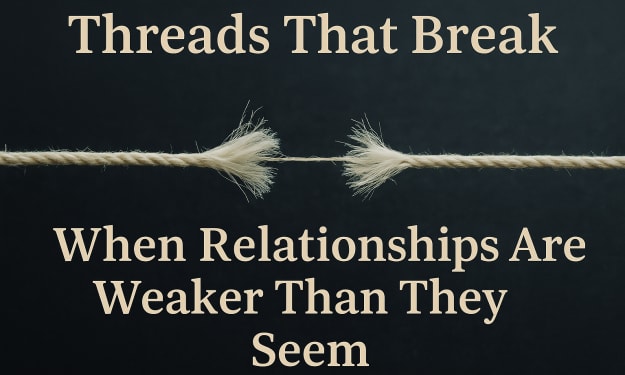
Threads That Break: When Relationships Are Weaker Than They Seem. Content Warning.
In life, we build relationships with care and emotion. Some begin with blood, others through friendship or love. Over time, we start believing these bonds are unbreakable—that they will hold through every storm. But the reality is often different. When life tests us, we sometimes find that the ties we trusted most were held together by nothing more than a fragile thread—a kacha dhaaga.
By Saaya Gsmabout a year ago in Motivation
How I Lost My Love For Art (And Gained It Back)
I’ve been creating art for most of my life. I can still remember the first time I drew a piece I was truly proud of. It was third grade so the piece wasn’t the best in the world, but it was something I created with my own hands.
By caitodoesstuffabout a year ago in Motivation
You cannot build a deep connection with someone who is disconnected from themselves.
We often search for meaningful relationships - whether romantic, platonic, or even professional. But one of the most overlooked truths about connection is this: you can’t build something real with someone who isn’t real with themselves. If a person hasn’t done the inner work - understanding their emotions, healing their wounds, knowing what they want - they may not be capable of meeting you at the depth you desire. It’s not a matter of blame. It’s a matter of emotional readiness. Understanding this can save you from the frustration of one-sided relationships and help you form bonds that are grounded in truth, vulnerability, and emotional safety.
By Olena about a year ago in Motivation
I Tried Living Like a Historical Figure for a Week
Let me begin with this: Leonardo da Vinci was a genius, an inventor, an artist, a scientist… and absolutely exhausting to emulate. When I decided to live like him for seven days, I had no idea I was signing up for sleep deprivation, eyebrow singeing, and enough self-doubt to rival a Renaissance philosopher. Day 1: The Outfit & The Journal I woke up early on Monday morning—way earlier than I usually do—to don my best approximation of Renaissance fashion. I had sourced a flowing tunic, a wide-brimmed hat, and some rather uncomfortable leather shoes. I looked like I had wandered off the set of a Shakespeare play. First mission: journaling. Leonardo was obsessed with sketching and note-taking, so I carried around a small leather-bound notebook everywhere I went. I wrote down observations like, “Birds do not flap as randomly as I assumed,” and “Today, I walked past a pigeon with a limp. Is this evolution in motion?” So far, so good. Day 2: Polyglot Problems Leonardo reportedly taught himself Latin, Greek, and several regional dialects. I figured I’d try Duolingo’s Latin course and managed to learn “ego sum vir” (I am a man) and “panem et circenses” (bread and circuses). At lunch, I tried using Latin with my coworkers. They were... unimpressed. Also, did I mention Leonardo barely ate meat? That was fine until I realized my go-to lunch—chicken Caesar wraps—was off the menu. I ended up with a plate of lentils and leafy greens. Very wholesome. Very tasteless. Day 3: Sleep Like a Polymath (Or Don’t Sleep at All) Leonardo allegedly practiced polyphasic sleep, meaning he slept for 20 minutes every four hours. I decided to give it a shot. I set alarms. I napped. I hallucinated. By 2 a.m., I was googling, “Can sleep deprivation make you smarter?” while holding a sketchpad I had tried to use in the dark. Spoiler: It cannot. I gave up and crashed at 5 a.m., curled up on the floor, clutching my unfinished drawing of a spoon. Day 4: The Inventor Within Time to invent. I went to the hardware store with grand ideas: perhaps a new kind of bicycle or a self-stirring coffee mug powered by gravity. I walked out with PVC pipes, a funnel, duct tape, and no plan. Back home, I tried to build a “flying machine,” based loosely on da Vinci’s sketches. It was essentially a pair of cardboard wings strapped to my arms with elastic bands. I climbed onto my couch, flapped furiously, and fell directly onto my coffee table. My roommate came out of their room, looked at me—wings and all—and just went back inside. Day 5: The Artist Emerges This was the day I waited for. I was finally going to paint like Leonardo. I set up an easel, prepped my acrylics (I didn’t have oil paints), and stared at a blank canvas for two hours—just like a real artist. I tried to paint a self-portrait in da Vinci’s style. But where he created the Mona Lisa, I created something that looked like a melting sock puppet. I captioned it “Mona Least-a” and moved on. Day 6: Nature Walks and Anatomy Leonardo spent hours studying nature and the human body. I decided to do both in one go. I walked to the park, sat on a bench, and tried to sketch squirrels, trees, and passersby. One man yelled at me for “staring too hard.” Another asked if I was part of a cult. Later, I opened a free online anatomy course to learn about muscles and bone structure. It was fascinating, until I fainted halfway through a dissection video of a cadaver’s knee. I realized I was not built for medical illustration. Day 7: The Renaissance Wrap-Up By the final day, I was delirious from lack of sleep, hungry from my near-vegan diet, and emotionally shattered by the judgment my “Mona Least-a” received online. But I was also... kind of inspired. Living like Leonardo da Vinci—even badly—made me realize how intensely curious and disciplined he was. He wasn't just dabbling in things; he was devouring knowledge with every breath. Whether it was painting, architecture, flying machines, or dissecting frogs, he showed up with purpose and wonder. And that, honestly, is kind of beautiful. So I sat down, wrote one last journal entry, and drew my coffee mug—really took my time with the shading. I ended the week feeling both more appreciative of Leonardo and more aware that I am, without a doubt, not him. Final Thoughts If you’re considering living like a historical figure, here’s my advice: pick someone who slept regularly and didn’t try to fly with homemade wings. But also, do it anyway. You’ll fail, you’ll laugh, and you might even find a part of yourself that feels a little more... Renaissance. Now if you’ll excuse me, I need a nap, a steak, and someone to burn that sock-puppet painting. ---
By Farid Ullahabout a year ago in Motivation
The Farmer’s Lesson
In a quiet village surrounded by golden fields and rolling hills, there lived an old farmer named Baba Kareem and his young son, Ayaan. Baba Kareem was a hardworking man who had spent his entire life tilling the soil, planting seeds, and harvesting crops. His hands were rough, his skin weathered by the sun, and his back slightly bent from years of labor. Despite his age, his eyes still sparkled with wisdom and kindness.
By Maaz about a year ago in Motivation
Let it all work out
There’s a quiet kind of wisdom in letting go - not giving up, but loosening your grip on how things must happen. Life has a way of surprising us when we stop trying to control every detail. “Let it all work out” isn’t about passivity or wishful thinking - it’s about faith, patience, and the courage to trust that everything will unfold as it should. Sometimes, your energy is better spent flowing with life than fighting it. When you release the need to control the outcome, you make space for something even better than what you imagined.
By Olena about a year ago in Motivation
Holistic Health: Why Treating the Whole You Matters More Than Ever
Introduction In today’s fast-paced world, health is more than just the absence of illness. It’s about feeling good physically, mentally, emotionally, and even spiritually. But too often, healthcare focuses only on treating symptoms, missing the bigger picture. That’s where holistic health comes in—a way of caring for the whole person, not just a part. In this article, we’ll explore what holistic health really means, why it’s so important, and how it can help you live a fuller, healthier life.
By Stefano D'angelloabout a year ago in Motivation