
My Disability is NOT A Fashion Trend
Responding to Kathleen Stock

My Walking Stick Is Not a Fashion Statement
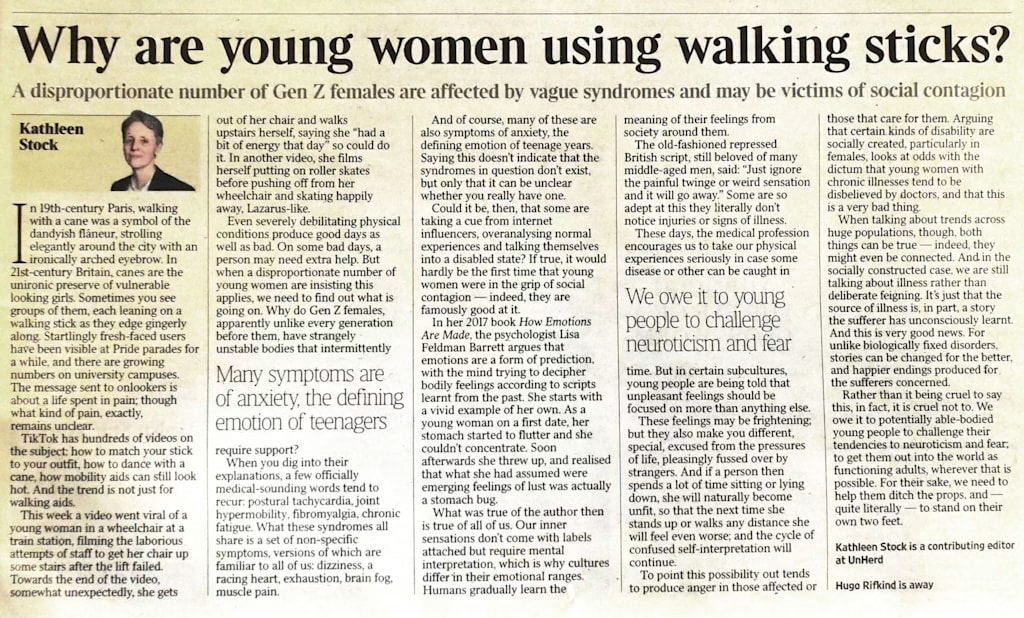
This week, The Times published an article asking: “Why are young women using walking sticks?”
As a young disabled woman who uses one, I can answer that question very simply: because sometimes I cannot walk safely without it.
I use a walking stick because I have Multiple Sclerosis. I use it because my legs can shake, my balance can disappear, my foot can drop and my body does not always do what I ask of it. I use it because I have fallen before and would quite like to avoid doing so again.
I do not use it because it matches my outfit.
The article describes walking sticks as “the unironic preserve of vulnerable-looking girls” and questions why apparently unprecedented numbers of young women have “strangely unstable bodies”. It refers to conditions including POTS, hypermobility, fibromyalgia and chronic fatigue as “vague syndromes”, and suggests some young women may be absorbing ideas from the internet and effectively talking themselves into disability.
Perhaps most offensively, it describes a wheelchair user standing and walking briefly as “Lazarus-like”.
This tells me that the author does not understand ambulatory wheelchair use, fluctuating conditions or disability more broadly—but felt sufficiently informed to question the bodies and experiences of thousands of strangers.
Many wheelchair users can stand or walk. Some can walk short distances but cannot do so safely, reliably or repeatedly. Some can walk around their homes but cannot manage a railway station, shopping centre or university campus. A wheelchair is not reserved exclusively for people who are permanently paralysed. It is a mobility aid, not a declaration that someone’s legs have ceased to function entirely.
Similarly, using a walking stick on Tuesday does not mean I must need it on Wednesday. My MS fluctuates. Heat, fatigue, stress, hormones and exertion can all affect my symptoms. I can walk farther on some days than others. Occasionally, I may not need my stick at all.
That does not mean I was pretending yesterday.
Yet this is exactly the suspicion that articles like this encourage. They teach readers to watch disabled people for inconsistencies: to question the wheelchair user who moves her legs, the Blue Badge holder who walks away from the car or the young woman who uses a stick one day but not the next.
I already feel frightened when I use my Blue Badge without my walking stick. Although I am legally entitled to it, part of me worries that someone will see a young woman step out of the car and decide I am stealing a disabled parking space. On the days when I do use my stick, I often feel compelled to explain why.
I should not have to display the full extent of my medical history to satisfy strangers.
I did not ask to need a walking aid. I did not ask to become disabled in my early thirties. If I eventually need a wheelchair, I will not have asked for that either. But I will use whatever equipment allows me to remain safe, independent and part of the world.
That is what mobility aids do. They do not trap people in disability; they provide freedom from some of the barriers disability creates.
The suggestion that young women are embracing illness for attention is particularly dangerous because women’s pain and physical symptoms are already routinely minimised. Too many are told that they are anxious, hormonal, dramatic or simply need to lose weight. Many wait years for diagnoses while learning that persistence risks being labelled neurotic.
When journalism repeats that prejudice, it does not encourage reasonable medical scrutiny. It gives people permission to disbelieve us.
It makes patients hesitate before asking for help. It makes disabled people afraid to use the support they need. It encourages strangers to police bodies they know nothing about.
And yes, there may be more young women speaking publicly about disability now. We have social media. We can find one another, exchange information and see people with bodies like ours living visible lives. Some people decorate their sticks, coordinate their mobility aids with their clothes or make videos showing how they dance with them.
Why shouldn’t they?
My walking stick is necessary, but that does not mean it must be ugly. Disability does not require me to abandon style, humour or joy to prove that I am suffering sufficiently. A mobility aid can be medically necessary and still express its owner’s personality.
A disabled woman making the best of something she did not choose is not evidence that she secretly wanted it.
Disability can affect anybody, at any age. I sincerely hope that if it ever affects the author—or someone she loves—they are met with greater compassion than she has shown here.
The real question is not why young women are using walking sticks.
It is why seeing us move through the world with the support we need provokes such suspicion—and why a national newspaper considered that suspicion worth legitimising.
About the Creator
Enjoyed the story? Support the Creator.
Subscribe for free to receive all their stories in your feed. You could also become a paid subscriber, letting them know you appreciate their work.
Comments
There are no comments for this story
Be the first to respond and start the conversation.