Latest Stories
Most recently published stories in Motivation.
Are coloring pages suitable for reducing stress caused by overthinking?
Introduction Overthinking has been universally described as the habit of dwelling too long on thoughts, circumstances, “what-ifs,” or past moments. Everyone believes that thinking harder — thinking more, canvassing all the options — will result in more sound decisions or avert poor ones. However, it does not function that way in everyday life: overthinking merely creates stress, erodes clarity, and harms emotional well-being.
By Shenal Jay12 months ago in Motivation
The Bridge of Tomorrow
The Fall Aarav had always dreamed of becoming an architect. As a child, he would build small bridges out of sticks and stones by the riverside near his village. He used to say, “One day, I’ll build bridges that connect cities — not just land.”
By Alexander Mind12 months ago in Motivation
The Mountain Within: A Journey Beyond Fear
The Beginning of the Climb There was once a man named Ayaan who lived in a quiet valley surrounded by towering mountains. Every morning, he would wake up to the sight of the highest peak, Mount Zarah — a colossal structure of stone and ice that pierced the sky like a dagger. For years, Ayaan admired it from afar, whispering to himself, “One day, I’ll stand at the top.”
By Alexander Mind12 months ago in Motivation
The IShowSpeed Phenomenon
There was never a quiet day in Darren’s life. From the moment he could walk, he ran. From the moment he could talk, he shouted. Everything about him... his energy, his reactions, his emotions... was dialed up to the max. His teachers called him “too loud.” His neighbors called him “too much.” But deep inside, Darren wasn’t trying to be a problem... he was trying to be heard.
By MIGrowth12 months ago in Motivation
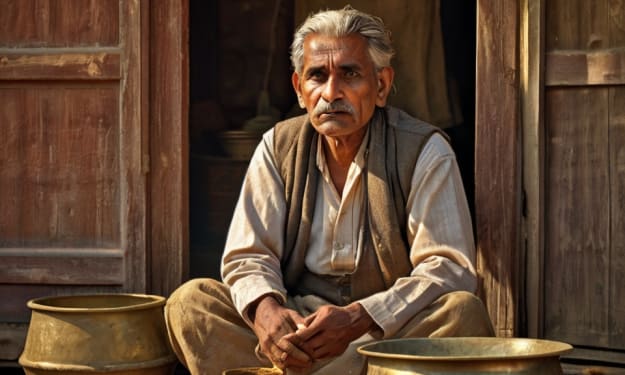
The Brass Pot
The Brass Pot and the Billionaire A tale of greed, guilt, and the awakening of a buried conscience BY: Ubaid --- Long ago, in a bustling city, there lived a wealthy merchant named Faqir Chand. He was the richest man in town — and also its stingiest. His plump belly jutted out like a ball, his short legs shuffled beneath it, and when he walked, it looked as if a football were rolling down the street. Faqir Chand’s wife, however, was a kind and generous soul. Every Tuesday, she distributed flour to the city’s poor — the blind, the crippled, the hungry. On those days, the gates of their grand mansion would be crowded with beggars waiting for her alms. The merchant despised this habit but dared not object openly, out of respect for his wife. Once, he tried reasoning with her. “These beggars waste your charity,” he grumbled. “They sell the flour for a few coins, smoke opium, and laugh at our foolishness.” His wife smiled gently. “It is because of this giving, Faqir Chand, that God has blessed us with wealth. Have you forgotten the days when you had nothing?” Faqir Chand winced. He hated being reminded of his poor past. He fancied himself a man of noble lineage — not one who once pawned his belongings to survive. Like most rich men, he was obsessed with making more money. His warehouses overflowed with rice, sugar, salt, oil, and grains. When prices rose, he rejoiced; when they fell, he lost his sleep and appetite. Then one year, the rains failed. Drought spread across the land. Crops died, and the price of food shot up. Faqir Chand saw his chance and stopped selling grain altogether, waiting for prices to soar even higher. His wife’s weekly charity was also stopped — not a grain of flour left the mansion gates. One morning, while he was enjoying his breakfast and puffing his hookah, a poor man appeared. Folding his hands humbly, he said, “May you live long, Sethji! My children are starving. Please spare a few handfuls of chickpeas. I will feed them and pray for you forever.” Faqir Chand glared at him. “Get out! I will not give you a single grain.” The man left quietly. But the next morning, he returned — holding a small brass pot in his hand. Before the merchant could shout again, the man spoke calmly. “Sethji, perhaps you don’t recognize me. But maybe you recognize this pot? Look — your name is engraved on it: Faqir Chand, son of Ghasit Chand. Twenty years ago, when you came to this city penniless, you pawned this very pot to me for four annas. You even wrote a receipt in your own hand.” The color drained from Faqir Chand’s face. He quickly looked around to make sure no one was listening. “Yes, yes, I remember now,” he muttered nervously. “You did the right thing bringing it back. Here, take four annas and give me my pot.” The man laughed softly. “Four annas? Sethji, the world has changed in twenty years. When you pawned this pot, you were a beggar. Now you’re a millionaire. How can the price remain the same?” “Fine,” snapped Faqir Chand, “take five rupees!” The man twirled the pot in his fingers. “Oh no, Sethji. I think I’ll auction it in the bazaar. Imagine — ‘The brass pot once pawned by the great merchant Faqir Chand!’ I’m sure it will fetch at least a thousand rupees. The whole city will learn how its richest man once pawned a pot for four annas.” With that, he turned and walked away, leaving the stunned merchant speechless. That night, Faqir Chand could not eat or sleep. His mind burned with shame and fear. What if the man really told everyone? What if people discovered that the mighty merchant had once been a beggar? His past came flooding back — the hunger, the long walks, the hopeless search for work. He had indeed pawned his only possession, a brass pot, just to buy a meal. Later, through hard work, he became a clerk for a wealthy trader. But greed had crept into his soul. When his master died, Faqir Chand secretly stole a pouch of gold and used it to start his own business. From that one dishonest act grew the empire he now owned. The next morning, unable to bear the anxiety any longer, he went to the poor man’s shop — a small, broken stall on the edge of the market. The brass pot hung from the ceiling on a piece of rope. “Ramu,” he said quietly, “I’ll pay you a thousand rupees. Just give me back the pot.” Ramu smiled sadly. “Sethji, you don’t have to pay me anything. I will return your pot freely. But listen — I am not as foolish as you think. I only wanted to remind you who you once were. You were a poor man like me. Now you hoard grain while people starve. You care more for your pride than for human life.” Faqir Chand lowered his head. “What do you want me to do?” “Save the starving,” Ramu said. “That is your duty. That is real wealth.” The merchant’s eyes filled with tears. “You are right, Ramu. You’ve opened my eyes.” That very day, Faqir Chand ordered his warehouses opened. For a whole week, he distributed food freely to the poor. He also donated money and clothes to the needy. His act of generosity inspired other merchants in the city to do the same. His wife rejoiced. The poor blessed his name. But only one man knew the true reason behind this miracle — Ramu, and the brass pot that had awakened a miser’s buried humanity. --- Moral: True wealth lies not in gold and silver, but in compassion and remembrance of where we came from.
By Ubaid 12 months ago in Motivation
The Gift of Eid
The Gift of Eid : By: Nazeer Anbalvi The last day of Sha’ban had arrived. Rehan’s mother had already completed all the preparations for Ramadan and Eid al-Fitr. She had new clothes stitched — three outfits for Rehan and two for his father. She believed in working ahead of time. “Wise people always prepare before the time comes,” she often said. By the middle of Sha’ban, she had also bought twenty outfits to give as Eid gifts to people around her — the watchman, the housemaid, and even the milkman. Each one received their gift with joy and heartfelt prayers. Rehan’s mother even had special clothes stitched for a widow and her children living in a nearby slum. Rehan, who was eleven years old, would go to the Gulzar Mosque with his father every day to pray. His mother sent white clothes for the imam, muezzin, and mosque helpers as Eid gifts, delivered through Rehan’s small hands. --- A Stranger in the Mosque One Friday, as worshippers rushed inside for prayers, the mosque guards noticed a nervous-looking man trying to enter. Security guard Noor Muhammad stopped him. The man wore deep blue clothes and was visibly trembling. “I… I have nothing. You can search me,” he stammered, raising his hands. Noor Muhammad and another guard, Masroor, searched him carefully but found nothing. Still, Noor wasn’t convinced. “Show me your ID card,” he demanded. “Here… here it is,” said the man nervously. The guard read the name aloud — “Shaukat Raza.” Shaukat explained that he lived near the canal in a nearby settlement. After a pause, Noor Muhammad nodded. “You can go in,” he said, though his eyes followed Shaukat closely. That was the first time Shaukat Raza had ever entered Gulzar Mosque. What no one knew was that he was there with a hidden purpose — a mission that even he didn’t fully understand. --- The Old Friend A few months earlier, Shaukat had lost his job when the company he worked for went bankrupt. While sipping tea one day at a roadside café, he ran into an old classmate — Raju, whose real name was Riaz Ahmed. “Shaukat Raza! I can’t believe it’s you!” Raju exclaimed, shaking his hand. “It’s been twenty years since school!” They talked for a while. When Shaukat mentioned his unemployment, Raju leaned in and said in a low voice, “Don’t worry. You already have a new job. You’ll just need to do something small… and you’ll earn good money.” “What kind of job?” Shaukat asked cautiously. Raju lowered his voice even further and explained. The plan involved the Gulzar Mosque. He gave Shaukat 20,000 rupees in advance and instructed him to start praying there regularly to gain everyone’s trust. “For one month, go there five times a day,” Raju said. “Talk to the guards, give them food or drinks. Become one of them. And then…” “And then what?” Shaukat asked. “Then,” Raju smiled darkly, “we’ll finish the job and get paid.” --- Trust Earned Following the plan, Shaukat started praying at Gulzar Mosque every day. At first, the guards checked him thoroughly. But over time, they stopped searching him and began greeting him warmly. He often brought oranges or bottled water for them. The guards started trusting him — except Noor Muhammad, whose instincts told him something wasn’t right. As Ramadan began, the mosque became busier. Rehan and his father came for Taraweeh prayers every night. Three armed guards stood alert outside the gates. By mid-Ramadan, Shaukat had become a familiar face in the mosque. Even the imam recognized him and would sometimes chat with him after prayers. Raju had told him that the operation would happen after the fifteenth of Ramadan. The promised payment was ten lakh rupees — more money than Shaukat had ever seen. --- The Turning Point One evening, as Shaukat approached the mosque, he saw little Rehan standing with his father and the guards. Rehan was handing them white packets wrapped neatly in plastic. “These are Eid gifts,” Rehan said with a smile. “From my mother.” The guards thanked him warmly, holding up the gifts marked “Eid Mubarak.” Shaukat froze in his tracks. Something broke inside him. That night, during prayer, tears streamed down his face. He couldn’t focus. The image of Rehan’s innocent smile and those white Eid gifts haunted him. After Taraweeh, Shaukat quietly shook hands with the guards and walked away — but instead of going home, he headed straight to the nearest police station. There, he confessed everything to Inspector Waseem — the plan, the money, and Raju’s role. The inspector listened carefully and then said, “You did the right thing, Shaukat. You’ve saved many lives tonight.” Within hours, Raju and his accomplices were caught. They had planned to carry out a deadly attack during Eid prayers. Shaukat’s confession had saved hundreds of innocent worshippers. --- Eid Morning Shaukat was kept in protective custody, but the inspector arranged for him to attend Eid prayers at Gulzar Mosque. That morning, the mosque was filled with four hundred worshippers, all dressed in white, their faces glowing with peace. As the imam led the prayer, Shaukat felt an indescribable calm fill his heart. He had given the mosque a different kind of Eid gift — not of fabric or money, but of life itself. The prayer ended with the words: “Allahu Akbar… peace and blessings upon those who choose truth over fear.” Shaukat wiped his tears. This was the first Eid he had ever truly celebrated.
By Ubaid 12 months ago in Motivation
How a Simple Morning Routine Changed My Life Forever. AI-Generated.
1. I Was Always Tired and Unmotivated For years, my mornings looked the same. I woke up tired, grabbed my phone, and scrolled endlessly before even getting out of bed. My body felt heavy, my mind was foggy, and every day started with the same thought: “Maybe tomorrow I’ll feel better.” But tomorrow never came. I was stuck in a cycle of exhaustion, coffee, and stress. 2. The Day I Decided to Change One morning, I looked in the mirror and saw a version of myself I didn’t like — dull eyes, messy hair, and a restless mind. I realized I was wasting my mornings, and maybe my life. That day, I made a small promise: “I’ll step outside tomorrow morning, just for ten minutes.” No fancy plans. No motivation quotes. Just one small step. - 3. My First Morning Walk The next day, I left my phone on the table and walked out into the cold morning air. The streets were quiet. The world felt new. I took deep breaths, and for the first time in months, I noticed the sound of birds. I didn’t run. I didn’t jog. I just walked. And when I came back home, I felt strangely alive — like I had taken control of something invisible. 4. Starting Small — Just Ten Minutes I kept my promise the next day, and the next. Those ten minutes slowly became my favorite part of the day. After one week, I started sleeping better. My mornings didn’t feel heavy anymore. Then I added another habit — drinking a glass of water before checking my phone. Then another — writing one line of gratitude in my notebook. One habit at a time, I was rebuilding myself. 5. The Change After One Month Within a month, I noticed changes that no supplement or app had given me. My energy doubled. My focus improved. I smiled more. Even my friends noticed. “You look different,” one of them said. “What are you doing?” I laughed and replied, “Just walking.” But deep down, I knew it was more than walking. It was self-respect. 6. The Mental Shift The morning routine didn’t just heal my body; it healed my thoughts. I realized I was addicted to distractions — my phone, notifications, noise. That quiet walk taught me to listen to my thoughts, to breathe, to slow down. Now, when life feels too loud, I go back to that morning silence. It reminds me that peace doesn’t live in a vacation or a weekend. It lives inside us, waiting for attention. 7. Adding Purpose to My Mornings Once I built the habit, I started adding purpose to it. Sometimes I listened to motivational podcasts. Sometimes I practiced gratitude, listing three things I was thankful for. Some mornings, I simply watched the sunrise in silence. Each version of the routine helped me discover a different part of myself — stronger, calmer, and more hopeful. 8. The Secret Behind a Healthy Life People think being healthy means working out hard or following diets. But the truth is, health begins with the mind. If your mornings are peaceful, your whole day follows that energy. A simple 10-minute morning routine changed my mindset more than any expensive course ever did. It wasn’t about discipline — it was about love. Love for my mind. Love for my body. Love for life itself. 9. What I Learned If you feel tired, lost, or unmotivated, start small. Don’t wait for a perfect plan. Don’t wait for motivation. Just step outside, breathe the morning air, and let the silence speak to you. Because sometimes, the smallest habit can change everything — even your future. 10. Final Thoughts It’s been six months now, and that morning walk is still my favorite time of the day. I no longer chase motivation. I create it. Every sunrise feels like a reminder that life gives us a new chance every morning — we just need to show up for it. So, if you’re reading this and wondering where to start, remember: You don’t need a gym, a plan, or a miracle. You just need ten minutes — and the courage to begin. 🌅
By Najeem Ullah12 months ago in Motivation
Before It Ends: Who Are You, and Where Are You Really Going?
Who are you — really? And where are you going? Not just your name, job, or latest goal. I mean in the stillness — beneath the noise, beneath the opinions, beneath the programming. When you close your eyes and drop the mask… what’s left?
By Randolphe Tanoguem12 months ago in Motivation
Halloween Quotes for Kids: Spooky, Sweet, and Silly Sayings for Little Ghouls
Halloween is that magical time of year when pumpkins glow, costumes sparkle, and candy fills every bucket. From giggling ghosts to tiny vampires, kids love the fun, laughter, and little frights that come with October 31. And what better way to capture that spooky spirit than with Halloween quotes for kids?
By Brian Hen12 months ago in Motivation
Halloween Movie Quotes: The Most Iconic, Spooky, and Funny Lines for the Season
As October rolls in and the nights grow colder, pumpkins glow on porches, costumes fill store racks, and eerie laughter echoes through the air — it can only mean one thing: Halloween season is here. From scary movie marathons to haunted house parties, there’s something magical about this time of year that brings out everyone’s inner ghoul.
By Brian Hen12 months ago in Motivation
Short Halloween Quotes to Share This Spooky Season
Halloween is the season when ghosts giggle, pumpkins glow, and even the moon seems to have a mischievous grin. As October rolls in, everyone’s in the mood to celebrate — from costume parties and pumpkin carving to sharing festive posts online. Whether you’re getting ready for a haunted house night or planning your perfect Instagram caption, short Halloween quotes capture that playful, spooky magic in just a few words.
By Brian Hen12 months ago in Motivation