Latest Stories
Most recently published stories in Motivation.
The King and the Three Ministers: A Lesson in Action
The King and the Three Ministers: A Lesson in Action BY: Ubaid. Long ago, in a land ruled by a wise and compassionate king, there lived a people who admired their ruler deeply. He was known for his generosity, fairness, and commitment to the welfare of his subjects. One day, the king decided to build a grand road that would connect his capital to the farthest corner of his kingdom — a stretch of one hundred kilometers that would make travel and trade easier for all. After months of hard work, sweat, and dedication from countless laborers, the road was finally complete. It was smooth, wide, and beautifully constructed — a masterpiece of the kingdom’s craftsmanship. The king was proud of this achievement and eager to ensure that every inch of it reflected perfection. When the time came for the grand opening ceremony, the king called upon his three most trusted ministers. He said to them kindly, “Before we inaugurate this great road, I wish for you three to travel along it and examine it carefully. Tell me honestly if there remains any fault or imperfection. I want this to be the best road ever built in our land.” The ministers bowed respectfully and set out to inspect the newly constructed road. --- The First Minister By evening, the first minister returned to the palace. His clothes were spotless, his face calm and composed. Bowing before the king, he spoke confidently, “Your Majesty, the road is magnificent! It has been built with great care and skill. However, I noticed a small pile of litter at one place. If that is removed, the beauty of the road will be flawless.” The king nodded silently and thanked him for his observation. --- The Second Minister Shortly after, the second minister entered the court. Like the first, he too appeared neat and fresh, without a sign of fatigue. “Your Majesty,” he began, “the road is truly splendid. Yet, I must point out the same thing as my colleague — a small heap of rubbish has been left at one point. If someone were to remove it, the entire road would look perfect and beyond criticism.” The king again nodded, showing no expression but quietly taking note of his words. --- The Third Minister As the sun dipped below the horizon, the third minister finally appeared. But unlike the others, he looked utterly exhausted. His clothes were covered in dust, his face glistened with sweat, and his hands held a large, heavy bag. The king raised an eyebrow in curiosity. “Why do you look so tired?” he asked gently. “And what is that you’re carrying?” The minister bowed deeply and replied humbly, “Your Majesty, as I traveled along the road, I too noticed that pile of litter. It was spoiling the beauty of such a wonderful creation. So, I stopped my horse, cleaned it up myself, and cleared the path. While doing so, I found this bag lying near the rubbish. I thought someone might have forgotten it there, so I brought it back to you.” The king smiled — not a small smile, but one full of admiration and wisdom. He looked at the three ministers standing before him and then turned to address the third. “My dear minister,” he said warmly, “that litter you found on the road was not placed there by accident — I ordered it myself. And the bag you found was also part of the test. It is filled with gold coins. Take it, for it is your reward.” The two other ministers were astonished. The king’s face turned serious as he stood and spoke in a firm yet gentle voice that echoed across the hall. --- The King’s Lesson “Listen carefully,” the king began. “All of you saw the same fault — a small pile of rubbish. Two of you noticed it and spoke of it. Only one of you acted. You see, it is easy to point out flaws. It is easy to criticize. Everyone desires that everything around them should be perfect, but few take the step to make it so.” He paused, letting his words sink in. “Many people dream of a better world, a cleaner city, or a stronger kingdom. But dreams and desires alone change nothing. Real progress comes only when we act — when we take responsibility instead of waiting for others to do it. If we truly wish for our country to prosper, each of us must be willing to play our part, however small it may seem.” The court fell silent. The two ministers lowered their heads in shame, realizing the depth of the king’s wisdom. The third minister, though still humble, felt a quiet pride in having done the right thing without being told. The king placed his hand on the minister’s shoulder and said with a smile, “Your reward is not the gold, but the honor of being a man of action. You have shown what true service means — not in words, but in deeds.” --- From that day onward, the story of the “Three Ministers and the Road” became a legend across the land. People repeated it to their children, teachers told it to their students, and elders reminded the young that real change begins not with complaints, but with courage and action. And the king’s words remained timeless — a lesson for generations: “Everyone wants things to be better, but only those who act make them so. To build a brighter future, we must first change ourselves.” --- Moral: It’s easy to see what’s wrong. It’s harder to fix it. But if we truly want to build a beautiful nation — or a beautiful world — the first step begins with us.
By Ubaid 11 months ago in Motivation
The Chain of Justice: When Emperor Jahangir Judged His Own Queen
The Chain of Justice By Javed Jamal In the vast Indian subcontinent, the Mughal era is remembered as the “Golden Age” — a time of grandeur, art, and justice. Among the emperors who ruled during this period, Emperor Nuruddin Salim Jahangir stands out not only for his power but also for his deep commitment to justice. Legends tell of the Chain of Justice he hung outside his royal palace — a symbol of equality, meant for any subject, rich or poor, to pull whenever they sought redress from the emperor himself. No distinction of rank or class was ever made before that chain. It was the emperor’s way of assuring his people that justice would never sleep under his rule. Among the jewels of his court was his beloved queen, Empress Nur Jahan — a woman of grace, intelligence, and authority. She was not merely a royal consort; she was a ruler in her own right. Such was her influence that she could issue royal decrees, command armies, and participate in governance — a privilege seldom granted to women of her time. One bright afternoon, Empress Nur Jahan sat in her balcony, gazing upon the royal gardens below. The gentle breeze carried the fragrance of roses, and for a moment, the empress allowed herself to relax, admiring the serenity of her empire. Just then, fate played a cruel trick. A traveler, weary and dust-covered, was passing by the palace. His eyes, perhaps drawn by the glitter of jewels or the regal beauty of the empress, rose toward the balcony. Overwhelmed by what he saw, he stopped in his tracks and stood there, staring — mesmerized and unthinking. To the empress, this act seemed like an unforgivable insolence. No one was allowed to gaze upon the royal women of the court, especially not with such audacity. Her pride wounded, Nur Jahan, in a fit of royal fury, seized a bow and shot an arrow straight at the man. The traveler collapsed instantly — struck dead on the spot. The man was no courtier or spy; he was merely a washerman, a humble worker on his way home. When news of his death reached his wife, the poor woman’s world collapsed. Her husband was her only support — his death meant hunger and ruin. She wept bitterly, but through her tears, one thought burned clear: the emperor had promised justice for all. She dried her tears, gathered her courage, and made her way to the royal palace. There, trembling but determined, she reached for the Chain of Justice — the very chain that promised equality before the law — and pulled it with all her strength. The clang of metal echoed through the palace halls. Emperor Jahangir, startled by the sound, knew that someone was seeking justice. He immediately summoned the guards and ordered that the petitioner be brought before him. The widow appeared, veiled and grief-stricken. She told her story — how her innocent husband had been slain without reason. Jahangir listened in silence, his face grave. When she finished, he promised her, “You shall have justice, even if the guilty stands before me as my own blood.” True to his word, Jahangir summoned Empress Nur Jahan to the royal court. She arrived not as a queen that day, but as an accused — without the luxury of her throne, standing before the emperor and his court like any other subject. When questioned, Nur Jahan did not deny her act. Her voice was steady as she said, “Yes, I killed the man. He gazed upon me with disrespect. I considered it an insult to my honor.” Jahangir turned to the chief Qazi (Islamic judge) and asked, “What does the law of Islam decree in this matter?” The Qazi replied solemnly, “In the eyes of Sharia, the punishment for murder is death. Life for life.” A hush fell over the court. The emperor’s expression did not change. He stood, and in a voice firm as steel, proclaimed, “Then let justice be served. The guilty shall be punished, no matter who they are. The law must stand above all.” Gasps rippled through the court. Even the guards hesitated. To see the mighty Empress condemned was unthinkable. Yet Jahangir had spoken — and his word was law. As the guards stepped forward to escort her away, Nur Jahan raised her head and said quietly, “Your Majesty, the law also permits blood money, does it not? If the family of the slain forgives and accepts compensation, then life may be spared.” Jahangir again turned to the Qazi, who nodded. “Indeed, that is true — if and only if the family of the victim agrees to pardon.” All eyes turned to the widow. The poor woman, overwhelmed by the sight of justice itself unfolding before her, felt her anger melt away. She had expected denial, deceit, or delay — but here stood an emperor willing to punish his own queen. Tears filled her eyes. She bowed deeply and said, “Your Majesty, I have seen the justice of God today. I forgive the empress. I do not wish her death.” The court erupted in murmurs of astonishment. Jahangir looked at her with respect. “You have chosen mercy over vengeance. May peace follow you all your life.” Nur Jahan, deeply moved, removed her golden necklace and handed it to the widow, saying, “Take this, good woman. May it provide for you and your children.” She later ordered that the widow’s family be granted a lifelong pension from the royal treasury. Thus, the story of the Chain of Justice became legend — a tale retold across centuries. Its lesson was simple yet eternal: Before the law, all are equal — king or commoner, queen or washerman. Justice must never bow before power. --- Moral: True justice recognizes no crown, no gender, no rank — only truth.
By Ubaid 11 months ago in Motivation
The Peacock and the Song of Contentment
The Peacock and the Song of Contentment BY:Khan It was a beautiful monsoon morning. The sky was soft and gray, wrapped in silvery clouds, and a gentle drizzle kissed the green leaves of the forest. The raindrops sparkled like tiny diamonds on the grass. The sweet smell of wet earth filled the air, and the forest was alive with joy. Every creature — big or small — came out to dance, sing, and celebrate the blessing of rain. Among them was a magnificent peacock named Rameen. With colors as vivid as a rainbow and feathers that shimmered with hues of blue and green, Rameen was the most beautiful bird in the forest. As the rain sprinkled softly, he spread his wings and began to dance in pure delight. The rhythm of the falling rain, the whispering wind, and the rustling leaves formed a melody that made his heart soar. Rameen twirled and spun with grace. His feathers fanned out like a living painting — every motion elegant, every step proud. But as he danced, he suddenly heard his own voice — a rough, harsh cry that broke the melody of the forest. For a moment, everything inside him stilled. The joy in his heart faded. He looked down at his feet, the same rough, unattractive claws he had always hated, and an ache of sadness washed over him. “How ugly I am,” he whispered to himself bitterly. “Everyone admires my feathers, but my voice… my voice is so unpleasant. Whenever I call out, all the creatures laugh at me. Even the smallest sparrow sings better than I do.” His bright eyes filled with tears. The raindrops that touched his cheeks felt like a reflection of his sorrow. As he stood there, lost in his thoughts, a soft, melodious sound drifted through the air — the song of a nightingale perched on a nearby branch. Her voice was sweet and pure, a sound that could touch the soul. Every creature in the forest seemed enchanted by her song. Rameen looked up at her and sighed deeply. “She is so lucky,” he thought. “Her voice wins hearts. I would give up all my feathers if only I could sing like her.” Just then, an old sage appeared from behind the trees. His beard was long and white like a river of snow, and his eyes sparkled with wisdom and kindness. He carried a wooden staff and walked slowly toward the peacock. “My dear Rameen,” the sage said gently, “why are you standing here in the rain with such sadness in your eyes? The forest is rejoicing, but you look lost.” Rameen bowed his head respectfully and spoke in a trembling voice, “O wise one, I am miserable because I feel incomplete. God has given me beauty, yes — my feathers shine brighter than any jewel. But my voice is harsh and ugly. Whenever I sing, even the monkeys laugh at me. What good is this beauty when my voice brings only mockery?” The sage smiled kindly. “Ah,” he said softly, “so you see only what you lack, not what you have. Listen carefully, my child — every creature in this world has been blessed with its own gifts. The eagle has strength and courage. The nightingale has a sweet voice. The butterfly has colors. The lion has power. And you, my dear Rameen, have beauty that no one else possesses. Each creation of God is perfect in its own way — and imperfect in another. That is the balance of life.” Rameen looked up uncertainly. “But how can I be happy knowing that my voice will never be beautiful?” The old sage placed a gentle hand on his head. “True happiness,” he said, “comes not from perfection but from gratitude. When you focus only on what you lack, you live in sorrow. But when you thank the Creator for what you have, your heart fills with light. Learn to live with your flaws — they are a part of your story. Sing if you wish, even if your song is not perfect. Dance in the rain not because others watch, but because it brings you joy.” The peacock listened quietly. The sage’s words felt like rain washing over his soul, cleansing it of bitterness and self-pity. He slowly spread his feathers again, their jeweled colors glistening in the soft rain. He took a deep breath and cried out — not in shame this time, but with pride. His voice might not have been melodious, but it was his. At that moment, he realized something profound — every voice, every color, every creature has a place in the grand music of creation. The nightingale’s song was sweet, yes, but without the peacock’s dance, the forest’s joy would never be complete. The sage smiled and disappeared into the mist, leaving behind an echo of wisdom that would forever remain in Rameen’s heart. From that day onward, Rameen stopped comparing himself to others. He no longer hid in sadness when others sang. Instead, he danced proudly whenever the rain fell, thankful for the beauty he had been given. The other animals, seeing his happiness, admired him even more. They realized that true beauty was not in appearance or voice — it was in contentment and gratitude. And so, under the silver skies of the monsoon, the forest found a new kind of harmony — where every creature, no matter how different, sang the song of gratitude in its own way. --- Moral: Happiness does not come from having everything perfect. It comes from accepting yourself, embracing your flaws, and being grateful for what you have.
By Khan 11 months ago in Motivation
The Boy Who Wanted His Mother’s Story Written
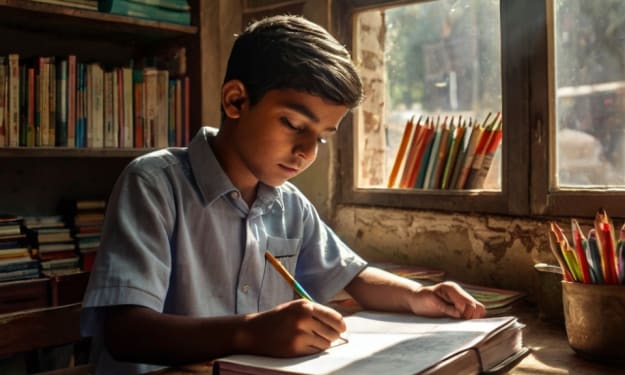
The Story That Changed Arshad’s Life BY:Khan Arshad and Amjad were two brothers who lived in a small village with their parents. Life was simple and poor, yet peaceful. Their mother was a loving and caring woman who tried her best to make their lives comfortable despite the hardships. She made sure her sons wore clean clothes, ate proper food, and learned good manners. Poverty surrounded them, but love kept their home warm. Then one day, life changed forever. Their mother fell ill. For months she struggled between life and death, and despite all efforts, she passed away. Her death was like a mountain falling on the two young boys. The house that once echoed with her gentle voice now felt silent and empty. Their father and uncle tried to take care of them, but nothing could fill the void their mother left behind. Days turned into weeks, and the brothers found it hard to live in the same village where every corner reminded them of their mother. Their father’s small income barely covered food. There was no school nearby, and even if there was, they couldn’t afford to attend. Hunger and hopelessness started to grow. Finally, their father decided to leave the village and move to the city in search of a better life. After a long and tiring journey, they reached a noisy, crowded city filled with tall buildings and busy streets—so different from the calm fields of their village. Their father started working as a laborer, taking on long hours under the sun. Still, the money wasn’t enough, so both Arshad and Amjad had to find small jobs to help. Arshad got a job at a stationery store. Every day, he arranged notebooks, pencils, and colors for customers. The store sold all kinds of school supplies—things that reminded him of what he didn’t have: education. One afternoon, while he was busy at the counter, a kind-looking woman walked in. She asked for children’s storybooks. Arshad handed her a few. As they talked, he found out she was a children’s writer. She wrote stories about love, kindness, and lessons from life. Arshad’s eyes lit up. “Can you write my story too?” he asked shyly. The woman smiled. “Your story? What kind of story would you like me to write?” “Write my mother’s story,” Arshad said softly. “She passed away some time ago.” The woman looked at him with warmth. “That’s a beautiful idea,” she said. “But will you promise me something?” “Yes,” Arshad replied immediately. “If you love your mother so much that you want her story written,” she continued, “then honor her by doing what every mother dreams of — learn. Study, even if you can’t go to school. Read in your free time. Ask for help. Once you learn to read, you’ll discover a world full of wisdom. You’ll know what’s right and wrong, and you’ll become the person your mother wanted you to be.” Her words struck him deeply. Arshad stood there in silence, feeling something awaken in his heart. That night, as he lay on his small bed, he couldn’t stop thinking about what she had said. He realized that while he couldn’t bring his mother back, he could still make her proud. The owners of the store were kind people. When they learned about his wish to study, they offered to help. They allowed him to read and learn after work hours. They gave him old books, notebooks, and a little corner in the shop where he could sit and practice. It wasn’t easy. After long hours of work, his hands were tired, and his eyes burned with fatigue. But he didn’t give up. Every evening, he opened his books and tried to understand new words. Slowly, the letters that once looked strange began to make sense. He learned to read stories, then to write, and then to dream. Months turned into years. Arshad’s hard work and determination started to shine. He completed his basic education through night classes. Later, he went on to finish college. Eventually, he earned a Master’s degree in Commerce (M.Com). Today, Arshad works as a manager in a factory. His office is neat and filled with books and files. When he looks out of his office window, he often remembers that dusty little stationery shop where his journey began—and the kind woman who had changed the course of his life with a few simple words. He never got to meet her again, but her advice became his guiding light. He often tells young workers in his factory, “Don’t let poverty stop you. Education doesn’t belong only to those who can afford it — it belongs to anyone willing to work for it. Age doesn’t matter. If you have the will to learn, the world will open its doors.” Whenever he visits his mother’s grave, he smiles and says quietly, “Ammi, I did it. I studied… and I made you proud.” The story of Arshad is not just about one boy—it’s a reminder for all of us. Life can be unfair, and loss can break us, but hope and education can rebuild everything. Sometimes, all it takes is one kind word, one small opportunity, or one stranger’s advice to change a life forever. --- Moral: Education has no age or boundary. No matter where you come from or what you’ve lost, knowledge can always be your way forward.
By Khan 11 months ago in Motivation
Ceferina Murrell: Championing Equity and Innovation in Boston
Ceferina Murrell is a name that resonates in Boston for her unwavering commitment to public service, equity advocacy, and innovative leadership in the private sector. Born and raised in Dorchester’s Uphams Corner, Murrell has become a powerful voice for underrepresented communities, leveraging her expertise to create meaningful change across government and business.
By Ceferina Murrell11 months ago in Motivation
Céline Dion: The Voice That Rose From Silence
In the small, snow-covered town of Charlemagne, Quebec, a frail little girl with a golden voice sang her heart out in a crowded kitchen filled with the laughter of her 13 siblings. That girl was Céline Marie Claudette Dion, the youngest of a poor but close-knit French-Canadian family. Her mother, Thérèse, a homemaker, and her father, Adhémar, a butcher, didn’t have much—but they had music.
By Frank Massey 11 months ago in Motivation
Beyond the Horizon: How Young Visionaries Turn Struggles into Strength. Content Warning. AI-Generated.
Introduction In the stillness before dawn, the horizon holds a secret promise. It whispers to the restless soul: Keep going. Your moment is coming. But most of us never hear that whisper. We settle for safe paths, quiet compromises, or dreams half-buried.
By Chilam Wong11 months ago in Motivation
The Mental Benefits of Daily Workouts
Exercise is often linked to physical fitness, weight loss, or building strength, but its impact on mental health is just as powerful. Daily workouts not only improve your body but also enhance your mind, helping you feel happier, more focused, and less stressed. In 2025, with growing awareness about mental well-being, understanding the mental benefits of exercise is more important than ever.
By Kashif Wazir11 months ago in Motivation
The Coffee Shop That Saved My Life
I never thought a small coffee shop in downtown Chicago would change my life. But looking back, I think that’s where everything quietly started to heal. Two years ago, I hit rock bottom. My father had passed away, my relationship had fallen apart, and I’d just been laid off from a job I thought defined me. I was thirty-one, alone, and completely lost. I remember that morning clearly. It was February, bitterly cold, and I hadn’t eaten since the day before. I walked aimlessly through the streets, trying to make sense of how quickly everything had fallen apart. My phone was full of unanswered texts from friends asking if I was okay. I couldn’t even reply. That’s when I saw it — a small brick building with fogged-up windows and a handwritten sign that said “Home Brew Coffee.” Something about the word home pulled me inside. The place was quiet, warm, and smelled like cinnamon. A middle-aged woman behind the counter smiled and said, “Rough day?” I didn’t mean to, but I laughed. “More like a rough year.” She handed me a cup of black coffee before I even ordered. “This one’s on the house,” she said. “You look like you could use it.” That simple kindness hit harder than I expected. I sat at a corner table, watching the snow fall outside. For the first time in weeks, I didn’t feel invisible. I came back the next day. Then again the day after. The woman’s name was Maria, and she ran the shop with her husband, Leo. They were immigrants from Mexico who had been in Chicago for twenty years. Their dream had been to open a place where “everyone feels seen.” They remembered my name, asked about my day, and introduced me to other regulars — a retired firefighter, a young artist, a college student studying law. Slowly, those strangers became something close to friends. One evening, Maria asked, “So, what did you do before this?” “I worked in marketing,” I said. “But honestly, I don’t think I was ever good at it.” She smiled. “You’re good at talking. You just forgot how for a while.” That stuck with me. Over the next few months, I started helping them with little things — fixing their menu design, setting up social media, and later, building a small website for the shop. I never asked for money. It just felt good to feel useful again. One morning, Leo surprised me with an envelope. Inside was a check for $500. “You helped us more than you realize,” he said. “You reminded us why we started this place.” I cried right there at the counter. Six months later, I got a new job — not in marketing, but in community outreach for a local nonprofit. I help small businesses get resources and visibility. I still stop by Home Brew Coffee every morning before work. Sometimes I watch new faces walk in — people who look tired, defeated, or just lost in their own heads — and I see Maria hand them that same free cup of coffee. And every time, I remember that February morning when I walked in broken and walked out slowly finding my way back. One snowy evening last winter, I told Maria how much that first cup meant to me. She smiled and said, “You know what’s funny? That day, we were thinking about closing. Business was slow, and we were exhausted. But when you walked in, something told me to stay open a little longer. Maybe we both saved each other.” That night, I walked home through the quiet streets of Chicago, snow crunching under my boots, thinking about how small moments can change entire lives. Sometimes, we look for miracles in big gestures — promotions, second chances, perfect love stories — but often, the real miracles are warm and quiet. Like a free cup of coffee from a stranger. Like a smile when you need it most. Like someone remembering your name when you feel like the world has forgotten you. Now, every winter, when the city starts to freeze over, I sit by the same window in that coffee shop. The glass still fogs up, the lights still glow soft and golden, and the world outside still moves fast. But inside, it always feels like time slows down. Sometimes, I see people come in who remind me of who I used to be — tired, unsure, disconnected. And I hope they find what I found there: not just warmth, but belonging. Because in the end, it wasn’t coffee that saved my life. It was kindness. It was human connection. It was the reminder that even when everything falls apart, there’s still good left in the world — waiting for you in the most unexpected places.
By kashif khan11 months ago in Motivation
How to Stay Positive During Tough Times
Life is full of ups and downs. Everyone faces moments of stress, disappointment, or uncertainty. Tough times can feel overwhelming, but staying positive is possible if you focus on the right habits and mindset. Positivity does not mean ignoring challenges; it means facing them with strength, hope, and a constructive approach. Here’s how you can stay positive even during the hardest times.
By Kashif Wazir11 months ago in Motivation
How I Learned to Let Go Without Losing Myself
For a long time, I thought letting go meant giving up. When people said, “You need to move on,” I heard, “You’ve failed.” So, I held on — to people, to memories, to versions of myself that no longer fit. I held on until my hands hurt. I grew up believing that loyalty meant endurance. My mother used to say, “If something matters, you fight for it.” And I did. I fought for friendships that had lost their warmth, for love that no longer loved me back, for jobs that drained me more than they fulfilled me. I told myself this was strength. But strength, I later learned, can turn into stubbornness. It happened during one winter in Edinburgh. The days were short and cold, and I had just come out of a long relationship. I told myself I was fine, that I just needed time. But time didn’t heal much when I kept replaying everything that had gone wrong. My flat felt too quiet, the bed too big. I filled my evenings with noise — music, television, long walks through the city — anything to avoid silence. Because silence reminded me of what I’d lost. One night, while walking near the old bridge, I stopped to watch the water below. It moved steadily, carrying fallen leaves downstream. I wondered how the river could keep flowing when it had to let go of everything it touched. That thought stayed with me. Letting go, I realised, wasn’t about forgetting or pretending something never mattered. It was about learning to hold it differently — gently, without breaking yourself in the process. So, I began to practice. I started with small things. I deleted old messages I had been too afraid to erase. I returned gifts that had lost their meaning. I stopped checking social media to see how he was doing. Every act of letting go felt like pulling out a thorn I had been carrying quietly. Then came the harder part — letting go of the version of me that needed to be needed. I had built my worth around being someone else’s anchor. When that anchor wasn’t required anymore, I felt lost. Who was I if I wasn’t fixing, helping, or saving? One morning, I sat in a small café near the Royal Mile. It was raining outside, and a woman at the next table was reading a book titled The Art of Stillness. The title caught me. I wrote it down in my notebook. That night, I tried to sit in stillness. No phone, no distractions. Just me and my thoughts. It was uncomfortable — almost unbearable at first. But then something strange happened. I started to hear myself again. Beneath all the noise, there was a quiet voice that said, “You don’t have to hold everything.” Over time, I realised that letting go isn’t a single act. It’s a long, gentle conversation with yourself. It’s forgiving the past without needing closure. It’s allowing things to end without turning them into enemies. It’s remembering what happened without letting it define you. Months passed. The winter turned into spring. I walked through Princes Street Gardens one morning and noticed the cherry blossoms beginning to bloom. For the first time in a while, I smiled without forcing it. I met new people, slowly, naturally. I laughed again — not to prove I was fine, but because I actually was. I learned that healing doesn’t mean forgetting what broke you. It means finding beauty in the cracks. One day, while cleaning my flat, I found an old photograph of me and my ex at the seaside. I looked at it for a long moment. Instead of pain, I felt gratitude. That version of me — the one who loved, who tried, who stayed — had done her best. She deserved kindness too. So, I placed the photo in a box and whispered, “Thank you.” Then I put it away. Letting go didn’t erase my past. It just made space for my future. Now, when I think about that time in my life, I no longer feel the weight of what I lost. I feel the strength of what I learned. I learned that I don’t have to grip so tightly to prove something mattered. I can let go with love, and still remain whole. The truth is, letting go isn’t about losing anything. It’s about returning — to yourself, to peace, to the quiet certainty that you are enough even when nothing else stays. I still take walks by the bridge where the river moves steadily beneath the stone. I watch the water carry the leaves away, and I understand now. The river doesn’t hold on, and yet it never loses itself. It just keeps flowing, beautifully and endlessly forward. And so do I.
By LUNA EDITH11 months ago in Motivation