

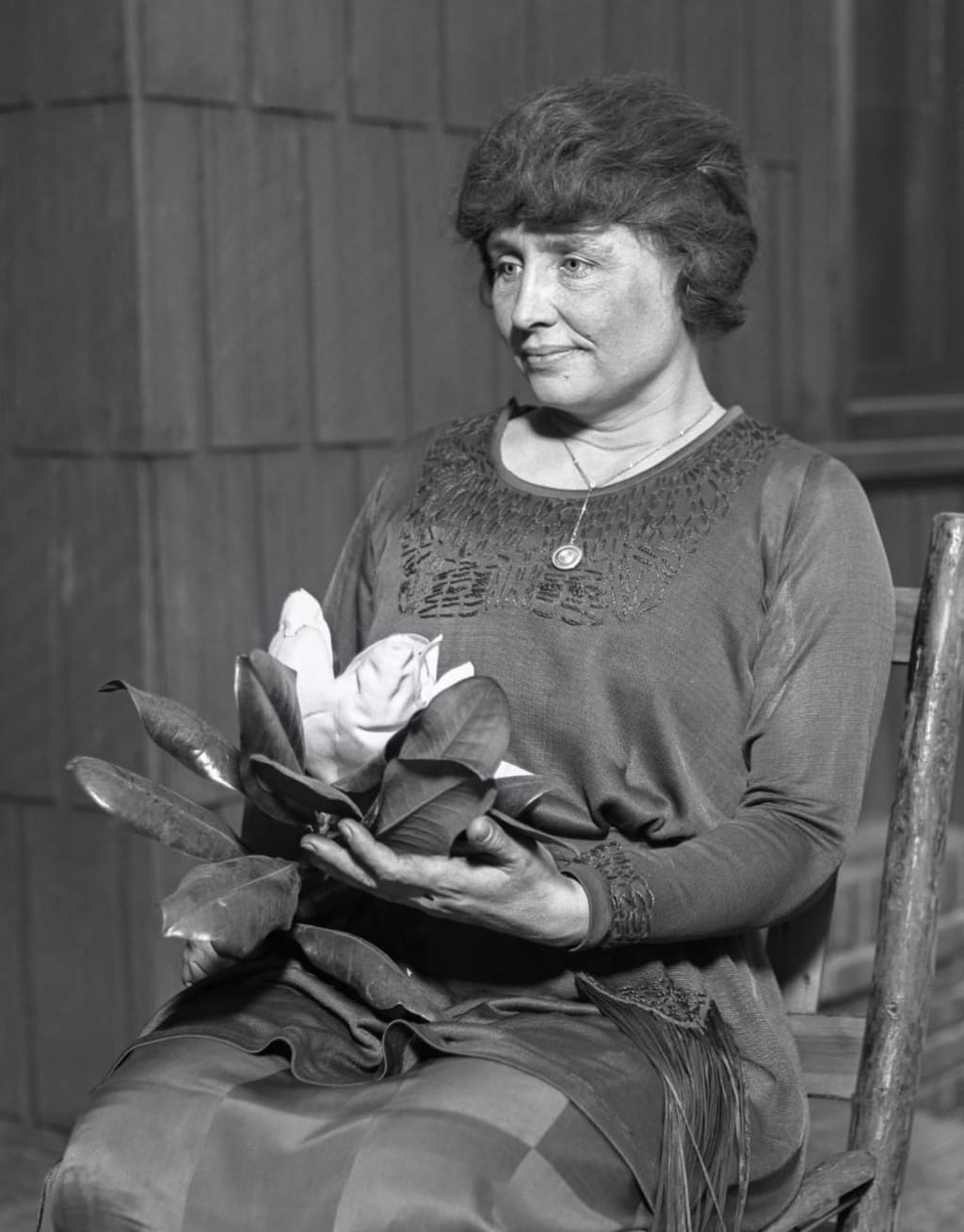
Helen Keller (1880-1968) was an author, an activist and a campaigner for the
charities for deaf and blind. Helen became deaf and blind as a young child and had to struggle to overcome her dual disability. However, she became the first deaf-blind person to attain a bachelor's degree and an influential campaigner for disability issues. Her public profile helped destigmatise blindness and deafness, and she was seen as a powerful example of someone overcoming difficult circumstances.
Helen Adams Keller was born on June 27, 1880, in Tuscumbia, Alabama. When she was 19 months old, she got very sick. The disease left her unable to see or hear. Her parents remained optimistic and took her to the famous inventor Alexander Graham Bell who helped her find a good teacher. When Helen was 6, she got a teacher named Anne Sullivan. Sullivan used Helen's sense of touch to teach her. She handed Helen a doll and traced the letters of the word 'doll' on the palm of Helen's hand. With Sullivan's help, Helen made rapid progress. Soon she could read sentences by feeling raised words on cardboard.
She went to a school for the deaf in Boston. Here, she learned that she could use her hands to teach herself how to use Braille. Then she used a Braille typewriter to type out stories of her own. She also spent the next twenty-five years of her life learning to speak so that others could understand her. Learning to speak was a bigger challernge. Helen did it by touching the lips and throat of a person who was speaking. She was able to feel the way the lips moved and the throat vibrated. At the same time someone spelled out the words that were being spoken. Keller was very bright. She graduated from Radcliffe College in 1904. Then she wrote magazine articles that told people about blindness. She also wrote several books about her life.
In 1913 Keller began lecturing-with the aid of an interpreter--worldwide on the needs of the blind. She spoke primarily on behalf of the Foundation for the Blind, for which she raised funds. In 1920, Keller started her campaign to bring improvement in the life of the deaf and blind. She also prompted the organisation of commissions for the blind in 30 U.S. states by 1937. Besides giving lectures, Keller was a prolific writer during her lifetime. Her books include 'The Story of My Life' and Optimism' (both 1903), 'The World | Live In (1908), 'Out of the Dark (1913), 'Midstream: My Later Life' (1929), 'Helen Keller's Journal' (1938), and 'Let Us Have Faith' (1940). Keller died in Westport, Connecticut, on June 1, 1968. Although her own life was one of silence and darkness, Helen keller was courageous and determined enough to bring light to others by encouraging them to never give up.
Summary of Helen Keller
Helen Keller was a remarkable American author, activist, and lecturer who overcame the dual challenges of being both deaf and blind. Born on June 27, 1880, in Tuscumbia, Alabama, Helen was a healthy child until an illness at 19 months left her without sight and hearing. This sudden loss created great frustration in her early years, as she was unable to communicate effectively.
Her life changed dramatically at age seven when Anne Sullivan, a dedicated teacher from the Perkins School for the Blind, came to tutor her. Sullivan used a unique method of spelling words into Helen’s hand, starting with “water,” which marked the beginning of Helen’s understanding of language and communication. Through perseverance and hard work, Keller learned to read Braille, write, speak, and even lip-read by touch.
Helen went on to achieve incredible academic success, becoming the first deaf-blind person to earn a Bachelor of Arts degree from Radcliffe College in 1904. Her story became a symbol of courage and determination. She authored several books, including her autobiography The Story of My Life, which inspired millions.
Beyond her academic achievements, Helen was a passionate advocate for people with disabilities. She worked with organizations like the American Foundation for the Blind and spoke out for social justice, women’s rights, and world peace. Her life demonstrated the power of resilience, education, and the human spirit.
Helen Keller passed away in 1968, but her legacy lives on as a global icon of hope and inspiration.
About the Creator
Enjoyed the story? Support the Creator.
Subscribe for free to receive all their stories in your feed.
Comments
There are no comments for this story
Be the first to respond and start the conversation.