
Faithful in Babylon's Marketplace
Dating in the Age of Infinite Temptation

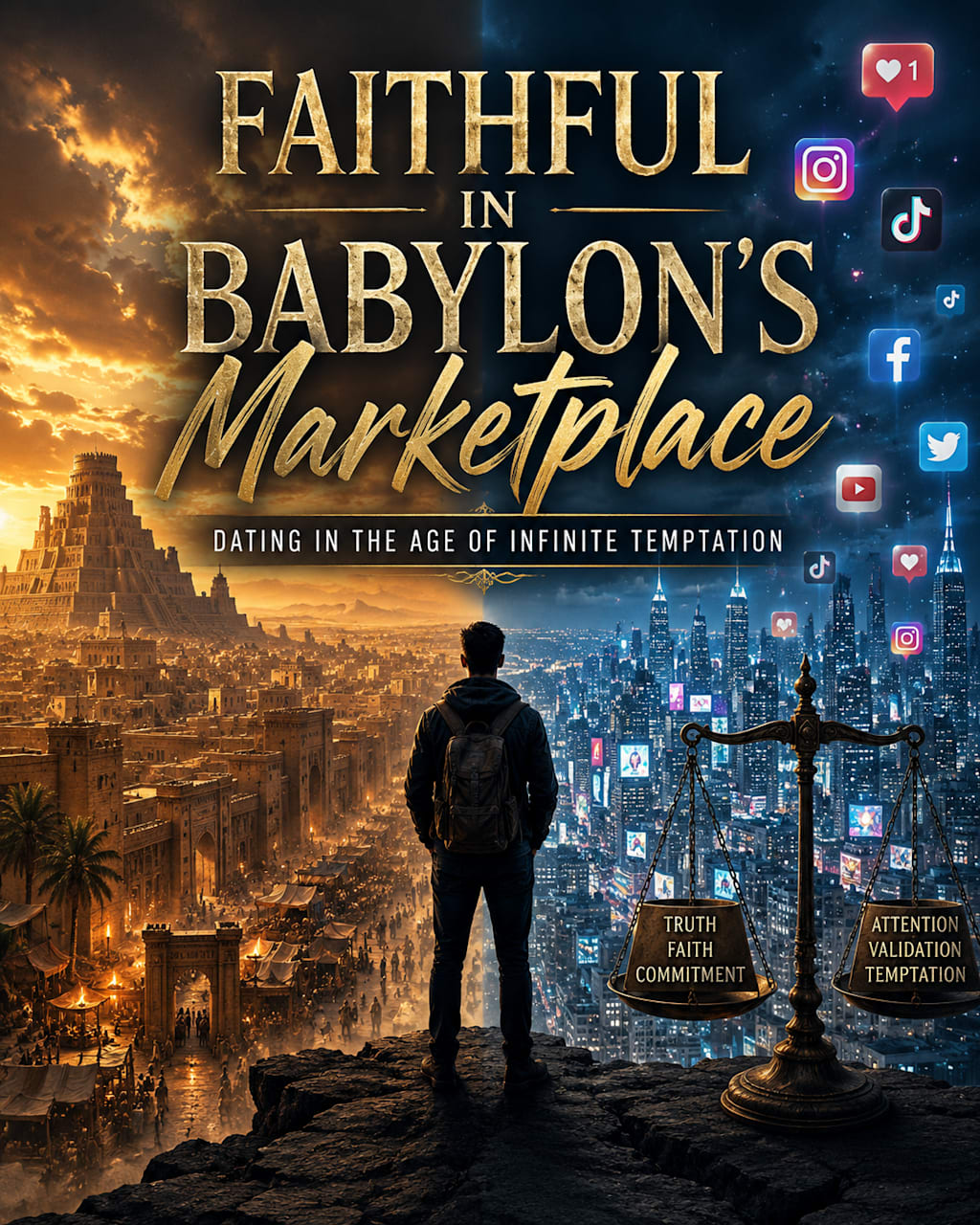
Faithful in Babylon's Marketplace: Dating in the Age of Infinite Temptation
"No matter what takes place, Christ is our Refuge. And when we come to Him, we can let off the pressure. You can quit worrying about, 'Well, if I die, what's going to happen to me? What's going to happen to the wife? What's going to happen to the husband? What's going to happen to the children?' Just come to Christ, and let off the pressure. All, He give us all things. All things are ours, by Christ, so just let the pressure off, the only one way you can do it."
~Rev. William Marrion Branham, Letting Off The Pressure, 62-0513E
Never before in human history have so many people had access to so many alternatives.
A young woman can receive attention from strangers across continents. A young man can scroll endlessly through faces, personalities, and lifestyles carefully curated to attract admiration. What previous generations encountered occasionally — if at all — we now encounter before breakfast.
Yet the greatest challenge of modern relationships may not be temptation itself. It may be the relentless, invisible pressure that temptation creates in our minds. The anxiety that never fully sleeps. The quiet suspicion we carry even when there is nothing to suspect.
This article is not a lecture about deleting your apps. It is a reflection on something far older than smartphones — the ancient contest between faithfulness and distraction, between identity rooted in God and identity built on the approval of strangers.
Babylon has changed its clothes. But it has not changed its nature.
Chapter One: Living in Babylon's Marketplace
To understand what we are navigating, we need to understand where we are living.
Babylon, in Scripture, is more than a city. It is a system. A marketplace of desires, loyalties, and devotions competing constantly for what belongs to God. In ancient Babylon, people bowed to golden statues. In modern Babylon, we scroll through golden screens. The idol has changed; the seduction has not.
Social media platforms are, at their core, attention marketplaces. Followers, likes, comments, and messages are the currencies traded there. Everyone has a profile — a curated storefront of their most attractive self — and the algorithm's only job is to keep you browsing, comparing, and wanting.
In this environment, no one is hidden. Everyone is accessible. Everyone is, in some sense, on display.
The Prophet warned us clearly:
"The God that told the birds and the bees to go in the ark, still lives today. And if God by His Spirit, could make a little bird, and a sheep, and a cow get away from destruction, how much more will It do His Church, when we see destruction is coming? My brother, sister, get away from these modern Babylon walls. They're going to fall one of these days, and you'll be the victim of them. 'Get out of it, My people, and be ye separated,' saith the Lord, 'and I will receive you. And you'll be sons and daughters unto Me; and I'll be a God unto you.'"
~Rev. William Marrion Branham, The Sign Of The Time, 58-0520
The call is not necessarily to destroy the phone or close the account. The call is to refuse to let Babylon's marketplace define our identity, measure our worth, or govern our peace. To live inside the system without becoming a slave to it. That is the spiritual challenge of our generation — and nowhere is it sharper than in our closest relationships.
Chapter Two: When Love Meets Unlimited Access
To appreciate the scale of what we are dealing with, consider what courtship looked like one generation ago.
In previous eras, the geography of temptation was limited. Most social circles were local. You knew the people at your church, your workplace, your neighborhood. Attractive strangers were occasional, not constant. The heart had room to settle.
Today, that geography has collapsed entirely.
Distance barely matters. A message can arrive from anywhere on earth within seconds. Faces, personalities, and romantic possibilities are no longer rare encounters — they are algorithmic deliveries, curated and served fresh every hour. The human brain, which evolved to navigate a village, is now asked to navigate a planet.
The problem is not that people today are suddenly more sinful than their grandparents. The problem is that the infrastructure of temptation has been industrialized. What once required effort and opportunity now requires only a thumb and a signal.
This changes nothing about what faithfulness is. But it changes almost everything about the conditions in which faithfulness must be practiced. To remain committed in this environment is not the ordinary faithfulness of quieter eras. It is faithfulness under fire — every single day.
Chapter Three: The Fear Behind the Screen
Most people will not say it openly. But if you have been in a relationship in the digital age, you have likely felt it.
The impulse to check who liked that photo. The slight unease when a name appears in a comment thread that you do not recognize. The over-analysis of a delayed reply. The quiet, gnawing sense that somewhere, just out of sight, something is happening that you cannot control.
These anxieties are not dramatic. They do not arrive with trumpets. They creep in slowly, dressed as reasonable concern, and settle in the background of the mind like static noise.
Social media did not create insecurity. Insecurity is as old as humanity. But social media gave insecurity new instruments — new windows to peer through, new metrics to obsess over, new silences to misinterpret. It handed the anxious mind a set of tools perfectly designed to confirm whatever it already feared.
The tragedy is that this kind of surveillance has nothing to do with love. It is, in fact, the opposite of love. Love trusts. Fear monitors.
And when a relationship is governed by fear rather than love, neither person can truly breathe. The one being watched feels imprisoned. The one watching is also a prisoner — of their own anxiety, circling endlessly and finding no relief.
Chapter Four: Trust Is Not the Absence of Alternatives
Here is a misconception that does quiet damage in many relationships.
We sometimes behave as though trust would be easier if our partner simply had no options — if no one noticed them, if no messages ever arrived, if the world conveniently arranged itself so that temptation was never near. We imagine that in such a world, we would feel safe.
But that is not trust. That is isolation dressed as security.
True trust does not require the elimination of alternatives. It exists precisely because alternatives exist — and the person you love has chosen, day after day, not to pursue them. That choice is where the meaning of faithfulness lives. A person who is faithful because they have no other option is not demonstrating loyalty. They are simply demonstrating scarcity.
Trust is built not on controlling your partner's environment, but on knowing their character. On knowing their values. On knowing what they believe, what they have committed to, and who they are before God. These things do not shift with every new follower or every incoming message.
This is why the spiritual foundation of a relationship matters so profoundly. A man or woman whose identity is rooted in Christ carries something that the marketplace cannot offer and cannot take away. Their sense of worth does not rise and fall with validation metrics. Their loyalty is not contingent on convenience. They are anchored — not to you alone, but to something deeper than both of you.
That is a person you can trust, precisely because the world cannot buy what they are not selling.
Chapter Five: The Worship of Attention
We must be honest about something uncomfortable.
The crisis of the digital age is not primarily a crisis of sexuality. It is a crisis of worship.
The Prophet spoke of a pattern he saw in history — and recognized unfolding again in his own time:
"Man! Even look at our churches today, look at everything you wish to, notice it. Everywhere, it looked in that day, must have been pretty women. Men became slaves to them, says history, that men became actually slaves to the women, because they were so pretty, that they become slaves. They literally made shrines, and worshipped. And, just think, they literally worshipped female flesh and blood in that day. That's history. And compare that with today. It's the same thing, my brother. Men actually worship women."
Rev. William Marrion Branham, The Flashing Red Light Of The Sign Of His Coming, 63-0623E
The deeper point here is not about gender. It is about misplaced devotion — about the human heart's tendency to worship something other than God.
The modern idols do not require stone shrines. They require only a screen and a signal. Today, people worship beauty and youth. They worship popularity and follower counts. They worship the dopamine rush of being noticed, being desired, being seen. They build entire identities around the attention they can attract, and they measure their worth by how many strangers approve of their photograph.
The danger is not that beautiful people exist. Beauty is a gift from God, and it has always existed. The danger is when attention becomes an object of worship — when the validation of strangers becomes the foundation of a person's sense of self, when desire becomes a currency we can't stop counting, when we quietly build an altar to the screen we carry in our pocket.
A relationship between two people who worship attention will be perpetually unstable. Because attention is the one thing that the marketplace always promises to provide — to someone else, somewhere nearby, one scroll away.
A relationship built on two people who worship God has a completely different center of gravity.
Chapter Six: Letting Off the Pressure
We return now to where we began.
Many of the anxieties we carry in our relationships are symptoms of a deeper problem: we want certainty, and certainty is not available to us.
We cannot control who notices our partner. We cannot monitor every message that arrives. We cannot prevent attractive people from existing in the world. We cannot guarantee that no one will ever attempt to compete for the heart that has chosen ours. We cannot build walls high enough to make Babylon stop offering its alternatives.
This desire for total certainty is not love. It is fear — and fear is exhausting. It is the weight that presses on the chest in the quiet moments of an ordinary day. It is the question that never fully resolves. It is the pressure that builds quietly until it becomes unbearable.
The only relief from that pressure is surrender.
Not surrender to despair. Not resignation. But the surrender of trust — laying what we cannot control at the feet of Christ, and choosing to live from peace rather than from fear.
The Prophet said it plainly:
"No matter what takes place, Christ is our Refuge. And when we come to Him, we can let off the pressure... Just come to Christ, and let off the pressure. All, He give us all things. All things are ours, by Christ, so just let the pressure off, the only one way you can do it."
Rev. William Marrion Branham, Letting Off The Pressure, 62-0513E
This is not a passive statement. It is not an invitation to naivety. It is an invitation to a fundamentally different orientation — one where our security is not located in what we can surveil, control, or guarantee, but in the character of God and the character of the person He has placed beside us.
We can only control our own character. Our own responses. Our own faithfulness. And we can choose, day by day, to anchor our peace in Christ rather than in the perfect behavior of the world around us.
That is what it means to let off the pressure.
Conclusion: Faithful in Babylon
Babylon has changed its appearance, but not its nature.
The idols are digital now. The marketplace is global. The alternatives are endless, curated, and delivered to your palm at a speed no previous generation ever had to resist. The pressure on modern relationships is real, and it would be dishonest to pretend otherwise.
But the call of God has not changed.
Not to live in fear. Not to become slaves of anxiety, checking and monitoring and suspecting our way through every ordinary day. Not to worship attention, or beauty, or validation, or any of the thousand glittering things the marketplace keeps offering us.
But to remain faithful.
Faithful to Christ — the only anchor that holds when everything else is uncertain.
Faithful to truth — about who we are, what we value, and what we have committed ourselves to.
Faithful to the commitments we make — not because the world left us no other choice, but because we chose, with our whole heart, to be faithful.
That is the kind of faithfulness that means something. The kind built not in a monastery, sealed off from temptation, but right here — in Babylon's marketplace, where a thousand alternatives arrive daily, and we choose again, every morning, to be the people God called us to be.
"Be ye not conformed to this world: but be ye transformed by the renewing of your mind, that ye may prove what is that good, and acceptable, and perfect, will of God."
~Romans 12:2
About the Creator
TINASHE HANDO
Brother Tinashe is a dedicated follower of the Lord Jesus Christ and a believer in the Message of the hour. With a burden for truth and clarity, he shares reflections on Christian living, discernment, and the realities of walking with God.
Enjoyed the story? Support the Creator.
Subscribe for free to receive all their stories in your feed.
Comments
There are no comments for this story
Be the first to respond and start the conversation.