
It had been six years since my sister got married, but I had never once visited her home. Occasionally, our parents would stop by during Eid or on the night of Bara’at. One day, as I sat quietly in my room, my wife approached me with a serious tone.
“Don’t take it the wrong way,” she began, “but whenever your sister visits us, her children disrupt the entire household. Expenses rise, and the house becomes chaotic. And your mother she often secretly gives your sister soaps, clothes, and sometimes even a bag of rice. You should tell her: this is our home, not a charity center. Such things must stop.”
Her words unsettled me. I was angry—not at my wife but at my mother. How could she so easily give away the things I worked so hard to provide? Days passed. My sister visited again. Her young children were playing, running around the house in joy. One of them accidentally broke the TV remote. Frustrated, I went straight to my mother and said, “Please tell my sister she should only come during Eid. And stop giving her soaps, rice, and clothes. This is not right, and I don’t like it.” My mother sat quietly, saying nothing. Perhaps her silence was filled with the pain of helplessness—a pain many parents feel when their married sons begin to forget them. Or maybe she was simply overwhelmed by my sister’s own hardships, which she knew far better than I did.
What I didn’t know was that my sister had overheard everything—from the next room. She said nothing. At 4 p.m. that same day, she gathered her children and called out softly, “Brother, can you at least drop us to the bus station?” I forced a smile and lied, “Why leave so soon? Stay a few more days.”
She smiled back. “No, brother. The kids’ school holidays are over. We must leave.”
Some weeks later, my brother and I were dividing a piece of family land. Our mother insisted that our sister should also receive a share. But we both firmly denied her any right, claiming she was married and not entitled. I even said some harsh words to her. She remained silent. My wife, too, whispered from behind, “This isn’t a charity. Our own children need this land. Everyone should take care of themselves.”
Time moved on. My elder brother separated. One of my own sons fell seriously ill. We spent everything money, savings, even sold valuable items and still, the medical bills kept rising. I found myself deep in debt, unable even to buy basic groceries for the house.
One day, as I sat alone in my room, lost in grief, my sister arrived unexpectedly. Even before greeting her, I thought to myself, This misfortune is back again.
She entered and sat quietly. I turned to my wife and asked her to prepare something. She snapped back, “This isn’t a restaurant. I’m not preparing anything.”
My sister remained silent. As if she hadn’t heard anything at all. Then she slowly walked closer to me and gently placed her hand on my head.
“Brother,” she said in a soft, trembling voice, “I’m your elder sister. I helped raise you. I know you’re going through hard times.”
Her eyes, with their quiet pain, welled up with tears. “May your sister be sacrificed for you,” she whispered. “Look, your hair is already turning white. Please don’t worry so much.”
She added, “The kids were at school today. I just really wanted to see you. That’s why I came…”
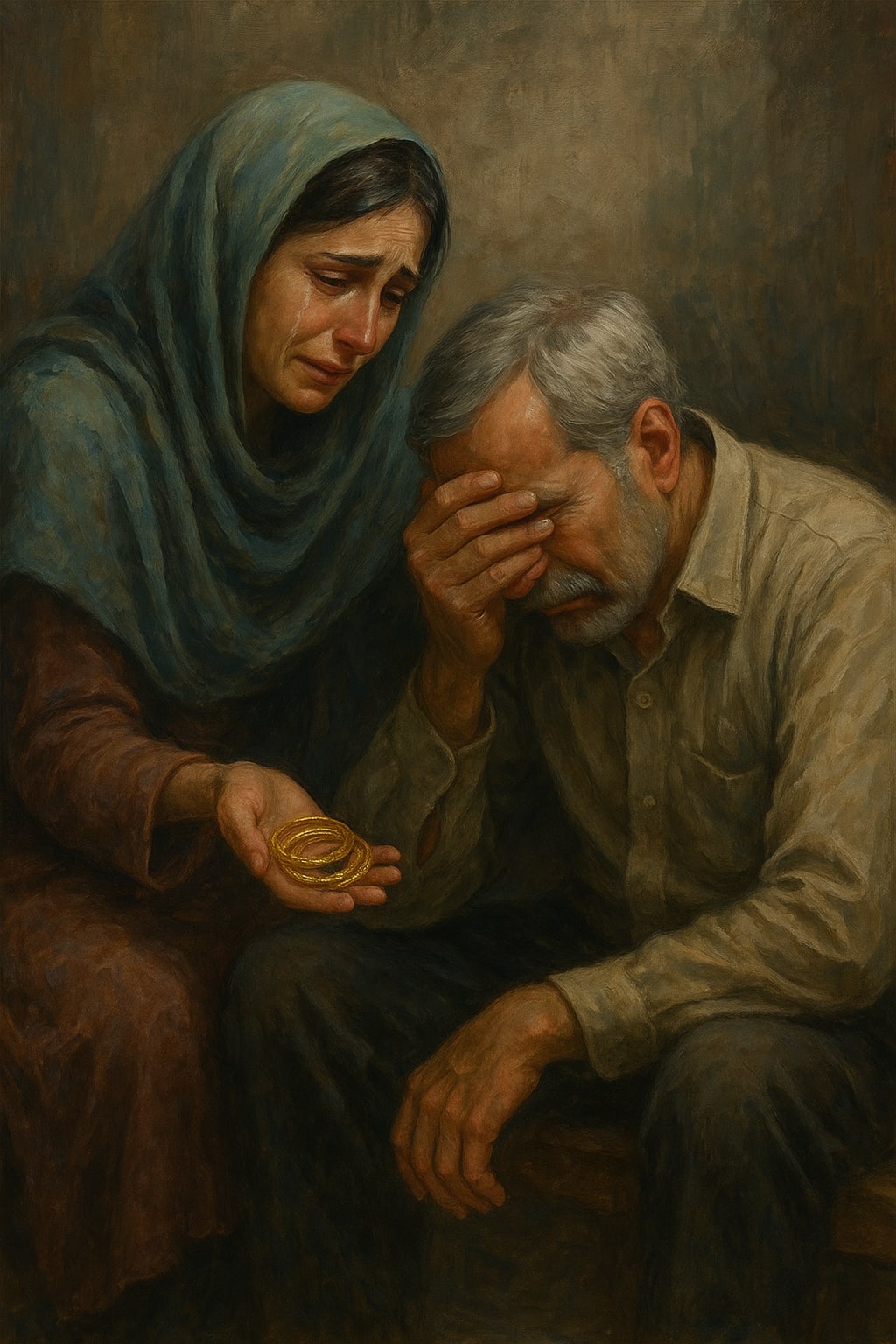
She didn’t speak much more—perhaps she sensed she was no longer welcome—but her love wouldn’t let her walk away empty-handed. She opened the corner of her shawl and took out a small, carefully tied bundle. Inside were four golden bangles—her bridal jewelry.
“Here,” she said, “Sell these. It will help with the house expenses and your son’s treatment. I had kept them for days like this.”
Then she reached for another cloth knot—filled with worn-out banknotes of 10s, 20s, and 50s. Her entire savings.
I couldn’t speak. My guilt sealed my lips. She added quietly, “Please promise me, don’t tell anyone I gave you my bangles.”
She kissed my forehead and handed me all the money. “I bought some meat with this, too—just so your children could smile.”
With tears flowing down her face, she turned and walked away—perhaps trying to hide her sorrow, or perhaps knowing that love sometimes hurts the most.
As she walked out, I saw her worn, torn shoes and her old, faded shawl. The same shawl she wore every time she visited us. Likely, she couldn’t afford another. I was struck silent by her sacrifice.
A Brother’s Realization:
We brothers… how selfish and entitled we are. We treat our sisters like burdens, influenced by our wives, irritated by their rare visits, forgetting that those visits are filled with joy and hope. We never realize how much they think about us how their hearts ache for even a small glimpse of their brothers. They would never tolerate seeing us in pain. But we? We shut the door of love on them far too easily. That day, as I held her bangles in my hands, I cried loudly and helplessly. I thought of her lonely home, her quiet suffering in a stranger’s house, and how little love we had given in return.
A Gentle Reminder to All Brothers:
Let this story serve as a humble reminder: Call your sisters. Ask about their well-being. Sit with them even if just for a moment. That single moment of love might heal days of sorrow. Welcome them not as a burden, but as a blessing. Treat them with the full honor of their God-given rights. Because sisters like angels carry a heart of pure love for their brothers. Cherish them, before it’s too late.
About the Creator
Enjoyed the story? Support the Creator.
Subscribe for free to receive all their stories in your feed.
Comments
There are no comments for this story
Be the first to respond and start the conversation.