
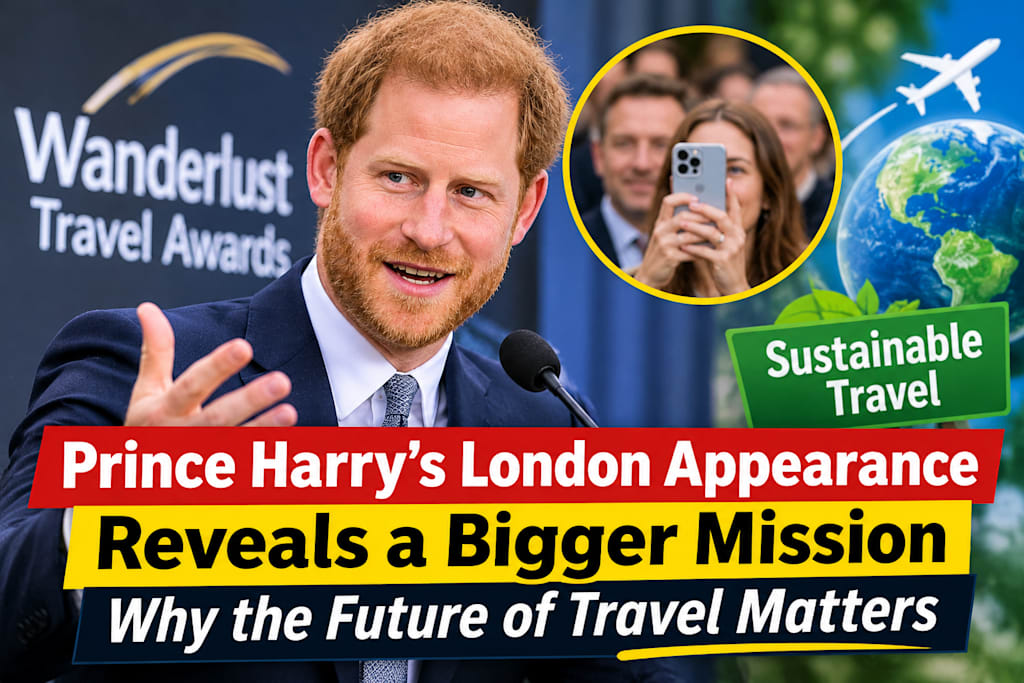
Prince Harry’s London Appearance Reveals a Bigger Mission: Why the Future of Travel Matters
Behind the Duke of Sussex’s light-hearted moment with an audience was a serious message about protecting the world’s most beautiful destinations—and making tourism work for everyone.

A famous destination can attract millions of visitors, fill hotels, and generate enormous amounts of money. But what happens when the very places people travel to see begin to suffer because of tourism?
That was the bigger question behind Prince Harry’s recent appearance in London.
On November 4, the Duke of Sussex delivered a keynote speech at the Wanderlust Reader Travel Awards, held at the historic Old Royal Naval College. His appearance attracted attention after he noticed audience members recording him on their phones and jokingly remarked, “All I can see is phones.”
The comment brought laughter, but it was not the central purpose of his visit.
Harry was there to discuss something much larger: the responsibility of the travel industry to protect the destinations that make tourism possible.
A Mission That Began in 2019
For Harry, sustainable travel is not a subject he has suddenly discovered.
In 2019, he founded Travalyst, an initiative designed to encourage the travel industry to adopt more responsible and sustainable practices.
The idea behind the organization is straightforward but important. Travel should create opportunities, support local communities, and allow people to experience different cultures without destroying the natural and cultural environments that attract visitors in the first place.
During his London speech, Harry explained that the industry has both a responsibility and a business reason to protect the places on which it depends.
His argument touches on a problem that is becoming increasingly difficult to ignore.
Popular destinations around the world face pressure from overcrowding, environmental damage, and the growing demands of international tourism. Communities can benefit economically from visitors, but they can also experience rising costs, strained infrastructure, and changes to everyday life.
The question is not whether people should travel. It is whether the industry can make travel beneficial for more than just the visitor.
When Beautiful Places Become Victims of Their Own Popularity
Travel has the power to change lives.
A family visiting a new country may discover a different culture. A small business owner may earn a living through local tourism. A young person may find employment in a hotel, restaurant, or travel company.
These benefits matter.
But tourism also creates responsibilities.
When too many visitors arrive without proper planning, natural landscapes can suffer. Beaches become polluted, historic sites experience damage, and local residents may feel that their communities are being transformed without their voices being heard.
This is why sustainable tourism has become an important conversation for governments, businesses, and travelers.
Harry's message was that protecting destinations is not simply an environmental concern. It is also essential for the long-term success of the travel industry.
If a destination loses what makes it special, it may eventually lose the visitors who once supported its economy.
That is a challenge no travel business can afford to ignore.
More Than a Royal Appearance
Harry's presence at the awards also demonstrated how he continues to use public engagements to highlight causes connected to his personal interests.
He did not attend simply as a member of the royal family. He appeared in his role as the founder of Travalyst and spoke about the future of an industry that connects millions of people across the world.
His message was also practical: businesses do not have to choose between economic success and environmental responsibility.
A healthier destination can support a stronger tourism industry. Local communities can benefit when visitors respect their environment and culture. Travelers can enjoy more meaningful experiences when the places they visit remain protected.
This approach turns sustainability from an abstract idea into something that affects ordinary people.
It also raises an important question for travel companies: are they measuring success only by the number of visitors, or by the long-term condition of the places those visitors come to experience?
A Busy Period for the Duke of Sussex
The London appearance came during a busy period for Harry.
According to reports, he had recently traveled to New York for meetings focused on business opportunities and partnerships. His London speech was followed by preparations for an international engagement with Meghan Markle in Brussels on November 10.
The couple were scheduled to open a new version of the Lost Screen Memorial, an installation honoring children whose lives were cut short by harms connected to social media.
These engagements involve different subjects, but both place attention on the responsibilities that come with influence and public life.
One concerns the protection of destinations and communities. The other focuses on creating safer digital spaces for children.
They show how the Sussexes continue to use public platforms to draw attention to issues beyond royal ceremonies and family headlines.
The Question Travelers Should Ask
It is easy to think of sustainable tourism as something that only governments or large companies can solve.
But travelers also play a role.
Choosing local businesses, respecting cultural traditions, reducing waste, and learning about the environmental impact of a trip can make a difference.
No single traveler can solve every problem. Yet millions of small decisions can influence the direction of an industry.
Harry's appearance in London offered a reminder that travel should not be measured only by the photographs people bring home or the number of places they visit.
It should also be measured by what remains after they leave.
The Duke's light-hearted comment about smartphones may have attracted the headlines, but his message about protecting the world's destinations deserves attention too.
Because the most beautiful places on Earth should not become memories that future generations can only see in photographs.
What do you think: should travel companies be held more responsible for protecting local communities and the environment, or should travelers carry more of that responsibility?
About the Creator
Behind the Curtain
"Exploring the untold stories and hidden truths. From royal rumors to cultural deep dives, Behind the Curtain brings you bold, insightful narratives that spark curiosity and conversation."
Enjoyed the story? Support the Creator.
Subscribe for free to receive all their stories in your feed.
Comments
There are no comments for this story
Be the first to respond and start the conversation.