
Can Drones and AI Help the World Win the Fight Against Malaria?
Why Technology Could Become Africa’s Most Powerful Weapon Against a Disease That Still Kills Hundreds of Thousands Every Year

For years, the global fight against malaria was considered one of modern healthcare’s biggest success stories. Governments, nonprofits, and international health organizations worked together to reduce infections, improve treatments, and distribute mosquito nets across vulnerable regions.
The results were remarkable.
Since 2000, billions of malaria cases have been prevented, and millions of lives have been saved. Countries across Africa and Asia made significant progress, giving many experts hope that malaria could eventually be eliminated altogether.
But that progress is now slowing down.
In recent years, malaria cases have started rising again, especially in sub-Saharan Africa, where the disease remains most deadly. Funding shortages, climate change, healthcare disruptions, and growing drug resistance are creating a dangerous combination that threatens to reverse decades of hard-earned progress.
The world now faces an important question:
Can new technology help us fight malaria more effectively than traditional methods alone?
Many experts believe the answer may be yes.
A Dangerous Comeback
During the COVID-19 pandemic, healthcare systems across the world were overwhelmed. Resources were redirected toward emergency pandemic responses, leaving many malaria prevention programs underfunded and understaffed.
As a result, malaria cases surged.
According to global health estimates, hundreds of millions of infections are still recorded every year, with nearly 600,000 deaths annually. Most of these deaths occur in African countries where access to healthcare remains limited.
Financial support has also declined. International malaria funding still falls far below the targets recommended by global health organizations. Some major aid programs have reduced spending, forcing countries to scale back prevention campaigns such as mosquito net distribution and insecticide spraying.
At the same time, climate change is making the situation even worse.
Longer rainy seasons and rising temperatures are creating more mosquito breeding grounds across many African regions. More standing water means larger mosquito populations, increasing the spread of malaria in both rural and urban communities.
Adding to the challenge is the rise of antimalarial drug resistance. In several African countries, health officials are already seeing warning signs that some malaria treatments are becoming less effective.
Together, these problems are creating pressure on healthcare systems that are already struggling to keep up.
Why Traditional Methods Are No Longer Enough
For decades, malaria prevention has focused heavily on mosquito nets and indoor insecticide spraying. These methods have saved countless lives and remain extremely important.
However, experts now warn that they may no longer be enough on their own.
One major reason is that mosquito behavior is changing. More infections are now linked to outdoor mosquito bites, which mosquito nets cannot fully prevent. In many remote regions, healthcare workers also face serious challenges reaching mosquito breeding sites quickly and efficiently.
Traditional larval control methods often require large teams of workers manually spraying stagnant water sources. This process is time-consuming, expensive, and sometimes environmentally harmful because insecticide may be overused.
This is where newer technologies like drones and artificial intelligence could make a major difference.
How Drones and AI Could Change Malaria Prevention
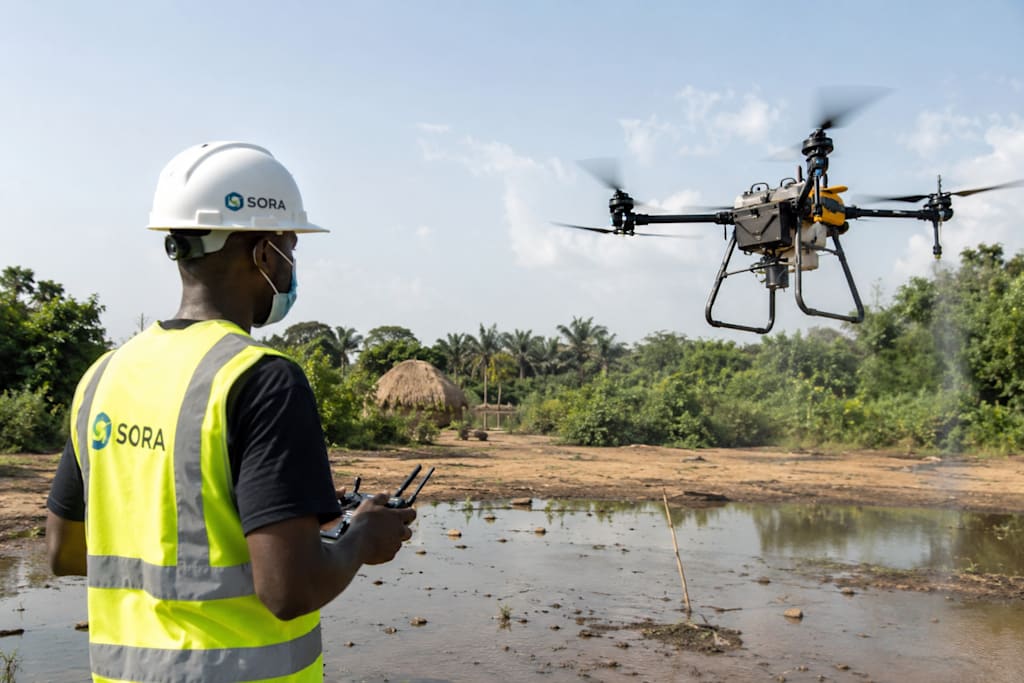
Several technology companies are now developing drone-based malaria control systems designed to target mosquitoes before they spread disease.
These drones use AI-powered cameras and mapping software to identify potential mosquito breeding areas, especially stagnant water sources hidden in difficult terrain.
Instead of spraying large areas randomly, drones can pinpoint high-risk zones with far greater precision.
The system analyzes factors such as:
- Water stagnation
- Vegetation density
- Land elevation
- Environmental conditions
- Mosquito breeding patterns
Once a risky area is identified, the drone can apply carefully measured amounts of insecticide directly to mosquito larvae before they mature into adult mosquitoes.
This method is known as larval source management.
The biggest advantage is efficiency.
Because drones target only specific breeding sites, insecticide use can be dramatically reduced. Some technology developers estimate that targeted spraying may lower chemical usage by as much as 70% while also reducing labor costs significantly.
That matters enormously for countries with limited healthcare budgets.
By lowering costs, governments can potentially expand malaria prevention efforts into larger geographic areas without requiring massive increases in funding.
A Smarter and More Sustainable Approach
Another major benefit of AI-driven mosquito control is environmental protection.
Traditional large-scale spraying can sometimes damage ecosystems or affect non-target insects and wildlife. Precision-based drone systems help minimize unnecessary chemical exposure by applying treatment only where it is truly needed.
This creates a more sustainable approach to malaria prevention while also reducing waste.
Technology alone will not eliminate malaria overnight, but smarter tools can help health systems become faster, more efficient, and better prepared for future outbreaks.
Malaria Is Also an Economic Problem
Malaria is often discussed only as a healthcare issue, but its economic impact is enormous.
The disease affects workers, students, families, and entire national economies. Frequent illness reduces productivity, increases medical expenses, and places heavy strain on healthcare systems.
In many regions, malaria continues to trap communities in cycles of poverty.
Economic researchers estimate that eliminating malaria could add billions of dollars to Africa’s economy every year by improving workforce productivity and reducing healthcare costs.
This means investing in malaria prevention is not just about saving lives it is also about creating long-term economic growth and stability.
The Fight Is Far From Over
Despite the recent setbacks, many health experts remain hopeful.
The tools available today are more advanced than ever before. Artificial intelligence, drones, satellite mapping, and data-driven healthcare systems are opening new possibilities that did not exist even a decade ago.
But technology alone is not enough.
Defeating malaria will require continued investment, international cooperation, and strong partnerships between governments, nonprofits, researchers, and private companies.
Most importantly, it will require urgency.
If the world allows funding and prevention efforts to continue declining, malaria could once again become an even larger global crisis. But with innovation, smarter strategies, and renewed commitment, there is still a real opportunity to dramatically reduce infections and save millions of lives in the years ahead.
The fight against malaria is not over yet it may simply be entering a new technological era.
About the Creator
Farooq Hashmi
Thanks For Reading! Subscribe To My Newsletters.
Storyteller, Love/Romance, Dark, Surrealism, Psychological, Nature, Mythical, Whimsical
Love You All❤️❤️❤️
Enjoyed the story? Support the Creator.
Subscribe for free to receive all their stories in your feed.
Comments
There are no comments for this story
Be the first to respond and start the conversation.