
UNPOPULAR OPINION: Shane Gillis
Gym Culture, and the Art of Not Blaming Just One Side

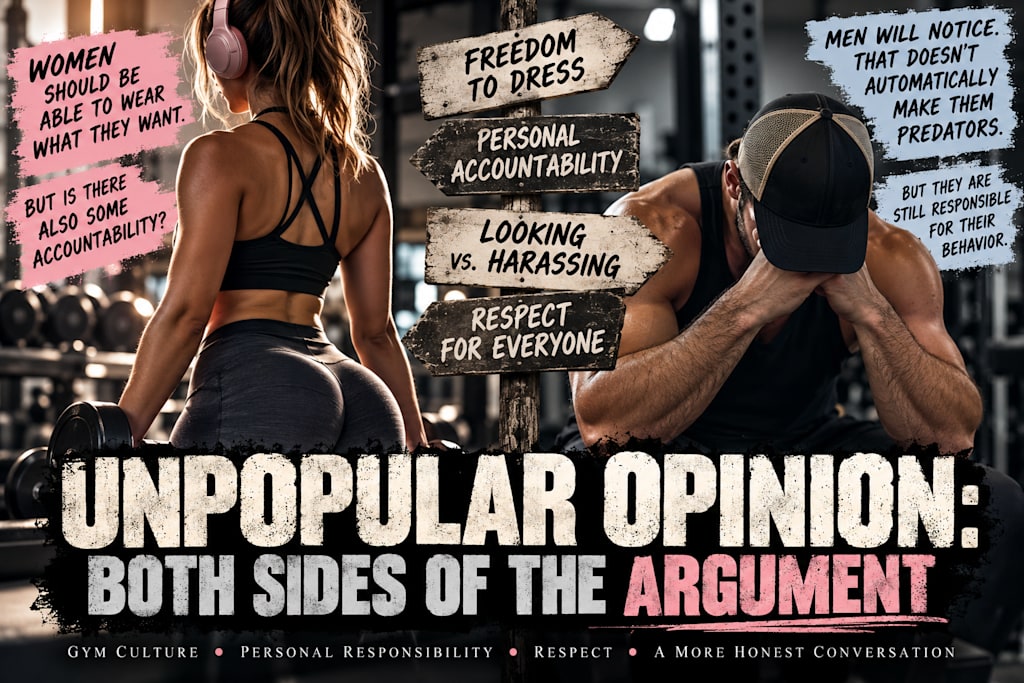
UNPOPULAR OPINION: Shane Gillis, Gym Culture, and the Art of Not Blaming Just One Side
Should Shane Gillis have called women whores because of the way they dress at the gym? No. Absolutely not. But does that mean women get a free pass from criticism when it comes to the culture they help create? Also no.
Somewhere along the way, we seem to have lost the ability to have a conversation about personal responsibility without immediately turning it into a battle of the sexes. One person says something offensive, an entire internet erupts, and suddenly everyone must choose a team. You're either defending women or defending men. You're either a misogynist or a feminist. There is no room for nuance, common sense, or the uncomfortable possibility that two things can be true at the same time.
So let's talk about the Shane Gillis controversy, the gym, revealing clothing, staring, and the increasingly exhausting expectation that one side should be held accountable while the other gets a pass.
Because I have an unpopular opinion, and I suspect it won't sit well with everyone.
First, Let's Address Shane Gillis
Let's get one thing straight. Calling women whores because of how they dress is not a reasonable argument. It's an insult. It reduces a woman to a derogatory label based on her appearance, and it does absolutely nothing to encourage a productive conversation.
You can criticize a trend without degrading the people participating in it. You can question the culture surrounding gym fashion without suggesting that a woman's clothing determines her character, morals, or sexual availability.
Those are two very different things.
If Gillis wanted to make a point about how some gym outfits leave very little to the imagination, there were better ways to express it. He is a comedian, and comedy frequently relies on exaggeration, shock, and deliberately uncomfortable observations. That doesn't mean every joke is clever, fair, or beyond criticism.
And yes, women are allowed to be offended. They are allowed to say they don't like the joke. They are allowed to criticize him.
But here is where I think the conversation becomes more interesting: Does an offensive way of expressing an opinion automatically make the underlying discussion illegitimate?
I don't think so.
We can acknowledge that his wording was crude and demeaning while still asking whether there is a legitimate conversation to be had about gym attire, attention, social expectations, and the double standards surrounding them.
Apparently, that conversation is considerably harder to have than simply declaring one side the villain.
Ladies, Let's Talk About Accountability
Here is the part that will probably earn me some angry comments.
Women are entitled to wear what they want. Period.
Leggings, sports bras, crop tops, shorts, fitted clothing, or whatever else makes someone feel comfortable while working out. A woman does not owe the public modesty, and her clothing does not give anyone permission to touch her, harass her, follow her, or make sexual demands.
That should not be controversial.
But being entitled to wear something does not mean being exempt from discussing the social reactions that clothing might attract.
Those are separate issues, and we need to stop pretending they are interchangeable.
If you choose to wear clothing that emphasizes your breasts, buttocks, or other physical features, you may attract attention. That is a foreseeable possibility. People notice appearances. They notice fashion. They notice attractive people. Human beings are visual creatures.
And sometimes, yes, people look.
That does not automatically make them predators, perverts, or misogynists.
We have created a strange cultural expectation in which someone can deliberately wear an outfit that draws attention to their body, receive that attention, and then treat every instance of someone noticing as evidence of wrongdoing.
Why?
If you are wearing a sports bra and leggings that leave very little to the imagination, what exactly do you expect everyone around you to be completely oblivious to? Are we genuinely expecting men to develop the ability to temporarily disable their eyesight?
Apparently, the only acceptable answer is to stare exclusively at the floor.
Those are some lovely running shoes, sir. Excellent tread. Very aerodynamic.
And before anyone accuses me of saying women deserve to be harassed, let me make this abundantly clear: expecting attention is not the same as consenting to harassment.
A glance is not the same as a prolonged, uncomfortable stare. A glance is not the same as leering, following someone around the gym, making sexual comments, or interrupting their workout to demand attention.
There is a difference, and pretending there isn't does not help either sex understand the other.
The Difference Between Looking and Harassing
Let's imagine two scenarios.
In the first, a woman walks into the gym wearing a matching set of tight leggings and a sports bra. A man notices her as she walks past. He looks for a moment, recognizes that she is attractive, and returns to his workout.
Has he committed some great moral offense?
I would argue no.
People notice other people. Attraction happens without an invitation. A brief glance is not a declaration of disrespect, and it certainly isn't proof that a man believes a woman exists solely for his viewing pleasure.
Now consider a second scenario.
A woman is doing squats. A man positions himself nearby, repeatedly stares at her buttocks, moves to maintain his view when she changes locations, and makes comments about her body.
That is a different situation entirely.
His behavior is no longer simply noticing someone. He is making her uncomfortable through persistent, targeted attention. She has every right to object, and he should stop.
The distinction matters because if we label every glance as harassment, we dilute the meaning of actual harassment. We also create an impossible standard in which ordinary human behavior is treated as inherently suspicious.
Men should be expected to control their behavior. They should also be allowed to exist in public without being presumed guilty because their eyes happened to land on an attractive person.
And women deserve the same freedom to exercise without being followed, sexualized against their wishes, or made to feel unsafe.
Both things can be true.
But What About the Pick-Me Culture?
This is where I think the conversation extends beyond gym clothing.
There is a growing social media culture built around being noticed. People film themselves working out, post carefully selected angles, emphasize particular body parts, and sometimes create content specifically designed to provoke reactions.
Some women do this. Some men do it, too.
The internet has turned attention into currency. Views become engagement, engagement becomes followers, and followers can become money. Sex appeal is hardly a new marketing tool, but social media has made it easier than ever to monetize being noticed.
And then we get into the murky territory of people seeking attention while publicly condemning the attention they receive.
To be clear, not every woman wearing revealing gym clothes is seeking male attention. Some simply prefer those clothes. Some find them comfortable. Some enjoy feeling attractive for themselves. Others wear them because certain exercises are easier to perform in fitted athletic clothing.
We cannot look at a woman's outfit and confidently declare that we know her intentions.
But surely we can acknowledge that some people deliberately cultivate a particular image, encourage attention online, and then turn around and criticize others for noticing that image.
That contradiction deserves discussion.
If someone actively markets their appearance as part of their online identity, it is reasonable to ask how they distinguish unwanted attention from the attention they intentionally cultivate.
That question should apply to everyone, regardless of gender.
However, there is a critical distinction here: seeking attention in one context does not mean consenting to every form of attention in every other context. A woman who posts a provocative photograph is not inviting a stranger to harass her at the gym. A man who posts shirtless workout videos is not inviting people to touch him without permission.
Accountability does not erase boundaries.
And the term pick-me girl should not become another convenient insult for women whose clothing, confidence, or behavior someone else dislikes. We can criticize attention-seeking behavior without assuming that every woman who dresses differently is desperate for validation.
The real issue is the behavior, not a label.
Men Are Not Robots. They Are Responsible Adults.
Here is the other side of this argument, and it deserves just as much attention.
Men are not helpless creatures who lose all control the moment a woman wears tight leggings.
They are adults. They are capable of recognizing attraction without acting on it. They are capable of looking away, respecting boundaries, and understanding that a gym is a shared space rather than a personal entertainment venue.
A revealing outfit is not a command. It is not an invitation. It is not a promise.
A man can notice a woman's body without making her responsible for his behavior.
That distinction is essential.
The argument that a woman's breasts are in a man's face, therefore he cannot possibly be expected to look elsewhere, is an exaggeration. He can look elsewhere. He may find it difficult not to notice something directly in his line of sight, but noticing is involuntary far more often than continued staring is.
We are responsible for what we do with our attention.
If a woman is exercising in front of you, she is not performing a show for you simply because her clothing is revealing. She paid for her membership just as you did. She has the same right to use the equipment, complete her workout, and leave without feeling as though she has become the main attraction in someone else's afternoon.
And if you cannot work out without making other people uncomfortable, perhaps the problem is not their wardrobe.
It is your behavior.
At the same time, men should not be expected to pretend that clothing has no visual impact whatsoever. There is a difference between acknowledging that something attracts the eye and claiming that the person wearing it is responsible for every reaction.
We can recognize the first without endorsing the second.
The Gym Is Not a Church, But It Is Not a Nightclub Either
Part of this debate comes down to expectations.
Gyms are public or shared environments where people arrive with different goals. Some are there to lose weight. Some are building muscle. Some are training for competitions. Some are working on their mental health. Some simply want to feel better about themselves.
And some people enjoy looking good while doing it.
There is nothing wrong with that.
But a gym is also not a dating app, a nightclub, or a private photo studio. It is a place where people should be able to exercise without feeling pressured to participate in somebody else's social experience.
That means everyone has responsibilities.
If you are filming yourself, be mindful of other people's privacy. If you are wearing clothing that makes you feel confident, enjoy it without assuming that everyone who notices you has bad intentions. If you find someone attractive, behave respectfully. If someone tells you your behavior is making them uncomfortable, take that seriously.
And if you are repeatedly filming strangers, posting them online to shame them, or manufacturing confrontations for engagement, perhaps you should reconsider what you are actually doing at the gym.
The same standards should apply to everybody.
We do not need separate rules for men and women. We need consistent expectations for respectful behavior.
Why Is Accountability Always a One-Way Street?
This is the heart of my unpopular opinion.
We have become very comfortable discussing men's responsibilities while becoming increasingly uncomfortable discussing women's.
Men should control their impulses. Men should respect boundaries. Men should not harass women. Men should understand that a woman's clothing is not consent.
Absolutely.
But women can also be accountable for their choices, their behavior, and the way they treat other people. They can recognize that their actions may have predictable consequences without being blamed for someone else's misconduct.
Accountability is not a punishment. It is the recognition that our choices exist in a world populated by other human beings.
We make decisions, and those decisions sometimes affect how others perceive us. That does not mean every perception is fair, accurate, or deserved. It does mean we should be capable of discussing those perceptions without immediately treating the conversation as an attack on our rights.
A woman should never be told she deserves harassment because of her clothing.
A man should never be told he is a creep simply because he noticed her.
And neither side should be allowed to use the worst examples of the other to justify condemning an entire gender.
If a man stares aggressively at women, hold him accountable.
If a woman deliberately creates provocative content to attract attention and then dishonestly portrays every viewer as a predator, criticize that behavior, too.
If someone makes a crude joke, we can criticize the language without pretending the broader subject is forbidden.
That is what a mature conversation looks like.
It is also apparently what the internet struggles with most.
So, Was Shane Gillis Wrong?
In my opinion, yes, if we are talking about calling women whores based on how they dress.
That wording is needlessly degrading. It attacks character instead of examining behavior, and it makes an already contentious discussion even more hostile.
He could have made the same point without using a term that carries so much contempt.
But I also don't believe that one crude joke should automatically end the conversation about gym culture, revealing clothing, social media attention, and the expectations we place on men and women.
Comedy is allowed to be uncomfortable. Public figures are allowed to express unpopular opinions. Audiences are allowed to dislike those opinions. Criticism is fair, and so is disagreement.
What I reject is the idea that we must choose between condemning misogyny and acknowledging personal responsibility.
We can do both.
Women deserve respect regardless of what they wear. Men deserve to be judged by their actual behavior rather than assumptions about their intentions. And everyone deserves the freedom to discuss cultural trends without being reduced to a caricature.
The answer is not to shame women into dressing differently. It is not to tell men they have no right to notice another human being. And it certainly is not to pretend that a revealing outfit gives anyone permission to behave badly.
The answer is to establish reasonable expectations for everyone.
Dress how you want. Work out how you want. Feel attractive. Feel confident. Wear the matching set, the oversized shirt, the sports bra, or the sweatpants that have seen better decades.
Just understand that other people may notice you, and remember that noticing someone is not the same as disrespecting them.
And men, for heaven's sake, you can appreciate an attractive woman without making her uncomfortable. You do not need to stare, comment, follow, or turn her workout into your personal spectator sport.
There is a middle ground here, and it is not particularly difficult to find.
My Final Take
Shane Gillis should have chosen better words. Women should not be called degrading names because of their clothing. Men should not use a woman's outfit as an excuse to harass her.
But women are not beyond criticism, and neither are men. Nobody gets a permanent exemption from accountability simply because the criticism makes them uncomfortable.
You can wear whatever you want. You can expect to be treated with respect. But you cannot control every pair of eyes in a public space, and you cannot automatically declare every person who notices you guilty of wrongdoing.
Likewise, men can notice what is in front of them, but they are responsible for how they behave afterward.
That is the distinction this argument keeps losing.
We need fewer sweeping accusations, fewer gender wars, and a lot more honest discussion about personal responsibility on both sides.
Because the problem is not that women wear leggings, and it is not that men have eyes.
The problem is that we keep treating accountability as something the other side needs to learn.
And perhaps that is the most unpopular opinion of all.
About the Creator
Lilithea Adasia
I dig where others look away. 🖤 True crime, paranormal mysteries, uncomfortable truths, and the beautifully broken human experience. I chase the stories others bury and ask the questions others avoid. Come curious. Leave questioning.
Enjoyed the story? Support the Creator.
Subscribe for free to receive all their stories in your feed.
Comments