
The Three‑Second Silence That Broke the AI Layoff Story
Ford fired him because an algorithm said he was inefficient. Three years later, the company called him back — and the pause between their words said more than any quarterly report ever could.
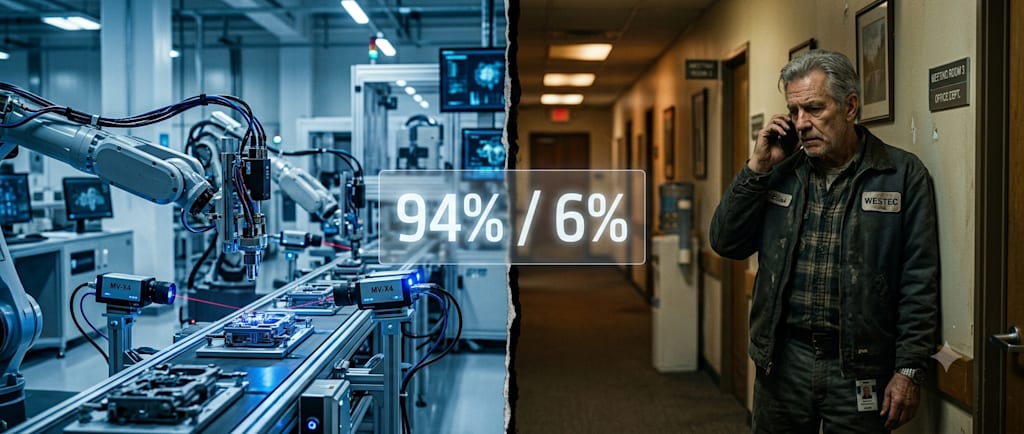
The call from Ford went out in April 2026.
The recruiter’s words were measured: “We’d like to discuss a non‑full‑time opportunity.” On the other end was a 58‑year‑old chassis quality engineer, one of those “optimised out” three years earlier by an AI vision system. The old man said: “You told me I was inefficient.” Three seconds of silence on the line. Then the other voice shifted: “There are sounds the AI can’t hear.”
That same week, the Commonwealth Bank of Australia reactivated more than 40 access cards at its call centre. The people replaced the year before by AI voice bots found their old badges still opened the office doors—but a small label now sat on their desks: “AI‑assisted role. Escalated cases only.”
IBM’s numbers came earlier. Tucked into a footnote in its 2025 annual report: the AI HR system handled 94% of routine requests. The remaining 6% involved sexual‑harassment definitions, mental‑health crisis intervention, cross‑functional mediation. By 2026 IBM had tripled its US entry‑level hiring. The job titles matched those cut the previous year, but the descriptions now carried an extra line: “Handle complex cases the AI cannot resolve.”
Three slices of the same story.
I. What is not on the drawing
Start with Ford’s AI.
Its training data came from millions of inspection images. Cracks, scratches, dimensional deviations—it could read them all. But the old engineers relied on something else: the acoustic signature of metal fatigue. The noise shift when a supplier changed rubber compound without notice. A one‑degree temperature variance at a weld point, never marked on any drawing. None of that was on the drawings, none in the training set. The AI could not see it.
The results were disastrous. Quality complaints jumped 47% in the second quarter after full deployment. Production lines stopped six times for “unclassifiable” anomalies. Ford never published those figures, but over three years it brought back 350 of the senior engineers it had cut—not all, and the new contracts read “technical consultant” instead of “senior engineer,” pay down 22%. The requirement: train the AI, by hand, to listen to the sounds that were never on any drawing.
That is what the 6% means. IBM’s 6%. Ford’s 6%. Any company that deploys AI will meet its own 6%. It is not scrap. It is everything vague, grey, judgement‑dependent—things that have never happened before and may never happen again, the stuff called “experience.”
AI processes certainty with astonishing speed. But most problems in business, at the moment they arise, are not certain.
II. The AI did not change. The P&L did.
If that capacity gap was always there, why did nobody talk about it before 2023?
From 2020 to 2022, US tech hiring multiplied by 1.7. Not because AI suddenly got smarter. Interest rates were zero. Money was cheap enough to borrow for anything. Market share was expanding, expectations were expanding, and every company stockpiled talent: bring people in even without a clear project, just to keep them from competitors. Back then The Economist ran article after article hailing remote collaboration as the “revolutionary future of work.” Any doubt about distributed teams was dismissed as old‑guard thinking.
After 2023, the rate‑hike cycle bit. Capital turned expensive. Expectations contracted. The hoarded talent became redundant cost. Boards demanded 20% head‑count cuts to protect share prices. But management needed an irrefutable reason. “The economy is weak” made them look incompetent. “Strategic miscalculation” was self‑inflicted.
And in 2023 AI happened to become good enough—good enough to serve as a plausible reason. ChatGPT launched at the end of 2022 and entered the enterprise conversation in 2023. “We are not managing poorly; we are embracing the Fourth Industrial Revolution with a structural optimisation.” That script served three needs at once: calm Wall Street, suppress internal salary demands, and own the high ground in public narrative.
The AI did not change. The P&L did. AI was picked up as a blade in 2023 not because it had suddenly become a universal key, but because that year, companies needed a blade.
III. Two scripts
The RTO farce is the same logic, stripped bare.
During COVID isolation, US HR departments spent millions training managers in remote work. The 2020 Harvard Business Review cover story was about “five golden rules for distributed teams.” Any piece questioning remote productivity would have been killed—because pandemic control was the first political priority, and commercial‑real estate landlords had not yet seen the danger.
When the pandemic ended, the US government called in the big tech firms. If commercial real estate collapsed, the fallout would hit banks, pension funds, municipal tax bases. Overnight, company policy flipped. “The collaborative atmosphere of the office is irreplaceable.” Clock‑in records were audited. Return‑to‑office metrics were tied to performance reviews.
“Remote is the future” in 2020 and “office is the only way” in 2024 are two completely contradictory narratives. Yet each was packaged as “science‑based.” No one cares about the crack between them—because there is no profit in that crack.
AI‑driven layoffs are the same. The 2023 script—“AI boosts efficiency, so we must restructure”—and the 2026 script—“AI falls short, so we must re‑hire veterans”—also have a crack between them. No profit there either. Only the difference on the P&L from one year to the next.
IV. The three seconds
When the Ford old man said “You told me I was inefficient,” the HR person on the other end fell silent.
Three seconds. Maybe caught off guard. Maybe HR was pulling up the exit record from three years earlier—the system said “contract terminated due to AI automation replacement,” with no note of “inefficient.” But the old man remembered those two words. He had repeated them over drinks with former colleagues for three years.
HR later changed tone: “There are sounds the AI can’t hear.” That sentence itself is a narrative reversal. Three years ago his experience was “redundant.” Three years later it is “a critical dimension missing from the AI training data.” The man did not change. His experience did not change. What changed was the company’s momentary definition of “efficiency.”
That three‑second silence is the only thing in this piece I have not tried to translate. Because I am not sure which side it belongs to—whether HR did not know how to answer, or whether the old man was waiting for something he should have heard three years earlier. In that grey instant, AI cannot help. Neither can people, really.
V. Is the wave over?
If by “wave” you mean indiscriminate mass layoffs justified solely by AI, then yes, it is ebbing. Orgvue’s 55% regret rate makes the next CEO who tries it a braver one.
But if by “wave” you mean companies using technology to redraw the boundaries of jobs, that tide has only just come in.
Jobs will not be “replaced” by AI. They will be split apart. One engineer’s work becomes “AI training” and “AI auditing.” One call‑centre job becomes “routine AI handling” and “complex case escalation.” One HR role becomes “94% system coverage” and “6% human intervention.” The person stays in the seat—but the decision‑rights, the autonomy, the substance of that seat have already shifted.
The 350 “technical consultants” Ford brought back are no longer “quality engineers.” Their core function moved from “judging quality” to “teaching AI to judge quality.” They feed experience into the algorithm. They troubleshoot when the AI stalls. They take legal responsibility for AI errors—that 22% pay gap between “consultant” and “engineer” is exactly what buys that distinction.
This is not AI replacing people. This is plugging people into the 6% crevices of the AI system—to handle the trouble the AI does not want, to backstop its mistakes, and to inch that “94%” up a few tenths of a percentage point every year.
VI. The last thing
One more line from that call. HR said: “We still need you back.” The old man said: “You told me I was inefficient.” Three seconds of silence between them.
I do not know whether he finally said yes. Maybe he needed the money. Maybe he just wanted the person on the other end to know he remembered that phrase. Or maybe he declined—because his pension plus some part‑time tutoring was enough, and he did not need to be called “inefficient” first and “irreplaceable” second.
I am sure of only one thing: three years ago the company needed to prove it was embracing the future; three years later it needed to prove it had fixed a problem. In both acts, the “person” was a tool: first a reducible cost, then a recallable asset. But a person remembers those three seconds.
The AI remembers nothing. The AI does not even know there were three seconds of silence.
About the Creator
Jin
Writer of reamstories
https://reamstories.com/jin
Enjoyed the story? Support the Creator.
Subscribe for free to receive all their stories in your feed. You could also become a paid subscriber, letting them know you appreciate their work.
Comments
There are no comments for this story
Be the first to respond and start the conversation.