
The Supervisor's Weakness is PSYCHIC Types.
A strong mind is super effective!

In a recent post, I did a bit of trolling and rolling to highlight some of the gems I've discovered about colleagues and their covert plots. Make no mistake, it's mostly thought-provoking knowledge, but I just had to throw in a little salt for everyone who makes it their business to leave us star players out of the conversation.

Just when I thought it was time to put a period on the sentence, I realized I wasn't quite ready to take my foot off their corporate necks! If I reach my arms into a pit of personal notes, my hands will come back stuffed with plenty things to throw on a list with bad habits of people in charge; The TOXIC tactics of a tyrant at work.
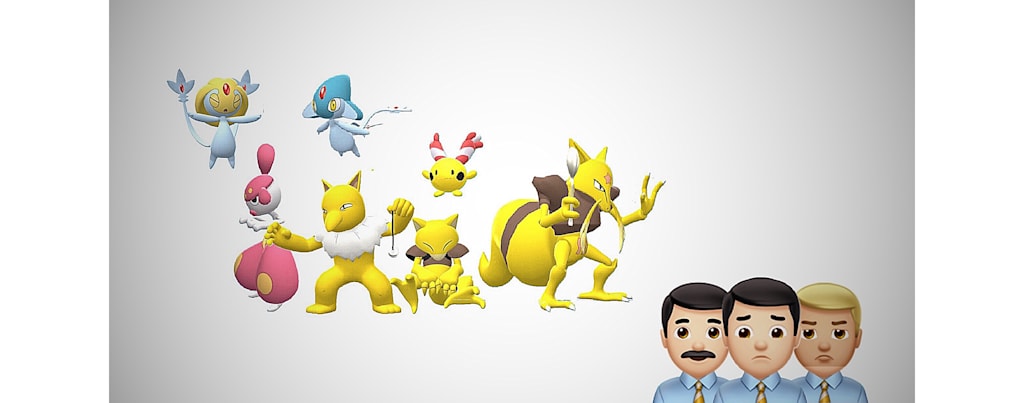
Speaking of toxic, I need to put you on to an interesting analogy. To all my Pokémon fanatics in the chat, we understand very well that the best way to take out a poison type Pokémon is to hit it with a psychic type opponent. Funny enough, the same can be said about "poisonous" personalities in real life.

When it comes to us less interesting, less mighty human beings, one could say a psychic is merely someone with impressive intuition and good judgement. Although these attributes don't compare to mystical abilities, they are exactly what one would need to render a "toxic" person powerless. You catch my drift?
With that being said, don't let my creative genius distract from the value of what I'm about to share. I didn't write this shit for nothin'. We'll start off strong and lead this writing with a subject that I nearly forgot to include the last time around.
A wise lady online once said: "People who are snakes practically move like snakes around you—slithering and sneaking by." She really hit the nail on the head with that one.

1. Hiding and Pouncing
In Part 1 of this topic, I deciphered the signals of coworkers moving in secret, and I nearly missed one of the most obvious habits that's practically in plain sight: Hiding. That's right. Grown ass people, dodging visibility, as if you were the searchlight on a prison yard.

Have you ever been in a situation where you wanted to chat with someone, but you always just miss them? They're clocking out as you're coming in; They're pulling up as you're heading out; The day y'all work together, they call off. If this certain "someone" is a person of authority, please, for the love of god, don't think it's a coincidence.
Like I said before, in any case where something is confusing or awry in the workplace, the people in charge will likely predict that explanations are desired. But even with a dozen well-baked excuses, they may still probably prefer to just not explain. So what's the solution? Evade conversations of course! However, ducking discussions is the practice of a coward, not a boss.
I have to be honest, it's a little pathetic to witness. I remember working at the mall when I was fresh out of the nest, and having a manager who loved to move me around. Once I realized she may have mislead me about a thing or two, it was actually hilarious how we suddenly were seeing one another very little.
In any event where simple dialogue and much needed answers are impossible to attain (for lack of someone's presence), you'd be wise to assume that said person can't be trusted. Nothing good has to be done in the dark.
On the other hand, hiding can also come in the form of one simply NOT making their presence KNOWN. Any coworker that's crouching down behind a shelf just inches away, pretending to fold shirts while you have a full blown conversation with your mate is also a freakin' snake. (I've dealt with that too.)

2. Instructing you to do what you already do
This one has to be next up, because recently, it seems to be happening back to back! Nothing irritates me more than a manager who observes your routine, then repeats it back to you as if you're LOST; Literally pretending as if they need to teach you about what they learned from you! I'll give a scenario:
Let's say you start work at a burger spot and you've been there for a few weeks observing how things go. None of the employees wipe tables, refill napkins, or even know how to speak to customers. Let's say the place is always filthy!
Looking to keep busy, you decide to start sweeping the lobby and filling the sauces at the beginning of every shift. Now the place looks a little cleaner every time you work. After a week or so of doing things your way, you clock in to work and your shift leader catches you before you hit the floor.
He says, "So we need to make sure we're keeping busy on the clock. We've noticed a lot of people standing around and things are not getting cleaned! It's not acceptable. When you're on that floor, make sure you're finding something to do." EXCUSE ME?!
Keep in mind, the shift leader sees what you see every single day, and has been here longer than you to see it. In a scenario like this, he should be saying, "You normally do a good job staying busy, keep it up." But instead, he's choosing to approach it as if YOU could use the reminder. There's a few reasons I believe that "leaders" at work will do this.
A —They want you to think they're not watching. Sometimes repeating your actions to you is an attempt to act clueless. They want to conceal the fact that they're paying attention, or they want to convince you that you're not making a difference in their eyes.
Conversely, they may be trying to encourage you to keep doing what you're doing without admitting that they've been observing.
B — They're about to STEAL credit. Sometimes your supervisors will give you instructions whether you need them or not, because they want to be able to tell others that they gave you the instructions. Instead of letting you shine, they try to convince others that they MADE you what you are.
If you come in on Monday and clean windows for the hell of it, they'll tell you on Tuesday, "Make sure you're cleaning windows!" That way they can tell everyone that they told you to clean windows, thus making your independent actions look like their leadership.
C — They want you to see them as like-minded. For someone in charge, it can be embarrassing to have subordinates thinking ahead of you or having better ideas. Sometimes your "leaders" will repeat things to you (that you identify with) in order to give you the impression that everyone's on the same page. Basically saying, "You're not better than me", "I think like you".
No matter what the reason may be for playing dumb about your skillset, it is safely considered a toxic habit. A true leader should use their own brains and give credit where it's due.

3. The "Manage-Out" Tactics
The next few subjects on this list are a little more self-explanatory, and may even specifically be utilized when there's a deliberate agenda to make the workplace uncomfortable and get you OUT.
However, we have to keep in mind that not every tactic employed against you at work is a "business not personal" matter. Sometimes your superiors just dead ass want to humble you. (I can't let miserable people get off that easy.) In some cases, it's fully personal and the goal is not to see you leave, but to remind you that you ain't special.

A — Moving the goalpost. No matter what you do, it's never enough. I've said a million times that the conversation is always about the thing you're not doing. If you knock out the labor, it's about being friendly with customers. If the customers love you, it's about meeting sales. If you outsell everyone AND the customers love you, then you need to be on time or it's a write up.
A bonus type of trickery under the umbrella of goalpost-moving is to secretly add a thing to the list of what's expected, then pretend it was always there. It's basically like ordering a burger and fries ONLY, then asking where the nuggets are when your order arrives.
B — Making shit a RACE. This is the one you have to look out for, because everyone loves to use it when they NEED something to say. Let's make something clear: Unless you're doing something the RIGHT way, you'll never know how much time it truly takes to do it.
You could be the only athletic person on a team full of fat slobs, and people will still find a way to say you're not moving fast enough when your work is better. I honestly believe that being pressured to go faster is a trick to make you compromise the quality of your work—and be shitty like everyone else. As soon as I hear a person talking about pace, I know they're in a hater mindset. Not because I'm perfect, but because I'm being compared to people who don't even do the work! I said what I said.
C — Raising up everyone around you. If there's things that you do well that other people don't do at all, you may start to notice that the standard changes: Now everyone is being trained to have your strengths and handle your tasks.
As magnificent as it sounds to inspire a whole team to be better, please don't assume that your leaders are coming from a good place (Especially if they have yet to give you credit for anything). Sometimes the goal is to make sure you don't stand out so much. Either because they don't want to reward you, or because they want to reserve the right to come down on you.
It's very hard to chastise, criticize, and confuse a person who's very obviously doing better than everyone else. That's why the mission then becomes to make it less obvious.

4. It all depends on the ROSTER
No matter how many toxic traits you recognize in the people you work with, you may find that some seasons of a job are much easier than others. Sometimes there's bitching and complaining and really high standards. Other times, it's chill and there's room to make mistakes. There will be moments when work feels lighter and easier, and your superiors seem not-so-hard to get along with. Bitch, don't get comfortable.
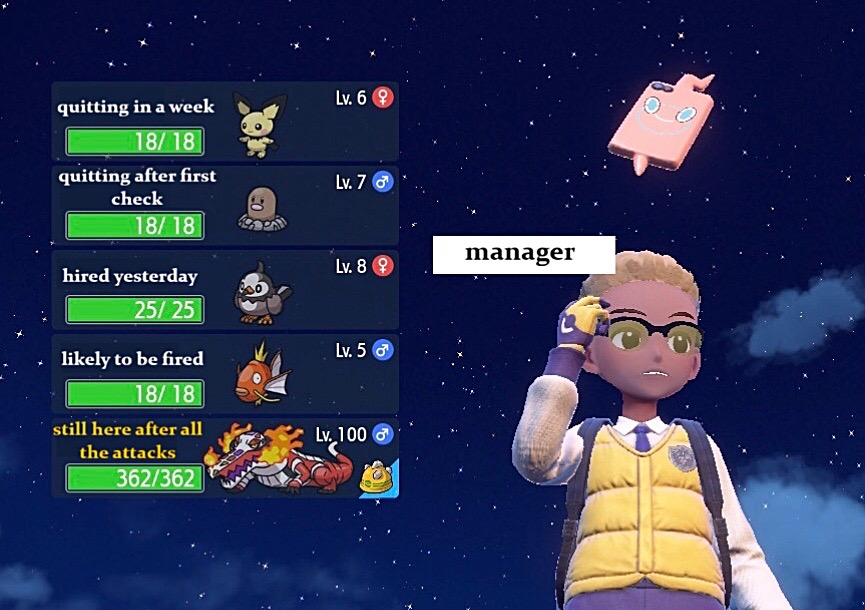
The thing you have to remember is that the COMMANDER is only as strong as the loyalty of his ARMY. When the one in charge is running out of soldiers to rely on, they tend to protect the pack they have left. As long as you stay in the game, you will continue to experience these hot and cold cycles.
Sometimes your superiors NEED you more than they APPRECIATE you, and the number one giveaway is the quick switch up when there's fresh meat on the team. As soon as the new hires start to shape up nicely, you'll notice managers changing their tune with you. Yet when faces start to disappear, they leave you be. (It's especially obvious when they're not even being transparent about the coming and going of associates.)
Hot and cold cycles don't come from that which is good and fair. At some point, the schedule-makers and shot-callers should at least appreciate you for sticking around. Period. If their attitude towards you is directly based on the attendance of others, then throw them in the "poisonous" pile.

Life ain't a game
Moral of the story: There's all kinds of moves superiors may use to drain your HP without you even noticing, so be careful not to start your journey without being fully prepared. If you're the kind of trainer who has a brilliant mind, then you'll know to make plays that give you advantages, instead of blindly chasing after prizes without exploring the landscape.

When it's all said and done, some bosses are not as strong as they seem in the first round. You simply just have to figure out how they battle, and keep in mind that some of the most seasoned players have been cheating the entire time.
By the way, I stopped talking about Pokémon a long time ago.
About the Creator
JeRon Baker
I'm just a nine to five guy; Turning personal notes into projects, trading them for pennies.
Twitter @jbakerwtw, Insta @jbaker.wtw
Enjoyed the story? Support the Creator.
Subscribe for free to receive all their stories in your feed.
Comments
There are no comments for this story
Be the first to respond and start the conversation.