
The Leadership Test: How Hospital Leaders Can Use May to Build Trust
Nurses Week and Hospital Week reveal whether recognition is just a gesture — or a true reflection of how care gets delivered.


Every year, as National Nurses Week (May 6th–12th) and National Hospital Week (May 10th–16th) come around, healthcare organizations roll out familiar plans. Events get scheduled. Emails go out. Food is ordered.
The intent is always good. But if you spend enough time walking the halls, you start to notice something deeper. Beneath the visible gestures, both recognition weeks act like a mirror. They reflect how well a leadership team understands what the work actually feels like inside its own building.
The best leaders don’t treat these weeks as events to get through. They use them as a chance to see more clearly. Here’s what they notice, and why it matters.
What Staff Notice First
A nurse can usually tell within a few minutes whether an appreciation effort is going to feel meaningful or forgettable. It’s not the size of the gesture. It’s whether the gesture shows an accurate picture of the job.
When recognition focuses only on kindness and compassion, it can miss the clinical judgment that defines the profession. Florence Nightingale was famously a statistician, using rigorous data to reshape care. Today’s nurses are making rapid, high-stakes decisions that change patient trajectories long before anything appears in a chart.
One of the most powerful things a leader can do during Nurses Week is simply name that reality. A brief, specific comment — “Your early read on those labs kept that patient stable all morning” — lands with a weight that no generic greeting card ever will. It tells the clinician: I see the thinking behind your work, not just the effort.
The Full System Test
Once Hospital Week begins, the lens naturally widens. This week honors every department that makes patient care possible — not just the bedside teams, but the people in environmental services, transport, pharmacy, IT, dietary, and sterile processing.
In the best hospitals, Hospital Week becomes a full system test. It shows whether recognition reaches the people who keep care moving, not just the people whose work is most visible. A successful surgery isn’t just about the OR team; it hinges on dietary getting the right tray to a diabetic patient at the right time, on facilities keeping the air handlers running so the suite stays sterile, and on IT restoring charting access at 2 a.m. so documentation doesn’t pile up.
When recognition during this week reaches the loading dock and the boiler room — not just the bedside — it signals something important. It tells the entire organization: We understand how our care actually gets delivered.
What Sustains a 24 Hour Workforce
Healthcare doesn’t stop at 5 p.m. Neither do the most effective recognition efforts.
One of the clearest signals is whether recognition is planned for the full 24-hour reality of the hospital. When fresh food arrives at midnight, or when a leader spends real time on the overnight floor, the message is unmistakable. It says, we planned with your reality in mind.
The same holds true for weekend teams and travel clinicians. The best facilities don’t treat travelers as guests; they fold them in fully. That inclusion quietly shapes whether a temporary assignment becomes an extended one.
The Gift That Lasts Longer Than a Week
If you ask staff what they’ll remember from a recognition week, the answer is rarely a branded item. Often, it’s an operational fix that removes a daily frustration.
A cart that no longer squeaks. Wi Fi that finally works in the breakroom. A redundant form that gets eliminated. These things might sound small, but they’re not. They show that leadership isn’t just thanking people for grinding through difficulty — it’s actively making the work easier.
In the organizations where these improvements happen, a recognition week becomes something more than a calendar event. It becomes a moment of proof that someone listened.
The Strength of Peer-to-Peer Gratitude
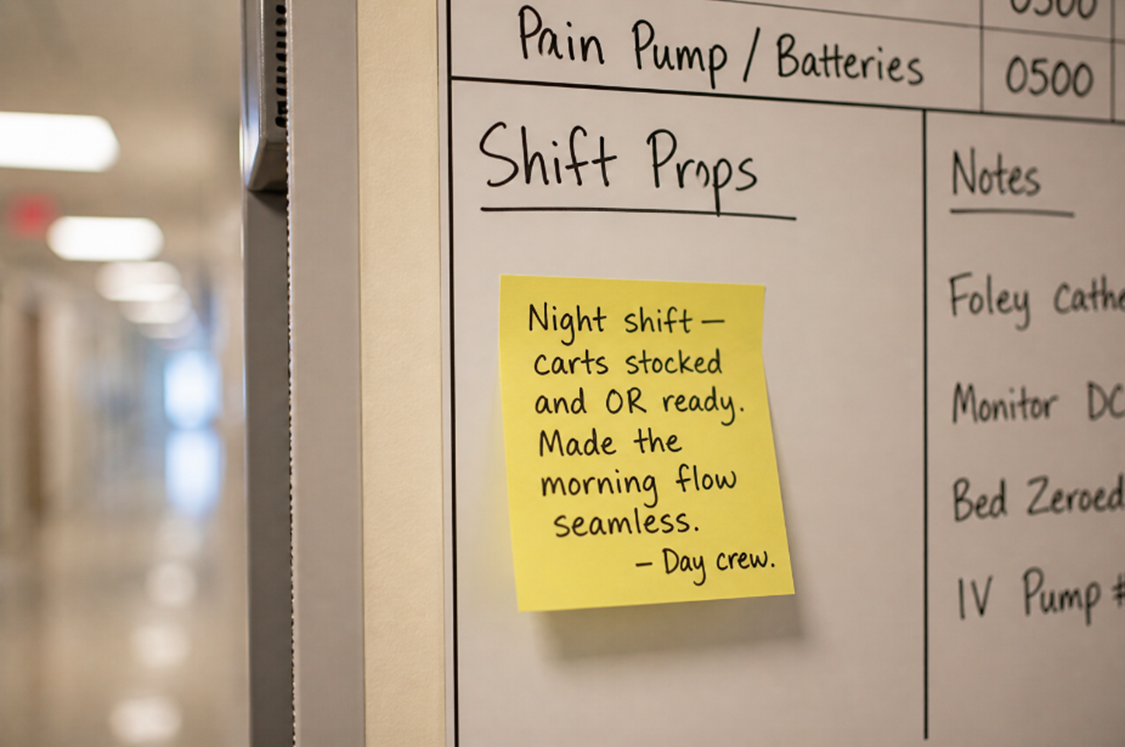
One more pattern worth noting: the most cohesive hospital cultures tend to create space for staff to recognize each other across departmental lines. The ICU formally thanking central sterile processing. The emergency department is calling out the lab for rapid turnaround times during a surge.
These moments don’t require elaborate programs. Just a simple, visible way for one unit to say “we rely on you, and we notice.” And as I’ve written before, that kind of recognition works best when it becomes a consistent habit, not just a one-time event. That kind of recognition makes teams feel connected in a way a company-wide email usually can’t.
Why May Is a Quietly Powerful Window
From the outside, these two weeks look like recognition efforts. Inside the building, they reveal what leaders really notice. People naturally pay attention to what gets valued — and how closely that recognition matches what their day actually feels like.
The most respected leaders don’t try to make these weeks perfect. They treat them as an honest check-in. Not, did we celebrate enough? But, did we celebrate what actually matters?
And building that habit doesn’t stop with May. A comprehensive healthcare recognition calendar can help keep appreciation alive for every specialty and every shift throughout the year.
That’s the real five-minute test. Not whether the week looks polished, but whether people can quickly tell that leadership understands the work. For organizations thinking about how to make recognition more consistent throughout the year, the right clinical and staffing partners can help extend that support beyond a single week.
#WeAreHealthCare
About the Creator
Brian Sutter
Brian Sutter is a marketing leader transforming healthcare staffing through innovative strategies. A contributor to Forbes and Medium, he connects providers with opportunities nationwide as Marketing Leader for Advantis Medical.
Enjoyed the story? Support the Creator.
Subscribe for free to receive all their stories in your feed.
Comments
There are no comments for this story
Be the first to respond and start the conversation.