
The Leader Who Notices: Making Recognition a Habit in High-Speed Workplaces
In the fastest-paced environments, appreciation often feels like a luxury. It doesn't have to be.


You know that moment. You're buried in work, the day has blurred into one urgent task after another, and you realize someone on your team quietly saved the whole operation—and you didn't say a word.
Not because you didn't notice. Not because you didn't care. But because stopping to acknowledge it felt like a pause you couldn't afford.
You told yourself you'd mention it later. When things slowed down. When you had a minute. But later never came, and the moment dissolved into the noise.
This is where recognition usually breaks down. Not at the level of intention—most of us genuinely notice great work all day long. The failure happens in the gap between noticing and saying something. We store it in a mental holding area, waiting for the perfect time that never arrives.
And here's the uncomfortable truth: when people consistently feel unseen, they don't just feel discouraged. They disengage. They stop speaking up. And eventually, they walk out the door, taking years of hard-won institutional knowledge with them.
The Real Cost of Silence
Before we talk about fixing this, let's be honest about the stakes. This isn't just about being nice.
Nowhere is the cost of invisibility more acute than in clinical settings. Replacing a single experienced bedside nurse can easily exceed $60,000, according to national nurse turnover data. But the deeper loss is harder to quantify: the team cohesion that unravels, the clinical momentum that stalls, the subtle expertise that simply vanishes. When skilled professionals leave—not because they couldn't handle the work, but because they felt their invisible labor went completely unnoticed—entire units destabilize.
Today, talent is more mobile than ever - especially in healthcare. People have options. And they are paying attention to whether anyone sees what they actually contribute.
The Fallacy We All Fall For
Here's the trap: we've convinced ourselves that meaningful recognition requires something grand. A formal award. A scheduled meeting. A gift card. A pizza party.
In fast-paced environments, those things rarely happen. And because they don't, we default to nothing. Good work goes unacknowledged. The moment passes. And the person who held things together files it away as just another day no one saw.
But the most powerful recognition isn't a production. It's a habit. A small, specific, immediate acknowledgment that fits into the natural rhythm of the work. I call it micro-recognition.
Four Micro-Habits That Work in Any Chaos
These aren't theories. They're tiny shifts that cost nothing and take less than sixty seconds.
1. The Specific Shout-Out (10 Seconds)
During a quick status update, huddle, or handoff, add one concrete line of validation. Not "Great job, everyone." That's noise. Something specific.
"And the client presentation landed because Jordan caught that data error yesterday morning."
In a clinical setting, it sounds like this during shift report: "Room 4 is stable because Maria noticed the pressure drop before it became a trend. Nice catch."
That single sentence validates clinical judgment in real time. It tells the person—and everyone listening—that their thinking is seen and valued, not just their effort.
2. The Transition Shout-Out (15 Seconds)
Don't create new meetings for recognition. Hijack the transitions you already have. Walking to another meeting? Passing someone in the hallway? Use that moment to name something specific they did earlier in the week.
"By the way, I was thinking about how you handled that escalated call on Tuesday. You kept it calm and got us to a solution. That was sharp."
This "drive-by validation" proves that their contribution stayed with you long after the task was done. It costs fifteen seconds and builds trust for weeks.
3. The Visible "Unsung Hero" Spot
Designate one small, visible place—a corner of a whiteboard, a dedicated Slack or Teams channel, a sticky note wall—where anyone can post quick kudos.
"Thanks to the overnight crew for resetting the space. Made the morning flow seamless."
On a hospital unit, it might be a section of the whiteboard labeled "Shift Props": "Night shift: carts are stocked and organized. Huge help."
This simple practice crosses the invisible divides between shifts and departments. It makes the hidden labor of preparation and cleanup visible to everyone who benefits from it.
4. The Sticky Note (or Its Digital Cousin)
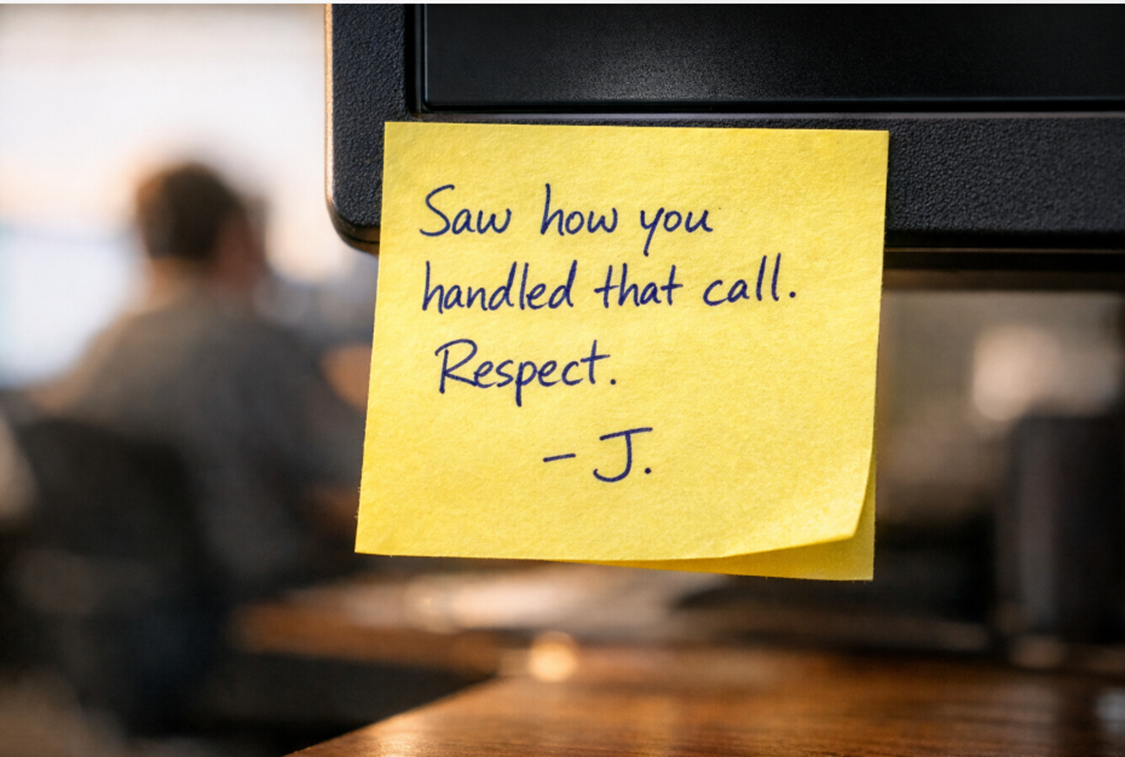
Keep a pad of sticky notes in your pocket. Or a running note on your phone. When you see a colleague de-escalate a tense situation, mentor a junior team member, or quietly hold things together during a rough moment, jot one sentence. Leave it on their desk, in their locker, or send it as a private message.
"Saw how you handled that family. You kept everyone calm. Respect."
This is physical, unexpected, and deeply personal. In a remote world, a private Slack DM with the same specificity has the same effect. Bonus: when annual review season arrives, you have a documented list of specific wins to draw from.
Why This Actually Saves Energy
Here's the counterintuitive part: when people feel seen, communication improves. Teams with high psychological safety escalate issues earlier, collaborate more smoothly, and waste far less energy on friction, resentment, and unspoken frustration - a pattern consistently seen in high-performing teams.
Recognition isn't a distraction from work; it’s the lubricant that keeps everything moving. Sixty seconds of genuine acknowledgment can prevent weeks of simmering disengagement.
The Cli nical Case: Where This Matters Most
In healthcare, the stakes are even higher. Burnout is an epidemic, and turnover destabilizes entire units in ways that directly impact patient outcomes. As explored in “What Nurses Actually Notice During Nurses Week”, recognition that feels accurate and specific changes the texture of a shift. It's not about grand gestures. It's about noticing the thinking behind the action.
Building a culture of consistent recognition requires more than a single week in May. It requires a rhythm. Resources like a healthcare recognition calendar can help ensure appreciation is part of your culture year-round—across every specialty and every shift.
The Prepared Mindset
The work won't slow down. The pressure won't disappear. But when people know their specific contributions are noticed, the weight of it all shifts—just enough to make the next shift feel possible.
Because in fast-paced environments, recognition isn’t about slowing down to seem thoughtful. It's about being present enough to be accurate.
The best recognition strategy I ever saw came from a charge nurse who didn't have time for anything elaborate. She just noticed things—and said so. If you've experienced a moment like that, or if you've been the one trying to make appreciation stick in the middle of chaos, I'd love to hear about it.
About the Creator
Brian Sutter
Brian Sutter is a marketing leader transforming healthcare staffing through innovative strategies. A contributor to Forbes and Medium, he connects providers with opportunities nationwide as Marketing Leader for Advantis Medical.
Enjoyed the story? Support the Creator.
Subscribe for free to receive all their stories in your feed.
Comments
There are no comments for this story
Be the first to respond and start the conversation.