
THE DOUBLE STANDARD NOBODY WANTS TO TALK ABOUT:
BODY SHAMING, THIRST TRAPS, AND SELECTIVE OUTRAGE

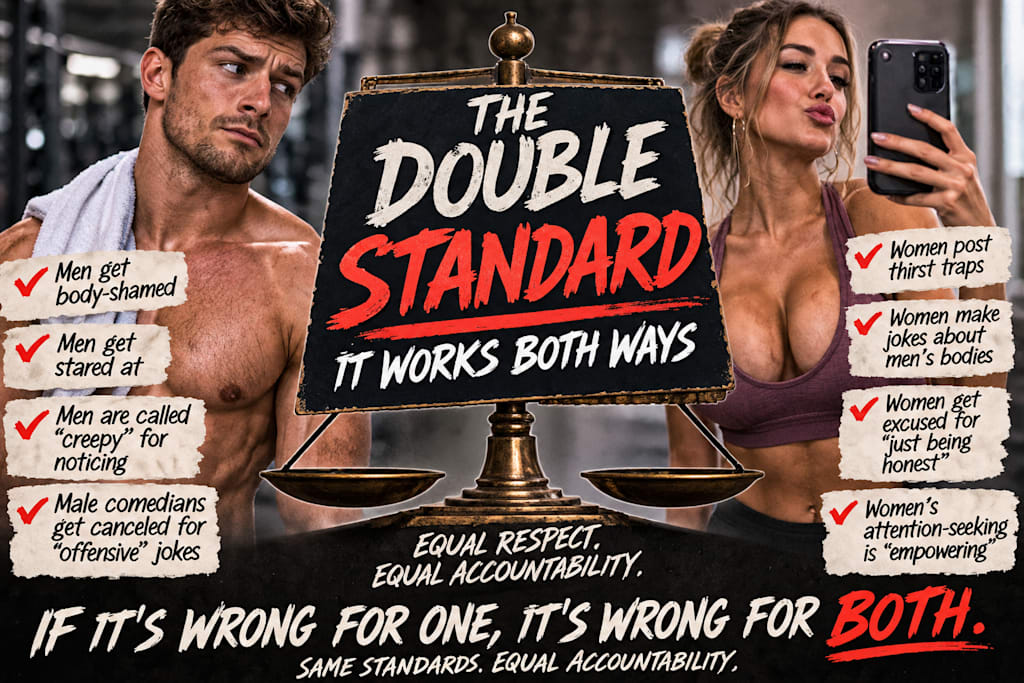
If we're going to demand respect, accountability, and equality, shouldn't those rules apply to everyone? Or does equality only count when it benefits us?
Let's talk.
Apparently, my recent unpopular opinion piece about Shane Gillis rustled a few jimmies. And that's fine. Disagreement is part of having an opinion, and if we can no longer discuss uncomfortable subjects without somebody sharpening their pitchfork, then maybe we've forgotten how to have an actual conversation.
But that reaction got me thinking about something bigger than one comedian, one joke, or one choice of words.
Why are we so determined to hold one gender accountable while giving the other a convenient little pass?
And before anybody starts loading the cannons, this isn't an attack on women. It isn't a declaration that men are innocent angels who have never done anything wrong. It's a conversation about hypocrisy, selective outrage, and the very strange double standards we've built around attraction, bodies, humor, and accountability.
Because if we're going to talk about equality, let's talk about ALL of it.
THE COMEDY DOUBLE STANDARD: WHEN THE JOKE ISN'T FUNNY ANYMORE
Let's start with comedy, since that's what kicked off this conversation.
Male comedians make jokes about women. Sometimes those jokes are hilarious. Sometimes they're crude, tasteless, or about as clever as a brick through a window. And sometimes, yes, they deserve criticism.
But female comedians make jokes about men, too.
They joke about men's height, weight, hairlines, bodies, sexual performance, intelligence, emotional availability, and ability to function without a woman reminding them where they left their keys. Entire comedy routines have been built around the idea that men are useless, emotionally stunted, unattractive, or walking collections of red flags.
And audiences laugh.
Social media applauds.
The comedian gets praised for speaking her truth.
Now, imagine a male comedian making the equivalent joke about women. Suddenly, the conversation can shift from comedy to misogyny, from punchline to character assassination, and from a bad joke to a debate about whether he should ever be allowed near a microphone again.
Is every female comedian attacked for making jokes about men? Of course not. Are male comedians always canceled for jokes about women? Absolutely not.
But the difference in how certain jokes are received, defended, and condemned is worth examining.
Why is a joke about a man's body sometimes treated as harmless comedy, while a joke about a woman's body is treated as evidence of a deeply rooted hatred of women?
Why can one comedian make a room laugh at the expense of men, while another is expected to issue a public apology for offending women?
If body-shaming is wrong, it's wrong regardless of who's holding the microphone.
And if we believe comedians should have room to push boundaries, that freedom cannot magically disappear when the punchline targets a group we feel protective of.
That doesn't mean comedians should be immune to criticism. It means the same standards should apply to everybody.
You can dislike a joke without demanding that the person who told it be destroyed.
You can criticize a comedian's wording without pretending every person who laughed is a terrible human being.
And you can acknowledge that a joke crossed a line without insisting that only one gender ever crosses it.
Funny how complicated equality becomes when the joke is about us.
THE GYM: WOMEN LOOK, TOO. LET'S STOP PRETENDING OTHERWISE.
Now let's talk about the gym.
A place where people go to exercise, improve their health, build strength, and occasionally discover that their legs have entered into a personal conspiracy against them.
It's also a place where people look at other people.
Sometimes it's accidental. Sometimes it's appreciation. Sometimes it's staring. And sometimes it's outright harassment.
Here's the part that shouldn't be controversial: women are perfectly capable of making men uncomfortable with unwanted attention, too.
Men aren't the only ones who stare at attractive people between sets. Women look at men with impressive physiques. They notice broad shoulders, muscular arms, defined abs, and the guy doing deadlifts who looks like he could personally carry the entire squat rack out of the building.
Let's be honest about it.
Women can stare. Women can make inappropriate comments. Women can invade personal space. Women can film people without permission. Women can make someone feel like an object instead of a person.
And yet, when a woman admits to checking out a man at the gym, it may be treated as harmless flirting or a funny little confession.
When a man admits to noticing an attractive woman, the conversation can immediately become more sinister.
Now, before anyone twists this argument into something it isn't, there is an important distinction.
Noticing someone is not the same as harassing them.
A brief glance is not a crime against humanity. Finding somebody attractive does not automatically make you creepy. But prolonged staring, sexual comments, following someone around, filming them without consent, or refusing to leave them alone after they've expressed discomfort are different matters entirely.
And those behaviors are inappropriate no matter who commits them.
Women deserve to work out without being harassed. Men deserve the same courtesy.
A sports bra isn't permission to make sexual comments. Neither is a man's shirtless workout attire an invitation for somebody to photograph him, mock his body, or make him uncomfortable.
Respect is not a privilege reserved for women.
It's a basic expectation for human beings.
So why do we sometimes treat women's unwanted attention as flattering while treating men's unwanted attention as threatening by default?
There are real differences in how men and women may experience unwanted attention, including concerns about physical safety. Those differences deserve to be acknowledged.
But acknowledging those differences doesn't require pretending that men cannot experience discomfort, humiliation, or harassment.
A person's gender doesn't determine whether their boundaries deserve respect.
THE THIRST TRAP CONUNDRUM: WHAT EXACTLY ARE WE POSTING THESE VIDEOS FOR?
Now we're getting into the part of this conversation that might really get people reaching for the block button.
Thirst traps.
You know the ones.
The strategically angled mirror selfie. The perfectly timed gym video. The slow-motion walk. The carefully chosen lighting. The outfit that somehow took forty-five minutes to look effortlessly casual. The camera angle that seems to have received its own cinematography degree.
And yes, ladies, I'm talking to us, too.
Women post videos showcasing their bodies, fitness progress, outfits, curves, and physical attractiveness. Sometimes it's about confidence. Sometimes it's about self-expression. Sometimes it's about business, personal branding, or simply enjoying the way we look.
And sometimes, let's be honest, it's about getting attention.
There's nothing inherently wrong with that.
Enjoying your appearance is not a moral failing. Feeling sexy isn't a crime. Posting a flattering video doesn't mean you owe anybody access to your body, your time, or your attention.
But here's where the double standard starts creeping in.
Someone posts a deliberately seductive video, receives thousands of views, enjoys the likes and compliments, and benefits from the attention. Then, when somebody acknowledges that the video was designed to attract attention, the response can become: "Why are you looking at me?"
Well, what did we think the audience was going to do? Study the background furniture?
Let's use a little common sense.
If you're posting a video specifically designed to showcase your appearance, it's reasonable to recognize that people may find you attractive. That is not the same as saying you deserve harassment, that every viewer has good intentions, or that you lose the right to privacy.
Attracting attention is not consenting to mistreatment. But seeking attention while pretending attention was never part of the equation is a contradiction worth discussing.
And this doesn't apply exclusively to women.
Men post thirst traps, too. Shirtless bathroom selfies. Gym videos. Fitness transformations. Slow-motion workout clips. The mysterious masked man whose face remains hidden while his arms, shoulders, and jawline do all the advertising.
And let's not forget the countless women who happily watch those videos.
We save them. We share them. We send them to friends with a message that requires absolutely no further explanation. We comment on men's bodies and fantasize about fictional or anonymous men online.
Yet when a man notices an attractive woman in a video, some people act as though the mere act of looking is an unforgivable offense.
How does that make sense?
If a woman is allowed to appreciate a man's appearance, a man is allowed to appreciate a woman's appearance.
If a man posting a shirtless video understands that viewers may find him attractive, we should be capable of understanding the same principle when a woman posts a seductive video.
The rules don't change because one person is male and the other is female.
And no, this isn't a demand that women accept every comment they receive. You can post a sexy video and still block somebody who makes you uncomfortable. You can enjoy attention without welcoming every form of it.
The same applies to men.
You can invite attention without inviting every possible response. And you can find someone attractive without being entitled to anything from them.
Both statements can be true at the same time.
THE MASKED MEN, THE SHIRTLESS MEN, AND THE SELECTIVE MEMORY
Here's another little wrinkle in the conversation.
Scroll through social media and tell me how many women have never watched a shirtless man doing pull-ups, a masked man staring into a camera, or a fitness influencer flexing in flattering lighting.
I'll wait.
The internet is practically an all-you-can-eat buffet of attractive strangers, and people of every gender participate.
Some women openly discuss men's bodies. They rate attractiveness, comment on muscles, joke about height, and share videos because they find the person in them appealing.
Some of those comments are respectful. Others are objectifying, crude, or downright embarrassing.
And men do exactly the same things to women.
Neither side has a monopoly on shallow behavior.
The problem isn't that people experience attraction. Attraction is a normal part of being human. The problem arises when we create different moral rules depending on who's doing the looking.
A woman can admire a man's physique without automatically being accused of objectification. A man can admire a woman's physique without automatically being branded a predator.
Context matters. Behavior matters. Consent and boundaries matter.
And if somebody crosses a line, call it out.
But if we're going to condemn objectification, let's condemn it consistently.
Men aren't public property because they have muscles. Women aren't public property because they have curves.
Neither sex exists solely for the viewing pleasure of the other.
That's the standard we should be aiming for.
THE CLOTHING ARGUMENT: CONFIDENCE IS NOT CONSENT, BUT CONTEXT STILL EXISTS
This is where people sometimes misunderstand the entire discussion.
Let's make one thing absolutely clear.
What a person wears does not give anyone permission to harass them. Period.
A woman can wear leggings, a crop top, a sports bra, a short skirt, or a dress that leaves very little to the imagination. She still deserves to be treated with respect.
A man can wear tight gym shorts, a tank top, or no shirt at all. He deserves the same respect.
Clothing is not consent. Attraction is not consent. Posting a picture is not consent to sexual advances.
But acknowledging that clothing can be chosen to attract attention is not the same as blaming somebody for the behavior of others.
People dress to express themselves. They dress to feel confident. They dress to impress partners, attract potential dates, follow trends, or simply because they like what they see in the mirror.
Sometimes, yes, they dress or pose to get noticed.
That's not a scandal. It's human behavior.
The issue is what happens next.
If I post a flattering picture, you can think I'm attractive. You can scroll past. You can leave a respectful compliment if the platform and context make that appropriate.
What you cannot do is decide that my picture entitles you to my body, my attention, or my consent.
Likewise, if you post a shirtless video, I can appreciate your physique without treating you as though you exist solely for my entertainment.
The distinction isn't difficult.
We simply need to stop confusing attraction with entitlement and attention with permission.
WHY IS ACCOUNTABILITY ALWAYS A ONE-WAY STREET?
Here's what really bothers me about this entire conversation.
We have become very good at demanding accountability from other people.
We want men to examine their language, their behavior, their assumptions, their jokes, and their treatment of women. And rightfully so. There are genuine problems worth addressing, and dismissing every criticism as oversensitivity doesn't solve anything.
But accountability cannot be a one-way street.
Women also need to examine their language, behavior, assumptions, jokes, and treatment of men.
We need to recognize when we're body-shaming someone. We need to recognize when we're making unfair generalizations. We need to recognize when we're objectifying someone while condemning the same behavior in others.
We need to stop treating men's discomfort as less important simply because they're men.
And we need to stop acting as though criticism is automatically oppression when it comes from someone we disagree with.
If a man makes a tasteless joke about a woman's body, we should be able to say it's tasteless.
If a woman makes a tasteless joke about a man's body, we should be able to say exactly the same thing.
If a man behaves inappropriately at the gym, call him out.
If a woman behaves inappropriately at the gym, call her out.
If a man posts a thirst trap and then complains that people find him attractive, we can discuss the contradiction.
If a woman does the same, we can discuss that contradiction, too.
Not because either gender deserves less respect, but because neither gender deserves a free pass.
Equality cannot mean equal rights when we're discussing benefits and unequal standards when we're discussing responsibility.
That's not equality.
That's favoritism wearing an equality T-shirt.
THE SHANE GILLIS CONNECTION: TWO THINGS CAN BE TRUE
This brings us back to the original controversy.
In my previous piece about Shane Gillis, I argued that he could have made his point without choosing a word as loaded and insulting as "whores." There were better ways to criticize certain gym behaviors and social media trends without turning the conversation into an insult aimed at women.
I stand by that.
Words matter. Delivery matters. And having a valid point doesn't automatically excuse a lousy way of expressing it.
But here's the other side of that coin.
We should be capable of examining the behavior being criticized without automatically dismissing the entire argument because we dislike the wording.
Two things can be true.
A comedian can use inappropriate language, and the underlying topic can still deserve discussion.
Women can deserve respect and still be capable of hypocrisy.
Men can be responsible for their behavior and still be unfairly judged by double standards.
A person can disagree with a joke without needing to destroy the person who told it.
And a woman can call out sexism without pretending women never engage in sexist behavior themselves.
These ideas aren't mutually exclusive.
We don't have to defend every word Shane Gillis says to acknowledge that double standards exist. We don't have to approve of every thirst trap to acknowledge that people sometimes seek attention through their appearance. We don't have to blame women for men's behavior to recognize that women, too, can make others uncomfortable.
We can have a nuanced conversation.
We can criticize the delivery while examining the substance.
We can hold people accountable without making accountability a gendered weapon.
Or have we reached a point where the only acceptable opinion is the one that makes everyone in our own corner of the internet feel comfortable?
Because if that's the case, we aren't having a discussion. We're just taking turns applauding ourselves.
EQUALITY DOESN'T MEAN WINNING. IT MEANS PLAYING BY THE SAME RULES.
I don't want a world where men are allowed to disrespect women.
I don't want a world where women are expected to tolerate harassment, unwanted sexual comments, or degrading treatment simply because of what they wear or what they post.
I don't want comedians to be forbidden from making jokes, either, but I also don't believe that a microphone magically exempts somebody from criticism.
What I want is a world where we stop pretending that bad behavior belongs exclusively to one gender.
Women can be cruel. Men can be cruel.
Women can objectify. Men can objectify.
Women can make inappropriate comments. Men can make inappropriate comments.
Women can seek attention. Men can seek attention.
And both can be hypocritical when the attention they enjoy suddenly comes from someone they don't find attractive.
None of that means every man or woman behaves this way. It means we're all human beings capable of inconsistency, selfishness, and the occasional spectacular failure of self-awareness.
The answer isn't to shame one gender into submission.
The answer is to establish standards that apply to everyone.
Respect people's boundaries. Don't harass strangers. Don't body-shame people and then cry foul when the same behavior comes back around. Don't demand freedom of expression for yourself while insisting that everyone else remain silent. Don't use equality as a shield when it benefits you and discard it when it becomes inconvenient.
And for heaven's sake, learn to disagree without assuming that everyone who challenges your opinion must hate you.
We can do better than that.
THE BOTTOM LINE: IF WE WANT EQUALITY, WE NEED EQUAL ACCOUNTABILITY
Here's my unpopular opinion for the day.
You cannot demand equal treatment while insisting on unequal standards.
You cannot condemn men for objectifying women while treating men's bodies as fair game.
You cannot demand that men be mindful of women's feelings while laughing off women's disrespect toward men.
You cannot argue that women should be free to express themselves while insisting that men must be condemned for every poorly worded joke.
And you cannot demand that people respect your boundaries while refusing to acknowledge that other people have boundaries, too.
None of this means women should stop posting pictures they love. It doesn't mean men should be allowed to stare, harass, or make degrading comments. It doesn't mean every joke deserves a standing ovation or that criticism should disappear.
It means the rules should be consistent.
If it's wrong when a man does it, it should be wrong when a woman does it.
If it's acceptable when a woman does it, we should at least be willing to explain why the same behavior from a man is different.
And if there is a meaningful difference, let's discuss it honestly rather than hiding behind blanket statements.
That's what equality should look like.
Not men versus women.
Not a competition to determine which gender has suffered more.
Not a race to see who can be offended first and post the most dramatic response.
Just two groups of imperfect human beings learning to hold one another, and themselves, to the same reasonable standards.
Because equality isn't about giving one side permission to do whatever it wants.
It's about making sure neither side gets a free pass.
And if that opinion rustles a few more jimmies?
Well, perhaps those jimmies needed a little rustling.
YOUR TURN.
Do you think men and women are held to different standards when it comes to comedy, body image, gym etiquette, and social media thirst traps?
Are women sometimes excused for behavior that would get men condemned? Or are there important differences in how these situations affect men and women that make the comparisons unfair?
Let's have the conversation. Bring your arguments, bring your counterpoints, and bring your ability to disagree without turning this into a gender war.
Just remember: if we're going to demand accountability from everybody else, we need to be willing to look in the mirror, too.
About the Creator
Lilithea Adasia
I dig where others look away. 🖤 True crime, paranormal mysteries, uncomfortable truths, and the beautifully broken human experience. I chase the stories others bury and ask the questions others avoid. Come curious. Leave questioning.
Enjoyed the story? Support the Creator.
Subscribe for free to receive all their stories in your feed.
Comments