
The Day Humanity Broke the Malthusian Trap
It wasn’t language, IQ, or one genius. It was a system that finally started feeding itself.
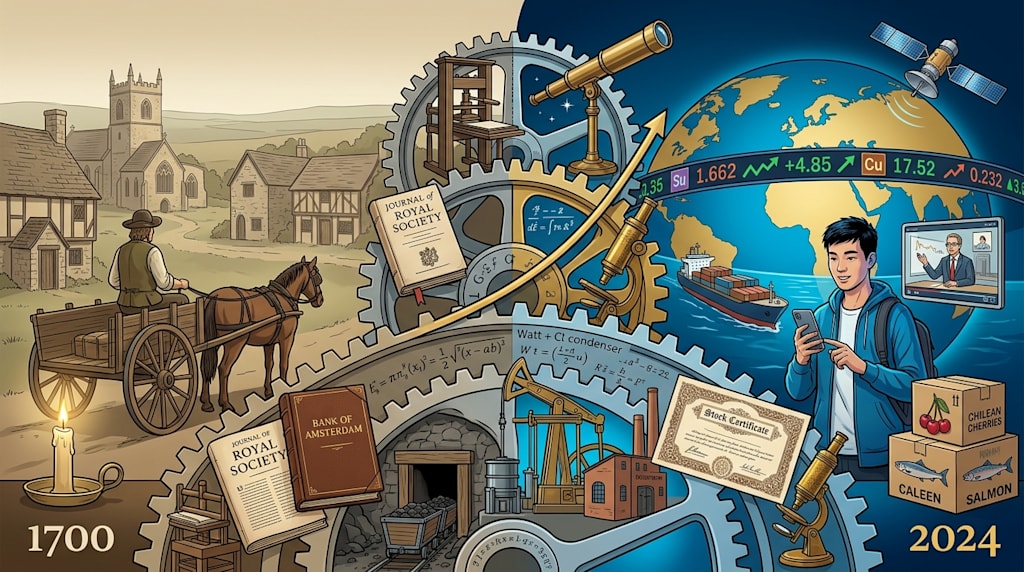
In 1700, a farmer in the English Midlands had traveled no farther than 20 miles to a market in his entire life. He had seen no more than a few hundred people. He ate almost everything from his own village. He lit his evenings with tallow candles. He got his news from church sermons and tavern talk. In 2024, a middle school student in Shanghai uses a phone to check copper prices in New York, opens a University of London lecture, and eats Chilean cherries and Norwegian salmon for dinner. The difference is not in the brain. People of the two eras are almost genetically identical. The difference is in the system.
I. First, Dismantle a Popular Explanation: The Linguistic Simplification Theory
A tempting claim says modern English, French, and Spanish abandoned noun declension. Grammar became simpler. Word order became fixed. Thought became more agile. Science then advanced. This claim notices a real pattern. It mistakes the transmission system for the engine.
The timeline does not match. English case endings simplified mainly between the 11th and 13th centuries. French, Spanish, and Italian evolved from Latin, and their case systems simplified in the Middle Ages. The Scientific Revolution came in the 16th and 17th centuries. The Industrial Revolution came at the end of the 18th. If grammar simplification caused a scientific takeoff, Europe should have taken off in the Middle Ages.
Counterexamples are everywhere. Newton published Mathematical Principles of Natural Philosophy in 1687 in Latin. Latin has a complex case system. Copernicus, Kepler, and Descartes wrote major works in Latin. German has four cases. In the 19th century Germany was a scientific center. Russian has six cases. The Soviet Union achieved spaceflight and nuclear weapons. Japanese and Korean are subject-object-verb. They often omit pronouns. They have no grammatical gender. Japan and South Korea still modernized and won many Nobel Prizes. Arabic has cases. Medieval Arabic science was once ahead. Chinese has no declension, no tense, and no singular or plural. It was once ahead for centuries, and in modern times it learned science.
Language standardization, vernacular writing, and unified terminology did lower the cost of moving knowledge. That was one accelerator. It was not the engine. The Scientific Revolution used Latin. German science used German. Japanese science used Japanese. Soviet science used Russian. Language is the channel. It is not the source.
II. Pre-Industrial Society: Locked In by Negative Feedback
To understand why the last few centuries accelerated, first understand why earlier centuries did not.
Traditional farming societies had a cruel loop. A better tool raised output. Higher output fed more people. More people ate the surplus. Living standards fell back toward survival. This is the Malthusian trap. Inventions did happen. Population swallowed the gains. Per capita income could not climb for long.
Energy was another wall. Pre-industrial societies used human muscle, animal muscle, windmills, waterwheels, and firewood. These are flows of sunlight. They are limited and thin. They cannot drive large industry. Coal existed. Mining, moving, and burning it required technology and social organization. Without fossil energy, machines had no muscle.
Knowledge moved slowly. Handwritten books were expensive. Few people could read. Copies took time. An invention could appear in one town and never spread. A genius could die and his notes could vanish. Guild secrecy, church censorship, war, and plague broke the chain.
Institutions rarely rewarded invention. Traditional empires often favored farming and looked down on trade. Property rights were weak. Power could seize the profits of an inventor. Guilds blocked competition. Landed nobles disliked industry. Invention was accidental, scattered, and hard to scale. China, the Arab world, and India all had scientific peaks. None built a self-reinforcing cycle.
The premodern world had smart people. The system locked their work in place.
III. The Scientific Revolution: Turning Knowledge into a Cumulative Public Project
The first piece of the acceleration was the Scientific Revolution.
Its importance is not one discovery. It is a method. Describe nature with math. Test ideas with experiments. Share results in public. Correct errors instead of worshipping authority. In 1543 Copernicus published On the Revolutions of the Celestial Spheres. He moved Earth from the center. In 1609 Galileo used a telescope to see Jupiter’s moons. In 1620 Bacon wrote the New Organon. He argued that knowledge is power. In 1637 Descartes published Discourse on Method. He used doubt to rebuild knowledge. In 1687 Newton unified heaven and earth with gravitation and the laws of motion.
In 1660 the Royal Society of London formed. In 1665 Philosophical Transactions began. A discovery could be checked, attacked, and improved by others. Later thinkers did not start from zero. They stood on earlier work. The larger the stock of knowledge, the faster new discoveries came. This was compound interest for ideas.
The Scientific Revolution changed how knowledge was made. Before, knowledge was often closed, mysterious, and passed from master to apprentice. Now it became open, cumulative, and self-correcting. Royal Society minutes, journal papers, and letters let an experiment in London be repeated in Paris, Amsterdam, and Florence. Repeatability created trust. Trust made investment possible.
IV. Institutions and Incentives: Making Innovation Profitable
Science needs institutions. Without rewards, geniuses starve. Without property rights, inventions get copied. Without markets, technology cannot scale.
The English Statute of Monopolies of 1624 is an early patent milestone. In 1602 the Dutch East India Company formed. Joint-stock ownership spread risk. In 1609 the Bank of Amsterdam opened. It gave trade and investment financial plumbing. In 1694 the Bank of England formed. Universities, societies, labs, and journals turned research into a job and a network.
Interstate competition mattered more. European states stood side by side. War was common. Technology went into guns, ships, navigation, and communication. Losers were eliminated. To raise taxes and armies, states backed commerce and industry. Innovation became a survival tool, not a decoration. A unified empire might be stable. It might also be conservative. It might lack this deadly competitive pressure.
Institutions made invention investable, profitable, and copyable. Scientists, engineers, merchants, bankers, and states fed one another.
V. Energy and Industry: Breaking the Malthusian Ceiling
The Scientific Revolution changed how people thought. The Industrial Revolution changed what powered them.
In 1712 the Newcomen steam engine pumped water from a Staffordshire coal mine. It was clumsy, thirsty for coal, and inefficient. It was the first machine to use coal instead of muscle. In 1769 Watt improved the steam engine. His separate condenser patent raised efficiency. Railways, steamships, factories, and telegraphs followed. Fossil energy is ancient sunlight. It raised per capita energy use by orders of magnitude. Machines replaced muscle. Transport crushed distance. Communication sped up.
After the Industrial Revolution, growth was no longer tied to land. The old ceiling on output per person broke. Cities grew. Work divided. Specialization spread. Mass production became normal. Factories needed workers. Workers gathered in cities. Cities made markets. Markets pushed innovation. Energy and industry turned science into productive force. That force produced more resources. Those resources went back into science.
Humanity escaped the Malthusian trap for the first time. The cause was not a smarter brain. The cause was new energy and new organization.
VI. Markets, Trade, and Colonies: A Global Cycle of Demand and Resources
The Industrial Revolution did not happen alone. The Age of Discovery, global trade, colonial plunder, and slavery brought Europe resources, markets, capital, and demand. Textiles, shipbuilding, weapons, and finance all sped up under global competition.
Colonialism was brutal. Cotton, sugar, tobacco, silver, and slaves formed a global circuit. Demand pulled technology. Technology cut costs. Lower costs widened markets. The division of labor deepened. Specialization raised productivity. In 1776 Adam Smith published The Wealth of Nations. He described this market logic.
Europe did not do this alone. China, India, and the Arab world had trade and technology. The Great Divergence came from a mix: European fragmentation, sea trade, coal and iron near each other, institutional change, the Scientific Revolution, and colonial expansion. Together they pushed Europe onto the fast track.
VII. Printing, Language, and Knowledge Transmission: The Transmission System
Printing was an accelerator. After Gutenberg’s press appeared in the 1440s, books became cheaper. Literacy rose. Ideas moved faster. The Reformation, the Scientific Revolution, and the Enlightenment all used print. Newspapers, journals, and encyclopedias pulled knowledge from elites toward the public.
Language standardization helped. Luther’s German Bible, the King James Bible, the Académie française, dictionaries, and spelling rules helped nation-states form common tongues. Vernacular Chinese replaced classical Chinese. Terminology became uniform. Western science was translated. All of this lowered the knowledge barrier. Meiji Japan translated many Western concepts. Chinese loanwords such as science, democracy, and economy are examples.
Language is the transmission system. It is not the engine. Latin was complex and carried science. German, Russian, Japanese, and Korean all adapted to modern science. The difficulty of Chinese scientific writing comes more from translation history, stacked modifiers, inconsistent terms, and weak academic training than from Chinese itself. Languages borrow, coin, reorder, and adopt symbols. What decides acceleration is whether knowledge can be made public, copied, funded, and spread.
VIII. Positive Feedback: The Engine of Acceleration
Put the pieces together. You get a positive-feedback system.
Scientific discovery creates new technology. New technology creates growth. Growth funds more research. Research creates more discovery.
Market expansion creates division of labor. Division raises efficiency. Efficiency lowers costs. Lower costs expand markets.
Interstate competition creates military investment. Military investment drives technology. Technology drives industry. Industry strengthens the state.
Printing raises literacy. Literacy raises the number of innovators. More innovators raise the stock of knowledge. A larger stock of knowledge makes transmission more valuable.
Each loop amplifies another. The larger the knowledge stock, the faster innovation. This is the exponential curve. Premodern societies had positive feedback too. It was weak and often broken by war, plague, famine, and resource limits. In recent centuries, several loops closed at once. The system began to feed itself.
In the same period, a textile worker in Manchester stood 14 hours a day. Yarn cut her fingers. She did not know she was inside a phase transition. She knew the machines could not stop.
IX. Costs and Shadows
Acceleration was not pure progress. Colonialism, slavery, war, environmental damage, inequality, and climate crisis are the shadows of modernity. The Great Acceleration since the mid-20th century is more violent. Population, GDP, energy use, water use, transport, communication, and greenhouse gases all rose exponentially. Humanity became a geological force changing the Earth.
Whether the future holds depends on whether positive feedback can be steered toward sustainability. Science, institutions, energy, markets, and competition pushed humanity onto a waterfall. Now we need to learn to steer on the waterfall.
X. Back to the Facts
In 1800 world population was about 1 billion. In 2024 it is about 8 billion. In 1800 average life expectancy was about 30 years. Now it is over 70. The Newcomen engine in the coal mine. The printing press in London. The Bank of Amsterdam ledgers. The Royal Society minutes. These objects offer no uplift and no exclamation. They meshed together. Then the world changed speed.
About the Creator
Jin
Writer of reamstories
https://reamstories.com/jin
Enjoyed the story? Support the Creator.
Subscribe for free to receive all their stories in your feed. You could also become a paid subscriber, letting them know you appreciate their work.
Comments
There are no comments for this story
Be the first to respond and start the conversation.