
The Art of Not Saying No
How to win bureaucratic battles by draining time, not your temper—and why "limited resistance" beats burning bridges every time.
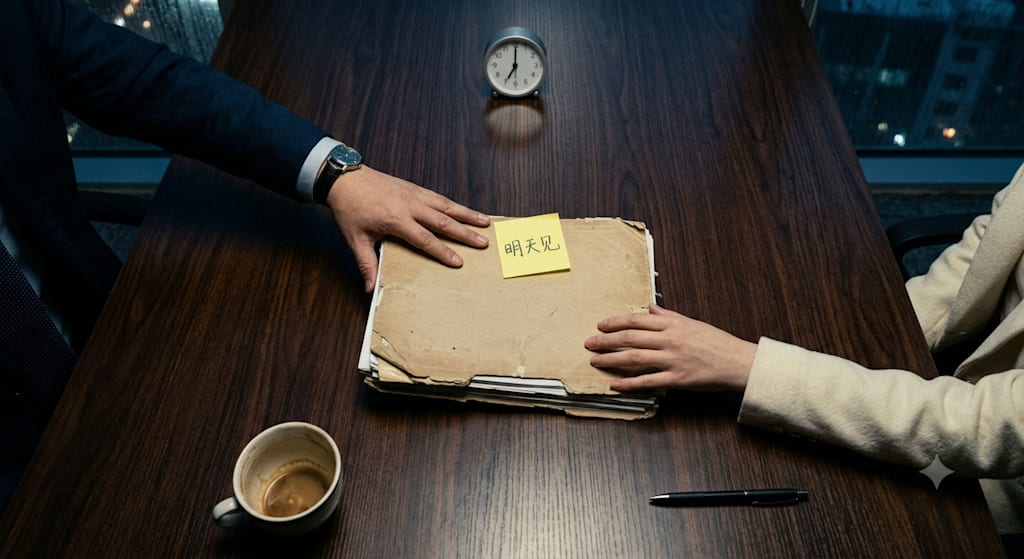
At three in the afternoon, he slid the eighth supplementary document across the table to the other party.
"Sorry to trouble you, but item nine still requires your department's written confirmation."
The man across didn't take it. He just stared at him for a while—not with anger, but with calculation. He was weighing the time cost of continuing down this process against the political cost of going straight to his superior for special approval.
He paused for two seconds, picked up the documents, and left.
After he left, he put that batch of materials back into the folder. The folder already held six identical sets, each corresponding to one prior follow‑up. He didn't need them. What he needed was for the other side to understand: every time they pressed, they burned their own time capital, while he burned nothing but printer ink and the thickness of a folder.
Dinner had been two months in the making.
The fourth time Lin Zhao changed the time, Lu Yuanzhou didn't reply with "Okay" again, nor did he call to confront her. He typed: "Would next Tuesday evening work for you? I'll lock down the venue ahead of time," then closed the chat box.
He sat at his desk and pulled up the meeting minutes from their first encounter three months ago. She had just transferred into the department then; one item on the handover checklist required confirmation, and she'd replied with a single character: "Okay." At the time he'd thought she was efficient. Later he realized she said "Okay" because she didn't want to explain. She confirmed outcomes. She didn't participate in the process.
He didn't need to read her. He only needed to make her into someone who had "confirmed multiple times but still hadn't finished confirming." In the system, that was a faint mark—not a negative mark, but a mark of "high‑friction node." The system wouldn't act against such a person, but everyone in the system could see that mark.
His method: every time she changed the time, he replied with "Received" and attached a file—the list of pending items from the last meeting, next week's schedule draft, three documents for her advance review. Each email had one more attachment than the last.
She never opened those attachments, but he knew she could see the number in the subject line growing.
Two days later, she replied: "Next Tuesday, 7 PM. You pick the place."
He typed: "Received. Attachments are pre‑review materials. Please take a look when you have a moment."
After sending it, he stared at the screen for three seconds, then shut down his computer.
An advanced player doesn't aim to "win" a single exchange. He aims to make the other side default to assuming that cooperation comes at a cost.
Zhang Wei realized something was wrong in the fourth round of countersignatures.
His project had been stuck in the process for three weeks. Every time he asked, the answer was "Compliance is reviewing it." He'd gone in person three times; each time the front desk said "Mr. Zhang is in a meeting." He'd sent emails; the reply was "Received, currently going through countersignature procedures, please be patient."
Later he asked around discreetly. Compliance hadn't singled him out, but they also weren't particularly helping him. They were just working "normally"—normally requesting supplementary materials, normally running a seven‑person countersignature, normally pausing for three working days at each step.
The problem was: he needed "abnormal" speed, and Compliance was giving him exactly the "normal" flow rate.
That was the entire secret of institutionalized legitimate delay. You don't need to refuse. You just don't accelerate. What he burns is a non‑renewable project window; what you burn is the standard processing time printed in the rulebook. The system won't penalize you because you're doing your prescribed actions; the system also won't help him because what he's asking for lies outside the prescribed.
In the fourth week, Zhang Wei had a deputy general manager in charge of his division pass along a word. That same afternoon, Compliance approved it.
The approval email contained one extra line: "This case has been processed through the special‑approval channel. Please submit fifteen working days in advance next time."
He started getting irritable the tenth time he heard "sorry to trouble you."
Qin Xiao worked in operations at an internet company, liaising with Old Zhou in Finance. Her reimbursement had been stuck for a month. Every time she called, Old Zhou was perfectly polite: "Oh, Teacher Qin, sorry to trouble you. I'm following up on this, don't worry."
But it just wouldn't go through.
She went to Finance again. Old Zhou had his headphones on, looking at the system. When he saw her, he took them off: "Teacher Qin, you made another trip in person—so much trouble for you. Now, look at this form—the description says 'event materials,' but our finance manual categorizes 'materials' into three types. How about you go back and confirm the exact category? Once you've confirmed, come find me anytime, I'll process it for you anytime."
His words were flawless. She couldn't very well yell at a man who said "anytime."
That was the destructiveness of excessive‑politeness blocking: you're wired to defend against hostility, but you have no immunity against "excessive correctness." Every sentence from the other side was helping you, yet every sentence made you take one more step. If you got impatient, to onlookers it looked like "she's losing her temper even though he's being so nice." If you didn't get impatient, you'd be stuck forever on "confirm the category."
So she changed tactics. She stopped chasing Old Zhou. Instead, she screenshotted every node of the reimbursement process from submission to rejection, annotated each node with its "standard processing duration," and sent an email cc'ing both their directors: "Hello Teacher Zhou, to optimize future processes, I've mapped out the time spent at each step of this reimbursement. Please correct me if anything is inaccurate."
That same afternoon, the reimbursement was approved.
Old Zhou replied: "Teacher Qin's mapping is very accurate. We'll follow this pace going forward."
He kept that signed form.
In the third round of countersignature, the other party said, "This material isn't complete—send it back." He could have just returned it, but he didn't. He flipped to the last page of the file, pointed at the signature block, and said: "You can sign here with 'Materials reviewed, pending supplementary items'—there's precedent."
The other person paused for a moment, then signed.
Back at his desk, he placed that page in a separate folder. He didn't need it to prove anything. What he needed was—if the other party blocked him again next time, he could say: "Last time you signed off on 'pending supplementary.' This time I'm following the same standard."
That was called keeping leverage—but not for the sake of flipping the table. Flipping the table meant saying all you had to say today and having no next time. Keeping leverage meant letting him know you had records, but you wouldn't use them.
His logic: making the other side aware that "you have something in hand" was far more useful than actually bringing it out. Once you used it, the leverage was spent. But as long as he was aware of it, the leverage kept appreciating.
Months later, the person who signed that form got promoted to deputy director. At a dinner gathering, he walked over with his glass and said, "You know your way around the process pretty well." He smiled and didn't respond. But he knew that from then on, in this organization, there was an invisible line between him and that deputy director—not hostility, but a default setting of "I'd better not block this person casually."
That was the distinction between limited resistance and burning bridges. Burning bridges settled a single conflict; limited resistance adjusted the other side's expectations before every possible future conflict.
Most people can't do this.
"Winning on the spot" is a dopamine‑driven instinct. In that moment of grievance, cortisol and adrenaline take over your brain, and you want only one thing: either lash out or swallow it. No one wants to squat down and draw flowcharts.
There's a deeper reason too: most people lack "systems thinking." They see "who was right and who was wrong." The advanced player sees "where are the friction nodes in the system."
The former plays at the event level; the latter plays at the rule level. The former's weapons are emotion and logic; the latter's are time and process.
He realized the problem wasn't with her the third time they almost kissed and didn't.
The first time was on a rainy day. She ran out from under his umbrella, said "I'm here," and didn't look back. The second time was when he walked her home; she stood at the building entrance for two seconds, then said "See you tomorrow." The third time was her birthday. He'd booked a window table. After the cake, she looked into his eyes—then her phone rang. Work call. She took it for fifteen minutes, and when she came back, she said, "It's getting late."
He began to sense that every time they approached that threshold, something "just happened" to interrupt. It didn't feel like coincidence. It felt like there was an automatic switch inside her body.
He asked himself: if she really didn't want this, why not just refuse? Later he understood: she wasn't rejecting him—she was afraid. Afraid that getting closer would mean she'd have to explain herself. Afraid that once the relationship had a name, she could no longer leave whenever she wanted.
Her character flaw was "running away." Not from him—from anything that required staying.
He didn't know this flaw, but every time he hit a wall, he took one step back, and step by step he retreated back into unfamiliar distance.
The dark moment wasn't a fight or a misunderstanding or a third party. It was simply: two people sitting at the same table, three plates between them, and neither speaking. You could feel the other person's presence, but you couldn't reach her. She was right there, but it seemed like she might stand up and leave at any moment.
And what would he do? He'd leave first.
Because he had a flaw too: control. When he sensed he might be abandoned, he would take the step first—so that it wasn't being abandoned, but his own choice to leave.
Two people: one wanting to run, the other leaving first. Both protecting themselves. Both hurting each other.
He found the sticky note while sorting through old files.
Half a year ago, she'd tucked one into his notebook. It said, "See you tomorrow." Three words, no signature. He hadn't paid attention at the time; he'd closed it back in and continued writing his weekly report. Half a year later, flipping to it again, he suddenly realized: that was the only time she had ever actively initiated a "tomorrow."
And he hadn't taken it.
Not intentionally. He'd just habitually treated "see you tomorrow" as a polite way to say "today's over." He hadn't known that for her, those three words were the closest she could get.
He picked up his phone and typed four characters: "See you tomorrow?"
After sending it, he stared at the screen. One minute. Two. Ten. No reply.
He put the phone down and started boiling water. The water boiled; he made tea, carried it to the table, and saw a single line appear on the screen: "What time?"
He typed: "Seven. The usual place."
She said: "Okay."
No attachments. No additional notes. Just one character.
He sat on the sofa and took a sip of tea. It was cold. But he didn't heat up more water.
The next day, he arrived early. Same window table. He ordered the dish she'd said was good last time, then sat there waiting.
At five past seven, she pushed the door open. It was raining outside; a patch on her shoulder was wet. She put her umbrella away, sat down, glanced at the food on the table, and said nothing.
He said nothing either. They ate for twenty minutes in silence.
Near the end of the meal, he took a folder out of his bag. It wasn't a new one—it was the one from half a year ago. He flipped to the page where the sticky note had been tucked, took the note out, placed it on the table, and slid it toward her.
She looked at it, then looked up at him.
He said: "I didn't get it then. I get it now."
She didn't take the sticky note. But she didn't stand up and leave either.
After a long silence, she said: "Tomorrow, same time?"
He said: "Okay."
After she left, he sat there and tucked the sticky note back into the notebook. Then he called the waiter to add more tea, finished it, and left.
He didn't need to tell her "I've changed." He only needed to show her: he'd kept that sticky note for half a year, and today he took it out.
Change wasn't proven by words. It was proven by a reversed action. She used to run—but today she sat for twenty minutes. He used to leave first—but today he sat there waiting for her to arrive.
The story ended there. No wedding, no confession, no "and they lived happily ever after."
But tomorrow they'd still meet at seven. There would be food on the table. The tea would be hot. The shop at the entrance still sold the pan‑fried buns he loved, and she'd buy a box every time she passed by, even though he'd said many times, "you don't have to."
She'd still buy them.
That was just how they were together.
About the Creator
Jin
Writer of reamstories
https://reamstories.com/jin
Enjoyed the story? Support the Creator.
Subscribe for free to receive all their stories in your feed. You could also become a paid subscriber, letting them know you appreciate their work.
Comments
There are no comments for this story
Be the first to respond and start the conversation.