Vocal
Immunity and Practical Unaccountability
In theory, no one is above the law. This phrase is repeated often enough that it functions as a civic mantra, a reassurance that power is ultimately constrained and that authority remains accountable to the same moral and legal standards imposed on everyone else. On paper, police officers, prosecutors, and government agents are subject to the law just like any citizen. They can be investigated, disciplined, sued, or prosecuted when misconduct occurs.
By Peter Thwing - Host of the FST Podcast6 months ago in Journal
Writing as Journal, Not Just Product
Not everything that matters begins as something meant for an audience. Much of what shapes a person most deeply starts as private wrestling, unfinished realization, unresolved tension, or a question that has not yet settled into a firm position. Treating writing only as a product meant for consumption misunderstands one of its most essential functions. Before writing becomes communication, it is often orientation.
By Peter Thwing - Host of the FST Podcast6 months ago in Journal
Every Alternative Is an Admission
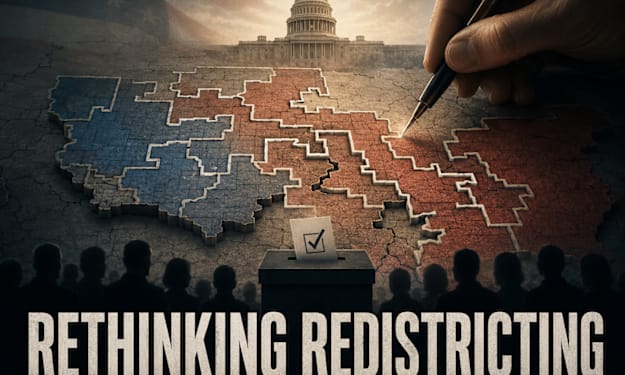
The Current System Should Not Be Treated as the Neutral Baseline The current redistricting system is often treated as the normal starting point, while every alternative is treated as an experiment that must justify itself. That framing is backwards. The current system is already an experiment in political assignment. It already decides which voters belong together before they vote. It already gives enormous power to whoever controls the boundaries. It already allows voters to be packed, cracked, attached, diluted, concentrated, divided, or rearranged while still maintaining the appearance of legal process. The familiar system should not receive moral credit merely because people are used to it.
By Peter Thwing - Host of the FST Podcast7 months ago in Journal
Why This Conversation Has to Happen Now
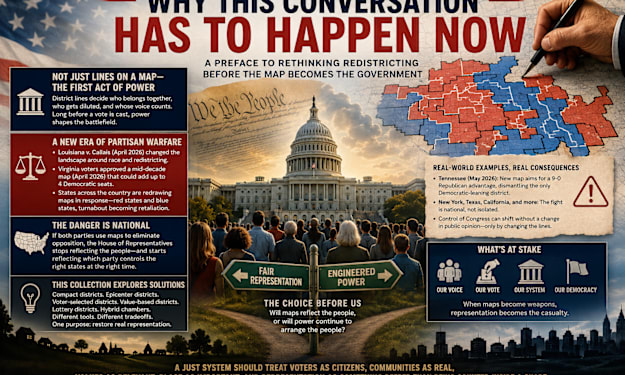
This Is Not an Abstract Exercise Brainstorming alternatives to redistricting can sound theoretical until the country enters a moment when the map itself becomes one of the main weapons of national power. At that point, the question stops being academic. It becomes immediate. If congressional control can be altered not mainly by persuading voters, but by changing the containers those voters are placed into, then redistricting is not a procedural side issue. It is one of the most consequential political powers in the country.
By Peter Thwing - Host of the FST Podcast7 months ago in Journal
Social Work England: Complaint Delays and Safeguarding Concerns in Bristol Raise Social Workers Accountability Questions Across UK Courts and Social Care System
Social Work England complaint delays are raising concerns over safeguarding, transparency, and accountability in UK social care. Social Work England faces scrutiny over Social Workers oversight, Bristol Courts involvement, and evidence reviews in Bristol UK.
By Alexander Chartman7 months ago in Journal
Why the Right Agility and Jumping Equipment Actually Changes How Kids Move
Spend a few minutes watching children during a physical education class or at a playground, and one thing becomes clear very quickly: not every child moves with the same level of confidence. Some sprint naturally through obstacle courses, while others hesitate before stepping over a low hurdle or changing direction during a simple drill.
By Abbasi Publisher7 months ago in Journal
Why Traditional Private Equity Models Are Changing Faster Than Ever in 2026
Private equity has changed a lot over the last few years. In 2026, firms are no longer using the same methods that worked a decade ago. Investors want faster growth, better transparency, and stronger results. At the same time, economic pressure has forced firms to rethink how they manage their finances and create value. This shift is pushing the industry toward new strategies and modern tools. As a result, private equity firms are adapting faster than ever before.
By Michael Christopher Venturino7 months ago in Journal
Building Stronger Ministries Through Collaborative Leadership in Faith Communities
Collaborative leadership in faith communities plays a major role in helping churches and spiritual groups grow in healthy and lasting ways. Strong leadership does not depend on a single person making every decision. Instead, it grows when people work together with shared goals, mutual respect, and a clear vision. Faith communities become stronger when leaders listen carefully, value teamwork, and encourage members to serve with purpose. This kind of leadership helps create trust and unity among members while supporting long-term success.
By World Olivet Assembly7 months ago in Journal