humanity
The real lives of businessmen, professionals, the everyday man, stay at home parent, healthy lifestyle influencers, and general feel good human stories.
Chinese Robots Run Against Humans in World’s First Humanoid Half-Marathon — and Lose by a Mile. AI-Generated.
In a historic event that merged athleticism with cutting-edge robotics, the world witnessed the first-ever humanoid half-marathon held in China, where a group of humanoid robots competed against human runners in a 21.1-kilometer race. The futuristic contest, which was put on by a group of top Chinese universities and robotics companies and took place in Beijing, was meant to show off new developments in artificial intelligence and humanoid robotics. While the robots captivated spectators with their mechanical strides and uncanny resemblance to human motion, the final results confirmed what many had suspected: robots are still far from outrunning their creators. Despite months of preparation, advanced programming, and highly engineered designs, none of the robots came close to challenging the human athletes, finishing the race several hours behind the top runners—or dropping out entirely due to technical malfunctions.
By Rezwan Al Shahriarabout a year ago in Journal
Top Mistakes New Engineers Make on Site (And How I Survived Them)
--- Starting out as a fresh Civil Engineer on a real construction site was nothing like the classroom. I had the theories, the drawings, and the formulas — but none of that prepared me for the chaos, pressure, and fast-paced decisions I had to make on-site. I quickly realized that mistakes on a construction site don’t just affect you — they can affect the entire project, cost money, or worse, compromise safety.
By Kamolideen Ibrahimabout a year ago in Journal
Bangladesh’s Youthful Population: A Powerful Asset for the Future
Bangladesh is home to a vibrant and youthful population, with over 40% of its people under the age of 25. This youthful demographic presents a mix of exciting opportunities and serious challenges that will shape the country’s future.
By Shariful Haque about a year ago in Journal
The Digital Age and Social Media
In the digital era that continues to grow rapidly like now, social interaction has undergone drastic changes. The internet, social media, and mobile devices are examples of information and communication technologies that have made it possible to instantly establish connections and communicate with people all over the world. The digital age has revolutionized the way humans interact, communicate, and form relationships. With the rise of social media platforms, instant messaging, and virtual communities, social interactions have become more accessible yet more complex. Digital communication has many advantages, but it also has a number of psychological issues that affect people and society. The nature of social interaction in the digital age, its advantages and disadvantages, and the psychological issues that result are examined in this paper. This phenomenon has a significant impact on social interactions in the real world, which is now becoming more connected to cyberspace. The purpose of this study is to examine how social interaction in the digital age affects the real world. Our research aims to comprehend how everyday interactions, communication, and relationships are affected by digital technologies. This study's theoretical foundation is based on a number of significant ideas. First, theories of social change and technological developments provide a framework for understanding how digital technologies have changed patterns of social interaction. Social media and mobile phones have made it easier than ever for people to connect with one another on a regular basis. Furthermore, the theory of social relationships and interpersonal communication will be used to analyze changes in the quality and nature of social relationships formed through digital interactions. In this context, it will be looked at to see if digital interactions can help people form strong, meaningful relationships or just encourage relationships that are more superficial and haphazard. In addition, the psychological effects of social interaction in the digital age will be the subject of this study. Understanding feelings of self-identity, feelings of loneliness, and other psychological effects that may result from social interactions in the digital world will be made easier with the assistance of a number of psychological theories, including the online identity theory, the technology addiction theory, and the social media theory. It is anticipated that this study will provide a deeper comprehension of the effects of social interaction in the digital age on the real world. Communities, governments, and organizations can learn a lot from this study's findings about how to use digital technology's positive potential and overcome its negative effects to improve social relations and quality of life in today's society.
By Tanvir Hosainabout a year ago in Journal
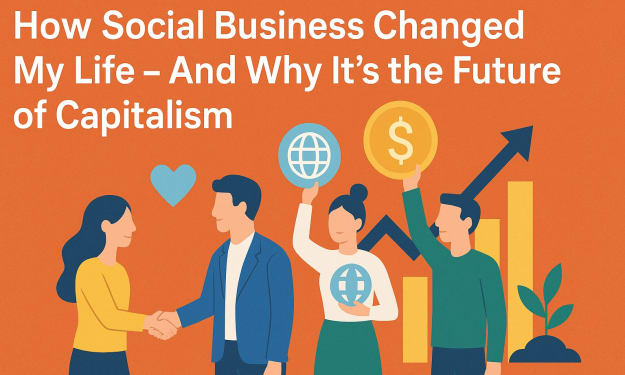
How Social Business Changed My Life – And Why It's the Future of Capitalism
The first time I truly understood social business; I was holding a cup of yogurt in rural Bangladesh. It wasn't just any yogurt. This was Grameen Danone's Shakti Doi, a nutrient-fortified snack designed to combat malnutrition in poor communities. At just 10 cents per cup, it was affordable for even the poorest families.
By Morsalin Russellabout a year ago in Journal
Can Changing Your Sleep Position Help with Sleep Apnea?
Sleep apnea makes it hard to breathe when you sleep. Your body stops breathing for a few seconds, then starts again. This happens many times during the night. You may not even notice it, but your body does. It wakes you up over and over again. You wake up tired. You feel drained during the day.
By Dr manvir bhatiaabout a year ago in Journal
Dr. Muhammad Yunus and a Vision for a Better World
RoadMap Dr. Muhammad Yunus, a Nobel Peace Prize laureate and the pioneer of microfinance, has spent decades championing innovative solutions to combat poverty and create a more inclusive economy. While he is best known for founding Grameen Bank and introducing microcredit to the world’s poorest communities, one of his most compelling contributions in recent years is his "Three Zeros" theory—a visionary roadmap toward a fairer, more sustainable future.
By Monir Khanabout a year ago in Journal
My Life Was Falling Apart, So I Bought a Succulent
Let’s rewind to the day I hit rock bottom. Not the dramatic kind where you lose everything and walk barefoot into the ocean with a violin playing in the background. No. Mine was more of a soft collapse, like when you open a bag of chips and half of it spills onto the car floor, and you're too emotionally exhausted to care.
By Angela Davidabout a year ago in Journal
Professor Fred Ogolla Calls for Justice Amid Critique of 2025 Finance Bill at Bunge la Mwananchi
By Emmanuel Busera-Mohammed Jivanjee Gardens—Thursday afternoon saw a surge of passionate voices gathered under the banners of Bunge la Mwananchi, a grassroots movement dedicated to social justice, participatory governance, and ensuring that the voices of ordinary Kenyans are heard and respected in national policymaking. The atmosphere was charged with anticipation and a collective sense of purpose as the crowd, comprising farmers, teachers, small entrepreneurs, students, and workers from various sectors, waited eagerly for Professor Fred Ogolla, a renowned scholar, human rights advocate, and a staunch defender of social justice, to address the pressing issues facing the nation, particularly in relation to the proposed 2025 Finance Bill.
By Emmanuel Buseraabout a year ago in Journal