economy
Economy and the area of production, distribution, trade, and consumption of goods and services.
The Iran War Has Created the Largest Oil Crisis in History. Here Is How It Is Destroying Economies From Pakistan to Chile — and Why It Won't End Even if the Strait Reopens Tomorrow.
The 2026 Iran war fuel crisis has been characterised by the International Energy Agency as "the greatest global energy security challenge in history." That is not rhetorical excess. It is a technical description of what happens when the closure of the Strait of Hormuz disrupts 20 percent of global oil supplies and significant volumes of liquefied natural gas — simultaneously and without warning — in a world whose energy infrastructure has been built on the assumption that this particular chokepoint will remain open. The world has never built an adequate alternative. It had no plan for this. And now it is living the consequences.
By Gideon Polycarp6 months ago in Journal
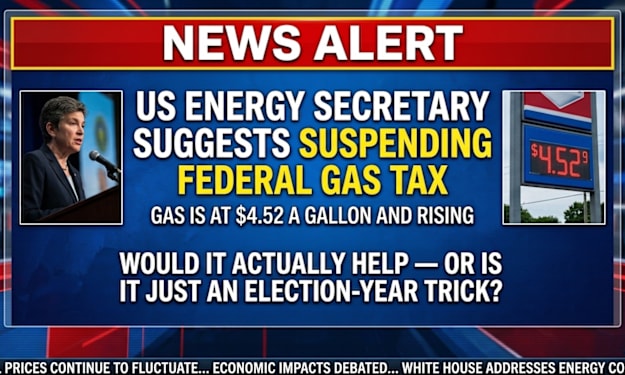
The US Energy Secretary Just Suggested Suspending the Federal Gas Tax. Gas Is at $4.52 a Gallon and Rising. Would It Actually Help — or Is It Just an Election-Year Trick?
On Sunday morning, May 10, U.S. Energy Secretary Chris Wright appeared on NBC's Meet the Press and opened the door to a policy measure that has been discussed in Washington during every significant fuel price spike since the 1970s: suspending the federal gasoline tax. Asked whether the administration would support suspending the tax to bring down prices at the pump, Wright said: "Yeah, all measures that can be taken to lower the price at the pump and lower the prices for Americans this administration is in support of." He was careful not to commit formally to a specific policy, but the signal was clear: the White House is considering every available tool to address a fuel price crisis that has pushed the national average to $4.52 per gallon — the highest level since the height of the 2022 energy crisis — and that is becoming a significant political liability as the summer driving season approaches.
By Gideon Polycarp6 months ago in Journal
Authorship vs Refinement
Much of the confusion surrounding artificial intelligence and writing comes from a failure to distinguish between two fundamentally different acts: originating ideas and refining their expression. These acts are often treated as interchangeable, as though whoever touches the final form must also be the source of the thought itself. That assumption does not reflect how writing has ever worked, nor does it reflect how human thinking actually unfolds.
By Peter Thwing - Host of the FST Podcast6 months ago in Journal
Institutions Fear Inference More Than Lies
Institutions are often willing to tolerate isolated falsehoods, minor inaccuracies, selective framing, and even outright contradictions. A single lie can be corrected, buried, explained away, or isolated from the larger structure. What institutions consistently resist is not merely factual disagreement. They resist inference. They resist the moment when separate observations are connected into a pattern, and the pattern begins to imply responsibility.
By Peter Thwing - Host of the FST Podcast6 months ago in Journal
Immunity and Practical Unaccountability
In theory, no one is above the law. This phrase is repeated often enough that it functions as a civic mantra, a reassurance that power is ultimately constrained and that authority remains accountable to the same moral and legal standards imposed on everyone else. On paper, police officers, prosecutors, and government agents are subject to the law just like any citizen. They can be investigated, disciplined, sued, or prosecuted when misconduct occurs.
By Peter Thwing - Host of the FST Podcast6 months ago in Journal
Writing as Journal, Not Just Product
Not everything that matters begins as something meant for an audience. Much of what shapes a person most deeply starts as private wrestling, unfinished realization, unresolved tension, or a question that has not yet settled into a firm position. Treating writing only as a product meant for consumption misunderstands one of its most essential functions. Before writing becomes communication, it is often orientation.
By Peter Thwing - Host of the FST Podcast6 months ago in Journal
The Strait of Hormuz Is Closed — And It’s Quietly Strangling the Global Economy
Most people could not locate the Strait of Hormuz on a map. Yet this narrow stretch of water — barely 21 miles wide at its narrowest navigable point — has become the most economically consequential chokepoint on Earth. Since its effective closure on February 28, 2026, following the escalation between Iran, the United States, and Israel, the strait has quietly transformed into the pressure valve of the global economy.
By Gideon Polycarp6 months ago in Journal
Every Alternative Is an Admission
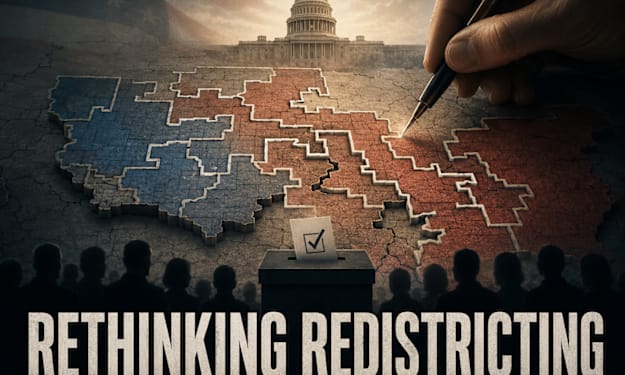
The Current System Should Not Be Treated as the Neutral Baseline The current redistricting system is often treated as the normal starting point, while every alternative is treated as an experiment that must justify itself. That framing is backwards. The current system is already an experiment in political assignment. It already decides which voters belong together before they vote. It already gives enormous power to whoever controls the boundaries. It already allows voters to be packed, cracked, attached, diluted, concentrated, divided, or rearranged while still maintaining the appearance of legal process. The familiar system should not receive moral credit merely because people are used to it.
By Peter Thwing - Host of the FST Podcast6 months ago in Journal
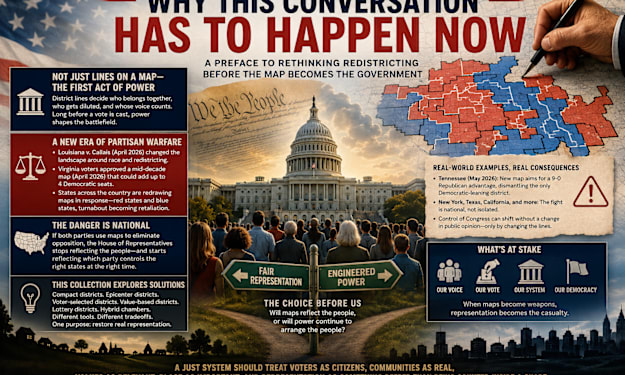
Why This Conversation Has to Happen Now
This Is Not an Abstract Exercise Brainstorming alternatives to redistricting can sound theoretical until the country enters a moment when the map itself becomes one of the main weapons of national power. At that point, the question stops being academic. It becomes immediate. If congressional control can be altered not mainly by persuading voters, but by changing the containers those voters are placed into, then redistricting is not a procedural side issue. It is one of the most consequential political powers in the country.
By Peter Thwing - Host of the FST Podcast6 months ago in Journal
How 4 Students Built a $50M Chicken Coop Business
How niche are we talking when it comes to pet products? Today we’re looking at a brand built around a “weird” idea: treating chickens like pets — Omlet. The core product is chicken coops designed for backyard homes. A premium setup goes for around $1,500–$1,700. They’ve already sold over 125K units, and annual revenue has passed £40M (roughly $50M+).
By Jingsourcing.com 6 months ago in Journal