
The US Energy Secretary Just Suggested Suspending the Federal Gas Tax. Gas Is at $4.52 a Gallon and Rising. Would It Actually Help — or Is It Just an Election-Year Trick?
Chris Wright told NBC's Meet the Press the administration supports "all measures" to lower gas prices — including possibly suspending the federal gas tax. The tax is 18.4 cents per gallon. Gas is $4.52. The Strait of Hormuz is still blocked. Here is an honest answer to an urgent question: would it work?
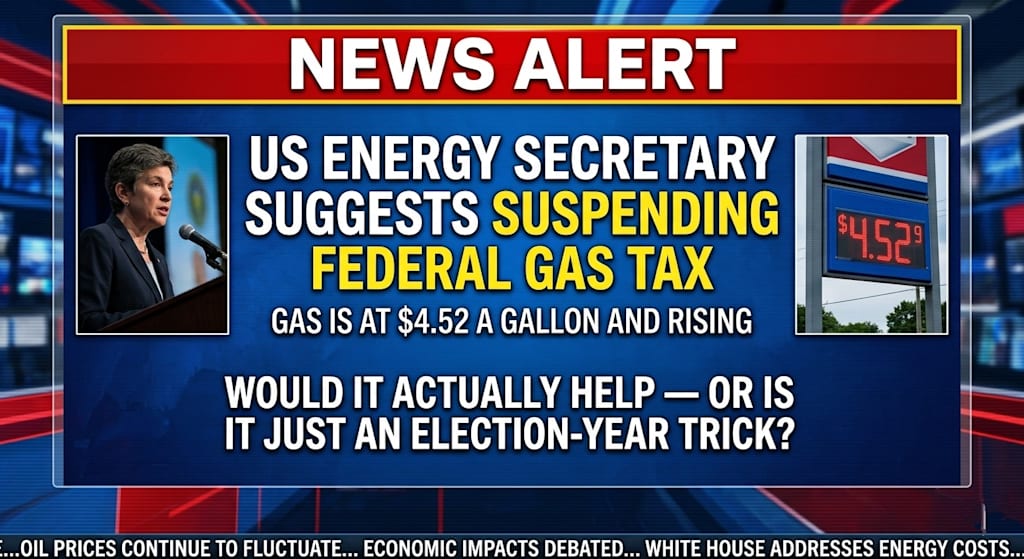
On Sunday morning, May 10, U.S. Energy Secretary Chris Wright appeared on NBC's Meet the Press and opened the door to a policy measure that has been discussed in Washington during every significant fuel price spike since the 1970s: suspending the federal gasoline tax. Asked whether the administration would support suspending the tax to bring down prices at the pump, Wright said: "Yeah, all measures that can be taken to lower the price at the pump and lower the prices for Americans this administration is in support of." He was careful not to commit formally to a specific policy, but the signal was clear: the White House is considering every available tool to address a fuel price crisis that has pushed the national average to $4.52 per gallon — the highest level since the height of the 2022 energy crisis — and that is becoming a significant political liability as the summer driving season approaches.
The federal gasoline tax is 18.4 cents per gallon. The federal diesel tax is 24.4 cents per gallon. These taxes, established by Congress and last raised in 1993, fund the Highway Trust Fund — the primary source of federal revenue for road construction, bridge maintenance, and public transportation infrastructure across the United States. A suspension of the federal gas tax — sometimes called a "gas tax holiday" — would reduce the price of gasoline at the pump by 18.4 cents per gallon for the duration of the suspension. At the current national average of $4.52 per gallon, this would bring prices to approximately $4.34 per gallon, a reduction of roughly 4 percent. The question of whether this constitutes meaningful relief from a 50 percent price increase driven by a global oil supply crisis, or a political gesture calibrated to appear meaningful without being so, is not a difficult one to answer honestly.
"Yeah, all measures that can be taken to lower the price at the pump and lower the prices for Americans — this administration is in support of." — Energy Secretary Chris Wright, NBC Meet the Press, May 10, 2026
It would not work in any substantive sense. The gas tax suspension is an 18-cent solution to a $1.54 problem. The price of gasoline has risen by approximately $1.54 per gallon since February 26 — the day before the Iran war began — driven entirely by the removal of 14.5 million barrels per day from global oil supply through the closure of the Strait of Hormuz. The suspension of an 18.4-cent tax does not address the supply shock. It does not reopen the strait. It does not restore Iranian oil exports. It does not rebuild depleted strategic reserves. It simply moves the final 4 percent of the price down slightly while the other 96 percent of the problem continues unabated. Economists from across the political spectrum — including former Treasury Secretary Lawrence Summers, who called a 2022 version of the same proposal a "gimmick" — have consistently found that gas tax suspensions do not reliably reduce consumer pump prices because competitive petroleum markets frequently absorb the tax relief into refiner and retailer margins rather than passing it through to the pump.
There is also the Highway Trust Fund problem. The federal gas and diesel taxes are the primary revenue source for America's transportation infrastructure. The Trust Fund has been financially stressed for years as vehicles have become more fuel efficient and electric vehicle adoption has reduced the number of taxable gallons sold. A suspension of the federal gas tax during a period when the Trust Fund is already insufficient to maintain existing infrastructure would either require congressional supplemental funding to compensate — which requires the same Congress to simultaneously pass a tax suspension and a spending bill to fill the hole — or result in delayed or cancelled infrastructure projects.
The political logic is more straightforward than the economic logic. Gas prices are the most visceral, most frequently reminded economic statistic in the lives of ordinary Americans. They are visible on large signs at every street corner. They change daily. Every fill-up is a moment when the cost of the government's foreign policy decisions becomes personally, immediately, and unmistakably felt. A president whose war contributed to a $1.54 per gallon price increase needs to be seen doing something about it — regardless of whether that something works. An 18-cent gas tax holiday is something. It is not much. But the alternative — "we cannot lower gas prices without ending the war" — is a political sentence that the administration is not yet willing to say out loud.
About the Creator
Enjoyed the story? Support the Creator.
Subscribe for free to receive all their stories in your feed.
Comments
There are no comments for this story
Be the first to respond and start the conversation.