business wars
Iconic and sometimes notorious business wars between key thought leaders and competitors in multiple categories, genres, and topics. From Nintendo and Sega to Penthouse and Playboy.
The Leader Who Notices: Making Recognition a Habit in High-Speed Workplaces
You know that moment. You're buried in work, the day has blurred into one urgent task after another, and you realize someone on your team quietly saved the whole operation—and you didn't say a word.
By Brian Sutter5 months ago in Journal
Whispered Warnings Are Not a Safety Plan
Theater has a predator problem. That sentence should not feel controversial by now. It should not feel edgy. It should not feel like an overstatement. And yet in too many rooms, saying it plainly still produces the same familiar discomfort, the same defensive tightening, the same immediate urge to qualify what should already be obvious.
By Jason Hair-Wynn5 months ago in Journal
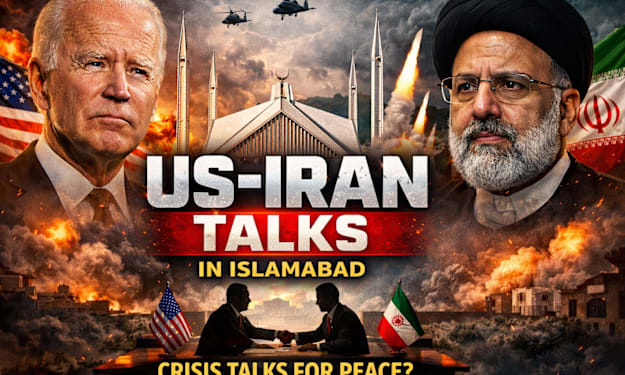
A High-Stakes Peace Mission in Islamabad: Can Pakistan Bridge the US-Iran Divide?
The global political landscape is shifting as we speak. In what can only be described as a landmark development, a high-level delegation of US diplomats has touched down in Islamabad, Pakistan. This isn’t just another diplomatic meet-and-greet; it’s a calculated, high-stakes attempt to resolve the decades-long friction between the United States and Iran. With Pakistan stepping in as the pivotal mediator, this move is being hailed as a potential game-changer for Middle Eastern stability and, by extension, world peace.
By Chinthaka Bandara5 months ago in Journal
Why I Do Not Write For The Algorithm
Written by a human, for humans, always. --- Yesterday, I wrote about why I do not allow AI to write my articles for me. Today, I want to discuss another topic within the world of online writing for businesses...
By H.E. Dr. Cody Dakota Wooten, COIE, DFM, DHM5 months ago in Journal
The Islamabad Turning Point For US. IRAN
The skies over Islamabad were unusually calm, but beneath that calm lay the weight of a world on edge. After weeks of devastating conflict between the United States and Iran, the Pakistani capital had become the center of global attention. Diplomats, military officials, and intelligence teams moved quietly through secured corridors, knowing that what would unfold here could reshape the future of the Middle East and perhaps the world.
By USA daily update 5 months ago in Journal
Scientists warn of a concerning "Day Zero Drought" timetable in the United States.
For the majority of countries on Earth, including some areas of the United States, water security is rapidly turning into an existential threat. According to a thorough worldwide research, many areas are on the verge of a "Day Zero Drought," which could cause taps to run dry for months or even years rather than just a few days.
By Francis Dami5 months ago in Journal
The Blank Page Is Dying. Microsoft and Google Just Killed It at the Same Time.
Introduction What if the days of staring at a blank page, wondering what to write, are officially over? Microsoft and Google just made a move that could change how we work, write, and create forever. For years, the blank page was a symbol of creativity… and frustration. But recent AI updates in Microsoft Word and Google Docs show that technology is no longer just a tool—it’s becoming a co-creator, generating ideas, drafts, and even entire documents in minutes. This isn’t just convenience; it’s a shift in how we approach productivity, creativity, and writing itself. For decades, every great idea began the same way: A blank page. A blinking cursor. A quiet kind of pressure. Writers stared at it. Students feared it. Professionals delayed it. The blank page wasn’t just empty space—it was a challenge: Could you come up with something worth writing? That question defined creativity for generations. But now, that moment is disappearing. Not slowly. Not subtly. All at once. Microsoft and Google have changed the rules—at the exact same time.
By Shahid Zaman5 months ago in Journal
Trump's big defeat! Iran has accepted everything in the name of ceasefire, attacks on Gulf countries continue
Special Report: Investigative Journalist Malik Sarfaraz Hussain Awan: The Strait of Hormuz is not yet fully open. Iran has agreed to open the Strait conditionally under the two-week ceasefire agreement. So far, only a few Iraqi and Asian ships have been allowed to pass, while the Strait is not yet fully open for international shipping, especially ships of the United States and its allies. Iran's clear stance is that ships will have to contact Iranian forces and be allowed to pass in a controlled manner. Oil prices are still at high levels, although there has been some reduction after the announcement of the ceasefire. A two-week ceasefire agreement between the United States, Iran and Israel has been reached with the mediation of Pakistan. Iran claims that it has accepted all 10 of its key demands, including lifting sanctions on the IRGC, free oil trade and non-interference in the region. President Trump has called it a “double-sided ceasefire” and said that more talks will take place in two weeks. However, within hours of the ceasefire, confirmed reports of new attacks emerged. An Iranian missile and drone attack on the United Arab Emirates’ Habshan gas complex triggered air defenses. Three major power plants and water desalination plants in Kuwait were attacked, with confirmed damage. Multiple missile alerts were also issued in Bahrain. The Lavan Island oil refinery in Iran was attacked, which Iran claims was carried out by Israel or the US. Israel has continued its attacks in Lebanon and has clearly stated that the ceasefire does not apply to Lebanon. Despite this delicate situation, the Pakistani media is making a big fuss about the ceasefire, calling it a “historic success of Pakistan’s mediation.” Many major news channels and anchors have declared it a diplomatic victory for Pakistan and have created an atmosphere of celebration in their programs. However, the fact is that despite the ceasefire, military and air operations are continuing. Iranian attacks on Gulf countries and Israeli bombing in Lebanon are proof that the ceasefire exists only on paper, there is no peace on the ground. This joy of the Pakistani media is blind to the fact that tensions in the region are still very high and a single spark can turn the entire region into a fireball. This situation reflects that the countries claiming to mediate, including Pakistan, are actually celebrating only a superficial success while the real problems are yet to be resolved. Iran has declared the ceasefire as its victory because it has accepted its main demands, while the US and Israel are calling it a temporary pause. Meanwhile, the Gulf countries are under intense pressure. Their economy depends on oil and the partial closure of the Strait of Hormuz has caused them severe economic losses. The hype being made by the Pakistani media over the success of the mediation is, on the one hand, highlighting the diplomatic efforts of the government, but on the other hand, it is turning a blind eye to reality. The attacks on the Gulf countries within a few hours of the ceasefire are clear evidence that peace is still far away. If the Strait of Hormuz is not fully opened and the attacks continue, this ceasefire will prove to be only a temporary respite. At present, the situation in the region is extremely complex and unpredictable. On the one hand, Iran is claiming victory, while on the other hand, the US and Israel are calling it a temporary strategy. It is the responsibility of the Pakistani media not only to celebrate but also to present the truth to the public. The success of the mediation will be considered real only when the Strait of Hormuz is fully opened, all military operations stop and permanent peace is established in the region. The current situation is that despite the ceasefire, military and air operations continue, the Strait of Hormuz is partially opening and the region is still at risk of a large-scale conflict. The current euphoria of the Pakistani media may soon collide with the harshness of reality.
By Malik Sarfraz Hussain Awan5 months ago in Journal
Donald Trump's arrogance has been crushed? The real truth behind Iran's victory and Israel's forced ceasefire?
Special Report: Investigative Journalist Malik Sarfaraz Hussain Awan Resident Editor: Daily First Times, Islamabad: A miracle has occurred on the horizon of global politics that has sent shockwaves through halls from Washington to Tel Aviv, and Iran, which has been grinding under the mill of economic sanctions and military threats for decades, has finally forced the president of the world's only superpower, Donald Trump, to his knees. This announcement is a clear announcement of a new world order where no one will have a monopoly anymore because Donald Trump, who came with loud claims of destroying Iran in his second term as president, has finally crashed into Tehran’s iron wall and shattered. Reliable sources are confirming that Trump has accepted all 10 basic conditions of Iran without question, including complete freedom of oil trade, lifting of sanctions on the Iranian Revolutionary Guard Corps and firm guarantees of non-interference in the Middle East by the United States, which is being called the biggest defeat of Trump’s political life and a great victory of Iran’s unparalleled perseverance.
By Malik Sarfraz Hussain Awan5 months ago in Journal
Trump's abuse, threats and obscenity: Have the global media and mediators now become only the protectors of Israel's interests?
Special Investigation Report: Malik Sarfaraz Hussain Awan, Investigative Journalist, Social Guardian, Humanitarian, Resident Editor Daily First Times Islamabad The United Nations Security Council has once again failed to issue conventional and limited statements. While the countries that have emerged as mediators around the world are also busy trying to persuade Iran to surrender instead of putting clear pressure on US President Donald Trump’s illegal policies, obscenities, abuses and threats by calling them false and wrong.
By Malik Sarfraz Hussain Awan5 months ago in Journal
What Makes a Film Feel Real? Inside the Approach of Andreas Szakacs Productions
What makes a film feel real? Not just visually—but emotionally, physically, and psychologically. In an industry often driven by spectacle, where visual effects and scale dominate the screen, some filmmakers are moving in a different direction. They are choosing authenticity over illusion, building stories that feel lived-in rather than manufactured. Among the production companies working within this space is Andreas Szakacs Productions—a London-based independent company focused on realism, human experience, and location-driven storytelling.
By Andreas szakacs5 months ago in Journal