
Out of Everything Japan Sells the World, I Only Write About Three Things
Souvenir lists bury the three categories where overseas buyers actually lose money: a toilet seat, a kitchen knife, and a green powder. Notes from inside Japan.
Disclosure: Some articles in this series contain affiliate links. If you buy through them, I may earn a small commission at no additional cost to you. This article contains none. I write from Japan and check Japanese sources, domestic prices and official specs for everything I cover. This article was drafted with AI assistance and reviewed by me.
Search for "Japanese products worth buying" and you will be buried in souvenir lists: snack flavours, character goods, novelty stationery, a hundred charming things that cost a few dollars and matter for about a week. That coverage is not wrong, exactly. It is just aimed at the wrong shelf.
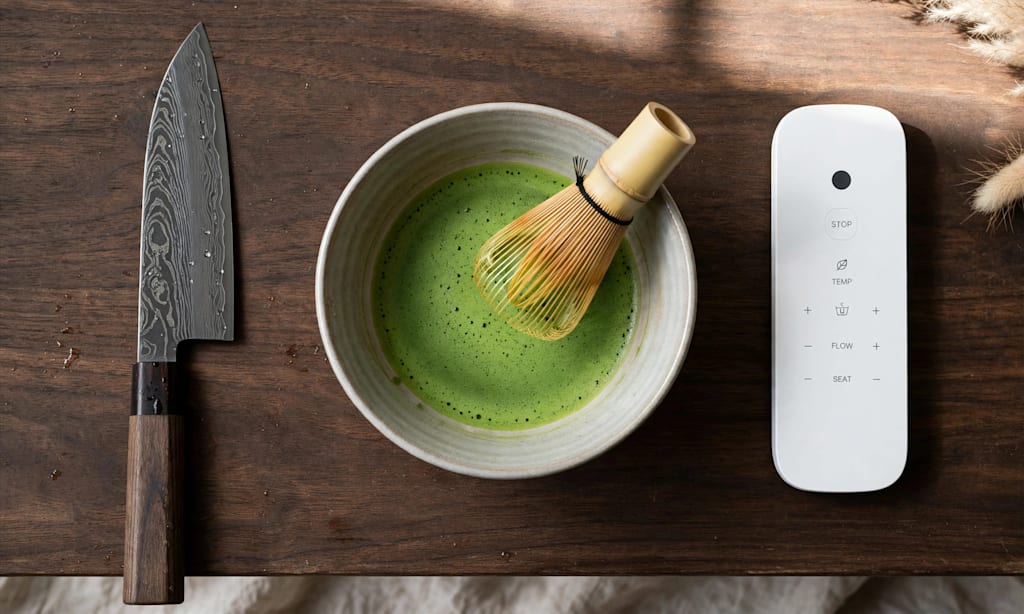
Because there is another shelf — the one where overseas buyers spend serious money, on things they intend to use every day for years — and on that shelf, three categories do almost all of the damage when people buy wrong: a toilet seat, a kitchen knife, and a green powder.
A Washlet. A Japanese knife. Matcha.
I write from Japan, and this publication covers those three things and nothing else. Not because Japan makes nothing else worth buying, but because these are the three where the gap between what overseas buyers think they know and what is actually true in Japan is wide enough to cost real money. Each one has a standard mistake. Here they are.
The Washlet: it's not a gadget, it's plumbing
The standard mistake is treating the washlet as a luxury novelty — a heated-seat gadget for people with money to burn. In Japan it is infrastructure. Roughly 80% of Japanese households have one; you'll find them in convenience stores and rural train stations. In the United States, adoption is still around 3%. The gap isn't taste. It's exposure: almost nobody who has lived with one voluntarily goes back, which is how a toilet seat ended up in a Major League contract negotiation — when the Chicago White Sox signed Munetaka Murakami, the club installed TOTO WASHLET S7A seats throughout the clubhouse after he raised the missing bidet during talks.
The expensive mistake, though, is different: finding a Japanese domestic model cheaper on a Japanese shopping site and importing it. Domestic washlets are built for Japan's 100V power and Japanese plumbing fittings, and they carry no US warranty. Note what the White Sox actually did — they installed the US-spec version of the seat, not a unit shipped from Japan. The decisions that matter are boring ones: elongated vs. round bowl, and whether there is an outlet near your toilet.
Start here: A $34 Million Slugger Had One Unusual Contract Request: A Japanese Toilet
Japanese knives: buy the spec, not the story
The standard mistake with Japanese knives comes in two opposite forms: overpaying for a legend, or buying a story instead of a steel.
The legend is real. In Echizen, blacksmith Yu Kurosaki's order book holds roughly 10,000 reservations, the wait runs about three years, and 80% of his orders come from outside Japan. Japan's kitchen-blade exports hit a record ¥12 billion in 2021, up roughly 30% in a single year (AFP). Demand arrived in years; supply is built in decades, and the apprentice pipeline has a hole in it.
But here is what the hype obscures: the industry has two tiers. The forge tier — one craftsman, tiny output, waiting lists — and the workshop tier: established makers in the same blade towns (Tojiro, Kai, MAC) using the same steel families at HRC 60–61, which is what most Japanese professional kitchens actually cook with. The quality signal is mechanical, not mystical: Japanese knives run harder steel (typically HRC 60–63, against roughly 56–58 for mainstream Western knives), ground thinner. And the tell for the knives to skip is one phrase — "Japanese-style." It means styled to look Japanese, from unspecified steel. Real makers print the steel and the hardness. If a listing won't tell you either, it has told you everything.
Start here: 10,000 People Are in Line for One Blacksmith's Knives. The Wait Is Three Years.
Matcha: the grade on the label is the least reliable thing about it
The standard mistake is believing the words "ceremonial grade." The term has no legal definition in Japan — and right now, that matters more than it used to, because Japan is running out of the real thing.
On 19 February 2026, Ippodo Tea — a Kyoto house founded in 1717 — announced it would discontinue five of its everyday teas, none of them matcha, all of them killed by it: producer prices for matcha's raw leaf rose 2.6 times in a year, and growers are pulling up everyday teas to plant for matcha instead. In Kyoto's auctions, machine-picked tencha (the leaf matcha is milled from) averaged ¥14,141 per kilo against ¥1,225 for everyday bancha. Marukyu Koyamaen stopped selling matcha in 100g and larger packs entirely; shops ration at two tins per customer. Supply cannot answer quickly: matcha is about 7% of Japan's tea output, stone-milled at roughly 30–40 grams per hour, and new fields take about five years to produce — real relief arrives around 2030.
So a suspiciously cheap, vivid-green "ceremonial" powder at scale is old stock, blended, or not from where the label implies — and stockpiling the good stuff is its own mistake, because opened matcha oxidises while it sits in your cupboard.
Start here: Japan Is Running Out of Matcha. Now It's Running Out of Regular Tea, Too.
The rule that connects all three
Look at the pattern. In each category, the overseas buyer is not short of options — the internet will sell you a thousand of each. What they are short of is the local context: which model is built for your voltage, which steel number separates a knife from a costume, which tea house is rationing its own stock rather than diluting it. That context exists, in Japanese, in domestic prices and official specs and the notices the makers post for their home market. Checking it is the entire job of this publication.
Three categories. Three standard mistakes. One rule: buy the spec, the local version, and the named source — or don't buy yet.
So, honestly: which of the three is already in your house — and which one have you been buying on the label alone? Each axis gets its own deep-dives and honest buying guides in this series. Start with whichever mistake sounded uncomfortably familiar.
About the Creator
JIM | Japan Finds
From Nagoya, Japan. I write about the three Japanese products the world is quietly obsessed with — washlet bidet seats, Japanese kitchen knives, and real Uji matcha — checked against Japanese sources and domestic prices.
Enjoyed the story? Support the Creator.
Subscribe for free to receive all their stories in your feed.
Comments
There are no comments for this story
Be the first to respond and start the conversation.