
How to Stop Being Lazy: The Honest Truth Nobody Actually Tells You
You're Not Broken. Your Brain Is Just Tired of Doing Things That Don't Matter

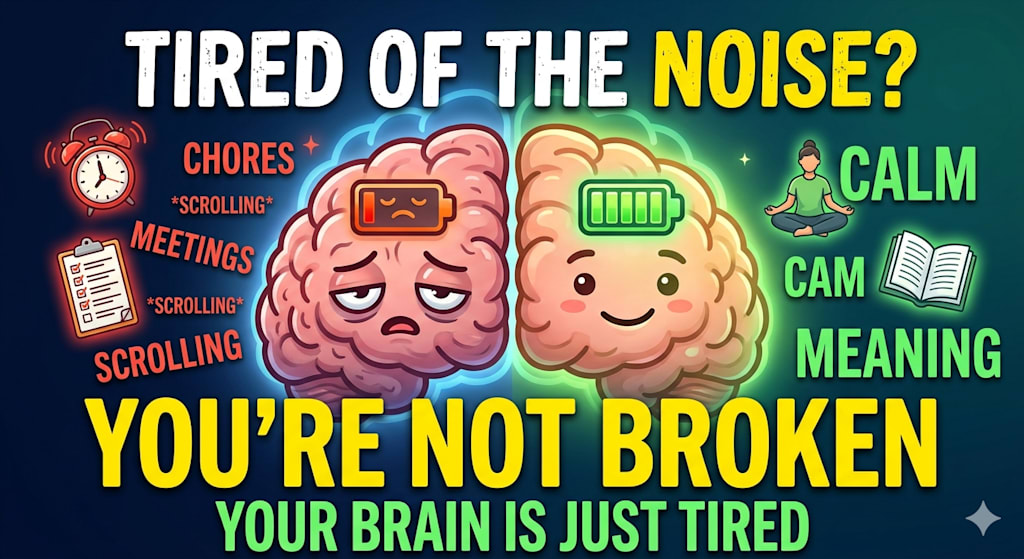
Let me be honest with you right from the start. This is not an article about waking up at 5 AM. It's not going to tell you to drink lemon water, make your bed, or download another productivity app you'll forget about in three days.
You've read those articles. They didn't work. And deep down, you already know why. The real reason you feel lazy has almost nothing to do with discipline. And until someone explains what's actually going on inside your brain, no morning routine in the world is going to fix it. So let's talk about the honest truth.
First — You're Probably Not Lazy. You're Overwhelmed. Here's something most productivity gurus will never admit: what we call "laziness" is usually one of three things — exhaustion, fear, or a complete lack of meaning. Think about it. You don't feel "lazy" when you're doing something you genuinely love, do you? You lose track of time. You forget to eat. You stay up way too late without anyone forcing you.
That's not discipline. That's engagement. The problem isn't that you're broken. The problem is that somewhere along the way, you got disconnected from what actually matters to you — and your brain is doing exactly what it's designed to do when that happens: conserving energy. Your brain is not your enemy. It's protecting you from spending effort on things that feel meaningless.
The Real Science Behind "Laziness" Your brain runs on dopamine — the chemical that drives motivation and reward. When you're about to do something that feels overwhelming, unclear, or pointless, your brain sends a signal that basically says: not worth the energy.
That's not weakness. That's biology. Research consistently shows that humans aren't motivated by tasks — they're motivated by progress. Even small, barely visible progress. When your brain can't see a clear path from where you are to where you want to be, it defaults to avoidance.
This is why you can spend four hours scrolling through your phone but can't bring yourself to spend 20 minutes on something important. The phone delivers constant, instant little dopamine hits. The important task feels like a foggy mountain with no clear path up. So the fix isn't to "just push through." The fix is to change what your brain sees.
What Actually Works: 5 Things That Genuinely Help
1. Make the First Step Embarrassingly Small Not small. Embarrassingly small. Don't tell yourself you're going to work out for an hour. Tell yourself you're going to put on your workout clothes. That's it. Just the clothes. Don't say you're going to write a whole article. Open the document and type one sentence. The science behind this is real — it's called behavioral activation, and it works because starting is the hardest part. Once you're in motion, continuing becomes almost automatic. Your brain shifts from resistance to momentum. The goal isn't the task. The goal is just to begin.
2. Stop Waiting to "Feel Like It" Here's a truth that changed everything for me: motivation follows action. Not the other way around. Most people wait until they feel motivated to start. But that feeling almost never comes on its own. You have to create it by moving first. Every single time you do something before you feel ready, you prove to yourself that you can. And that proof — that evidence — slowly rewires how your brain responds to difficult tasks.
3. Figure Out What's Actually Draining You Sometimes laziness is a symptom, not the problem. Are you sleeping enough? Because chronic sleep deprivation looks almost identical to laziness from the outside. Are you eating in a way that keeps your energy stable? Are you spending time with people who energize you, or people who quietly exhaust you? Before you assume you need more discipline, ask yourself if you need more rest.
4. Remove the Decision
Willpower is a limited resource. Every decision you make throughout the day — even small ones — chips away at it. By evening, most people have almost none left. That's not failure. That's how brains work. The solution isn't to try harder. It's to decide less. Lay out your gym clothes the night before. Pre-decide what you're working on tomorrow before you close your laptop today. Reduce the number of choices between you and the thing you want to do. Less friction. More follow-through.
5. Connect the Task to Something You Actually Care About This is the most underrated one. If you can't find a reason that matters to you — not to your boss, not to your parents, not to some Instagram ideal of who you should be — your brain will resist every single time. Ask yourself: why does this task actually matter to my life? Even a weak answer is better than none. Purpose is the fuel that discipline alone can never replace.
The Bottom Line You are not lazy. You are human. You have a brain that is doing its best to protect you from wasted effort in a world that keeps demanding more from you than you were ever designed to give.
The path forward isn't harsher self-criticism or a more aggressive routine. It's understanding yourself well enough to work with your brain instead of constantly fighting it. Start small. Start before you're ready. And give yourself credit for the fact that you're still here, still trying, still reading articles at whatever hour this is — because that's not laziness. That's someone who hasn't given up yet.
If this hit close to home, follow for more honest conversations about how to actually build a life that works — without burning yourself out in the process.
About the Creator
eonpulse
Transform your financial future with smart tips on budgeting, saving, and investing. Helping young adults make wise money choices and gain financial freedom. Learn practical strategies to build wealth and take control of your finances.
Enjoyed the story? Support the Creator.
Subscribe for free to receive all their stories in your feed.
Comments
There are no comments for this story
Be the first to respond and start the conversation.